I was thinking about that 3.53GHz. For e-cores, that just seems really high. And it’s the main reason why I’ve assumed it’s power draw would be quite high. For instance the A17 Pro e-cores clocked at 2.11GHz.Negativeonehero:
Truly.
Dimensity 9400 : 3.63 GHz
A18 Pro : 4.04 GHz
8 Gen 4 : 4.32 GHz
Never did I dream there would phone CPUs running at 4 GHz, and so soon too.
The 8 Gen 4 in particular seems to be a speed demon. It's "E-cores" run at 3.53 GHz, almost the same as the 3.63 GHz peak clock of the Dimensity 9400.
Efficiency is the big question now.
All 3 chips are on TSMC N3E node, so it should allow for some nice iso node comparisons.

-
We’re currently investigating an issue related to the forum theme and styling that is impacting page layout and visual formatting. The problem has been identified, and we are actively working on a resolution. There is no impact to user data or functionality, this is strictly a front-end display issue. We’ll post an update once the fix has been deployed. Thanks for your patience while we get this sorted.
You are using an out of date browser. It may not display this or other websites correctly.
You should upgrade or use an alternative browser.
You should upgrade or use an alternative browser.
Discussion Qualcomm Snapdragon Thread
Page 142 - Seeking answers? Join the AnandTech community: where nearly half-a-million members share solutions and discuss the latest tech.
Does this fire is supposed to suggest burnt hands from too hot phones?😉 Eh, I am afraid it will once again be more marketing than technical info event.

FlameTail
Diamond Member
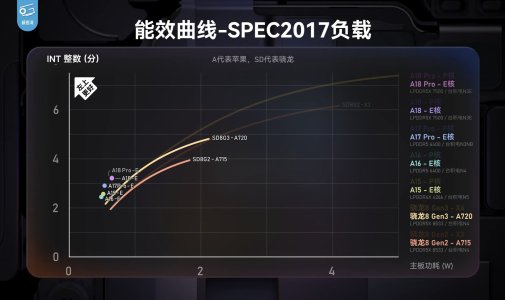
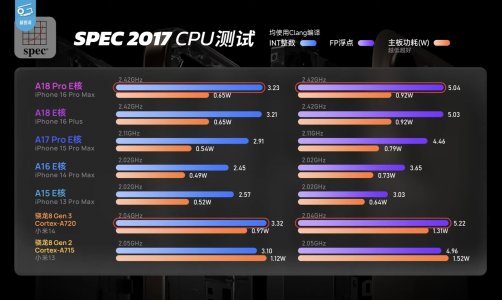
There is a quite remarkable energy efficiency uplift, going from the A715 core of 8 Gen 2, to the A720 core of 8 Gen 3.
If you look at the power curve, A720 doesn't seem to be so bad compared to A18-E. It consumed much more peak power, bit also goes on to deliver higher peak performance.
Very curious how Oryon Phoenix-M of 8 Gen 4 will stack up against this.
Don’t forget the A725 which replaces the A720. I think the A725 is the more appropriate comparison.That makes me think...
- How 8 x A720 core will fare
- How 8 x Phoenix-M core will fare
I do expect seeing the first in D8400 and the 2nd in 7+ Gen 4
Interesting... unless they have the Phoenix-S (small core) since having 2 less cores sounds weird.[Speculation]
8 Gen 4
2 × Phoenix-L (12 MB sL2)
6 × Phoenix-M (4 MB sL2)
12 MB SLC
8s Gen 4 / 7+ Gen 4
2 × Phoenix-L (8 MB sL2)
4 × Phoenix-M (3 MB sL2)
8 MB SLC
7 Gen 4
6 × Phoenix-M (6 MB sL2)
6 MB SLC
FlameTail
Diamond Member
iPhones have had 6-core CPUs for almost a decade now.Interesting... unless they have the Phoenix-S (small core) since having 2 less cores sounds weird.
Whereas on the Android side, 8 cores seem to be the tradition. $150 phones boast of 8-core CPUs, evn if they are 8 A55 cores.
This is what I was thinking. Maybe...Ah, a curious thought.
If Phoenix-L stands for Phoenix-Large, and Phoenix-M stands for Phoenix-Medium, doesn't that suggest the existence of a Phoenix-S (Phoenix-Small)?
Phoenix-L ≈ Cortex X series
Phoenix-M ≈ Cortex A7xx series
Phoenix-S ≈ Cortex A5xx series
8 Gen 4
2 × Phoenix-L (12 MB sL2)
6 × Phoenix-M (4 MB sL2)
12 MB SLC
8s Gen 4 / 7+ Gen 4
2 × Phoenix-L (8 MB sL2)
4 × Phoenix-M (3 MB sL2)
2 x Phoenix-S
8 MB SLC
7 Gen 4
6 × Phoenix-M (6 MB sL2)
2 x Phoenix-S
6 MB SLC
The reason is that Android is configured to use 8 cores now.
I've tested my Snapdragon 820 phone and the 650 one and both are sluggish now with the SW.
FlameTail
Diamond Member
| Clock Speed | FP32 ALUs | FP16 ALUs | Architecture | |
| A18 Pro | 1490 MHz | 768 | 768 | Family-9 6-core |
| 8G3 | 903 MHz | 3072 | 1536 | Adreno 750 |
Adreno 750 has multiple times more ALUs, but gets hammered by the A18 Pro in terms of performance anyways;
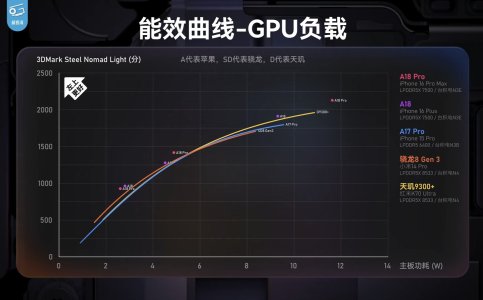
This really shows how primitive Adreno 7 series architecture is.
I hope Qualcomm has overhauled the architecture with Adreno 8 series. It is necessary, or else Snapdragon X Gen 2 will suffer.
One month till 8 Gen 4 is revealed to the world with Adreno 830.
Snapdragon Summit 2024
October 21st.
I do see Apple in the next iteration going Octa too similar to SD8 Gen 4 (2 Big and 6 middle)iPhones have had 6-core CPUs for almost a decade now.
Whereas on the Android side, 8 cores seem to be the tradition. $150 phones boast of 8-core CPUs, evn if they are 8 A55 cores.
I do see Apple in the next iteration going Octa too similar to SD8 Gen 4 (2 Big and 6 middle)
I doubt it. The only reason to add more little cores would be to look better in MT benchmarks. It wouldn't help any real world loads.
I don't know much about GPU architectures, but it seems that the number of ALUs doesn't accurately assess performance. Obviously, Apple has something deeper that makes it better at executing complex instructions in the GPU. It would be nice if Apple also increased the number of ALUs, increasing the area of the GPU with lower clock speed. This is the path that Qualcomm took when it released 8 gen 2. It would significantly improve power efficiency.
Clock
SpeedFP32
ALUsFP16
ALUsArchitecture A18
Pro1490
MHz768 768 Family-9
6-core8G3 903
MHz3072 1536 Adreno 750
Adreno 750 has multiple times more ALUs, but gets hammered by the A18 Pro in terms of performance anyways;
View attachment 107878
This really shows how primitive Adreno 7 series architecture is.
I hope Qualcomm has overhauled the architecture with Adreno 8 series. It is necessary, or else Snapdragon X Gen 2 will suffer.
One month till 8 Gen 4 is revealed to the world with Adreno 830.
Snapdragon Summit 2024
October 21st.
these big cores use so much power in phones, they are used just for burst perfomance, efficient cores are workhorse of these mobile soc, when Qualcomm moved from 3 cores to 4 cores in sd 8 gen 2 perfomance and efficiency increased a lot, geekerwan did demonstrate itI doubt it. The only reason to add more little cores would be to look better in MT benchmarks. It wouldn't help any real world loads.
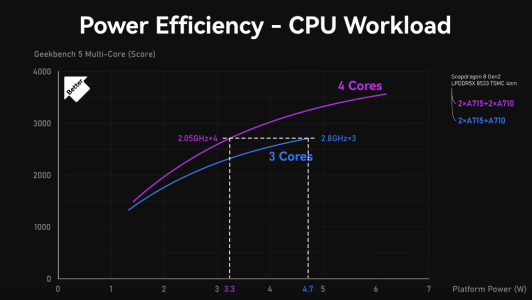
having 6 efficient cores definetely would help to sustain more perfomance in phone, i think having 2 big cores is gimmick compare to having more E cores.
digitaldreamer
Member
I think you overestimate the performance of E cores and I strongly doubt you would enjoy using a phone with just E cores, even if there were 6 cores. Most CPU designers have actually done the tests.<snip>
having 6 efficient cores definetely would help to sustain more perfomance in phone, i think having 2 big cores is gimmick compare to having more E cores.
If phones were just for sitting on the desk or in your pocket, I think you'd have a point. But, responsiveness in a phone is from the P cores.
I think the 2P + 4E strikes a good balance in a phone, at least for now.
Qualcomm and Mediatek seem to disagree 🙂I think you overestimate the performance of E cores and I strongly doubt you would enjoy using a phone with just E cores, even if there were 6 cores. Most CPU designers have actually done the tests.
I think the 2P + 4E strikes a good balance in a phone, at least for now.
But I’d be curious how an A18 Pro would perform with a 2P+6E configuration.
iPhone's E cores are not the same as the normal ARM e cores.I think you overestimate the performance of E cores and I strongly doubt you would enjoy using a phone with just E cores, even if there were 6 cores. Most CPU designers have actually done the tests.
If phones were just for sitting on the desk or in your pocket, I think you'd have a point. But, responsiveness in a phone is from the P cores.
I think the 2P + 4E strikes a good balance in a phone, at least for now.
Those things are on a similar tier than the A7XX processor with A5XX consumption and that says a lot on how well Apple does the things.
FlameTail
Diamond Member
Snapdragon 8 Gen 4 might be renamed.
Not sure if this is a joke or what.
Not sure if this is a joke or what.

Efficiency cores here I refer Phoenix M, Cortex A720, Apple E cores etc not the smallest one cortex A520/A55 etc.I think you overestimate the performance of E cores and I strongly doubt you would enjoy using a phone with just E cores, even if there were 6 cores. Most CPU designers have actually done the tests.
If phones were just for sitting on the desk or in your pocket, I think you'd have a point. But, responsiveness in a phone is from the P cores.
I think the 2P + 4E strikes a good balance in a phone, at least for now.
We have test of Cortex A78 vs X1/X2 and cortex A720 vs X4 in both test cortex A720 and A78 were more efficient than P cores at 2W or below. So for device with power budget around 5 to 7W it make sense having more of A720 than cortex X series.
FlameTail
Diamond Member
The Galaxy S24 Ultra powered by the Snapdragon 8 Gen 3 destroys the iPhone 16s powered by A18 Pro in Mrwhosetheboss battery test.
Ranking:
iPhone 15 : 7hr 45min
iPhone 16 : 8hr 19min
iPhone 16 Pro : 8hr 19min
iPhone 16 Plus : 8hr 45 min
iPhone 15 Pro Max : 9hr 35 min
iPhone 16 Pro Max : 11hr 22min
Galaxy S24 Ultra : 12hr 31min
Ranking:
iPhone 15 : 7hr 45min
iPhone 16 : 8hr 19min
iPhone 16 Pro : 8hr 19min
iPhone 16 Plus : 8hr 45 min
iPhone 15 Pro Max : 9hr 35 min
iPhone 16 Pro Max : 11hr 22min
Galaxy S24 Ultra : 12hr 31min
Maybe due the 4 supersticion idea.Snapdragon 8 Gen 4 might be renamed.
Not sure if this is a joke or what.
FlameTail
Diamond Member
Dieshot of Snapdragon XR2+ Gen1 (a AR/VR headset SoC):
Kurnal:
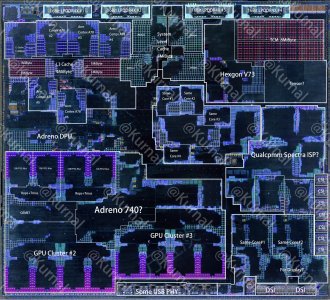
Kurnal:
Qualcomm Snapdragon XR2+Gen1(SXR2230P)
A brand new processor, 6-core A78
GPU similar to 8G2, 1536Alus,
NPU (hexgon) is a product of 8gen1
7-way Csi, 4-waydsi
J=Samsung its in 4nm but its 4LPX=SF5
The package is estimated to be fccsp
Diesize=10.28*11.27=115.85mm2
TRENDING THREADS
-
 Discussion Zen 5 Speculation (EPYC Turin and Strix Point/Granite Ridge - Ryzen 9000)
- Started by DisEnchantment
- Replies: 25K
-
Discussion Intel Meteor, Arrow, Lunar & Panther Lakes + WCL Discussion Threads
- Started by Tigerick
- Replies: 24K
-
 Discussion Intel current and future Lakes & Rapids thread
- Started by TheF34RChannel
- Replies: 24K
-

-
