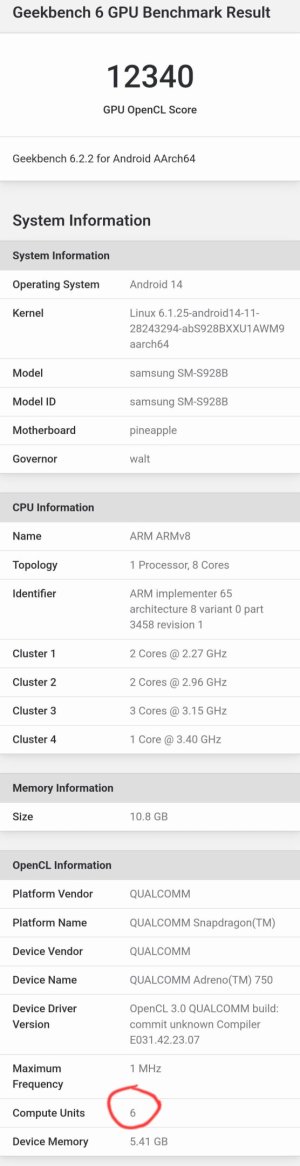
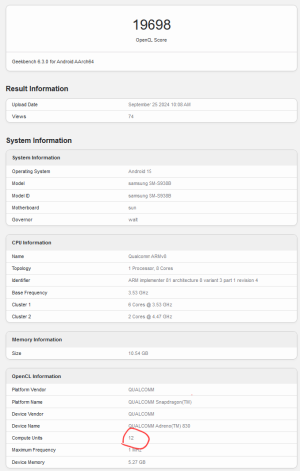
First GB score, looks pretty solid.Looks like Jeff Geerling received his Snapdragon Dev Kit;
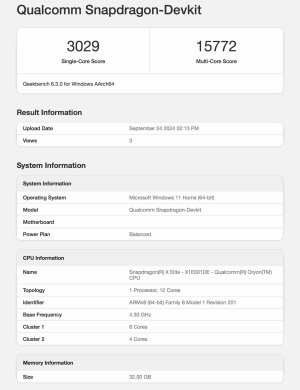

First GB score, looks pretty solid.Looks like Jeff Geerling received his Snapdragon Dev Kit;

Rumor has it that Qualcomm will have a part based on the ARM X925 called the "8 Gen 4s"View attachment 108251
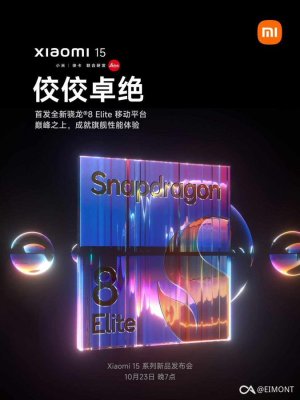
Snapdragon 8 Gen 4 will be renamed as "Snapdragon 8 Elite"?
It will be funny if it's true. The X925 core has a better IPC than Oryon.Rumor has it that Qualcomm will have a part based on the ARM X925 called the "8 Gen 4s"
퀄콤이 삼성과 미디어텍 둘다 엿먹일지도 모르겠네요. (정정) - 미코
퀄콤도 Cortex-X925 쓴다는 정보 포착했을 때 "아..누비아가 잘 안되었을 때 백업플랜이군.." 정도로 생각했는데 그게 아닌 스냅드래곤8s Gen4 포지션 제품인듯합니다. 내년부터 레알 준플래그십 성능으로 스냅드래곤...meeco.kr
It's likely to cost less and compete w/ the Samsung and Mediatek flagships as the "8 Elite" will perform a tier above those and likely be priced accordingly.
The branding choices Qualcomm has made seems particularly sensitive to the Chinese perception that "8" is lucky (particularly 3 8's cf. 888) and "4" is unlucky (homonym for death).
We'll see what they do when the inevitable "4" suffix arrives... (for instance "8 Elite Gen 4") but I'm sure they'll try to weasel away somehow.
Almost certainly; the Oryon 1.5 in the S8 Elite is rumored to have IPC ~ARM X4. However, the added complexity necessary for higher IPC will limit clocks and may not be the knee of the curve for PPA.It will be funny if it's true. The X925 core has a better IPC than Oryon.
Na. In terms of IPC, the Snapdragon 8 Elite is much higher than the X4. Keep in mind the X4 was in the Snapdragon 8 Gen 3. (I’m using the Galaxy specific versions for the comparison).Almost certainly; the Oryon 1.5 in the S8 Elite is rumored to have IPC ~ARM X4. However, the added complexity necessary for higher IPC will limit clocks and may not be the knee of the curve for PPA.
SM8750 (Snapdragon 8 Gen 4) - Q4'24
SM8735 (Snapdragon 8s Gen 4) - Q1'25
no confirmation on SM8775 for now
Ideally they should not change the naming scheme
Yep. It seems with the new Adreno 8 series GPU architecture, the new CU is half the size of the old CU in Adreno 7.If I can see for each side... the CU increased but the performance for each one decreased?
Now there's Oneplus and Honor slides as well;View attachment 108251
Snapdragon 8 Gen 4 will be renamed as "Snapdragon 8 Elite"?

 blog.imaginationtech.com

Apples RT cores are pretty good but you won’t see them flex their muscle on solar bay, that’s why Geekerwan had to test on an intensive RT benchmark provided by 3D mark.Although Qualcomm was the first to bring Ray Tracing to mobile with the Adreno 740 (8G2 - 2022); theirs isn't the most advanced Ray Tracing implementation in a smartphone now. The A17 Pro (2023) which came one year later, surpassed it, and I believe the A18 Pro has the lead over Adreno 750 (8G3 - 2023).
Adreno 740/750 - Level 2 RT
A17/A18 - Level 3 RT
Ray Tracing levels as defined by Imagination Technologies;
Introducing the Ray Tracing Levels System – and what it will mean for gaming - Imagination
Not all ray tracing solutions are created equal. Learn about the Ray Tracing Levels System here.
Perhaps Adreno 830 will upgrade to Level 3 RT. One could hope...
It is interesting to know what Imagination's developments and patents were used to develop the Apple RT.Although Qualcomm was the first to bring Ray Tracing to mobile with the Adreno 740 (8G2 - 2022); theirs isn't the most advanced Ray Tracing implementation in a smartphone now. The A17 Pro (2023) which came one year later, surpassed it, and I believe the A18 Pro has the lead over Adreno 750 (8G3 - 2023).
Adreno 740/750 - Level 2 RT
A17/A18 - Level 3 RT
Ray Tracing levels as defined by Imagination Technologies;
Introducing the Ray Tracing Levels System – and what it will mean for gaming - Imagination
Not all ray tracing solutions are created equal. Learn about the Ray Tracing Levels System here.
Perhaps Adreno 830 will upgrade to Level 3 RT. One could hope...
It is interesting to know what Imagination's developments and patents were used to develop the Apple RT.
 www.imaginationtech.com
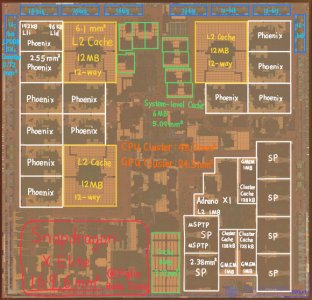
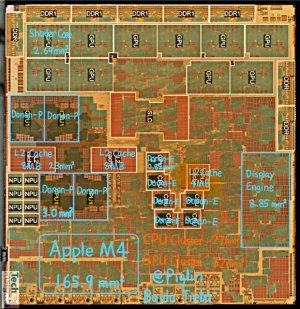
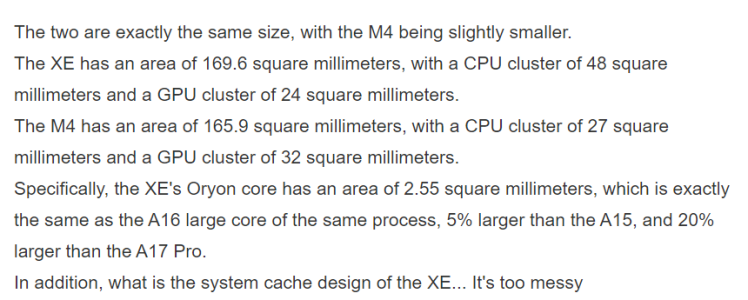
Some more translated info from the same sourceSnapdragon X Elite Die Shot (169.6 mm2):
View attachment 108365
M4 Die Shot (165.9 mm2) for Reference:
View attachment 108366
Source

Snapdragon Dev Kit teardown by Jeff Geerling;
Qualcomm Snapdragon Dev Kit for Windows Teardown (2024)
Update - October 17: Today Qualcomm cancelled all remaining orders, and will no longer support the Dev Kit. In late July, a week after ordering the Snapdragon Dev Kit, I wondered where it was. Arrow's website said 'Ships tomorrow' when I ordered, after all. Many developers eager to test their...www.jeffgeerling.com
 github.com
Rumor has it that Qualcomm will have a part based on the ARM X925 called the "8 Gen 4s"
퀄콤이 삼성과 미디어텍 둘다 엿먹일지도 모르겠네요. (정정) - 미코
퀄콤도 Cortex-X925 쓴다는 정보 포착했을 때 "아..누비아가 잘 안되었을 때 백업플랜이군.." 정도로 생각했는데 그게 아닌 스냅드래곤8s Gen4 포지션 제품인듯합니다. 내년부터 레알 준플래그십 성능으로 스냅드래곤...
It's likely to cost less and compete w/ the Samsung and Mediatek flagships as the "8 Elite" will perform a tier above those and likely be priced accordingly.
CB score of 131 ST at 28W/1227 MT at 99W.The GitHub issue, where Jeff has added some prelim. power numbers:

Qualcomm Snapdragon X Dev Kit for Windows · Issue #51 · geerlingguy/sbc-reviews
Basic information Board URL (official): https://www.arrow.com/en/products/c8380-12c-mp-32g/thundercomm Board purchased from: Arrow Board purchase date: 2024-07-16 (Arrived 2024-09-25) Board specs (...
GB6 1T
28W total - 11W idle → 17W idle normalized | 4.3 GHz Oryon
Its 1T power seems a good chunk higher than the Apple M2 on a similar-ish mode; the ~800 MHz clock disparity likely plays no small part. I'd hoped for sub-10W (my dear fanless dream) but alas, another generation perhaps.
These 1T numbers (of admittedly the fastest SKU) are between Lunar Lake and the M2.
Good side: some excellent perf & perf / W comparison data between X925 & Oryon cores!
Curious side: why not sell weaker-bins of the Oryon mobile SoC → cheaper SKUs? X Elite on PC has eight SKUs per its 12C die. Surely some weaker Oryon dies can be binned down. Wouldn't that more cost effective?
Or is the Oryon mobile SoC that pricey that even after binning (e.g., all usable dies exhausted), Qualcomm can't get the per-die price low enough for OEM interest? Would that imply Oryon's production cost >>> X925's licensing and production cost?
100 watts? Good lord.Curious side: why not sell weaker-bins of the Oryon mobile SoC → cheaper SKUs? X Elite on PC has eight SKUs per its 12C die. Surely some weaker Oryon dies can be binned down. Wouldn't that more cost effective?CB score of 131 ST at 28W/1227 MT at 99W.
GB score of 3020 ST/15969 MT.
I don't think it has anything to do with Oryon.Or is the Oryon mobile SoC that pricey that even after binning (e.g., all usable dies exhausted), Qualcomm can't get the per-die price low enough for OEM interest? Would that imply Oryon's production cost >>> X925's licensing and production cost?
This is Hamoa.Snapdragon X Elite Die Shot (169.6 mm2):
View attachment 108365