
-
We’re currently investigating an issue related to the forum theme and styling that is impacting page layout and visual formatting. The problem has been identified, and we are actively working on a resolution. There is no impact to user data or functionality, this is strictly a front-end display issue. We’ll post an update once the fix has been deployed. Thanks for your patience while we get this sorted.
You are using an out of date browser. It may not display this or other websites correctly.
You should upgrade or use an alternative browser.
You should upgrade or use an alternative browser.
Discussion Qualcomm Snapdragon Thread
Page 20 - Seeking answers? Join the AnandTech community: where nearly half-a-million members share solutions and discuss the latest tech.

poke01
Diamond Member
Let’s just wait for Gen 1 to come out first lolIt is being discussed in the Apple Silicon thread regarding whether M chips follow a 18 month or 12 month cadence.
SO LET'S POSIT THAT QUESTION HERE:
What should be the cadence of Snapdragon X series processors?
12 months? 18 months? 24 months?

FlameTail
Diamond Member
Is that the general sentiment here?Let’s just wait for Gen 1 to come out first lol
I already want to talk about future Snapdragon X processors, but if nobody else wants to, I'll wait 🙂
Still early days yet, wait till lots benchies for v1 is out first.I already want to talk about future Snapdragon X processors, but if nobody else wants to, I'll wait 🙂

Tup3x
Golden Member
It's hard to speculate since we don't really know that much about X Elite so there really isn't much to speculate. We don't know currently strengths or weaknesses.Is that the general sentiment here?
I already want to talk about future Snapdragon X processors, but if nobody else wants to, I'll wait 🙂


ARM Ltd has entered the chat...."We must move quickly. Intel/AMD are relentless. We must destroy them, to secure our position in the PC"
Qualcomm: Why do I hear boss music?
😆
FlameTail
Diamond Member

Alleged Snapdragon 8s Gen 3 makes tepid Geekbench debut
A new Snapdragon chip codenamed SM8635 has shown up on Geekbench with a 1+4+3 CPU layout. A Weibo leaker says it is the Snapdragon 8s Gen 3, and it will launch alongside Realme and Redmi smartphones.
 www.notebookcheck.net
8s Gen 3?
Smells like a repurposed 8 Gen 2 die.
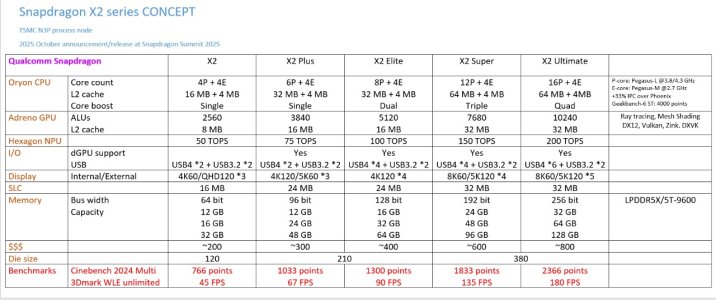
Impressive specs but its expensive for sure. I like the fact that Ultimate starts at 32GB RAM. Laptops with it will cost 2500 bucks plus for sure.
Sure, I know this and you know that. I don’t want to get back into it. They did raise clocks by 10% though and went wider."Given where they already are with power" - that assumes A17's higher power draw is because of design issues, and not N3B's yield issues. Apple may have been forced through a combination of poor yields and TSMC's "known good die" pricing to have to use some number of marginal dies that are "working" only if more power than Apple would normally prefer is delivered to them. Dies which Apple normally would discard, since good yields allow you to bin not just on "working" but "working within acceptable power ranges".
What they actually do is they standardize it the voltage to minimize QC variation, yeah. So it’s possible the worst tail of the N3B yields make it worse for all (I’m not going to read the next paragraph because I know where you’re headed! And it’s fair.)Theoretically Apple could test every die and figure out the voltage it requires - the best ones may work at around half the voltage of the worst, and have each use only what is necessary to function at the standard clock speed. But then you'd have a situation where some people would get iPhones with noticeably better battery life / heat than others. To my knowledge however, the only time that's happened was with A9 when Apple was dual sourcing from TSMC and Samsung.
I think the real question then is: do we think Apple has another A12 -> A13 update in store with a nice 10% IPC and the 5-8% frequency boost. Maybe! I just wouldn’t bet on it based on previous results and their design talent trends.
So rather than do the extra work of characterizing each die like Intel/AMD would (which pays for itself because they can sell the ones that operate at very low voltages / higher clocks at a premium as "U" class / top speed bins) and risk customer ire (and people returning perfectly good phones hoping to get one with a "golden" SoC) they may set them all to the "worst case" voltage. That would cause all A17s to use more power than they would have had N3B not been a broken process. Since N3E is supposed to have typical TSMC yields, they won't have to do that with A18 so I think there's a good chance its power efficiency will be more like A14/A15/A16 than A17, regardless of whether its performance improves by 5% or 20%.
Bigger question is do mobile soc have a clock ceiling or can they keep going up. Then we lose performance boosts through clock speed increases. Of course they could add more cores to improve multi threaded numbers but not sure it makes sense for mobile soc. For laptops I hope the base models have more than 4+4 that seem to be the standard.
FlameTail
Diamond Member
As long as the core is within power limits, the frequency can go as high as possible, if the node × design allows it.Bigger question is do mobile soc have a clock ceiling or can they keep going up. Then we lose performance boosts through clock speed increases. Of course they could add more cores to improve multi threaded numbers but not sure it makes sense for mobile soc. For laptops I hope the base models have more than 4+4 that seem to be the standard.
This is what Apple has done in the past few years. They are using the benefit of the node + tweaking their microarchitecture, to ensure the power consumption does not blow up when the frequency is increased.
But when they indefinitely keeps relying on clock speed increases, they are eventually gonna get to a point where they cannot increase frequency any further (5 GHz? 6 GHz?) without the power consumption exploding.
That is when they hit the brick wall and are in deep trouble. For any more performance increase, they'll have to increase IPC. But increasing IPC at high clock speeds is difficult. Further, widening the core usually comes with a clock regression. They'll have to do a massive redesign of the architecture to bring the clock speed down, and increase IPC by like 50%.
Meh, it is quite possible to make an efficient 6ghz chip.As long as the core is within power limits, the frequency can go as high as possible, if the node × design allows it.
This is what Apple has done in the past few years. They are using the benefit of the node + tweaking their microarchitecture, to ensure the power consumption does not blow up when the frequency is increased.
But when they indefinitely keeps relying on clock speed increases, they are eventually gonna get to a point where they cannot increase frequency any further (5 GHz? 6 GHz?) without the power consumption exploding.
That is when they hit the brick wall and are in deep trouble. For any more performance increase, they'll have to increase IPC. But increasing IPC at high clock speeds is difficult. Further, widening the core usually comes with a clock regression. They'll have to do a massive redesign of the architecture to bring the clock speed down, and increase IPC by like 50%.
Going Sky high on frequency doesn’t always mean a dumpster fire in terms of thermals and power.
However, when you have to chase both, it is good to have a balanced design for your target market.
FlameTail
Diamond Member

Snapdragon 8s Gen 3 leak indicates Qualcomm could be back with confusing SoC names
A new leak has shared the core configuration and speeds of what could be the Snapdragon 8s Gen 3. Read on to learn the lineup shapes up!
 www.androidauthority.com
The confusing names are back boys!
So Qualcomm has two upper midrange (sub-flagship) class chips coming up: 8s Gen 3 and 7+ Gen 3.
FlameTail
Diamond Member
Is it possible for Snapdragon X2 series (as per this concept), to be fabbed on Intel's newly unveiled 18A-P node?
18A-P should be better than N3P right?
FlameTail
Diamond Member
Qualcomm did once consider using Intel nodes, but they backed off eventually.
If Qualcomm does use Intel's nodes, it means they would be simultaneously relying on 3 foundries! That's crazy!
Qualcomm already dual sources their mobile SoCs between Samsung and TSMC.
Adding a third foundry means, they now have to recalibrate their IP for that third foundry (which is Intel, in this case). That is a complicated and costly (?) process.
Not that Qualcomm can't do it. But rather it wouldn't be economical.
So if Qualcomm accepts to use Intel Foundry, then they will probably break away from one of their other sources- either TSMC or Samsung.
Is this a valid assessment?
Qualcomm, which designs chips and outsources manufacturing, wanted to work with Intel, and assigned a team of engineers to work toward making mobile-phone chips at Intel’s factories. It was particularly interested in a cutting-edge chip-making technology that Intel hopes will be the most advanced in the world by late next year.
In early 2022, Intel’s foundry arm sent a delegation to Qualcomm’s San Diego headquarters, where they met with CEO Cristiano Amon. Then Intel missed a June performance milestone toward producing those chips commercially. It missed another in December.
Qualcomm executives concluded Intel would struggle making the kind of cellphone chips they wanted, even if it succeeded in making high-performance processors. Qualcomm told Intel it was pausing work while it waits for Intel to show progress, according to people involved in the discussions.
This was several years ago though. There is a possibilty that Qualcomm might reconsider Intel again, especially after the exciting announcements yesterday.He said Intel has been more focused on chipmaking technology that works in high-performance processors like those used in PCs. Making chips for mobile phones with limited battery lives requires new skills and new circuit designs. Intel said recently it is collaborating with Arm, a chip-design company that specializes in cellphone circuits.
If Qualcomm does use Intel's nodes, it means they would be simultaneously relying on 3 foundries! That's crazy!
Qualcomm already dual sources their mobile SoCs between Samsung and TSMC.
Adding a third foundry means, they now have to recalibrate their IP for that third foundry (which is Intel, in this case). That is a complicated and costly (?) process.
Not that Qualcomm can't do it. But rather it wouldn't be economical.
So if Qualcomm accepts to use Intel Foundry, then they will probably break away from one of their other sources- either TSMC or Samsung.
Is this a valid assessment?
FlameTail
Diamond Member
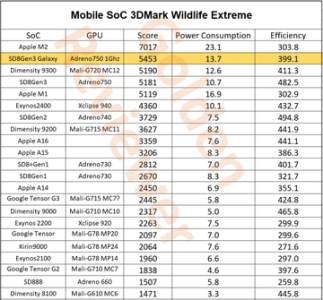
Snapdragon 8G4 might reach 3000 points in GB6 ST, by running Oryon core at 4.0 GHz.
While that won't beat Apple A18, it matches(or slightly beats) A17 Pro.
That's honestly not bad. Snapdragon being able to close the gap in single core to just 1 generation vs Apple. 3000 point ST for 8G4 is a 30% uplift over 8G3.
While that won't beat Apple A18, it matches(or slightly beats) A17 Pro.
That's honestly not bad. Snapdragon being able to close the gap in single core to just 1 generation vs Apple. 3000 point ST for 8G4 is a 30% uplift over 8G3.
FlameTail
Diamond Member
According to this twitter thread, Phoenix-L core in 8G4 brings IPC increase?
It's not the same core as in X Elite then.
FlameTail
Diamond Member
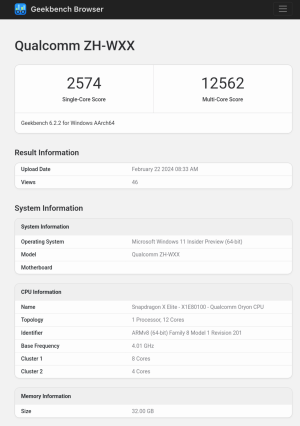
Snapdragon X Elite spotted on Geekbench listing.
Something interesting to note: The 12 core CPU is divided into 2 clusters, one with 8 cores and the other with 4 cores.
Hmm. What's going on here?
@SpudLobby I recall you said something about 8+4 setup.
Something interesting to note: The 12 core CPU is divided into 2 clusters, one with 8 cores and the other with 4 cores.
Hmm. What's going on here?
@SpudLobby I recall you said something about 8+4 setup.
Attachments
Snapdragon X Elite spotted on Geekbench listing.
Something interesting to note: The 12 core CPU is divided into 2 clusters, one with 8 cores and the other with 4 cores.
Hmm. What's going on here?
@SpudLobby I recall you said something about 8+4 setup.
That's a much lower score than we've seen before.
FlameTail
Diamond Member
That's a much lower score than we've seen before.
You can go to Geekbench Browser and search for "Oryon".
There's a bunch of results from October 31st, which was the same day Qualcomm held the Performance Preview, where they invited journalists to show them the X Elite Qualcomm Reference Devices running benchmarks.
Then there is a bunch of results that were uploaded this past week. Interestingly, these numbers are lower than the October 31st numbers.
TRENDING THREADS
-
 Discussion Zen 5 Speculation (EPYC Turin and Strix Point/Granite Ridge - Ryzen 9000)
- Started by DisEnchantment
- Replies: 25K
-
Discussion Intel Meteor, Arrow, Lunar & Panther Lakes + WCL Discussion Threads
- Started by Tigerick
- Replies: 25K
-
 Discussion Intel current and future Lakes & Rapids thread
- Started by TheF34RChannel
- Replies: 24K
-

-
