• We’re currently investigating an issue related to the forum theme and styling that is impacting page layout and visual formatting. The problem has been identified, and we are actively working on a resolution. There is no impact to user data or functionality, this is strictly a front-end display issue. We’ll post an update once the fix has been deployed. Thanks for your patience while we get this sorted.

Discussion Optane Client product current and future

Page 16 - Seeking answers? Join the AnandTech community: where nearly half-a-million members share solutions and discuss the latest tech.
But 16GB only needs 900 MB/s......so PCIe 3.0 x 2 is plenty. Furthermore, PCIe 3.0 x 4 increases latency compared to PCIe 3.0 x2.

Good points.

This could be simple as marketing. The 2.1GB/s Read barely justifies the x4 link.

This would mesh with what you were thinking about which is HBR = High Bandwidth Requirement.

Haha. No, even I think that was a bit crazy. Hybrid makes much more sense.

It's not practical to specifically optimize NAND for sequential and Optane for random. The increased controller complexity and overhead will render it useless even before it starts up.

Also, if Optane becomes part of the drive, and its next to the controller, they can get the sequential much higher than discrete modules would suggest so we won't need to resort to such things.
 
Last edited:
Could this be a hybrid controller? One that works both with Optane and NAND?

Micron is developing a controller that works with both 3DXpoint and NAND (as I mentioned earlier in this thread)....but I don't know if works with 3DXpoint and NAND at the same time.

Are you saying the controller can work with Optane-only or NAND-only by simply switching out the memory chips? It'll be sub-optimal compared to already existing standalone controllers.

Who knows? I'm very on board with hybrid Optane as cache NAND drive.

FWIW, Here is the article from Tom's hardware:

https://www.tomshardware.com/news/cnex-labs-3d-xpoint-controller,32463.html

And notice this part here:

"Data scientists can use unique management techniques on the host computer to preserve data locality, carve SSDs into multiple LUNs with different QoS profiles and QD allocations, support an unlimited number of data streams, and even employ direct-programmed (and customized) RAID and erasure coding. The system also reduces write amplification, which increases endurance. "

P.S. Here were some of Nosirrahx ideas on RAID with Optane that I thought were very interesting:

https://forums.anandtech.com/threads/optane-as-os-drive-vs-960-evo.2552377/#post-39529267

On the topic of NVMe + Optane, I wonder if a new form of RAID could be created. Imagine if the Optane driver could read both the NVMe drive and Optane drive at the same time but read one of them in reverse byte order. Instead of RAID 0 where data is striped and read from 2 drives at once the data (when cached) exists on both drives and read requests go to both drives but one of the drives reads the data starting at the end of file. This would allow all files to load faster than either NAND or Optane could do on their own.

https://forums.anandtech.com/thread...-price-and-performance.2552818/#post-39543663

What I want to see for the next for any caching technology is a new form of RAID that allows cache to work with reads instead of superseding them.

Lets say cache can grab 80% of a file in the time it takes the dedicated storage to grab 20% of that same file. Why not let both read from opposite ends of the file and collectively grab the file faster than either could on their own?
 
Last edited:
Here is part of the QVL list from ASRock H370M Pro4:

Screenshot-17.png


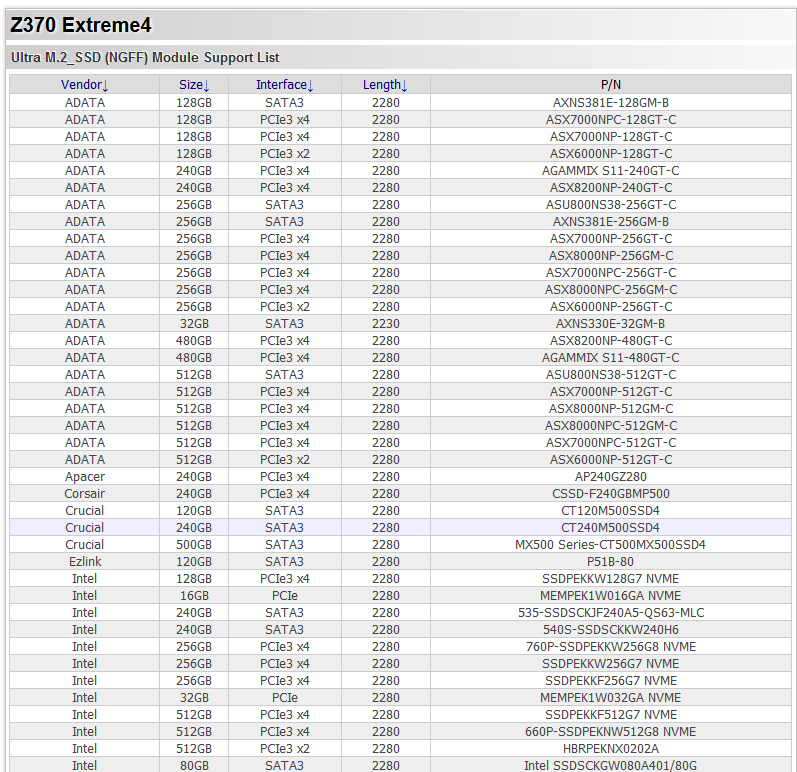
And part of the QVL list from ASRock Z370 Extreme 4:

Screenshot-20.png


Notice that HBRPEKNX0202A is listed as PCIe 3.0 x 2 rather than PCIe 3.0 x 4 on both of these.

I wonder what ends up being right? PCIe 3.0 x 4 or PCIe 3.0 x 2?

Maybe both in the sense that the interface is PCIe 3.0 x 4, but the Optane NVMe controller is PCIe 3.0 x 2 with a separate 3D QLC SATA SSD on the same M.2 2280 PCB. (Optane caching SATA SSD, but SATA SSD able to use the extra bandwidth available from the PCIe 3.0 x 4 interface. Think of how some data might be called from cache and from SATA SSD at the same time.)

Another option, of course, would be Optane caching NVMe NAND based SSD.
 
Last edited:
If HBRPEKNX0101A and HBRPEKNX0202A do, in fact, end up being hybrid drives I'm thinking Dual drive (ie two drives on one PCB) using the Intel Optane application is the most likely outcome.

However, maybe Intel did go single drive (using either a hybrid controller or separate Optane and NAND controllers) with optane acceleration handled by the drive's firmware? (This would allow usage in more systems and could even allow the drive to be used with AMD StoreMI.)
 
Last edited:
...with optane acceleration handled by the drive's firmware? (This would allow usage in more systems and could even allow the drive to be used with AMD StoreMI.)

The closer the integration, the faster it is. There are limits you can achieve with a software-based solution. So it would be better as a single drive, but who knows. This also applies to controllers. The controller can't be a separate one, as it would increase cost and power consumption. The latter of which will discourage using it in laptops.

The best will be a NAND SSD that uses Optane as a cache/buffer instead of DRAM as in traditional SSDs. Either way, I'm very interested to see what it is.
 
  • Like
Reactions: cbn
The closer the integration, the faster it is. There are limits you can achieve with a software-based solution. So it would be better as a single drive, but who knows. This also applies to controllers. The controller can't be a separate one, as it would increase cost and power consumption. The latter of which will discourage using it in laptops.

The best will be a NAND SSD that uses Optane as a cache/buffer instead of DRAM as in traditional SSDs. Either way, I'm very interested to see what it is.

Perhaps Intel working on Optane DIMMs will result in memory controller technology that will make DRAM and Optane interchangeable.

If so large capacity QLC SSDs could be outfitted with either a small DRAM cache or larger Optane cache onboard without the need for producing 2 different controllers.
 
Dealing with some frustrating Optane problems if you want to follow along:

https://communities.intel.com/message/596537#596537

Basically Intel's support documents indicate something that is either not supported due to a bug or not supported and they have posted incorrect information.

EDIT:

After doing some more checking it looks like Intel released this device ahead of the software that supports it.
 
Last edited:
@nosirrahx

I used Intel boards exclusively when they offered it. They are great. However they are not without flaws.

Initially, the drivers are behind, and even contain bugs that seem very obvious. Over the life cycle of the product they improve and get even better. However, because codes always contain bugs, I prefer a company offering service for a longer period over one that does day 1 better but stops. I also use their desktop wifi for the same reason.

The desktop board team basically moved into making specialty products like the NUC. I'm pretty sure it'll get fixed. Don't spam the forums so they don't ignore you.
 
@nosirrahx

I used Intel boards exclusively when they offered it. They are great. However they are not without flaws.

Initially, the drivers are behind, and even contain bugs that seem very obvious. Over the life cycle of the product they improve and get even better. However, because codes always contain bugs, I prefer a company offering service for a longer period over one that does day 1 better but stops. I also use their desktop wifi for the same reason.

The desktop board team basically moved into making specialty products like the NUC. I'm pretty sure it'll get fixed. Don't spam the forums so they don't ignore you.

My issue here is that all of the advertising very clearly mentions Optane as a selling point yet they did not make sure this selling point was functional. I only bought these NUCs to make used of a pile of used parts to make decent cheap computers.

I also thought it was pretty obvious that posting in the NUC and Optane forum was done so that they could decide which was the better place to deal with the issue.

They sure were quick to get annoyed with that but did not even bother posting in the other thread that they are looking into this.

EDIT:

Check this out, they not only claim that Optane is supported but go as far as to claim that the 16GB and 32GB modules have been validated which is hilarious because they Optane outright rejects the motherboard.

http://compatibleproducts.intel.com...ype=Kits&productName=Intel® NUC Kit NUC8i3BEH
 
Last edited:
Call Intel support. If its validated then maybe there's something wrong with either the NUC or the Optane module. No need to wait around. I'd even tell the price I bought it from and maybe they'll refund it or give you a replacement.
 
Call Intel support. If its validated then maybe there's something wrong with either the NUC or the Optane module. No need to wait around. I'd even tell the price I bought it from and maybe they'll refund it or give you a replacement.

Did you see the error message? Optane does not recognize the chipset as supported.

There is also a new driver posted that has been retracted that is supposed to support Optane (clearly they have seen their error).

There is nothing wrong with anything here other than Intel did not update the "these chipsets are OK list" inside the installer.

This will get fixed, just going to have to wait a bit.
 
Yes I did see the error message. Computers are incredibly complex devices. Don't you get free tech support from them?

And what could they possibly do here? The installer looks that the chipset and says "you are not on the list".

They have already pulled the driver offline, I'll test the new one when it gets posted.

I don't have time to go over a script of things to do with support, there is nothing they can do about this.
 
That's true. Although I believe any company worth something should have competent tech support, vast majority do not.

Just call the store and get a replacement, or a refund.
 
That's true. Although I believe any company worth something should have competent tech support, vast majority do not.

Just call the store and get a replacement, or a refund.

Replacement? I just bought 4 for a project, do you really think they put the wrong chipset in 4 identical devices?

This has nothing to do with anything other than a failure to update their software to account for a new chipset ID.

BTW, these devices are so new that CPUZ also does not know what they are, only gives and ID #.
 
Wow. You bought 4? With 4 matching Optane devices? And none of them work? Well, that changes perspective.

I don't know what to say now. Sorry for you I guess?
 
Wow. You bought 4? With 4 matching Optane devices? And none of them work? Well, that changes perspective.

I don't know what to say now. Sorry for you I guess?

I bought the 4 systems to make use of a bunch of spare parts. I do a lot of IT stuff and at this moment I have a bunch of DDR4 SODIMMS, HDDs and just so happen to have 2 16GB Optane modules and 2 32GB Optane modules.

The plan was to buy these 4 super cheap (but surprisingly decent) bare bones systems and build some decent machines out of them to be given away to charity. I have 2 spoken for already, kind of annoyed that I might need to tell people to wait.

Intel replied to my thread, told me to wait for the driver to be re-posted once it comes out of maintenance status.
 
It is very likely that the entire NUC8i#BE* lineup is suffering from this issue as the entire lineup is currently redirecting to the same driver maintenance message.

Its kind of hard to believe that an entire lineup could be released without confirming that advertised features actually work as advertised.

While on this subject, let just tell you that working on a HDD after using SSDs for so long is insanely painful. I really can't wait to activate Optane on these systems and get back to normal.
 
Small update. I was able to track down a copy of the driver they pulled. It does allow for Optane activation so I can only assume that the driver created specifically for the NUC8 series was pulled for an issue serious enough that disabling Optane on an entire lineup was the lesser of two evils.
 
Optane Memory H10 with QLC Solid State Storage revealed:
https://www.intel.com/content/www/u...-storage/optane-memory/optane-memory-h10.html

Add responsiveness and capacity to your computer with the intelligent combination of Intel® Optane™ memory and Intel® QLC 3D NAND Storage in one M.2 form factor. Available spring 2019.

Update: The PCI-SIG integrator page is showing x4 for the link speeds. I'd take that site for accuracy over vendor sites any day, for obvious reasons.

It's code name is Teton Glacier.
 
Last edited:
@Dayman1225 Yes I have seen that slide.

I'm little worried looking at the board shots. The left side has 3D XPoint die, its controller + firmware chip. The right side has QLC NAND die + controller + DRAM die. Its eerily similar to existing products, like they mashed Optane Memory and 660p together. If it was built up from the ground up, we'd see a single controller with no DRAM, as the 3D XPoint die can replace the DRAM buffer. The name is also a giveaway. They are not calling it "680p SSD" for example.

A cynical way of viewing it is that they are piling up inventory on 3D XPoint dies and its a hastily mashed solution.

My question is how integrated is it? The laziest way is if they are handled entirely by software, so there's zero difference between it and the discrete Optane Memory solution.

There could potentially be a further integration so it acts more like a single drive, simplifying the setup process. That could work well, because the current setup isn't the simplest. Being able to avoid data loss with a corrupted driver installation is also a potential positive.

(On the presentation, Harris Harbor and Neptune Harbor refers to 760p and 660p SSDs respectively)
 
Its eerily similar to existing products, like they mashed Optane Memory and 660p together.

I think that's almost exactly what they did, so now we have to worry about which PCIe x4 M.2 slots support bifurcation down to x2+x2. And it'll probably be a pain for me to benchmark on my current consumer testbed.
 
Back
Top