• We’re currently investigating an issue related to the forum theme and styling that is impacting page layout and visual formatting. The problem has been identified, and we are actively working on a resolution. There is no impact to user data or functionality, this is strictly a front-end display issue. We’ll post an update once the fix has been deployed. Thanks for your patience while we get this sorted.

One year ago, anand said the ARM vs x86 war had begun, now?

Page 6 - Seeking answers? Join the AnandTech community: where nearly half-a-million members share solutions and discuss the latest tech.
Ironic isn't it? AMD had better products than Intel, at certain times in their history, but they didn't sell the way that you would expect that they would, given that they were better product. Some people also wished for an Intel monopoly.

Now with Intel trying to break into mobile, it's nearly the same story all over again, only Intel is playing the part of AMD, and QualComm is playing the part of Intel.

I love this "us versus them" attitude. Just FYI, I loved AMD chips back during that time, I was a big fan of the early Athlon chips and I most certainly did buy them over intel. This seems to be an ongoing thread in several threads such as this one. Us versus them. The AMD extreme fans talking bad of intel just cuz its...intel. No other reason. Us versus them.

Whatever man. Just by your example, i'm a consumer. I don't care about what corporation gives it to me, if AMD came out with a better than core desktop product in terms of IPC tomorrow. Do you know what I would buy? Do you know what I would scrap? Here's a hint, if AMD delivered a desktop CPU better than core, then I would no longer own an intel desktop CPU. That's what it boils down to with me. I like the better product. The product with better performance, better experience, the one that is a pleasure to use. The early Athlon chips delivered that, and guess what? I bought them. I did not buy intel products during that period of time. Anyone that subscribes to an "us versus them" attitude is, quite frankly, an idiot in the consumer market place.

Even ignoring the "better product", I also like competition. Even if I hate a product, if it's a good product, that means it benefits ME as a CONSUMER. Competition helps, it doesn't hurt. So here's my take on the entire mobile thing. I could care less about intel's financials, but they're still making a ton of profit and have a ton of cash in their war chest. Not that I care. Does that affect me as a consumer directly? No. But back to the mobile thing. If they deliver a great product for mobile, even if I don't buy, I benefit. I get better prices. I get better products from intel's competition. I personally feel very strongly that intel has delivered a great product in BT, and (potentially) even more so with BT's successor later this year. If i'm wrong about Bt's successor, so be it, but I think it will be an absolutely great product. One that will benefit mobile consumers such as myself.

Now obviously some disagree and have semi plausible arguments, while others are just hating on intel just because it is intel, while others are stuck on the "i'm an AMD fan and I have to bad talk intel because us versus them", but , Intel's SOC products have merit. I think intel will do good things in the market, but nothing speaks louder than action. Intel sold a BUTTLOAD of BT chips for windows tablets. They now support android. So I guess we'll re-evaluate 8 months from now. Actions speak louder than words. Some naysayers think intel is just going to wither and die. I would say, probably not. I don't think they will dominate, but they WILL be a good competitor. That's all I want. Market choice. I want better products. Again, in the desktop context, when AMD had the better product, was I buying intel? Absolutely NOT. I buy whatever is better and whatever gives me more pleasure to use in terms of user experience. I don't care if it's intel or AMD. Now certainly intel is winning that race on the desktop right now in terms of IPC, so I buy intel desktop CPUs. But if that ever changed. I would not buy intel.

So what I see in this thread is about a hundred posts ignoring the merits that intel has and just naysaying because it's. Intel. At least that's the gist i'm getting, which quite frankly, is ridiculous. I don't get it. I don't necessarily agree with those stating that intel will stomp everyone in mobile, but like I said. They will be a formidable competitor IMO. I think they have the great product. They have the will to make it happen. I just want the better product and better competition, and I think intel will do that.
 
Last edited:
Brand loyalty is for suckers, plain and simple. If x86 and ARM are having a "war," great! This is not a war where sides must be chosen. Better to wait on the sidelines while they fight it out, and reap the rewards that competition brings.
 
I don't, if you mean within the next two years, and judging by the next part, it seems you do.


I predict Intel will get some wins, but will still be a comparatively small player in 2015.

I could see them expanding past that after that, but you OTOH are basically asking for a mobile chip revolution by Intel in two years. That's a pretty tall order, and probably overly optimistic.

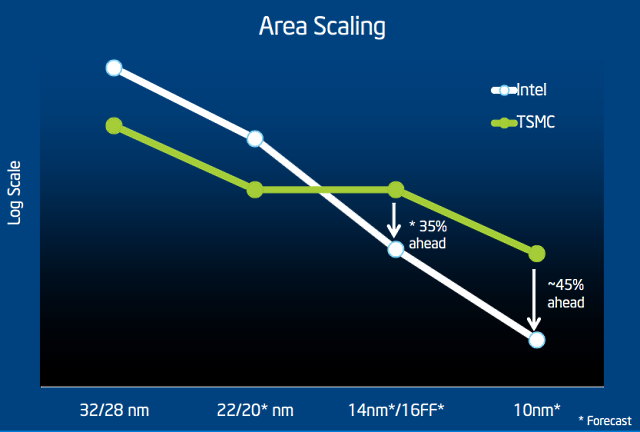
Remember that the economics of 20nm and 20nm + FinFET aren't good at all, while Intel is making great progress at 14nm, in contrary to TSMC. Meanwhile, Qualcomm and MediaTek and ARM are only putting more of the same on a die, with embarrassing throttling, octacore madness becoming the standard and FUD campaigns, respectively. So SoFIA should easily defeat those SoCs with its much higher performance. I'm not so sure about Merrifield and Moorefield, but they offer great performance and performance/watt, so that won't be a problem.

But as I see it, smartphones are about a year behind tablets, like the fast Cherry Trail. So in 2015/2016, Intel should take a lot of market share. I expect a lot from Broxton (Broxton and 14nm SoFIA) in 2H 2015. In 2H 2016, ultimately, Intel will have 10nm which is about 2 to 3 nodes ahead in terms of transistor density and price, 2 nodes ahead in terms of performance and will have new, cutting edge technology like FinFET that will greatly improve performance and power consumption.

So, by then, Intel will have by far the best products on the market, in large part due to their huge 3 to 5 year process lead, with the logical conclusion being that those will give Intel a lot of market share and a mobile victory (which for some should also mean other things). All according to the roadmap.

Of course I end with what I think might be the most poetic and interesting slide of all time, which tells exactly what will happen to Intel's market share; it will leapfrog TSMC (= Qualcomm, Apple, MediaTek, Samsung, Nvidia) from 22 to 14 and extend at 10nm.

14nm-2.png


I hope it will be clear why Intel will overtake ARM within a few short years after those 55 links have been read. If not, we'll find out soon enough. In fact, I started to expand this post with tons of links so I could point to this next time someone denies Intel capabilities of conquering the mobile space. I've also been writing an extended article on this for myself, maybe I'll put that on the internet sometime.
 
"All according to the roadmap" doesn't sound cult-like at all
Roadmaps are very important.

--

Anyway, I just noticed something extremely interesting. I was thinking by myself how Goldmont would compete (against Qualcomm's new microarchitecture). I thought if Goldmont would be the fastest SoC on the market, which it quite certainly will be, it would be able to take a lot of market share in H2 2015. I was then thinking that Goldmont wouldn't be called Goldmont if it wouldn't be first (gold)... after which I noticed that Goldmont is actually an upgrade of Silvermont: silver -> gold. I hadn't noticed this before because Airmont is in between (and I'm not native English).
 
tl;dr

Well, I did read a bit but it was far too one sided to take seriously.

Sorry witeken.

Might as well replace TL;DR with:
"I want to ignore the fact that Intel will hit node shrinks much faster than the competition.
 
Ironic isn't it? AMD had better products than Intel, at certain times in their history, but they didn't sell the way that you would expect that they would, given that they were better product. Some people also wished for an Intel monopoly.
.


This false history pops up again and again. Contrary to the myth AMD was wildly successful during the period that it had its best products.
Its market share doubled to the point that practically matched Intel 1 to 1. AMD products all but disappeared from the DIY market because they weren't able to keep up with OEM demand. Since then AMD market share has gone from >40% to <20%.

So its very obvious that AMDs market share directly related to their chips' performance relative to Intel.
 
This false history pops up again and again. Contrary to the myth AMD was wildly successful during the period that it had its best products.
Its market share doubled to the point that practically matched Intel 1 to 1. AMD products all but disappeared from the DIY market because they weren't able to keep up with OEM demand. Since then AMD market share has gone from >40% to <20%.

So its very obvious that AMDs market share directly related to their chips' performance relative to Intel.

I think what he meant is that AMD should have sold more chips as performance king. Yet there was tons of things going around about AMD about the time including that they were "Arab Microtech Devices" and that terrorists were using them for funding. All types of crazy things. This was the time where people just went "Intel has faster clockspeeds therefore is faster." Not saying AMD didn't do AMAZING during the time, just saying that what he said did have some merit in that there was a smear campaign against AMD at the time.

That said, they did gain a large marketshare for having better chips and if they had CONTINUED to do so they would have gained marketplace dominance. Intel, if they can make a superior chip or hell, just a competitive chip, I think they'll get a foothold in the market.

People in the thread seem to think that Intel only is in the race because they subsidize their chips. Like I've said before, just read the BayTrail review. It's clear intel is doing some things right and just wait and see what CherryTrail brings with a node shrink.

Intel was late to the party I won't disagree. I think that has to do a LOT with the fact that the minds that work their are similar to enthusiast minds. They discounted the tablet/mobile market and were interested in performance. By the time they made moves to hit lower power usage they were already behind.

Intel has the R&D, they have the fabs, they have an ADVANTAGE at making chips over the competition, I don't see how they won't be a major player in this market down the road.
 
Intel has the R&D, they have the fabs, they have an ADVANTAGE at making chips over the competition, I don't see how they won't be a major player in this market down the road.

They will be a player, most likely a major one, but at what costs to their gross margins?
How long can they sell at cost or at a loss into that market sector?

Edit: Multiplier-unlocked chips and flashy skull logos won't cut it in the mobile market.
 
They will be a player, most likely a major one, but at what costs to their gross margins?
How long can they sell at cost or at a loss into that market sector?

Edit: Multiplier-unlocked chips and flashy skull logos won't cut it in the mobile market.

Gross margins will be just fine. You DO realize of course that mobile chips are cheaper *and* cheaper to make, right?

A 70mm^2 Merrifield that only needs to clock at 2.13GHz is going to be much cheaper to make than an i7 4500U that needs to turbo to 3GHz, weighs in at 180mm^2, and also comes with it an on-package separate PCH 🙂

Don't confuse raw gross margin dollars with gross margin %.
 
Gross margins will be just fine. You DO realize of course that mobile chips are cheaper *and* cheaper to make, right?

A 70mm^2 Merrifield that only needs to clock at 2.13GHz is going to be much cheaper to make than an i7 4500U that needs to turbo to 3GHz, weighs in at 180mm^2, and also comes with it an on-package separate PCH 🙂

Don't confuse raw gross margin dollars with gross margin %.

I was speaking of the comparative gross margins of competing SoC makers in that market. If QualComm is only raking in (for example only) 20% GMs on their SoCs, then what makes Intel think that they can continue their 60% GMs, by entering this market?

If OEM mfgs are only paying X% amount out of their total BOM for a tablet or phone (Edit: for the SoC/CPU), what makes Intel think that they will pay Y% for an "Intel branded" SoC.
 
And that is the multi-billion dollar question for Intel. If the company is willing to accept low margins, I have always thought it will do fine. The problem is the company almost never accepts low margins. Not as a long-term strategy which is what is needed for success.
 
I was speaking of the comparative gross margins of competing SoC makers in that market. If QualComm is only raking in (for example only) 20% GMs on their SoCs, then what makes Intel think that they can continue their 60% GMs, by entering this market?

If OEM mfgs are only paying X% amount out of their total BOM for a tablet or phone (Edit: for the SoC/CPU), what makes Intel think that they will pay Y% for an "Intel branded" SoC.

Garbage in, garbage out 🙂

What makes you think Qualcomm's gross margin profile is only 20%? It's more in the low-to-mid 40% range after paying TSMC's foundry tax, an OSAT's packaging & test tax, and ARM's royalties. >50% margins at similar/better performance levels is more than likely given that Intel has a process lead (which helps performance and economics) and keeps both the wafer fab margins as well as packaging and test margins for its parts.
 
And that is the multi-billion dollar question for Intel. If the company is willing to accept low margins, I have always thought it will do fine. The problem is the company almost never accepts low margins. Not as a long-term strategy which is what is needed for success.

PC business is in decline, tablet/phone market is exploding, and Intel needs volumes to continue to invest in its own factories. Better to take lower margin business and make money at it than to not take it and not make money at it.

If Intel didn't, they'd be long-term dead.
 
Garbage in, garbage out 🙂

What makes you think Qualcomm's gross margin profile is only 20%?
Uhh, I did say, "for example only". I wasn't attempting to make a statement that QCOMM's GMs were really 20%, it was a stab in the dark to use as an example. Thanks for the clarification though. (I'm not a finance guy, I don't follow these things.)
 
Uhh, I did say, "for example only". I wasn't attempting to make a statement that QCOMM's GMs were really 20%, it was a stab in the dark to use as an example. Thanks for the clarification though. (I'm not a finance guy, I don't follow these things.)

Right, right...sorry about that.

I guess my point is this: mobile chips are cheaper to make, so just because they sell for cheaper than PC chips doesn't mean they're lower gross margin %. They will generate less raw profit, though.
 
Gross margins will be just fine. You DO realize of course that mobile chips are cheaper *and* cheaper to make, right?

A 70mm^2 Merrifield that only needs to clock at 2.13GHz is going to be much cheaper to make than an i7 4500U that needs to turbo to 3GHz, weighs in at 180mm^2, and also comes with it an on-package separate PCH 🙂

Don't confuse raw gross margin dollars with gross margin %.


From 180mm2 to 70mm2 the waffer cost is 60% lower for the smaller die, binning/tests and packaging will cost the same reducing the difference to about 30% , i let you do further calculations when looking at the selling prices difference and the resulting margins.
 
They will be a player, most likely a major one, but at what costs to their gross margins?
How long can they sell at cost or at a loss into that market sector?

Edit: Multiplier-unlocked chips and flashy skull logos won't cut it in the mobile market.

They want to reaplce Qualcomm, and Qualcomm is doing just fine in the mobile market. Once the market has consolidated and Intel has a nice market share, profits and margins will go up for sure.
 
And that is the multi-billion dollar question for Intel. If the company is willing to accept low margins, I have always thought it will do fine. The problem is the company almost never accepts low margins. Not as a long-term strategy which is what is needed for success.

It's a common misconception that Intel is only willing to accept high margins.
 
They want to reaplce Qualcomm, and Qualcomm is doing just fine in the mobile market. Once the market has consolidated and Intel has a nice market share, profits and margins will go up for sure.

So they re trying to get the competition out of the market by selling products well below manufacturing costs and they re hoping that once the competition is trounced thanks to this illegal policy they ll raise their prices to recoup the lost money..??.

Quite a plan , we ll know better in a year or two but it would be surprising that such a tricky strategy will work according to previsions , it just say that if Intel need to rely on such shenanigans then it means that their CEO s claims of superior technology is just an empty claim to keep the investors out of concerns.
 
So they re trying to get the competition out of the market by selling products well below manufacturing costs and they re hoping that once the competition is trounced thanks to this illegal policy they ll raise their prices to recoup the lost money..??.

Quite a plan , we ll know better in a year or two but it would be surprising that such a tricky strategy will work according to previsions , it just say that if Intel need to rely on such shenanigans then it means that their CEO s claims of superior technology is just an empty claim to keep the investors out of concerns.

No, they will use their process lead to their advantage. Their process lead gives them higher performance, lower power consumption and higher performance/watt. On top of that, transistor cost is much lower, meaning they can put more of those faster transistors than the competition at the same price.

So Intel can offer a product at a much lower price than the competition (Qualcomm) that performs vastly superior. That's how they'll gain a huge market share. After the market has consolidated and the price wars stopped, the smartphone and tablet market will become very profitable for them (e.g. look at the HDD and RAM markets). I don't think there's anything stopping them from executing this strategy.
 
No, they will use their process lead to their advantage. Their process lead gives them higher performance, lower power consumption and higher performance/watt. On top of that, transistor cost is much lower, meaning they can put more of those faster transistors than the competition at the same price.

So Intel can offer a product at a much lower price than the competition (Qualcomm) that performs vastly superior. That's how they'll gain a huge market share. After the market has consolidated and the price wars stopped, the smartphone and tablet market will become very profitable for them (e.g. look at the HDD and RAM markets). I don't think there's anything stopping them from executing this strategy.

Their process advantage mean nothing currently, besides its cost is about double the the cost of cheap 28nm offerings , they can offer a product that is competitive price wise only by taking huge losses, it s amazing that people insist on vaporware claims , the reality is in the numbers not in what is wished..

IBS14_FDSOI_FinFET_wafercost.jpg
 
I love this "us versus them" attitude. Just FYI, I loved AMD chips back during that time, I was a big fan of the early Athlon chips and I most certainly did buy them over intel. This seems to be an ongoing thread in several threads such as this one. Us versus them. The AMD extreme fans talking bad of intel just cuz its...intel. No other reason. Us versus them.

Whatever man. Just by your example, i'm a consumer. I don't care about what corporation gives it to me, if AMD came out with a better than core desktop product in terms of IPC tomorrow. Do you know what I would buy? Do you know what I would scrap? Here's a hint, if AMD delivered a desktop CPU better than core, then I would no longer own an intel desktop CPU. That's what it boils down to with me. I like the better product. The product with better performance, better experience, the one that is a pleasure to use. The early Athlon chips delivered that, and guess what? I bought them. I did not buy intel products during that period of time. Anyone that subscribes to an "us versus them" attitude is, quite frankly, an idiot in the consumer market place.

Even ignoring the "better product", I also like competition. Even if I hate a product, if it's a good product, that means it benefits ME as a CONSUMER. Competition helps, it doesn't hurt. So here's my take on the entire mobile thing. I could care less about intel's financials, but they're still making a ton of profit and have a ton of cash in their war chest. Not that I care. Does that affect me as a consumer directly? No. But back to the mobile thing. If they deliver a great product for mobile, even if I don't buy, I benefit. I get better prices. I get better products from intel's competition. I personally feel very strongly that intel has delivered a great product in BT, and (potentially) even more so with BT's successor later this year. If i'm wrong about Bt's successor, so be it, but I think it will be an absolutely great product. One that will benefit mobile consumers such as myself.

Now obviously some disagree and have semi plausible arguments, while others are just hating on intel just because it is intel, while others are stuck on the "i'm an AMD fan and I have to bad talk intel because us versus them", but , Intel's SOC products have merit. I think intel will do good things in the market, but nothing speaks louder than action. Intel sold a BUTTLOAD of BT chips for windows tablets. They now support android. So I guess we'll re-evaluate 8 months from now. Actions speak louder than words. Some naysayers think intel is just going to wither and die. I would say, probably not. I don't think they will dominate, but they WILL be a good competitor. That's all I want. Market choice. I want better products. Again, in the desktop context, when AMD had the better product, was I buying intel? Absolutely NOT. I buy whatever is better and whatever gives me more pleasure to use in terms of user experience. I don't care if it's intel or AMD. Now certainly intel is winning that race on the desktop right now in terms of IPC, so I buy intel desktop CPUs. But if that ever changed. I would not buy intel.

So what I see in this thread is about a hundred posts ignoring the merits that intel has and just naysaying because it's. Intel. At least that's the gist i'm getting, which quite frankly, is ridiculous. I don't get it. I don't necessarily agree with those stating that intel will stomp everyone in mobile, but like I said. They will be a formidable competitor IMO. I think they have the great product. They have the will to make it happen. I just want the better product and better competition, and I think intel will do that.

and you are just the type of consumers that big business likes to exist

i will give you a hint

when you buy from amd or other competitors you are doing more in the long run than you would by boycotting intel
 
@Abwx Their process already gives them leading performance/watt. Wafer costs are offset by density improvements:

Chart-4.png


For TSMC on the other hand (low density improvements + worse yields + higher wafer costs).
 
Last edited:
Back
Top