• We’re currently investigating an issue related to the forum theme and styling that is impacting page layout and visual formatting. The problem has been identified, and we are actively working on a resolution. There is no impact to user data or functionality, this is strictly a front-end display issue. We’ll post an update once the fix has been deployed. Thanks for your patience while we get this sorted.

***Official GeForce GTX660/GTX650 Review Thread***

Page 6 - Seeking answers? Join the AnandTech community: where nearly half-a-million members share solutions and discuss the latest tech.
Imho,

Absolutely! It's refreshing when sites investigate or look into these things for both-- and the IHV's police themselves to some degree as well -- when one of them feel the other is crossing the line or going down a slippery slope -- they try to create some awareness.
 
Just a food for thought,

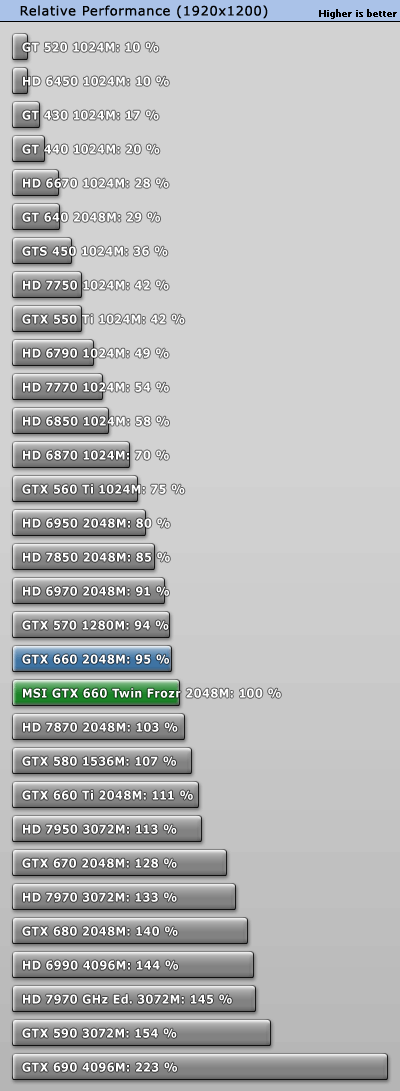
http://www.techpowerup.com/reviews/MSI/GTX_660_Twin_Frozr_III/27.html
perfrel_1920.gif


GTX560Ti MSRP price of the time of release 1/25/2011 = $249,00
GTX660 MSRP price of the time of release 9/14/2012 = $229,00

GTX660 vs GTX560Ti = ~27% faster at almost the same MSRP price after 20 months


HD6870 MSRP price of the time of release 10/21/2010 = $239,00
HD7870 MSRP price of the time of release 3/5/2012 = $350,00
HD7870 MSRP price as of today 9/14/2012 = $249,00

HD7870 vs HD6870 = ~47% faster at almost the same MSRP price after 33 23 months

I call that progression D:

Edit: 23 not 33
 
Last edited:
Just a food for thought,

http://www.techpowerup.com/reviews/MSI/GTX_660_Twin_Frozr_III/27.html
perfrel_1920.gif


GTX560Ti MSRP price of the time of release 1/25/2011 = $249,00
GTX660 MSRP price of the time of release 9/14/2012 = $229,00

GTX660 vs GTX560Ti = ~27% faster at almost the same MSRP price after 20 months


HD6870 MSRP price of the time of release 10/21/2010 = $239,00
HD7870 MSRP price of the time of release 3/5/2012 = $350,00
HD7870 MSRP price as of today 9/14/2012 = $249,00

HD7870 vs HD6870 = ~47% faster at almost the same MSRP price after 33 months

I call that progression D:

If your comparing the 7870 vs 6870, you should be comparing the 660 to a 560 (non Ti) no?
 
Just a food for thought,

GTX560Ti MSRP price of the time of release 1/25/2011 = $249,00
GTX660 MSRP price of the time of release 9/14/2012 = $229,00

GTX660 vs GTX560Ti = ~27% faster at almost the same MSRP price after 20 months


HD6870 MSRP price of the time of release 10/21/2010 = $239,00
HD7870 MSRP price of the time of release 3/5/2012 = $350,00
HD7870 MSRP price as of today 9/14/2012 = $249,00

HD7870 vs HD6870 = ~47% faster at almost the same MSRP price after 33 months

I call that progression D:

Not sure how one card releasing 3 months after the other (10/21/2010 to 01/25/2011) adds 13 months to your time span.

Might want to recheck that. 33 months from 10/21/2010 is 07/21/2013.
 
If your comparing the 7870 vs 6870, you should be comparing the 660 to a 560 (non Ti) no?

And yeah, I'd assume the non-Tis would have at it.

The cost of corn oil has sky rocketed in the last half decade or so. Glad my computer parts still cost within a reasonable price point of what I've always bought.
 
Not saying they are cheating. Regardless of how many times or how many members try to twist it into that. I AM saying it should be looked into. And why the hell not,right?


For verification purposes, yes, why not I guess. It has been done to Nvidia on many occasions. I am sure it has been verified independently already. That's how the Nvidia outrage began when someone noticed that Nvidia was just skipping rendering in 3dmark 03 on sky elements which in turn was calculating into faster FPS when ultimately it was skipping frames altogether.
 
Since a certain prominent NVIDIA fanboy is crying like a three year old, I take it this release isn't that impressive?

Hopefully prices will drop nonetheless.
 
Maybe also better frametimes though Techreport themselves admitted in their frametime article that there are other links in the graphics chain that make their frametime measure less than perfect:

http://techreport.com/review/21516/inside-the-second-a-new-look-at-game-benchmarking/11 "Now, take note of the implications here. Because the metering delay is presumably inserted between T_render and T_display, Fraps would miss it entirely. That means all of our SLI data on the preceding pages might not track with how frames are presented to the user. Rather than perceive an alternating series of long and short frame times, the user would see a more even flow of frames at an average latency between the two."

Ordinarily I don't quote myself, but I would like to add an addendum: NV does seem to produce smoother multi-GPU experiences subjectively in some situations. For instance, HardOCP compared 7970 vs 680 in multi-GPU configs and said:

"We can't communicate to you "smoothness" in raw framerates and graphs. Smoothness, frame transition, and game responsiveness is the experience that is provided to you as you play. Perhaps it has more to do with "frametime" than it does with "framerate." To us it seems like SLI is "more playable" at lower framerates than CrossFireX is. For example, where we might find a game playable at 40 FPS average with SLI, when we test CrossFireX we find that 40 FPS doesn't feel as smooth and we have to target a higher average framerate, maybe 50 FPS, maybe 60 FPS for CrossFireX to feel like NVIDIA's SLI framerate of 40 FPS. Only real-world hands on gameplay can show you this, although we can communicate it in words to you. Even though this is a very subjective realm of reviewing GPUs, it is one we surely need to discuss with you.

The result of SLI feeling smoother than CrossFireX is that in real-world gameplay, we can get away with a bit lower FPS with SLI, whereas with CFX we have to aim a little higher for it to feel smooth. We do know that SLI performs some kind of driver algorithm to help smooth SLI framerates, and this could be why it feels so much better. Whatever the reason, to us, SLI feels smoother than CrossFireX.

Personally speaking here, when I was playing between GeForce GTX 680 SLI and Radeon HD 7970 CrossFireX, I felt GTX 680 SLI delivered the better experience in every single game. I will make a bold and personal statement; I'd prefer to play games on GTX 680 SLI than I would with Radeon HD 7970 CrossFireX after using both. For me, GTX 680 SLI simply provides a smoother gameplay experience. If I were building a new machine with multi-card in mind, SLI would go in my machine instead of CrossFireX. In fact, I'd probably be looking for those special Galaxy 4GB 680 cards coming down the pike. After gaming on both platforms, GTX 680 SLI was giving me smoother performance at 5760x1200 compared to 7970 CFX. This doesn't apply to single-GPU video cards, only between SLI and CrossFireX."

http://www.hardocp.com/article/2012/03/28/nvidia_kepler_geforce_gtx_680_sli_video_card_review/9

 
Ordinarily I don't quote myself, but I would like to add an addendum: NV does seem to produce smoother multi-GPU experiences subjectively in some situations. For instance, HardOCP compared 7970 vs 680 in multi-GPU configs and said:

"We can't communicate to you "smoothness" in raw framerates and graphs. Smoothness, frame transition, and game responsiveness is the experience that is provided to you as you play. Perhaps it has more to do with "frametime" than it does with "framerate." To us it seems like SLI is "more playable" at lower framerates than CrossFireX is. For example, where we might find a game playable at 40 FPS average with SLI, when we test CrossFireX we find that 40 FPS doesn't feel as smooth and we have to target a higher average framerate, maybe 50 FPS, maybe 60 FPS for CrossFireX to feel like NVIDIA's SLI framerate of 40 FPS. Only real-world hands on gameplay can show you this, although we can communicate it in words to you. Even though this is a very subjective realm of reviewing GPUs, it is one we surely need to discuss with you.

The result of SLI feeling smoother than CrossFireX is that in real-world gameplay, we can get away with a bit lower FPS with SLI, whereas with CFX we have to aim a little higher for it to feel smooth. We do know that SLI performs some kind of driver algorithm to help smooth SLI framerates, and this could be why it feels so much better. Whatever the reason, to us, SLI feels smoother than CrossFireX.

Personally speaking here, when I was playing between GeForce GTX 680 SLI and Radeon HD 7970 CrossFireX, I felt GTX 680 SLI delivered the better experience in every single game. I will make a bold and personal statement; I'd prefer to play games on GTX 680 SLI than I would with Radeon HD 7970 CrossFireX after using both. For me, GTX 680 SLI simply provides a smoother gameplay experience. If I were building a new machine with multi-card in mind, SLI would go in my machine instead of CrossFireX. In fact, I'd probably be looking for those special Galaxy 4GB 680 cards coming down the pike. After gaming on both platforms, GTX 680 SLI was giving me smoother performance at 5760x1200 compared to 7970 CFX. This doesn't apply to single-GPU video cards, only between SLI and CrossFireX."

http://www.hardocp.com/article/2012/03/28/nvidia_kepler_geforce_gtx_680_sli_video_card_review/9


Be nice if [H] did a follow-up review with current drivers. Hopefully AMD has alleviated the problem with their recent driver enhancements.
 
There is nothing called "future proof" in technology get real.

Don't be darf.

There certainly is. A nice recent example for you: Gtx570 vs 580, with its bigger vram buffer it actually CAN play with higher settings, especially high-res texture packs.

But an obvious example, would you buy a usb2 vs usb3 laptop/system/ext hdd?

But now in the GPU comparison, we have an architecture (GCN) that is significantly faster in compute while being just as fast or faster in games... often at a lower price point. I'm pretty sure there's "future proof" in my 7950 purchase over say, the 660ti.
 
I currently run an AMD MSI 5770. Ive been wanting to switch back to nvidia(I like the drivers better).

I am intrigued with the GTX 650 but, honestly, its priced at bit high right now(which makes sense because it was just released). The GTX 650 is the same price as the AMD 7770 basically. The AMD 7770 is quite a bit faster than the GTX 650/5770/6770/GTX 550 ti. : /

I wish it were in more of the $70-$80 price point and theyd probably have a sale.
 
Since a certain prominent NVIDIA fanboy is crying like a three year old, I take it this release isn't that impressive?

Hopefully prices will drop nonetheless.

When somebody brings up a point that you don't like, you call it crying like a three year old. Tell me, what is more mature? Bringing up a topic of discussion, or saying that because the topic was brought up, I'll call the guy a crying 3 year old and see how far that fuels the fire and flames.

Grow up dude.

And to answer your surprisingly on topic inquiry, the 660 is just where it needed to be. Impressive? I'd say more "expected" at this point.
The 650 is okay for it's price as well.
 
Last edited:
When somebody brings up a point that you don't like, you call it crying like a three year old. Tell me, what is more mature? Bringing up a topic of discussion, or saying that because the topic was brought up, I'll call the guy a crying 3 year old and see how far that fuels the fire and flames.

Grow up dude.

And to answer your surprisingly on topic inquiry, the 660 is just where it needed to be. Impressive? I'd say more "expected" at this point.
The 650 is okay for it's price as well.

To be fair, I don't see anywhere in his post where he identifies who he is talking about or if he is even on these forums. He could even be talking about JHH or something.

You may want to edit your 650 comment if you want any credibility at all, btw, given that 7770's outperform it substantially at roughly the same price as 650s.
 
To be fair, I don't see anywhere in his post where he identifies who he is talking about or if he is even on these forums. He could even be talking about JHH or something.

You may want to edit your 650 comment if you want any credibility at all, btw, given that 7770's outperform it substantially at roughly the same price as 650s.

Yes he could have. But you and I are not that stupid. Agreed?

And define "roughly". I see the 650 for 110. I see the 7770 for 110 as well. The prices will work themselves out to where they are supposed to be. It's as fast or faster than a 7750, and a bit slower than 7770. So I think if anything, it's not too far off from where it's supposed to be.
 
Last edited:
Don't be darf.

There certainly is. A nice recent example for you: Gtx570 vs 580, with its bigger vram buffer it actually CAN play with higher settings, especially high-res texture packs.

But an obvious example, would you buy a usb2 vs usb3 laptop/system/ext hdd?

But now in the GPU comparison, we have an architecture (GCN) that is significantly faster in compute while being just as fast or faster in games... often at a lower price point. I'm pretty sure there's "future proof" in my 7950 purchase over say, the 660ti.
You have absolutely no idea what are you talking about.Did they cost similar?If I spend more of course it implies that I can retain that piece longer.
Are they priced same?
Another garbage point.The AMD's highest Firepro got hammered by a two year old Quadro 6000.Need any more proof?Most people touting the term compute just "have" no idea what they are talking about
 
Another garbage point.The AMD's highest Firepro got hammered by a two year old Quadro 6000.Need any more proof?Most people touting the term compute just "have" no idea what they are talking about

Yeah, i think only people working for AMD are using this term right now. There is no application on the market which makes a real difference. Why should i care if <=GK104 cards need a few second longer?

In 2 weeks Borderlands 2 comes to the market. With GPU-PhysX there is a huge difference in quality. That is a reason to buy a nVidia card instead of AMD. But Luxmark?
 
Just noticed the 99th frame time analysis by tech report AMD does seem to struggle Crysis 2 badly, but what's the most interesting of all is BF3 on older cards. The 460 and 560TI do so badly on frame times suggesting a 6870 would offer a significantly better play experience. I wonder if nVidia degraded IQ to get better performance numbers vs AMD and we all missed it? Maybe keys can look into it over there for us?

This is actually quite an interesting question (minus the conspiracy bit).

Going over the techreport numbers the reference GTX 660 is on average (all games minus BF3) 16% faster than the GTX 560 Ti in 99 percentile frame time (20% if you don't count dirt 3), however in BF3 the 660 is a whooping 138% faster than the 560 Ti.

How in the world did Nvidia manage such a huge boost in this one game?. The specs don't seem able to explain it, so the most reasonable guess would seem to be that drivers for the Fermi generation cards (or at least the 560 Ti, 460 and 470) are completely broken when it comes to 99 percentile frame times. This theory is also supported by the fact that the 6870 also beats the three Fermi cards quite soundly in this category.

Would be interesting to see a more thorough investigation of this.
 
In 2 weeks Borderlands 2 comes to the market. With GPU-PhysX there is a huge difference in quality. That is a reason to buy a nVidia card instead of AMD. But Luxmark?

i am not trolling,
just curious...

but, how many games uses (will use) physX this year?
Borderlands 2 is the only that i remember
 
Yes he could have. But you and I are not that stupid. Agreed?

And define "roughly". I see the 650 for 110. I see the 7770 for 110 as well. The prices will work themselves out to where they are supposed to be. It's as fast or faster than a 7750, and a bit slower than 7770. So I think if anything, it's not too far off from where it's supposed to be.

I have not read everything in this thread so I really don't know who he is referring to, sorry. If you guys were specifically talking to each other then allow me to butt out of the crossfire, now. 🙂

Roughly meaning within 10% of the price of the 7770. Drivers are new and maybe the 650 will improve over time with better drivers, but as it stands it just does not look competitive with 7770s that cost about the same or a little more. I know a thing or two about 7770s having owned one myself, and you can find them on sale for ~$99 occasionally. Even right now you can find them for ~$110 after rebate, same as the $110 650s. And the 7770 is substantially faster than the 650; the 650 is not just "a bit" slower, particularly at the kinds of framerates you will likely see with these lower-end parts where a 25% fps difference may translate to 24 fps (barely playable) vs 30fps (significantly better).

http://www.tomshardware.com/reviews/geforce-gtx-660-geforce-gtx-650-benchmark,3297-24.html

What I'm curious about is typical oc headroom, because a 7750 can overclock well, and the 650 may not keep up if its oc headroom is worse. We will have to wait till more oc reviews come out to figure out typical 650 oc headroom, I guess.

As you said, though, the market is dynamic and prices will fluctuate. So I am limiting my comment about 650 price/perf solely to today's street prices at major retailers.
 
Last edited:
Buying a card just for physix games is like buying a console just for a specific game people still do it

That's a pretty good analogy. Halo, anyone? And there are PC exclusives like Diablo III that got a LOT of less-hardcore people to upgrade their PCs, if they didn't already, due to WoW and SC2. Maybe we'll see another wave when Half Life 3 hits.
 
Buying a card just for physix games is like buying a console just for a specific game people still do it

But buying a card for no compute applications is better? :awe:

i am not trolling,
just curious...

but, how many games uses (will use) physX this year?
Borderlands 2 is the only that i remember

HAWKEN is the second one this year.
 
Last edited:
Back
Top