BallaTheFeared
Diamond Member
Yikes, what an awful future you've painted 🙁

Look at the last 2 quarters of AMD's GPU division's earnings. Even if AMD didn't sell a single GPU in all of 2013, it wouldn't kill the company. And even if HD8000 was 10x faster than GTX700, it wouldn't save the company by any measures. The key markets where AMD is losing $ (CPUs, APUs, servers, etc.) are actually what can kill the company because the losses there are major and they seem never-ending. What AMD needs to execute well on are Richland, Kabini, Piledriver, etc., not HD8000 GPU that might make them $25 million in profits every 3 months. Even if AMD could launch a GPU as fast as the Titan for $1K, it wouldn't even make a dent in their financials.
Look at the last 2 quarters of AMD's GPU division's earnings. Even if AMD didn't sell a single GPU in all of 2013, it wouldn't kill the company. And even if HD8000 was 10x faster than GTX700, it wouldn't save the company by any measures. The key markets where AMD is losing $ (CPUs, APUs, servers, etc.) are actually what can kill the company because the losses there are major and they seem never-ending. What AMD needs to execute well on are Richland, Kabini, Piledriver, etc., not HD8000 GPU that might make them $25 million in profits every 3 months. Even if AMD could launch a GPU as fast as the Titan for $1K, it wouldn't even make a dent in their financials.

Russian I'm kinda shocked you're defending this whole situation. And especially in this manner.
AMD needs all the help it can get right now. They can't afford to relax on a single segment within the company. The company needs to fire on all cylinders. Good companies do not postpone a release of a product line because "it won't kill them" nor do good managers breed that kind of complacency. The company is bleeding money in most of it's product divisions, the last thing they can possibly deal with is one of their only profitable divisions slipping in sales and profits due to stale products and / or increased competition. Fresh products garner interest, interest garners sales. Right now they are buying keys from publishers to just keep their products selling (in lesser quantities than a year ago). In other words, they are bringing in less revenue off their graphics cards than they were a year ago because they are having to market significantly more for a 15% decline year over year sales and a 5% decline vs. the previous quarter.
Complacency and bad management is what got AMD into their financial disaster to begin with. Delaying a product lineup by 2 quarters is exactly what they don't need to do right now.

why spend so much time preaching amd graphics then. Overall it means nothing.
I am kinda blown away with your post really.
Russian I'm kinda shocked you're defending this whole situation. And especially in this manner. Good companies do not postpone a release of a product line because "it won't kill them" nor do good managers breed that kind of complacency. Complacency and bad management is what got AMD into their financial disaster to begin with. Delaying a product lineup by 2 quarters is exactly what they don't need to do right now.

Someone said that TSMC 28nm wafers cost 1/3 as much now as they did at launch, with presumably higher yields too, so in terms of profitability AMD is probably making more money on their GPUs than you might think. And it may actually make sense to stay on 28nm longer, whether with 7xxx or 8xxx. In fact if NVDA and AMD wanted to collude, they could both refuse to launch anything new and milk 28nm for as long as possible.
I've read reports that AMD says it definitely will be launching another series by the end of the year, but that doesn't contradict the OP which was talking about the "bulk of 2013," not "all of 2013." You could have a Christmastime launch of HD8xxx and have both statements be true.
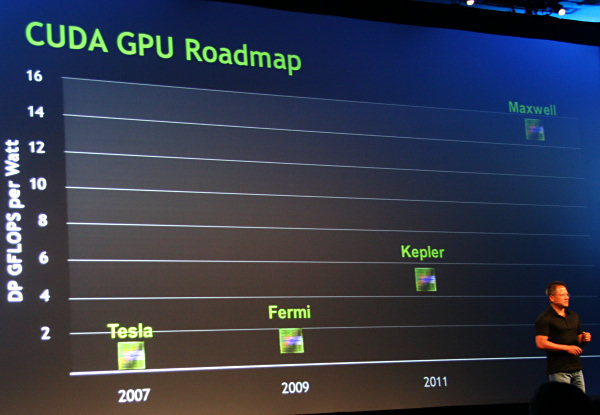
AMD doesn't even have the resources to compete with NV in the Tesla / HPC markets and they surely won't double their GPU revenues any time soon either. Therefore, the answers for AMD's long-term sustainable financial health are not discrete desktop GPUs. If you've always followed what NV said, GeForce is a cost center for them. If NV's professional GPU segment didn't exist, the entire GeForce brand would be barely profitable. And the only way products like Tesla are possible is because of the R&D costs that are subsidizes by the GeForce brand. JHH has mentioned this on various occasions to investors.

Someone said that TSMC 28nm wafers cost 1/3 as much now as they did at launch, with presumably higher yields too, so in terms of profitability AMD is probably making more money on their GPUs than you might think.
I've read reports that AMD says it definitely will be launching another series by the end of the year, but that doesn't contradict the OP which was talking about the "bulk of 2013," not "all of 2013." You could have a Christmastime launch of HD8xxx and have both statements be true.
Nonsense.
The Geforce business is their bread and butter. It makes more than half of the revenue and 66% of the operative income.
The only reason nVidia had money to went into the Tesla and Tegra business was because of the consumer business. The whole R&D of the architecture comes from the Geforce business. That's the reason why their professional business has gross margins between 50-70%.
Yikes, what an awful future you've painted 🙁
If they are delaying for technical reasons or because inventories are currently too high, then that is one thing. But if they are delaying for the sake of delaying, then stupid stupid stupid stupid stupid.
To the people who are shocked by my comments, how many AMD GPUs have you purchased in the last 5 years? You are so afraid of AMD going down now but you did nothing to help them all this time. Now you are nervous they might go bankrupt?
Going bankrupt or not, why are we obligated to help them? If their products aren't up to par, we should put our money into mediocre solutions?
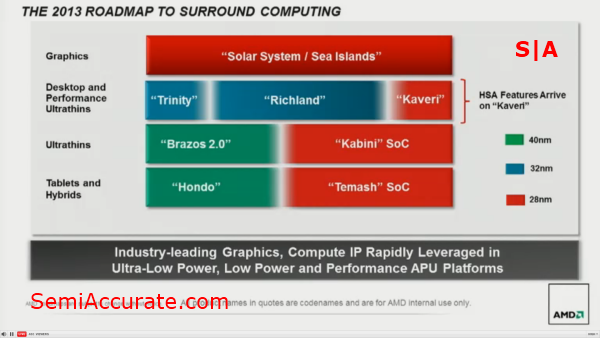
But AMD's own roadmaps from this time last year showed Sea Islands launching in Q1 of this year.
The fear mongering is silly. I sometimes emotionally root for the underdog, but I never, ever, ever make a purchase decision because "if I don't they might go out of business." If that was the case, I'd have bought lots of crap through the years from now defunct companies that I can't get warranty work on or product replacements for.
Going bankrupt or not, why are we obligated to help them? If their products aren't up to par, we should put our money into mediocre solutions?
No such thing was ever stated. This is media making up facts. I posted AMD's roadmaps above. There are no indications of desktop HD8000 launching in Q1.
You stated earlier something along the lines of "AMD needs all the help they can get." If you are so concerned you'd be buying their GPUs. You didn't. What you are concerned about is if AMD goes under, NV raises prices or delays progress for everyone of us.

No, you aren't obligated. But then jump on the bandwagon how HD8000 launching later is a big deal. You did nothing to support the company when they made a superior card than a GTX670 and then you are upset they are in financial trouble and may need more time to get their next series out, which in turn might mean NV stalls too, or raises prices, etc.? Again, there isn't a single credible source of AMD ever publicly stating HD8000 desktop cards were to launch Q1 2013.
HD7970Ge is the fastest single GPU. Nearly everything else has class leading price/performance, overclocking and game bundles. Why exactly is AMD in a rush to replace that series? Your comment that their GPUs are sub-par / mediocre does not compute. HD7970GE spanks your 670 so hard, they are not even in the same performance class. Same story on the price/performance front. HardOCP's overview late summer pitted HD7950 OC vs. GTX670 OC and 670 couldn't beat it despite at the time costing $70-80 more.
You are right, I stand corrected. So either the floating specs and release dates of the various sea islands chips that have floated around are entirely fabricated, or (as I believe) there is still some kind of delay taking place between the retail 8000 series and 7000 series. The time between Cypress and Cayman was 14(ish) months. If the time between Tahiti and ]Sea Islands highest end chip] is looking to be a minimum of 18 months if it comes Q3 2013, 21 months if it comes Q4.
That looks like a delay to me.
“If PS4 has a real-time OS, with a libGCM style low level access to the GPU, then the PS4 1st party games will be years ahead of the PC simply because it opens up what is possible on the GPU. Note this won’t happen right away on launch, but once developers tool up for the platform, this will be the case. As a PC guy who knows hardware to the metal, I spend most of my days in frustration knowing damn well what I could do with the hardware, but what I cannot do because Microsoft and IHVs wont provide low-level GPU access in PC APIs. One simple example, drawcalls on PC have easily 10x to 100x the overhead of a console with a libGCM style API.”
Except, you forget I did buy a 7970 GE, which I always agreed was the top of the line solution at the moment. I switched to a 670 because I got a good price for the 7970 GE (thanks to everyone's hype) and I got the 670 for what ended up being $130 less than what I paid for the 7970 GE.
The point is, you seem pretty intent on rallying everyone to support AMD by buying their GPUs. There's a bit of bias in that alone.
What I said, is that if they do produce mediocre components, then it's their fault they're in the hole. Which is why they are in the position they are now... they've had mediocre solutions for a number of years and only now have they come back with the 7000 series. Why they need to push on a 8000 series launch is that they don't lose their momentum, I'm happy to see AMD being relevant again.
I supported AMD whenever they provided a good solution (in the past, with their processors, with their GPUs, and now with a 7970). But if they consistently produce mediocre solutions with a few good ones, then I'm not obligated to continue supporting them.
Sorry, but you seem to think AMD is the win-all solution for everyone, when it's not. Look in my signature, my purchase history ranges over AMD, Intel and nvidia. In fact, I've bought more AMD-based products alone over everything else. But I don't believe in brand support, I don't harp a single solution. Why do you?
I think AMD is stuck with a lot of HD7xxx inventory. The are giving $100 worth of free games to try to move it.
Which is why I argue in favor of Valve coming out with a steam-PC. The hardware might be mid-range compared to today's best, but having a unified hardware set without directx, and with which developers can squeeze performance out of by getting closer and closer to the hardware over time like what happens on consoles, it would be a great thing for PC gaming. Mods + controller input freedom + better graphics + cheaper games = better.
I think AMD is stuck with a lot of HD7xxx inventory. The are giving $100 worth of free games to try to move it.
I agree that it would be great for PC gaming/Steam if more users join and start buying more PC games. Since games won't necessarily be coded around Steam box as it won't be a fixed hardware over 6-7 years, I am not sure how much it would benefit from hardware level access though. What I got about Steam box is that it's supposed to be upgradable over time and there would be various SKUs of it. What do you think?


