Discussion Leading Edge Foundry Node advances (TSMC, Samsung Foundry, Intel) - [2020 - 2025]

Page 246 - Seeking answers? Join the AnandTech community: where nearly half-a-million members share solutions and discuss the latest tech.

DisEnchantment

Golden Member
Mar 3, 2017
1,779
6,798
136
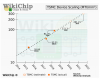
TSMC's N7 EUV is now in its second year of production and N5 is contributing to revenue for TSMC this quarter. N3 is scheduled for 2022 and I believe they have a good chance to reach that target.
1587737990547.png
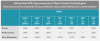
N7 performance is more or less understood.
1587739093721.png

This year and next year TSMC is mainly increasing capacity to meet demands.

For Samsung the nodes are basically the same from 7LPP to 4 LPE, they just add incremental scaling boosters while the bulk of the tech is the same.

Samsung is already shipping 7LPP and will ship 6LPP in H2. Hopefully they fix any issues if at all.
They have two more intermediate nodes in between before going to 3GAE, most likely 5LPE will ship next year but for 4LPE it will probably be back to back with 3GAA since 3GAA is a parallel development with 7LPP enhancements.


1587739615344.png

Samsung's 3GAA will go for HVM in 2022 most likely, similar timeframe to TSMC's N3.
There are major differences in how the transistor will be fabricated due to the GAA but density for sure Samsung will be behind N3.
But there might be advantages for Samsung with regards to power and performance, so it may be better suited for some applications.
But for now we don't know how much of this is true and we can only rely on the marketing material.

This year there should be a lot more available wafers due to lack of demand from Smartphone vendors and increased capacity from TSMC and Samsung.
Lots of SoCs which dont need to be top end will be fabbed with N7 or 7LPP/6LPP instead of N5, so there will be lots of wafers around.

Most of the current 7nm designs are far from the advertized density from TSMC and Samsung. There is still potential for density increase compared to currently shipping products.
N5 is going to be the leading foundry node for the next couple of years.

For a lot of fabless companies out there, the processes and capacity available are quite good.

---------------------------------------------------------------------------------------------------------------------------------------------------


FEEL FREE TO CREATE A NEW THREAD FOR 2025+ OUTLOOK, I WILL LINK IT HERE
 
Last edited:

511

Diamond Member
Jul 12, 2024
5,461
4,888
106
15-20 million units of the bases chip is about what they ship annually, so if the rumor is correct then its a sole source. Though it also sounds like Pro/Max/Ultra would be staying with TSMC which is odd. Apple reuses their cores, so presumably they're either changing that or creating two designs for the same core, which I'm having trouble buying.
same design ported to a different node most likely
 

Doug S

Diamond Member
Feb 8, 2020
3,840
6,791
136
15-20 million units of the bases chip is about what they ship annually, so if the rumor is correct then its a sole source. Though it also sounds like Pro/Max/Ultra would be staying with TSMC which is odd. Apple reuses their cores, so presumably they're either changing that or creating two designs for the same core, which I'm having trouble buying.

They don't need to dual source as in having both Intel and TSMC produce M7 at the same time. They will already have all the same SoC blocks designed for TSMC for the Pro/Max so there is little incremental design cost being "ready" to make base M7 on TSMC as a backup plan.

They would go forward with the floorplanning / layout - everything except having the masks made. They will know if 18AP is going to work for them before the drop dead date for having TSMC masks made, if it runs into issues they go forward with the TSMC masks and production and don't miss a beat. Zero risk, very little additional effort.
 
  • Like
Reactions: 511

511

Diamond Member
Jul 12, 2024
5,461
4,888
106
So we’re looking at A20P on N2, A21P on A14?
I was under the impression the A21P would be on N2P.
A14 HVM is like H1/H2 28 so expect A22 on A14 ( In apple terms they are launching A22 processor based on their A14 Processor).
 

jdubs03

Golden Member
Oct 1, 2013
1,497
1,086
136
A14 HVM is like H1/H2 28 so expect A22 on A14 ( In apple terms they are launching A22 processor based on their A14 Processor).
Ah yes yes. Makes more sense. My impression thus remains the same.
 

Joe NYC

Diamond Member
Jun 26, 2021
4,224
5,829
136
C.C. Wei comments of supply vs. upcoming demand, and says: "Not enough". He considered wearing a T-Shirt saying "No more wafers"


Doug S

Diamond Member
Feb 8, 2020
3,840
6,791
136
I don't buy this rumor

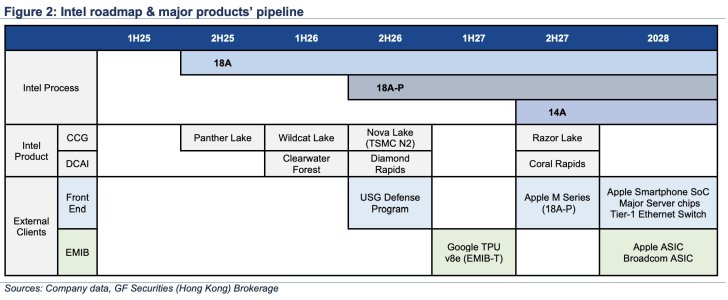
I would want to see some corroboration before believing it. I'm also skeptical given the timeline they show. Why would Apple be using 18AP for these if Intel has 14A ready to go at that time? Since when has Apple decided an N+1 node is good enough for them?

Something about this is off. Either the timeline (i.e. arriving sooner than H2 '27) the process (14A rather than 18AP) or the product (watch SoCs, modem or wifi/BT basebands)
 

LightningZ71

Platinum Member
Mar 10, 2017
2,696
3,395
136
Either that, or the expense of cutting edge nodes is growing so high that low margin products won't pay the bills enough to justify using those nodes. N-1 is likely good enough for products that don't have maximum performance as their target.
 

511

Diamond Member
Jul 12, 2024
5,461
4,888
106
I would want to see some corroboration before believing it. I'm also skeptical given the timeline they show. Why would Apple be using 18AP for these if Intel has 14A ready to go at that time? Since when has Apple decided an N+1 node is good enough for them?

Something about this is off. Either the timeline (i.e. arriving sooner than H2 '27) the process (14A rather than 18AP) or the product (watch SoCs, modem or wifi/BT basebands)
I am not shocked about the process as much as i am shocked about Apple using IFS 18AP might be better for them in the cost structure point of view 14A Risk production is 27
 

Geddagod

Golden Member
Dec 28, 2021
1,681
1,720
136
I am not shocked about the process as much as i am shocked about Apple using IFS 18AP might be better for them in the cost structure point of view 14A
There's no way that Intel isn't on their knees letting Apple pay dirt cheap prices for either process in order to get customers. It's not as if the product they are allegedly using it for has always been skimped on, process wise, either.
I would want to see some corroboration before believing it. I'm also skeptical given the timeline they show. Why would Apple be using 18AP for these if Intel has 14A ready to go at that time?
They almost certainly won't. LBT himself said that 14A is a 2028-2029 node.
Coral Rapids, according to LBT, is also a 2028 product.
I would be very surprised if Razer Lake is 14A. At best (for IFS ig) I think Intel may choose to go back to 18a-p for compute tiles if design changes can address power and 18A node maturity could help it match Fmax.
 
  • Like
Reactions: Joe NYC

511

Diamond Member
Jul 12, 2024
5,461
4,888
106
They almost certainly won't. LBT himself said that 14A is a 2028-2029 node.
Coral is going to be H1 28 launch though apparently they said somewhere i can't remember they are focusing on bringing coral early by cancelling DMR-SP
I would be very surprised if Razer Lake is 14A. At best (for IFS ig) I think Intel may choose to go back to 18a-p for compute tiles if design changes can address power and 18A node maturity could help it match Fmax.
It might be possible for the mobile part
 
Mar 23, 2007
43
25
91
Apple will still be utilizing the latest nodes from TSMC for their flagship products, for sure. But, I can see them also tapping Intel 18A-P for their older products, say Apple TV, for example.
And, I don't think any of this is a done deal. It's surely contingent on whether Intel can meet Apple's performance requirements and deadline.
 
  • Like
Reactions: marees

511

Diamond Member
Jul 12, 2024
5,461
4,888
106
Apple will still be utilizing the latest nodes from TSMC for their flagship products, for sure. But, I can see them also tapping Intel 18A-P for their older products, say Apple TV, for example.
And, I don't think any of this is a done deal. It's surely contingent on whether Intel can meet Apple's performance requirements and deadline.
it will be relatively easier on 18AP tbh if they are targeting 2027
 

Doug S

Diamond Member
Feb 8, 2020
3,840
6,791
136
Either that, or the expense of cutting edge nodes is growing so high that low margin products won't pay the bills enough to justify using those nodes. N-1 is likely good enough for products that don't have maximum performance as their target.

The expense isn't gonna be affecting Apple's anytime soon, and it'll hit everyone else's consumer/PC lineup before it hits Apple. If AMD can make Ryzens using N2 it is ridiculous to believe Apple will find it too expensive.

Even at the rumored $30K for N2 a 13mm x 13mm die (169 mm^2, versus M4 at 165.9) nets 347 candidates per wafer. If you assume you yield 300 of them that's $100 per chip. Hardly a burden given the pricing of products that contain it - and Apple is already staking out a lower end using iPhone SoCs so they'll have room to increase prices for M silicon Macs if they find $100 too pricey. PC OEMs can only dream about obtaining chips with half of Apple's performance level from Intel/AMD for $100!

Whatever Apple's reasons may be for (possibly) switching to Intel for M7, cost will not be one of them. Even if Intel offered Apple massive discounts so they could get them for $50 each instead of $100, I really doubt they'd do it if it meant accepting a big gap in either performance or power compared to N2P.
 
  • Like
Reactions: Geddagod and Kryohi

eek2121

Diamond Member
Aug 2, 2005
3,487
5,179
136
The expense isn't gonna be affecting Apple's anytime soon, and it'll hit everyone else's consumer/PC lineup before it hits Apple. If AMD can make Ryzens using N2 it is ridiculous to believe Apple will find it too expensive.

Even at the rumored $30K for N2 a 13mm x 13mm die (169 mm^2, versus M4 at 165.9) nets 347 candidates per wafer. If you assume you yield 300 of them that's $100 per chip. Hardly a burden given the pricing of products that contain it - and Apple is already staking out a lower end using iPhone SoCs so they'll have room to increase prices for M silicon Macs if they find $100 too pricey. PC OEMs can only dream about obtaining chips with half of Apple's performance level from Intel/AMD for $100!

Whatever Apple's reasons may be for (possibly) switching to Intel for M7, cost will not be one of them. Even if Intel offered Apple massive discounts so they could get them for $50 each instead of $100, I really doubt they'd do it if it meant accepting a big gap in either performance or power compared to N2P.
FYI, Any pricing you see published or “leaked” is NOT what companies actually pay. Pricing varies per customer and is negotiated via a number of variables, including volume. I haven’t actually been following the numbers for N2, but it the public number IS $30k, just know that AMD/Apple/Intel/etc. are paying less.
 
  • Like
Reactions: dr1337

Joe NYC

Diamond Member
Jun 26, 2021
4,224
5,829
136
The expense isn't gonna be affecting Apple's anytime soon, and it'll hit everyone else's consumer/PC lineup before it hits Apple. If AMD can make Ryzens using N2 it is ridiculous to believe Apple will find it too expensive.

Even at the rumored $30K for N2 a 13mm x 13mm die (169 mm^2, versus M4 at 165.9) nets 347 candidates per wafer. If you assume you yield 300 of them that's $100 per chip.

I think that wafer price is exaggerated, especially for the biggest TSMC customers.

As far as AMD, its laptop chips will be N3P, probably in the ballpark of die size you indicated (~170 mm2).

The N2 chip will be optional 12 cores with die size of that chip ~75 mm2 on N2.

Maybe just > $100 for both chips (~$65 + ~$50)?


Hardly a burden given the pricing of products that contain it - and Apple is already staking out a lower end using iPhone SoCs so they'll have room to increase prices for M silicon Macs if they find $100 too pricey.

Yeah, should be no problem for Apple.

PC OEMs can only dream about obtaining chips with half of Apple's performance level from Intel/AMD for $100!

PC OEMs don't have a to pay for CPU / SoC development team. Apple OpEx for that is probably in 100s of millions or billions.

Whatever Apple's reasons may be for (possibly) switching to Intel for M7, cost will not be one of them. Even if Intel offered Apple massive discounts so they could get them for $50 each instead of $100, I really doubt they'd do it if it meant accepting a big gap in either performance or power compared to N2P.

It's only a rumor and there have been many false rumors.
 

Khato

Golden Member
Jul 15, 2001
1,381
491
136
Heh, the non-public N2 wafer pricing I've seen is above $30k.

Being a 'big customer' that's paid for allocation well in advance simply means that you get to avoid the bidding war over the non-reserved capacity and 'only' pay the exorbitant base rate. Such prices are to be expected when combining an effectively monopoly with demand outpacing supply.
 

Doug S

Diamond Member
Feb 8, 2020
3,840
6,791
136
PC OEMs don't have a to pay for CPU / SoC development team. Apple OpEx for that is probably in 100s of millions or billions.

Those costs are amortized across over a quarter billion iPhone/Mac SoCs per year. Even if it was a billion a year that's $4 per chip. If they had the choice PC OEMs would gladly pay that instead of the AMD/Intel markup lol
 

511

Diamond Member
Jul 12, 2024
5,461
4,888
106
Heh, the non-public N2 wafer pricing I've seen is above $30k.
which i doubt is the price for Intel/AMD/Nvidia/Appls or others
Being a 'big customer' that's paid for allocation well in advance simply means that you get to avoid the bidding war over the non-reserved capacity and 'only' pay the exorbitant base rate. Such prices are to be expected when combining an effectively monopoly with demand outpacing supply.
Yeah
 
  • Like
Reactions: Joe NYC