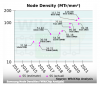
Discussion Leading Edge Foundry Node advances (TSMC, Samsung Foundry, Intel) - [2020 - 2025]

Page 187 - Seeking answers? Join the AnandTech community: where nearly half-a-million members share solutions and discuss the latest tech.

DisEnchantment

Golden Member
Mar 3, 2017
1,779
6,798
136
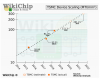
TSMC's N7 EUV is now in its second year of production and N5 is contributing to revenue for TSMC this quarter. N3 is scheduled for 2022 and I believe they have a good chance to reach that target.
1587737990547.png
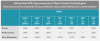
N7 performance is more or less understood.
1587739093721.png

This year and next year TSMC is mainly increasing capacity to meet demands.

For Samsung the nodes are basically the same from 7LPP to 4 LPE, they just add incremental scaling boosters while the bulk of the tech is the same.

Samsung is already shipping 7LPP and will ship 6LPP in H2. Hopefully they fix any issues if at all.
They have two more intermediate nodes in between before going to 3GAE, most likely 5LPE will ship next year but for 4LPE it will probably be back to back with 3GAA since 3GAA is a parallel development with 7LPP enhancements.


1587739615344.png

Samsung's 3GAA will go for HVM in 2022 most likely, similar timeframe to TSMC's N3.
There are major differences in how the transistor will be fabricated due to the GAA but density for sure Samsung will be behind N3.
But there might be advantages for Samsung with regards to power and performance, so it may be better suited for some applications.
But for now we don't know how much of this is true and we can only rely on the marketing material.

This year there should be a lot more available wafers due to lack of demand from Smartphone vendors and increased capacity from TSMC and Samsung.
Lots of SoCs which dont need to be top end will be fabbed with N7 or 7LPP/6LPP instead of N5, so there will be lots of wafers around.

Most of the current 7nm designs are far from the advertized density from TSMC and Samsung. There is still potential for density increase compared to currently shipping products.
N5 is going to be the leading foundry node for the next couple of years.

For a lot of fabless companies out there, the processes and capacity available are quite good.

---------------------------------------------------------------------------------------------------------------------------------------------------


FEEL FREE TO CREATE A NEW THREAD FOR 2025+ OUTLOOK, I WILL LINK IT HERE
 
Last edited:

Io Magnesso

Senior member
Jun 12, 2025
578
165
71
It's for their cloud business they are not throwing anything well when TSMC started Intel also took the risk with them why won't AMZN/MSFT won't take risk with their old business partner if you don't take risk you can't be first.

TSMC has some ownership by Taiwan's Government also how about actually giving Intel the money with stringent requirements than the joke Chips act is and setting favorable policies for TI/Micron/GF/Intel.
Government agencies are involved in some way, and there are some semiconductor companies.
So it's not a strange story if government agencies are somehow involved with Intel.
In-house production is important
If you want to be made in the United States, then everything from research and development to manufacturing is done by an American company in the United States…
 
Jul 27, 2020
28,173
19,210
146
we will see in 1-1.5 year when intel will ship most of their product stack containing 18A.
Please please whoever you know on Twitter who is connected to Intel in some way, please tell them to use AI to put out a limited edition P4 shrink @ 6.0 GHz on 18A with 256MB eDRAM cache and 64GB MoP. I will pay $1000 for it!
 

511

Diamond Member
Jul 12, 2024
5,373
4,781
106
Please please whoever you know on Twitter who is connected to Intel in some way, please tell them to use AI to put out a limited edition P4 shrink @ 6.0 GHz on 18A with 256MB eDRAM cache and 64GB MoP. I will pay $1000 for it!
I am sorry but ain't happening they listen to OEM more than us random folk on AT Forums.
 
  • Haha
Reactions: Thunder 57
Jul 27, 2020
28,173
19,210
146
I am sorry but ain't happening they listen to OEM more than us random folk on AT Forums.
Put it in OEM's head then. Particularly Chinese one.

I would say, "Remember P4? P4 good, very good, yeah? P4 is four times Pentium which is many times Celeron. Maybe Intel can call the P4 Anniversary Edition Pentium 8. Eight very lucky number, yes? You can sell so many laptops and desktops in China, ok? You agree, right?".
 

johnsonwax

Senior member
Jun 27, 2024
469
674
96
That's what many companies do
You can usually do it if you're a big company
No, big companies can cover large fixed costs, but they don't do it without a return. Either you have a low volume/high unit cost to recover that cost, or you have a high volume/low unit cost. We know the latter is the better route given that the marginal costs on semi are extremely low, though the former is viable under the right conditions.

But what's Intels market here? AMD has TSMC who is distributing their fixed costs across AMD, Nvidia, Apple, Qualcomm, and ffs, even Intel. Their contribution is to some degree subsidized. Intel needs customers to do that, and either they need to be competitive with those customers not just in terms of tech but also availability and volume (note Apple alone buys more chips than Intel makes) or they need to have regulatory advantages like ITAR, etc. that TSMC can't follow.

Note, Apple can make the investments they do because they aren't trying to get a ROI on the semiconductor itself, but on the entire device being sold. They don't particularly care if their margins come off of the silicon or the software or the services and they can trade one out for the other as circumstances require. A lot of Apples services they ran break even or at a small loss but kept running them because the aggregate value with the rest of the system was there. Nvidia is building a little bit of that same kind of business around their AI systems, but apart form that everyone else needs an immediate ROI on the component itself. Just because you have $25B in the bank doesn't mean you're going to blow it on a fab that will only generate $10B in revenue. You're going to have to have at least enough volume there or enough pricing control to get $40B off of that and pricing control is hard to come by given how the industry is structured.
 
  • Like
Reactions: adamge

Doug S

Diamond Member
Feb 8, 2020
3,805
6,737
136
A lot of Apples services they ran break even or at a small loss but kept running them because the aggregate value with the rest of the system was there.

A lot of people just assume everything under Apple's 'Services' umbrella is massively profitable (and therefore massively overpriced) because of the huge margins they report for their Services sector. That margin is mainly due to Google paying them over $20 billion a year for simply setting a default on Safari, a default end users are free to change. Hard to beat having $20+ billion in revenue at 100% margin for making your overall numbers look good! If that goes away, and given the way Google's antitrust proceedings are going that seems likely to happen eventually, their Services margins will be lower than the margins in their other sectors. If the other cases attacking them on their 15%/30% App Store cut by making it easier for apps to use alternate payment systems, alternate app stores, etc. their overall Services margin could easily end up negative.

Not sure how Apple would deal with those possibilities, though I'm sure they've gamed everything out and have strategies in place if that happens.
 

Doug S

Diamond Member
Feb 8, 2020
3,805
6,737
136
^^^^

Much of the rest of the Services revenue is Apple's cut of F2P games.

Yep and that all goes away if Apple has to make it easy for them to do their own billing or operate their own app store. Almost all apps are free now, the revenue comes after download. Take that away and operating the App Store is all cost and zero revenue. Talk about low margin business lol!
 

511

Diamond Member
Jul 12, 2024
5,373
4,781
106
No, big companies can cover large fixed costs, but they don't do it without a return. Either you have a low volume/high unit cost to recover that cost, or you have a high volume/low unit cost. We know the latter is the better route given that the marginal costs on semi are extremely low, though the former is viable under the right conditions.

But what's Intels market here? AMD has TSMC who is distributing their fixed costs across AMD, Nvidia, Apple, Qualcomm, and ffs, even Intel. Their contribution is to some degree subsidized. Intel needs customers to do that, and either they need to be competitive with those customers not just in terms of tech but also availability and volume (note Apple alone buys more chips than Intel makes) or they need to have regulatory advantages like ITAR, etc. that TSMC can't follow.
This is not true Intel actually uses the most number of wafers even more than Apple
Note, Apple can make the investments they do because they aren't trying to get a ROI on the semiconductor itself, but on the entire device being sold. They don't particularly care if their margins come off of the silicon or the software or the services and they can trade one out for the other as circumstances require. A lot of Apples services they ran break even or at a small loss but kept running them because the aggregate value with the rest of the system was there. Nvidia is building a little bit of that same kind of business around their AI systems, but apart form that everyone else needs an immediate ROI on the component itself. Just because you have $25B in the bank doesn't mean you're going to blow it on a fab that will only generate $10B in revenue. You're going to have to have at least enough volume there or enough pricing control to get $40B off of that and pricing control is hard to come by given how the industry is structured.
Yeah Intel used to do N/N-1 fabs now they are expanding the lifecycle of fabs to get more ROI from them
 
  • Like
Reactions: Io Magnesso

DavidC1

Platinum Member
Dec 29, 2023
2,124
3,255
106
Please please whoever you know on Twitter who is connected to Intel in some way, please tell them to use AI to put out a limited edition P4 shrink @ 6.0 GHz on 18A with 256MB eDRAM cache and 64GB MoP. I will pay $1000 for it!
First, they aren't going to spend exorbitant amounts for eDRAM production, and then MoP on top of that, 64GB no less!

It may not be entirely unrealistic to have TSMC fab Pentium 4 die on an older 28nm process, and since it's a really old design you might get Intel on board assuming you have enough money to do so. :p

Not $1000 but 100x $1000 might achieve your dream. You know what they say, put your money where your mouth is. You don't want to disappoint us ATers do you?
 
  • Haha
Reactions: 511
Jul 27, 2020
28,173
19,210
146
Not $1000 but 100x $1000 might achieve your dream. You know what they say, put your money where your mouth is. You don't want to disappoint us ATers do you?
:(

Can someone do a GoFundMe for me coz I don't want to become (in)famous as the 44-year old who wants a modern P4 because he couldn't afford it back in the day and wants it to feel just as fast as when he experienced it on his friend's brand new PC?
 

Thunder 57

Diamond Member
Aug 19, 2007
4,250
7,047
136
:(

Can someone do a GoFundMe for me coz I don't want to become (in)famous as the 44-year old who wants a modern P4 because he couldn't afford it back in the day and wants it to feel just as fast as when he experienced it on his friend's brand new PC?

Why would you even want a P4 because outside of Northwood they were hot garbage?
 

Thunder 57

Diamond Member
Aug 19, 2007
4,250
7,047
136
Northwood is a good product
Also, there aren't many, There is also WILLAMETTE
So far there's been no problem...

Williamette was hot garbage and had no upgrade path because the socket changed. Northwood was good when it got dual channel DDR and HT. Prescott was more hot garbage. The Athlons and P3 Tualatin had no trouble beating Williamette.
 

Io Magnesso

Senior member
Jun 12, 2025
578
165
71
Williamette was hot garbage and had no upgrade path because the socket changed. Northwood was good when it got dual channel DDR and HT. Prescott was more hot garbage. The Athlons and P3 Tualatin had no trouble beating Williamette.
Still, it's better than Prescott, which is Explosive heat generation
If you think of Willamette as the first generation...
 
Jul 27, 2020
28,173
19,210
146
I had a P4 as well was very young at the time.
Then you are the lucky one my friend. You HAD SSE2 at the time when no one else did! You didn't feel left out when you installed that kayaking game and it threw an ad into your face saying that this game ran MUCH better with SSE2. I installed MS Office on a Northwood and an Athlon 1500+ around that time. It was the Northwood that blew me away with its "feel" of speed. I think with bigger caches and smaller process, even a Prescott would work like a champ today.
 
Jul 27, 2020
28,173
19,210
146
Why would you even want a P4 because outside of Northwood they were hot garbage?
Because they were far ahead of their times. They need much smaller process. A P4 on 18A would be absolutely tiny. Intel could probably get over 1000 dies from a wafer.
 

511

Diamond Member
Jul 12, 2024
5,373
4,781
106
Then you are the lucky one my friend. You HAD SSE2 at the time when no one else did! You didn't feel left out when you installed that kayaking game and it threw an ad into your face saying that this game ran MUCH better with SSE2. I installed MS Office on a Northwood and an Athlon 1500+ around that time. It was the Northwood that blew me away with its "feel" of speed. I think with bigger caches and smaller process, even a Prescott would work like a champ today.
it's around 2010 ish also i was barely 13 at the time so i don't even remember what SSE2 was all i remember is that i saw Pentium 4 displayed during boot
 
Last edited:
  • Like
Reactions: igor_kavinski

johnsonwax

Senior member
Jun 27, 2024
469
674
96
This is not true Intel actually uses the most number of wafers even more than Apple
You're being pedantic and missing the point. Intel is not available for Apple as a fab because their volume is too low to accommodate Apple. Maybe for some of their lower volume silicon, but not A series, and therefore not M series because by all accounts they go together in terms of design. So at Intels volumes, Apple isn't really a potential customer. So it's not enough for Intel to catch TSMC on node, they need to catch TSMC on scale as well - at least to some degree. And it's not like Apple didn't help fund TSMCs scaling and could opt to do the same for Intel, but they aren't going to do that without proof that it's going to work. Apple isn't about to bet the farm that Intel has gotten their act together, because I still don't see a viable business model here.

And I think that's the problem - Intel needs a compelling offering to get customers, and maybe that's just tariffs - we'll see (I commented in another thread that quite a few Silicon Valley companies were closed last week due to reduced demand due to tariffs) but people (up to and including the President) can wishcast all they want regarding how the market can come to Intel and generate the necessary revenue, but they are not compelled to do so. That's what capitalism is. They are not going to act out of some kind of 'gee it would suck to lose Intel' sentiment - they've got 10Qs to fill in.
 
  • Like
Reactions: adamge

511

Diamond Member
Jul 12, 2024
5,373
4,781
106
You're being pedantic and missing the point. Intel is not available for Apple as a fab because their volume is too low to accommodate Apple. Maybe for some of their lower volume silicon, but not A series, and therefore not M series because by all accounts they go together in terms of design. So at Intels volumes, Apple isn't really a potential customer. So it's not enough for Intel to catch TSMC on node, they need to catch TSMC on scale as well - at least to some degree. And it's not like Apple didn't help fund TSMCs scaling and could opt to do the same for Intel, but they aren't going to do that without proof that it's going to work. Apple isn't about to bet the farm that Intel has gotten their act together, because I still don't see a viable business model here.
Never said Apple is going to be a customer again unless TSMC messes up big time but other companies can sideload some stuff at Intel customer like AMZN/MSFT/Google are within possible realms for decent volume combined.
And I think that's the problem - Intel needs a compelling offering to get customers, and maybe that's just tariffs - we'll see (I commented in another thread that quite a few Silicon Valley companies were closed last week due to reduced demand due to tariffs) but people (up to and including the President) can wishcast all they want regarding how the market can come to Intel and generate the necessary revenue, but they are not compelled to do so. That's what capitalism is. They are not going to act out of some kind of 'gee it would suck to lose Intel' sentiment - they've got 10Qs to fill in.
Exactly they had the manufacturing moat pre 2015 they need some thing that TSMC don't have some secret weapon of some sort to on board customers.
 
  • Like
Reactions: Io Magnesso

DavidC1

Platinum Member
Dec 29, 2023
2,124
3,255
106
Northwood wasn't that good, it was a classic bad Intel design propped up by stellar Intel process. Intel would have been in a far better position if they optimized Pentium M earlier for desktops and had that instead.

I remember when the stance against Pentium 4 changed. That was in January 2002 with the introduction of the 2.2GHz Pentium 4 "Northwood". 5% faster per clock along with 10% higher clocks allowed Intel to edge out Athlons. The clocks scaled faster due to Intel's new process.

I used to be a big Intel fan back then. I would email Intel before Northwood release saying: "Hey 5% gains with doubled cache isn't enough..." or to that effect. Which was what Northwood turned out to be.

My friend conveyed the reality of the chip for me: "Oh it's only a few % better". When Conroe came out, it was dramatically better. That wasn't Northwood.

In fact I think Northwood's success is what delayed the inevitable transition to the new uarch focused on power efficiency.
 
Last edited:

soresu

Diamond Member
Dec 19, 2014
4,242
3,744
136
Intel would have been in a far better position if they optimized Pentium M earlier for desktops and had that instead

When Conroe came out, it was dramatically better

Actually Conroe/Yonah is Pentium M (Banias/Dothan) the sequel for all intents and purposes.

It's only dramatically better if you assume that Pentium M never existed.

It had continuity with that µArch gen -> gen at the very least.

Northwood was (aside from the lack of CMT) much like AMD's Bulldozer, sacrificing IPC to boost clock frequencies into the stratosphere.

Prescott continued and doubled down on it, and made it soooo much worse.

I think that they designed Pentium M exclusively to be a mobile/battery powered though.

It was easier to just continue letting Northwood/Prescott embarrass itself rather then fix Banias for desktop (wall powered) use while they got Conroe/Yonah up and running.
 

DavidC1

Platinum Member
Dec 29, 2023
2,124
3,255
106
Actually Conroe/Yonah is Pentium M (Banias/Dothan) the sequel for all intents and purposes.

It's only dramatically better if you assume that Pentium M never existed.
That's what I meant. That we have fond memories because Northwood was better, but it was only 5% better. Pentium M was a lot better, as evidenced by Conroe. Conroe was merely a clockspeed optimized successor of it. They could have stayed a mobile chip in an alternate world.
I think that they designed Pentium M exclusively to be a mobile/battery powered though.
They were in response to Crusoe chips. But they should have went that direction in the first place.

It doesn't matter how much you want to optimize Pentium 4. It's not technicals of the chip that made it bad. Heck, you could have had best engineers with best management on Netburst, but ultimately you would have been hobbling your team. The problem is ideals, just like today. Once they gave up on that clockspeed is king ideal, then it was much easier to make a better product.

The thing that boggles people's minds even today is how such smart people could not have seen what average overclockers would have known. That the 5GHz+ clock speed they dreamed of was only possible due to super low thermals achieved by water cooling and even more exotic methods such as liquid nitrogen.

It's because your all-in focus makes you lose sight in the big picture.