
-
We’re currently investigating an issue related to the forum theme and styling that is impacting page layout and visual formatting. The problem has been identified, and we are actively working on a resolution. There is no impact to user data or functionality, this is strictly a front-end display issue. We’ll post an update once the fix has been deployed. Thanks for your patience while we get this sorted.
You are using an out of date browser. It may not display this or other websites correctly.
You should upgrade or use an alternative browser.
You should upgrade or use an alternative browser.
Interesting GPU OC statistics from HWBot (680, vs Titan, vs 7970, vs 7950, vs 580)
Page 2 - Seeking answers? Join the AnandTech community: where nearly half-a-million members share solutions and discuss the latest tech.

blastingcap
Diamond Member
Take any oc numbers with a grain of salt, because different people have different ideas of what a "stable" OC means. Stable enough to run a few minutes of a benchmarking program is not the same as stable enough to survive a 24 hour of OCCT, for instance.
I do agree that these may be higher than usual simply because the people at HWBot are pretty fanatical about overclocking, but I don't believe that these statistics are flawed.
After some Googling, I see that a couple of people are claiming 1150-1200MHz as an average overclock.
So not even a one review where they achieved +300-350 MHz offset? That link didn't open but I presume 1150-1200MHz was about the actual clock after boost, that sounds about right.

chimaxi83
Diamond Member
People are givning " galego " a hard time...but lets stuff like this slide?
lol
What explains the Steam Survey which shows GTX 680 and 670 dominance?
Yeah, they probably couldnt play games with the driver issues, what else are they going to do?....LOL../joke
Here we go. 🙄

SirPauly
Diamond Member
And yet you ignore this:
This must be on target! 🙂
Plus, most of Nvidia's dominance is probably from lower end cards which are snapped up by OEMs and fools in B&M stores
This must be on target! 🙂

BallaTheFeared
Diamond Member
GTX 470 is listed as 33% on air, 45% on water...
Putting 28nm to shame... :thumbsup:
Mine were a bit better of course ()🙂
Putting 28nm to shame... :thumbsup:
Mine were a bit better of course ()🙂
And yet you ignore this:
This must be on target! 🙂
Still though, if this was true then AMD's high end cards would be at least on par with Nvidia's in Steam's survey, especially with all the steam-game codes AMD is handing out with their games (Hitman, Sleeping Dogs, Tomb Raider, Bioshock Infinite). I'm of sick of people saying Steam's survey is neither accurate no indicative to what the market is bearing when it doesn't display results that they think it should display.
GTX 470 is listed as 33% on air, 45% on water...
Putting 28nm to shame... :thumbsup:
Mine were a bit better of course ()🙂
First generation Fermi parts OCed really well because NV clocked them low because of thermals, but there are some 28nm parts that OC just as well if not better. The original 7950 that was clocked at 800MHz was the most overclock-able recent part I can think of. It's not unusual to see it working at 1200MHz, that is on air, a few even manage more.
Sleepingforest
Platinum Member
So not even a one review where they achieved +300-350 MHz offset? That link didn't open but I presume 1150-1200MHz was about the actual clock after boost, that sounds about right.
Sorry about that link, I've tried a couple times and it still doesn't work. Just Google it though: "1200MHz Titan". I' sure that if you google "1300MHz Titan you'll also get a few, but not too many, good results.
BallaTheFeared
Diamond Member
First generation Fermi parts OCed really well because NV clocked them low because of thermals, but there are some 28nm parts that OC just as well if not better. The original 7950 that was clocked at 800MHz was the most overclock-able recent part I can think of. It's not unusual to see it working at 1200MHz, that is on air, a few even manage more.
Looking at it from a performance perspective, 7950 stock competes with a 3rd cut GK104 chip, that's like below GTX 460SE relativity speaking 😉
Whereas the stock 470 competes with stock GF114, the counterpart to the 680.
That's why the 800MHz stock 7950 was never impressive, it actually competes to this day with the GTX 580 in performance.
The overclocks are quite nice, but really you need a highly clocked 7950 to put it in the proper performance bracket in the first place. ()🙂
SirPauly
Diamond Member
Still though, if this was true then AMD's high end cards would be at least on par with Nvidia's in Steam's survey, especially with all the steam-game codes AMD is handing out with their games (Hitman, Sleeping Dogs, Tomb Raider, Bioshock Infinite). I'm of sick of people saying Steam's survey is neither accurate no indicative to what the market is bearing when it doesn't display results that they think it should display.
AMD offered nice performance value coupled with a nice attractive bundle, which may of helped them garner a bit of share away from nVidia in discrete desktop ----but to say nVidia products are snapped up by fools from B&M stores is extremism to a very high degree, imho!

Elfear
Diamond Member
GTX 470 is listed as 33% on air, 45% on water...
Putting 28nm to shame... :thumbsup:
Mine were a bit better of course ()🙂
Um. The 7970 is listed as 30% air and 40% water. I wouldn't call a couple percentage points "putting it to shame".

toyota
Lifer
a gtx470 oced by 33% would still be slower than my dinky 660ti at stock speeds and would use more power than my whole pc does. lolGTX 470 is listed as 33% on air, 45% on water...
Putting 28nm to shame... :thumbsup:
Mine were a bit better of course ()🙂
BallaTheFeared
Diamond Member
a gtx470 oced by 33% would still be slower than my dinky 660ti at stock speeds and would use more power than my whole pc does. lol
Grats?
toyota
Lifer
just saying how inefficient GF100 was.Grats?
lavaheadache
Diamond Member
Grats?
How is what he said any different from the Balla of old? All of us had to listen to a similar tune day after day from you. 😉
BallaTheFeared
Diamond Member
How is what he said any different from the Balla of old? All of us had to listen to a similar tune day after day from you. 😉
More power to him!
I find myself in a similar situation with dual 7950's, though I don't suppose I'll get the same amount of grief I did with my 470s.
What uses more power, is a bit faster, and costs less? Is it 470s vs 7970 or is it 7950s vs 780? ()🙂
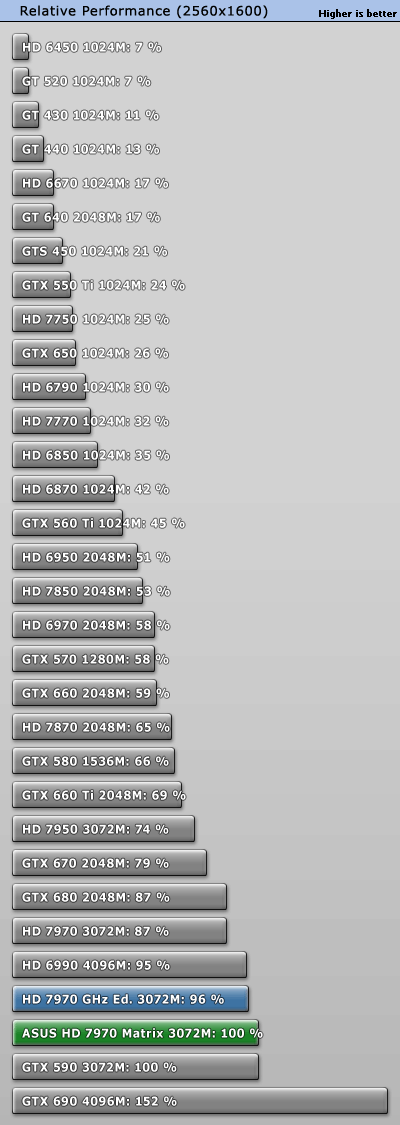
Yeah compare a card that launched 1.5 year later then the other. As for 7950 800MHz, when you clock it at 1100MHz it's faster then GTX680. That's how unimpressive GK104 really is, just 30% faster then GF110, GK110 is 50% faster then GK104 fabricated on the process. As for 7950 800MHz even at stock it's still decently faster then GTX580, but when it launched it was just a bit faster, it was a very different architecture for AMD the drivers needed to mature. GTX580 is really a competitor for 7870. But to be fair at stock all of those cards are close enough, so close that the performance difference would be immaterial. Anything under 10% is not really noticeable, what would be noticeable is 28nm vs 40nm.
Last edited:
BallaTheFeared
Diamond Member
Yeah compare a card that launched 1.5 year later then the other. As for 7950 800MHz, when you clock it at 1100MHz it's faster then GTX680. That's how unimpressive GK104 really is, just 30% faster then GF110, GK110 is 50% faster then GK104 fabricated on the process. As for 7950 800MHz even at stock it's still decently faster then GTX580, but when it launched it was just a bit faster, it was a very different architecture for AMD the drivers needed to mature.
Wut?
GK104 is decent since it's just a mid-range chip. It did well for itself in that regard.
It's like asking a 190w GTX 560Ti to be as fast as GK110, it wasn't designed to be, it won't ever be.
7950 at 800Mhz is dead even with the 580 at 1200p and hardly anything close to what I would call "decently faster" at 1600p/

Fermi still gets performance enhancements.
TPU changed their game suite and now it favors NV cards. In the old test suite it was 12% faster and in the new it's just 5% faster. That's roughly the same performance difference as between 7870 and GTX580, 7870 and GTX580 are even a bit closer. That is splitting hairs, really.
For a flagship card GTX680 was terribly unimpressive. I guess we won't get as much more performance as we used to from the next node shrink since the current scheme worked so well financially for NV.
it's like asking a 190w GTX 560Ti to be as fast as GK110, it wasn't designed to be, it won't ever be.
For a flagship card GTX680 was terribly unimpressive. I guess we won't get as much more performance as we used to from the next node shrink since the current scheme worked so well financially for NV.
Last edited:
BallaTheFeared
Diamond Member
Looks like they just dropped some old titles and replaced them with newer ones to me.
SirPauly
Diamond Member
TPU changed their game suite and now it favors NV cards.
Interesting!

wand3r3r
Diamond Member
TPU changed their game suite and now it favors NV cards. In the old test suite it was 12% faster and in the new it's just 5% faster. That's roughly the same performance difference as between 7870 and GTX580, 7870 and GTX580 are even a bit closer. That is splitting hairs, really.
For a flagship card GTX680 was terribly unimpressive. I guess we won't get as much more performance as we used to from the next node shrink since the current scheme worked so well financially for NV.
That's interesting.
Did they discuss the change anywhere? I wonder if it was purely dropping old games and adding new ones, or something else?
They could have added games that would make AMD's card look the same or better, but they didn't, I don't hold it against them. They just test the games they want, that's all. For example they got rid of Alan Wake where AMD cards fare well. Max Payne 3 was also discarded, another game where AMD cards did well. Literally all of the changes were bad for AMD's cards. Bioshock Infinite was added, a game where AMD's cards do very bad, it's a new game and it should be in the suite but not at the cost of Alan Wake or Max Payne 3, but rather Diablo 3 that's not suitable for testing high-end cards. IMHO they made some obvious omissions such as Metro Last Light, and if they added so many games where AMD's cards do bad why didn't they add games where NV's cards falter such as Dirt:showdown? Another game that should be discarded instead of Alan Wake or Max Payne 3 is Black Ops 2 because it's not a challenge even for GTX580. Why did they got rid of Alan Wake and Max Payne 3 instead of D3 and Black ops2? It does not make sense to me.
All in all I don't like the new test suite.
All in all I don't like the new test suite.
Last edited:
TRENDING THREADS
-
 Discussion Zen 5 Speculation (EPYC Turin and Strix Point/Granite Ridge - Ryzen 9000)
- Started by DisEnchantment
- Replies: 25K
-
Discussion Intel Meteor, Arrow, Lunar & Panther Lakes + WCL Discussion Threads
- Started by Tigerick
- Replies: 25K
-
 Discussion Intel current and future Lakes & Rapids thread
- Started by TheF34RChannel
- Replies: 24K
-

-
