
-
We’re currently investigating an issue related to the forum theme and styling that is impacting page layout and visual formatting. The problem has been identified, and we are actively working on a resolution. There is no impact to user data or functionality, this is strictly a front-end display issue. We’ll post an update once the fix has been deployed. Thanks for your patience while we get this sorted.
You are using an out of date browser. It may not display this or other websites correctly.
You should upgrade or use an alternative browser.
You should upgrade or use an alternative browser.
Intel Skylake / Kaby Lake
Page 29 - Seeking answers? Join the AnandTech community: where nearly half-a-million members share solutions and discuss the latest tech.
If it can hit stock 4.2 then I doubt its a suicide run at 4.8 but it might involve custom water to get 4.8. If it does 4.8 on air or aio water I'm getting this on release.
It is not under water but with a much more extreme cooling solution, he could had displayed 6GHz as wel,l but i guess that it had to stay realistic.
The "leaker" didnt pay attention to some details, expressely that 14nm require higher voltage than 22nm, and that on air 1.419V is not enough to sustain 5GHz unless the 14nm process has a perfect voltage/frequency curve up to 5.0, wich is dubbious since the 22nm has terrible caracteristic above 4.0 with the 4770K requiring 50% more power to get to 4.4 from 4.0...
All this rather look like an orchestrated marketing campaign if not a damage control campaign...

Dave2150
Senior member
We dont know at what voltage that 4.8GHz was obtained, could be a suicide run so lets wait and see.
That screenshot of 4.8Ghz is from Broadwell, the I7 5775C, not skylake.

"fc-lga14c"
Yeah, what is that? A search for it also turns up Broadwell at NCIX.
I'm thinking the 14 must be nanometers, and not anything to do with the chipset.

IntelUser2000
Elite Member
Well, most tests are done with HT on. This graph isn't going to match what is essential an effective 'IPC' per core w/SMT that you'll find in lots of review sites.
Most users aren't looking for SPECint_rate scores for single core w/o HT and single core w/HT type results - so PC enthusiast sites don't run those kind of tests (at least I haven't seen that lately).
That graph is wrong, at least for client workloads.
http://ixbtlabs.com/articles3/cpu/sandybridge-core-vs-lynnfield-p1.html
With Nehalem the tests are all over the place. It gets a lot in memory bandwidth sensitive applications sure, but that's much less common in client workloads than in server. In those that represent mostly core enhancements, the gains are often only 5%. In RWT some reported that in code that are core-bound and show architectural differences, it can be close to nothing and even slower.
Sandy Bridge was more consistent, and greater overall. The bigger jumps are not from Wolfdale to Lynnfield(which in the Toms test has a 2% disadvantage due to clocks)/Bloomfield but to Sandy Bridge.
http://www.tomshardware.com/reviews/processor-architecture-benchmark,2974-11.html
Same on here, although with 4 cores/HT off/Turbo off/Same clocks: http://www.anandtech.com/show/8426/...view-core-i7-5960x-i7-5930k-i7-5820k-tested/2
Even if you normalize for clocks, the biggest gain is from Nehalem to Sandy Bridge, not Ivy Bridge to Haswell.
http://www.anandtech.com/show/7003/the-haswell-review-intel-core-i74770k-i54560k-tested/6
Clock-normalized:
Cinebench R11.5 ST
3770K to 4770K-7.2%
965 to 2700K-19.8%
MT
3770K to 4770K-6%
965 to 2700K-14%
POV Ray
3770K to 4770K-13%
965 to 2700K-14.3%
7-zip ST
3770K to 4770K-1.9%
965 to 2700K-7.4%
MT
3770K to 4770K-1.2%
965 to 2700K-1.9%
Kraken Javascript
3770K to 4770K-7.8%
965 to 2700K-22%
x264 First Pass(3.46GHz for 965 and 3.8GHz for 2700K)
3770K to 4770K-5.7%
965 to 2700K-12%
x264 Second(3.33GHz for 965 and 3.7GHz for 2700K)
3770K to 4770K-13%
965 to 2700K-9.4%
Visual Studio 2012(3.33GHz for 965 and 3.7GHz for 2700K)
3770K to 4770K-14.9%
965 to 2700K-6.9%
(Assuming 3.33GHz Turbo for 965 and 3.6GHz for 2700K on MT, and 3.46GHz for 965 and 3.9GHz for 2700K on ST, except when noted)
Still saying Haswell has greater gains?
Yeah, what is that? A search for it also turns up Broadwell at NCIX.
I'm thinking the 14 must be nanometers, and not anything to do with the chipset.
FC is flip chip. LGA is land grid array. The 14c I have no idea on, but it might be a generational code of some kind or node. IE, search for FC-LGA12C and you'll find a bunch of IB and HW parts.
That graph is wrong, at least for client workloads.
http://ixbtlabs.com/articles3/cpu/sandybridge-core-vs-lynnfield-p1.html
With Nehalem the tests are all over the place. It gets a lot in memory bandwidth sensitive applications sure, but that's much less common in client workloads than in server. In those that represent mostly core enhancements, the gains are often only 5%. In RWT some reported that in code that are core-bound and show architectural differences, it can be close to nothing and even slower.
Sandy Bridge was more consistent, and greater overall. The bigger jumps are not from Wolfdale to Lynnfield(which in the Toms test has a 2% disadvantage due to clocks)/Bloomfield but to Sandy Bridge.
http://www.tomshardware.com/reviews/processor-architecture-benchmark,2974-11.html
Same on here, although with 4 cores/HT off/Turbo off/Same clocks: http://www.anandtech.com/show/8426/...view-core-i7-5960x-i7-5930k-i7-5820k-tested/2
Even if you normalize for clocks, the biggest gain is from Nehalem to Sandy Bridge, not Ivy Bridge to Haswell.
http://www.anandtech.com/show/7003/the-haswell-review-intel-core-i74770k-i54560k-tested/6
Clock-normalized:
Cinebench R11.5 ST
3770K to 4770K-7.2%
965 to 2700K-19.8%
MT
3770K to 4770K-6%
965 to 2700K-14%
POV Ray
3770K to 4770K-13%
965 to 2700K-14.3%
7-zip ST
3770K to 4770K-1.9%
965 to 2700K-7.4%
MT
3770K to 4770K-1.2%
965 to 2700K-1.9%
Kraken Javascript
3770K to 4770K-7.8%
965 to 2700K-22%
x264 First Pass(3.46GHz for 965 and 3.8GHz for 2700K)
3770K to 4770K-5.7%
965 to 2700K-12%
x264 Second(3.33GHz for 965 and 3.7GHz for 2700K)
3770K to 4770K-13%
965 to 2700K-9.4%
Visual Studio 2012(3.33GHz for 965 and 3.7GHz for 2700K)
3770K to 4770K-14.9%
965 to 2700K-6.9%
(Assuming 3.33GHz Turbo for 965 and 3.6GHz for 2700K on MT, and 3.46GHz for 965 and 3.9GHz for 2700K on ST, except when noted)
Still saying Haswell has greater gains?
It's not wrong just using different benchmarks, for example Tom's Hardware 2015 CPU charts gives for Total Time:
I7-975 EE (3.33/3.6) 1854
I7-2600K (3.4/3.8) 1678 10.6%, about 8.2% clock adjusted
I7-2700K (3.5/3.9) 1638
I7-3770K (3.5/3.9) 1523 7.6%
I7-4770K (3.5/3.9) 1385 10%
That graph is wrong, at least for client workloads.
<snip>
Still saying Haswell has greater gains?
A) I never claimed Haswell has greater gains - check my post.
B) Every 'graph' is wrong in a sense since there is no industry standard workload. Which also means every graph is right, according to the workload used.
The simple point that I was making is that there are two types of IPC with an SMT core. In Intel's case, with HT on and with HT off.
Already listed and launching in August? Something is weird here.
Haswell-E prices leaked/had pre-order prices around mid-July. Released late August, reviews out around then.. http://www.zdnet.com/article/pre-order-pricing-for-intel-haswell-e-desktop-processors-revealed/
is that the normal turn around?
If Computex has manufacturers showing off new motherboards - is there something that could leak if Intel doesn't announce more info at Computex? (Alpine Ridge for example?). Would the OEMs and motherboard makers want to have Skylake CPUs to demo, or would Intel force them to wait?
Haswell-E prices leaked/had pre-order prices around mid-July. Released late August, reviews out around then.. http://www.zdnet.com/article/pre-ord...sors-revealed/
That article is from last year. Haswell-E is already released.

LTC8K6
Lifer
That article is from last year. Haswell-E is already released.
He knows that. He was asking if the timing of pre-order/release/review would be similar.
He knows that. He was asking if the timing of pre-order/release/review would be similar.
D'oh! Sorry.
Why are we discussing broadwell in skylake, thread?
It is not under water but with a much more extreme cooling solution, he could had displayed 6GHz as wel,l but i guess that it had to stay realistic.
The "leaker" didnt pay attention to some details, expressely that 14nm require higher voltage than 22nm, and that on air 1.419V is not enough to sustain 5GHz unless the 14nm process has a perfect voltage/frequency curve up to 5.0, wich is dubbious since the 22nm has terrible caracteristic above 4.0 with the 4770K requiring 50% more power to get to 4.4 from 4.0...
All this rather look like an orchestrated marketing campaign if not a damage control campaign...

Tsavo
Platinum Member
What about the memory controller on Skylake, I hear a while ago that Skylake will have a memory controller that will let it support DDR3 (not DDR3L) and DDR4, is that actually true? or it is confirmed by Intel?
PS. i'm looking for that article.
DDR3L and LPDDR3....not plain DDR3. Not official though.

iSkylaker
Member
Oh I see.DDR3L and LPDDR3....not plain DDR3. Not official though.
Here is the article in question, or it is just another click bait article hehe
http://wccftech.com/skylake-dual-imc/
Apparently Apple skipped Broadwell-H.
www.macrumors.com/2015/05/19/apple-releases-new-15-inch-macbook-pro
There were rumours of quad-core Skylake with Iris Pro 'GT4e' graphics launching as soon as Q4 or early 2016. Perhaps that's when the big refresh will happen.
Given that the necessary Broadwell chips are not yet available, the new 15-inch MacBook Pro and 27-inch iMac still have Intel's fourth-generation Haswell processors. Based on the average product cycle for the MacBook Pro and iMac, Apple may choose to skip Broadwell processors and use next-generation Skylake processors for the next versions of the notebook and all-in-one desktop computer respectively. Those models are unlikely to be released until late 2015 at the earliest.
www.macrumors.com/2015/05/19/apple-releases-new-15-inch-macbook-pro
There were rumours of quad-core Skylake with Iris Pro 'GT4e' graphics launching as soon as Q4 or early 2016. Perhaps that's when the big refresh will happen.
In Intels current graphics driver a new GPU naming scheme appeared and I'm pretty sure it belongs to Skylake.

Intel® Genuine Intel® CPU 0000 with HD Graphics 520
https://compubench.com/device.jsp?b...enuine Intel(R) CPU 0000 with HD Graphics 520
First Skylake entry with Intels new HD graphics naming scheme.
coolpurplefan
Golden Member
Intel® Genuine Intel® CPU 0000.
Oh my gosh, I want to buy the Intel® Genuine Intel® CPU 0000. 😀
iSkylaker
Member
This has to be related with the new 100-series boards?
http://www.spinics.net/lists/intel-gfx/msg67011.html
http://www.spinics.net/lists/intel-gfx/msg67011.html
Leak: Skylake-Y, Skylake-U, Skylake-H, Skylake-S Models and Launch Date
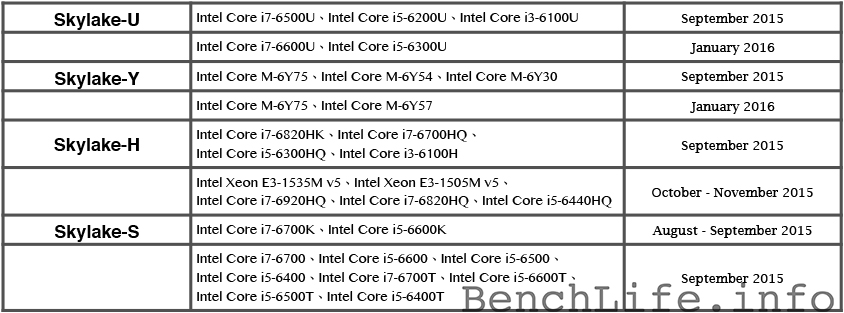
http://benchlife.info/intel-skylake-replace-broadwell-start-from-q3-05202015
Skylake-Y, Skylake-U, Skylake-H and Skylake-S will arrive as soon as September 2015.
http://benchlife.info/intel-skylake-replace-broadwell-start-from-q3-05202015
Skylake-Y, Skylake-U, Skylake-H and Skylake-S will arrive as soon as September 2015.

Arachnotronic
Lifer
Leak: Skylake-Y, Skylake-U, Skylake-H, Skylake-S Models and Launch Date
http://benchlife.info/intel-skylake-replace-broadwell-start-from-q3-05202015
Skylake-Y, Skylake-U, Skylake-H and Skylake-S will arrive as soon as September 2015.
And now we know why Apple skipped Broadwell-H.
And now we know why Apple skipped Broadwell-H.
And ASUS's statement about Skylake + Windows 10 notebooks by Q3 makes sense. 🙂
That's quite a bit sooner than I was expecting, especially Skylake-H.
Arachnotronic
Lifer
And ASUS's statement about Skylake + Windows 10 notebooks by Q3 makes sense. 🙂
That's quite a bit sooner than I was expecting, especially Skylake-H.
This is how I'd expect a company like Intel to execute, not the mess that we saw with Broadwell.
TRENDING THREADS
-
 Discussion Zen 5 Speculation (EPYC Turin and Strix Point/Granite Ridge - Ryzen 9000)
- Started by DisEnchantment
- Replies: 25K
-
Discussion Intel Meteor, Arrow, Lunar & Panther Lakes + WCL Discussion Threads
- Started by Tigerick
- Replies: 25K
-

-

-
