igor_kavinski
Lifer
First Gracemont laptop available for sale.
Anybody got disposable $500 to buy and test this laptop? 😛

You are right, I totally forgot that detail!Leaving fantasy land, we do know that a few things are in play:
Intel is going to begin to retire processors from Intel 7 (alder/raptor) so there will be excess capacity there. Intel does not currently have an Intel 3 based IMC design/implementation. They aren't going to invest the money in making one for an N-series processor.
Skymont, as implemented, only exists on expensive TSMC logic. They won't pay for an N series chip on a leading TSMC node. We won't see a Skymont N series product any time soon, or possibly ever.
What we will see is an N series refresh of the current Alder Lake based product. You might get higher clocks, but that's about it. I would not be shocked if they used the 4 X 4 Crestmont cluster from Raptor Lake in a 16 e-core embedded product.

if it survivesThere's Wildcat Lake which is an ADL-N successor but with few P cores.
125W and 159W are just the TDP and PL2 of a complete 245K CPU. Obviously, it will be much lower power if the CPU is running with the P cores disabled.@Kosusko
3.6GHz - 4.6GHz @ 125-159W vs. 2.0GHz - 3.3GHz @ 15-54W?
That's quite the silly comparison.

ST perf.What's the point of Lion Cove in mobile?
Is this real world usage with us in the room.Ultra mobile frequency tops out below 5GHz in real world usage
Turns out mobile chips are for anything but cinememe.Even at 3.5GHz such a part would do 20,000 CB R23 MT.
Think about it some more. I'll give you a hint, when you remove LNC clock speed advantage (mobile) LNC has very little IPC over Skymont, but is over 3 times larger.ST perf.
Is this real world usage with us in the room.
Turns out mobile chips are for anything but cinememe.
They tend to do stuff like web browsing and all. Stuff that needs a big core with maximum 1t perf available.
Were it not for their internal politics, they could've gone with Skymont Big and Skymont Little, the former optimized for hitting 5.5 GHz and the latter for conserving power, using the relevant transistor libraries.LNC has very little IPC over Skymont, but is over 3 times larger.

Think about it some more. I'll give you a hint, when you remove LNC clock speed advantage (mobile) LNC has very little IPC over Skymont, but is over 3 times larger.
Were it not for their internal politics, they could've gone with Skymont Big and Skymont Little, the former optimized for hitting 5.5 GHz and the latter for conserving power, using the relevant transistor libraries.
Clock speed advantage is literally how you keep the big cores distinct above all.I'll give you a hint, when you remove LNC clock speed advantage (mobile) LNC has very little IPC over Skymont, but is over 3 times larger.

No core should be 3x the size just to hit 25% more clocks. I'm sure if you gave the E core team just 2x the transistor budget, not even 3x, they'd be able to beat LNC handily in all metrics.Think about it some more. I'll give you a hint, when you remove LNC clock speed advantage (mobile) LNC has very little IPC over Skymont, but is over 3 times larger.

They'd need to increase IPC and clock rate without exploding area. In any case it would no longer be Skymont but something else. And it wouldn't have been ready in time to launch in 2024.they'd be able to beat LNC handily in all metrics.
Unified Core isn't due until late 2020s yeah.They'd need to increase IPC and clock rate without exploding area. In any case it would no longer be Skymont but something else. And it wouldn't have been ready in time to launch in 2024.
Nothing exciting on the horizon other than Strix Halo, Sound Wave and maybe Oryon V3, eh?Unified Core isn't due until late 2020s yeah.
Lion Cove would've been worth it if they could've cranked it up to 6 GHz.Clock speed advantage is literally how you keep the big cores distinct above all.
Skymont is a good effort, but it needs to do better. It needs to be in ballpark of ARM.No core should be 3x the size just to hit 25% more clocks. I'm sure if you gave the E core team just 2x the transistor budget, not even 3x, they'd be able to beat LNC handily in all metrics.

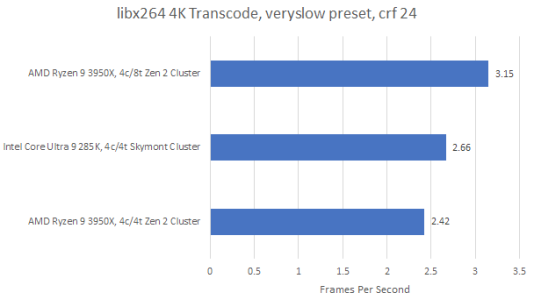
Summary from your article link:Skymont in Desktop Form: Atom Unleashed
Skymont is Intel's newest E-Core architecture
source: https://chipsandcheese.com/p/skymont-in-desktop-form-atom-unleashed