Discussion Intel Meteor, Arrow, Lunar & Panther Lakes + WCL Discussion Threads

Page 970 - Seeking answers? Join the AnandTech community: where nearly half-a-million members share solutions and discuss the latest tech.

Tigerick

Senior member
Apr 1, 2022
942
857
106
Wildcat Lake (WCL) Specs

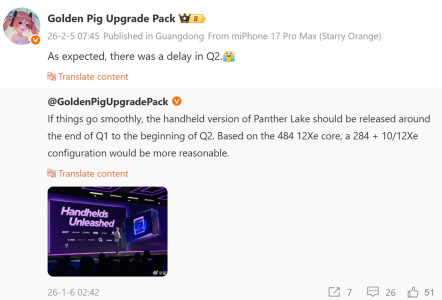
Intel Wildcat Lake (WCL) is upcoming mobile SoC replacing Raptor Lake-U. WCL consists of 2 tiles: compute tile and PCD tile. It is true single die consists of CPU, GPU and NPU that is fabbed by 18-A process. Last time I checked, PCD tile is fabbed by TSMC N6 process. They are connected through UCIe, not D2D; a first from Intel. Expecting launching in Q1 2026.
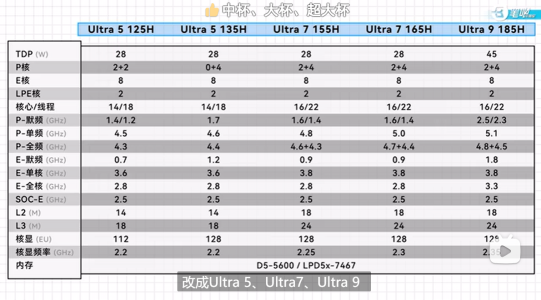
Intel Raptor Lake UIntel Wildcat Lake 15W?Intel Lunar LakeIntel Panther Lake 4+0+4
Launch DateQ1-2024Q2-2026Q3-2024Q1-2026
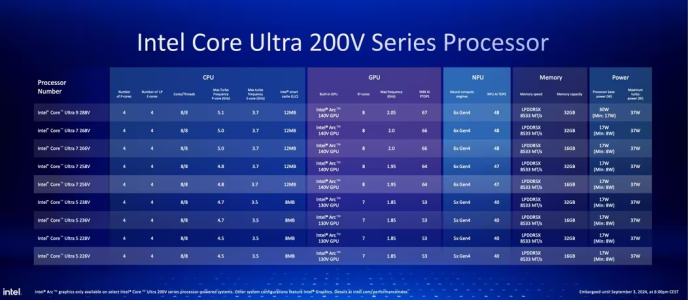
ModelIntel 150UIntel Core 7Core Ultra 7 268VCore Ultra 7 365
Dies2223
NodeIntel 7 + ?Intel 18-A + TSMC N6TSMC N3B + N6Intel 18-A + Intel 3 + TSMC N6
CPU2 P-core + 8 E-cores2 P-core + 4 LP E-cores4 P-core + 4 LP E-cores4 P-core + 4 LP E-cores
Threads12688
Max Clock5.4 GHz?5 GHz4.8 GHz
L3 Cache12 MB12 MB12 MB
TDP15 - 55 W15 W ?17 - 37 W25 - 55 W
Memory128-bit LPDDR5-520064-bit LPDDR5128-bit LPDDR5x-8533128-bit LPDDR5x-7467
Size96 GB32 GB128 GB
Bandwidth136 GB/s
GPUIntel GraphicsIntel GraphicsArc 140VIntel Graphics
RTNoNoYESYES
EU / Xe96 EU2 Xe8 Xe4 Xe
Max Clock1.3 GHz?2 GHz2.5 GHz
NPUGNA 3.018 TOPS48 TOPS49 TOPS


PPT1.jpg
PPT2.jpg
PPT3.jpg


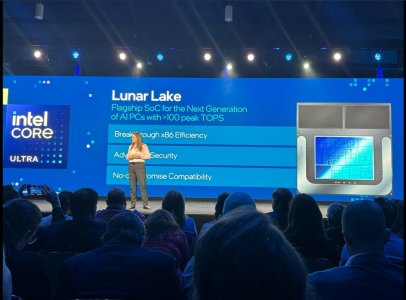
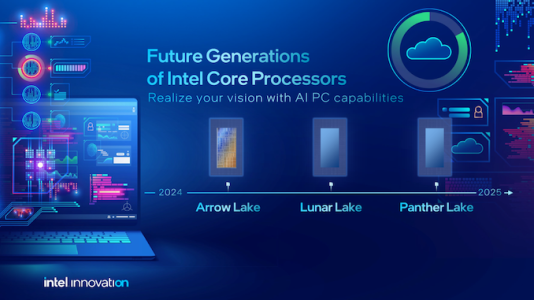
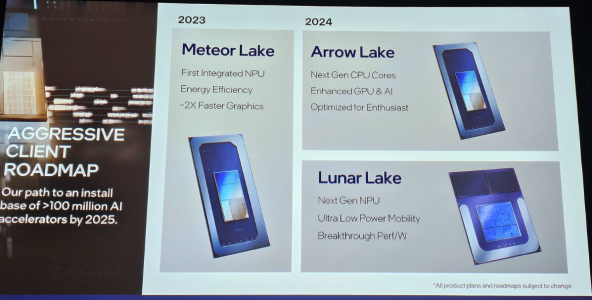
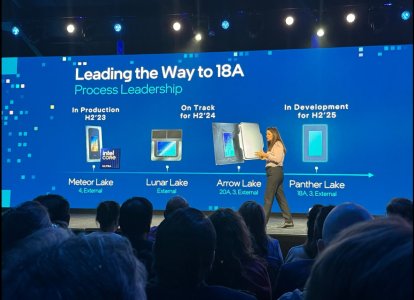
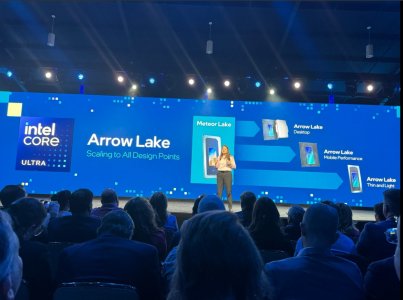
As Hot Chips 34 starting this week, Intel will unveil technical information of upcoming Meteor Lake (MTL) and Arrow Lake (ARL), new generation platform after Raptor Lake. Both MTL and ARL represent new direction which Intel will move to multiple chiplets and combine as one SoC platform.

MTL also represents new compute tile that based on Intel 4 process which is based on EUV lithography, a first from Intel. Intel expects to ship MTL mobile SoC in 2023.

ARL will come after MTL so Intel should be shipping it in 2024, that is what Intel roadmap is telling us. ARL compute tile will be manufactured by Intel 20A process, a first from Intel to use GAA transistors called RibbonFET.


LNL-MX.png
 

Attachments

  • PantherLake.png
    PantherLake.png
    283.5 KB · Views: 24,044
  • LNL.png
    LNL.png
    881.8 KB · Views: 25,531
  • INTEL-CORE-100-ULTRA-METEOR-LAKE-OFFCIAL-SLIDE-2.jpg
    INTEL-CORE-100-ULTRA-METEOR-LAKE-OFFCIAL-SLIDE-2.jpg
    181.4 KB · Views: 72,439
  • Clockspeed.png
    Clockspeed.png
    611.8 KB · Views: 72,326
Last edited:

Hulk

Diamond Member
Oct 9, 1999
5,383
4,096
136
Isn't it amazing that it is so hard to get reliable data on these CPU's we love to use and analyze so much?

I mean really, all we are asking for is a variety of solid benchmark scores for single and multithread that are recorded with average frequency power usage during the run.

Give us that and 90% of our arguements here are gone. Most of what causes the confusion is extrapolating this benchmark from this cpu to that one or this test to another test run under different circumstances...

I realize it can be hard to lock down frequencies but I tell you if it were my job and how I make a living I'd figure out a way. Especially if I had a direct line to engineers and such at Intel and AMD.

It's just frustrating to try and analyze without proper data.

Edit - I forgot to add that I'm no huge fan of Cinebench either. Thing is, it is one benchmark that is semi-reliable from system-to-system that will isolate a single thread. It's not that I love it, it's just one of the only halfway decent data points we have where we can "kind of" know the frequency since it runs ST and most CPU's WILL hold thier max advertised frequency through the test.
 
Last edited:
  • Like
Reactions: 511

DrMrLordX

Lifer
Apr 27, 2000
23,219
13,300
136
It's a mess of naming but Panther Cove is the core in diamond rapids and coyote cove is the client version of Panther Cove.

E cores is arctic wolf.

Both are proper Tock
So Nova Lake-S will have the core from Diamond Rapids? What differences are there between Panther Cove and Cougar Cove?
 

Doug S

Diamond Member
Feb 8, 2020
3,832
6,767
136
I mean really, all we are asking for is a variety of solid benchmark scores for single and multithread that are recorded with average frequency power usage during the run.

That would be hard enough to do if you limited it to a single OEM/OS combo, like only Intel/Windows or only Apple/macOS. Making it work across ISAs raises the bar significantly, and making it work across OSes is even worse.

What is the "average" frequency, for instance? If I give you samples once per second and also give you samples once per millisecond you may get very different numbers when you calculate an "average" depending on how aggressive the power saving settings are. What if the OS is moving the load around between cores during the run to even out hot spots? That's gonna kill repeatability because it won't necessarily follow the same pattern on subsequent runs. A minor OS patch might change how that works in significant ways.

The same issues apply for power usage. There are also plenty of ways to measure power - do you measure power going to the CPU? In a CPU benchmark that makes sense. Well what about others where you can only get the power going to an entire SoC? Maybe others can only give you the package power which includes DRAM? You can measure at the wall but then you have to arrange to shut off displays, radios, etc. and do your best to put SSDs into a sleep state.

And what about heat? A better cooled CPU can run at max frequency for longer and get better numbers, and the same CPU will have different amounts of cooling depending on the product/model it is in. You can't say "Intel CPU 123 has performance x" because it might have performance 1.1x in a premium self build but performance 0.9x in a badly implemented Dell.

And all this is before you measure performance at all.
 

fastandfurious6

Senior member
Jun 1, 2024
984
1,089
96
OK pantherlake CPU numbers are out
tldr Panther is DOA.... cheapest model has similar price with HALO 392.
Pantherlake laptops cost 1500-2500 bucks, no dgpu, 1.2kg
cinebench cores and barely rtx4050 perf
with the same 1500 bucks you can get AMD HALO 392, 1.2kg
12 full zen5 cores plus fat iGPU with RTX5060 performance

View attachment 137526

- as expected, intel cinebench cores inside©™
- inflated bench numbers, terrible perf in real world
- Blender and 7zip- 100% slower to prevgens 7945HX and 285HX, 40-70% to HALO 392
- Geekbench 6 is obviously cooked...

The practical part is market and pricing.


other AMD options at same price,
- HX370/470 + dgpu RTX 5060, 2kg
- 7945HX 16 full zen4 cores + RTX 5060 but 2.5kg

but cheap Halo eclipses both. if available.


Ultimately, pantherlake replaces nothing. It's eaten by Halo 392 for breakfast at same price point or even apple silicon... M5 PRO will smoke PTL in games too


How many news titles am I going to exactly predict?
 

Hulk

Diamond Member
Oct 9, 1999
5,383
4,096
136
That would be hard enough to do if you limited it to a single OEM/OS combo, like only Intel/Windows or only Apple/macOS. Making it work across ISAs raises the bar significantly, and making it work across OSes is even worse.

What is the "average" frequency, for instance? If I give you samples once per second and also give you samples once per millisecond you may get very different numbers when you calculate an "average" depending on how aggressive the power saving settings are. What if the OS is moving the load around between cores during the run to even out hot spots? That's gonna kill repeatability because it won't necessarily follow the same pattern on subsequent runs. A minor OS patch might change how that works in significant ways.

The same issues apply for power usage. There are also plenty of ways to measure power - do you measure power going to the CPU? In a CPU benchmark that makes sense. Well what about others where you can only get the power going to an entire SoC? Maybe others can only give you the package power which includes DRAM? You can measure at the wall but then you have to arrange to shut off displays, radios, etc. and do your best to put SSDs into a sleep state.

And what about heat? A better cooled CPU can run at max frequency for longer and get better numbers, and the same CPU will have different amounts of cooling depending on the product/model it is in. You can't say "Intel CPU 123 has performance x" because it might have performance 1.1x in a premium self build but performance 0.9x in a badly implemented Dell.

And all this is before you measure performance at all.
Good points, let's go through them.

Average frequency
When you run a benchmark, like Cinebench, either ST or MT, when you watch the average frequency in HWinfo, it's quite steady. In addition, if you reset the counters right after starting the test it will provide you with an average that you can record at the end of the run.
What is that average frequency? No need to get into the weeds. It's a number that can be recorded in the same way on different systems and is repeatable. The end result is to divide that number into the score and calculate a "throughput/GHz" metric. Doesn't matter how accurate "average frequency" is for comparison purposes. We're not measure old school IPC.
As for ST moving around due to hot spots, all CPU's will do that. It doesn't create big variations in single thread results.

So much for average frequency. It can be recorded quite easily, even if it isn't exactly average frequency, it's the number we need.

Same for power usage. Just reset the counter and grab the average package power at the end of the run. It's measured the same way for each system. Works well for comparison purposes if not for absolute accuracy.

Heat is tied to frequency, which was already measured as described above.

I've done many forum benchmarks over the years going all the way back to MediaStudioPro in the MURC forums nearly 30 years ago. Handbrake testing in this forum, etc... The method I just described produced "throughputs" that were very close among the same core types, showing it works.

Finally, for most non hybrid systems you can lock down the max frequency, set it below your cooling system limits and it will sit right there.

Also I should add, that a lot of systems allow for locking max frequency in the BIOS.

It's really not as impossible as you make it sound. But yes, it's easier to throw your hands up in the air and say "It's impossible" than to just do it and give up.

Otherwise we argue about much less rigorously tested data, leaks, "I saw this here," etc...

Like I said, I've being doing these types of community tests for over 30 years and have learned quite a bit.
 

Khato

Golden Member
Jul 15, 2001
1,378
485
136


How many news titles am I going to exactly predict?
I was wondering how long it'd take before the MLiD fluff was referenced as proof that PTL is expensive. (Just because a reputable outlet is reporting on MLiD doesn't make the source any more credible.
 

511

Diamond Member
Jul 12, 2024
5,442
4,869
106
So Nova Lake-S will have the core from Diamond Rapids? What differences are there between Panther Cove and Cougar Cove?
Cougar cove is essentially Lion Cove + while Panther Cove is different design with 2 cores sharing L2 and APX/AVX 10.2 that's all things that are known to us.
 

DrMrLordX

Lifer
Apr 27, 2000
23,219
13,300
136
How many news titles am I going to exactly predict?

If you think that's bad, I recently saw an HX 375 + RTX 5080 lappie for $2k.

Cougar cove is essentially Lion Cove + while Panther Cove is different design with 2 cores sharing L2 and APX/AVX 10.2 that's all things that are known to us.
Wait, Intel was putting cores with shared L2 in a server design? That's certainly a choice. Probably won't be so bad for client though.
 

511

Diamond Member
Jul 12, 2024
5,442
4,869
106

OneEng2

Golden Member
Sep 19, 2022
1,007
1,210
106
18A I think only needs to be competitive with N2 for Intel to really stay in the game. Let me put some numbers to what I'm thinking.
If Zen 6 does indeed hit 6.4GHz on a single core and Nova Lake is stuck at 5.7GHz ST then that is not competitive.
Or if Zen 6 is hitting 65,000 in CB R23 at 200W and Nova Lake requires 275W then that is not competitive.
They need to be around 5% in the important metrics.

Now things get "fuzzy" with process and architecture because they are inexorably intertwined. A really great architecture can "cover" for a not so good node, and vice-versa. If 18A has great density and they can get all of those core crammed into a cost effective tile then Nova Lake can do well MT based on just having a transistor advantage.

Max ST frequency, max MT frequency/power/heat, ST IPC, lots of unknowns still. AMD has been firing on all cylinders since they moved to TMSC because for the first time they had the process advantage, which Intel has relied on previously. AMD really only has one ball in the air, architecture, TMSC handles the other one for them. Intel has two balls in the air. It can be a great show IF you don't drop a ball.

I think Panther Lake is looking to be a rather big technical success for Intel. 5.1GHz on 18A ain't bad for mobile. Efficiency looks to be very good if not great. iGPU is very, very good with no reports (so far) of major driver issues (Alchemist R&D paying dividends), and CPU performance did creep ahead of Lion Cove, which has the advantage of being desktop in terms of memory subsystem.

If they can get the clocks competitive with Zen 6 (whatever that will be) and pull another 5% out of Cougar Cove and catch up in gaming this could be fun. Yeah I know, lots of "ifs."
I thought that some (or all) NVL would be built on N2 for the compute tile?
N2 is a better node otherwise Intel wouldn’t use it for higher end SKUs.

In fact Intels 48 core CPU wouldn’t be possible on 18A.
Beat me to it ;).
Clocks dont need to be competitive with Zen 6 if IPC increases another 10% from Panther Lake. Vs Zen 5, Panther Lake is already +10% ahead in integer IPC and tied in fp IPC. They pull off a +10/+10 in Nova Lake and they can afford to be down 10% in clocks and still be competitive.
I'm not sure I'm buying SPEC anymore though.
I wonder how that +10% INT and 0% FP will translate into applications and benchmarks we know and love? I wish we have an apples-to-apples comparison of Cougar Cove and Lion Cove to get a little more perspective.
Exactly. Seems like the low level benches aren't tracking like they used to in real world performance.
64 Core DMR Compute Tile wants to have a word with you
:).
I pulled them from these, which are in this thread.
Also, Lion Cove seems to be a little better than Zen 5 in CB.
And yet Zen 5 dominated ARL in nearly all real world highly threaded applications.
 

fastandfurious6

Senior member
Jun 1, 2024
984
1,089
96
I was wondering how long it'd take before the MLiD fluff was referenced as proof that PTL is expensive. (Just because a reputable outlet is reporting on MLiD doesn't make the source any more credible.

I predicted PTL is gonna be very expensive. Market proved that It is very expensive, and often even more than faster competition, Halo.

MLID agrees both with me and the market.

The market is not fluff, it is reality.