• We’re currently investigating an issue related to the forum theme and styling that is impacting page layout and visual formatting. The problem has been identified, and we are actively working on a resolution. There is no impact to user data or functionality, this is strictly a front-end display issue. We’ll post an update once the fix has been deployed. Thanks for your patience while we get this sorted.

Discussion Intel Meteor, Arrow, Lunar & Panther Lakes + WCL Discussion Threads

Page 870 - Seeking answers? Join the AnandTech community: where nearly half-a-million members share solutions and discuss the latest tech.

Tigerick

Senior member
Wildcat Lake (WCL) Specs

Intel Wildcat Lake (WCL) is upcoming mobile SoC replacing Raptor Lake-U. WCL consists of 2 tiles: compute tile and PCD tile. It is true single die consists of CPU, GPU and NPU that is fabbed by 18-A process. Last time I checked, PCD tile is fabbed by TSMC N6 process. They are connected through UCIe, not D2D; a first from Intel. Expecting launching in Q1 2026.
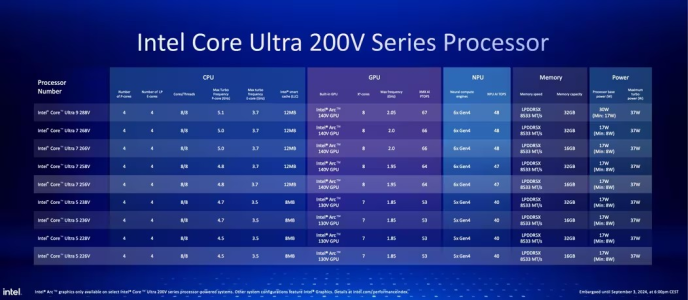
Intel Raptor Lake UIntel Wildcat Lake 15WIntel Lunar LakeIntel Panther Lake 4+0+4
Launch DateQ1-2024Q2-2026Q3-2024Q1-2026
ModelIntel 150UIntel Core 7 360Core Ultra 7 268VCore Ultra 7 365
Dies2223
NodeIntel 7 + ?Intel 18-A + TSMC N6TSMC N3B + N6Intel 18-A + Intel 3 + TSMC N6
CPU2 P-core + 8 E-cores2 P-core + 4 LP E-cores4 P-core + 4 LP E-cores4 P-core + 4 LP E-cores
Threads12688
Max Clock5.4 GHz4.8 GHz5 GHz4.8 GHz
L3 Cache12 MB6 MB12 MB12 MB
TDP15 - 55 W15 - 35 W17 - 37 W25 - 55 W
Memory128-bit LPDDR5-520064-bit LPDDR5x-7467128-bit LPDDR5x-8533128-bit LPDDR5x-7467
Size96 GB48 GB32 GB128 GB
Bandwidth83 GB/s60 GB/s136 GB/s120 GB/s
GPUIntel GraphicsIntel GraphicsArc 140VIntel Graphics
RTNoNoYESYES
EU / Xe96 EU2 Xe8 Xe4 Xe
Max Clock1.3 GHz2.6 GHz2 GHz2.5 GHz
NPUGNA 3.017 TOPS48 TOPS49 TOPS


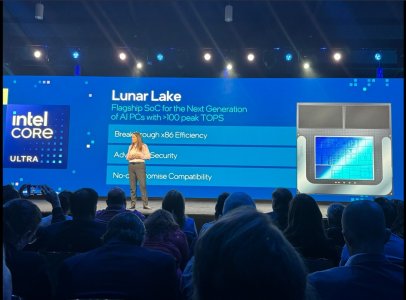
PPT1.jpg
PPT2.jpg
PPT3.jpg


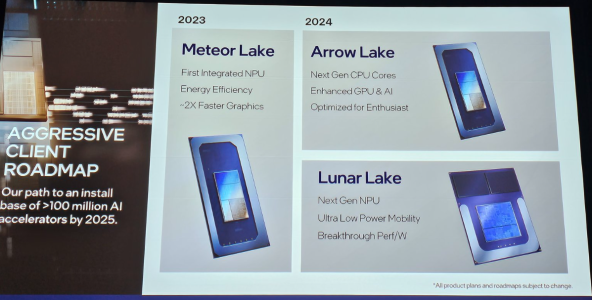
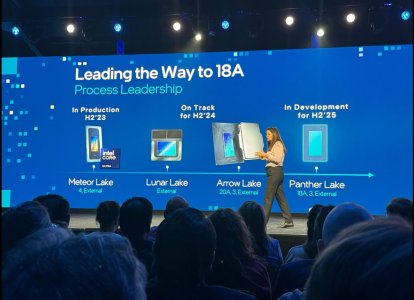
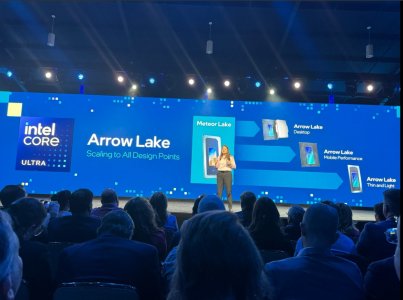
As Hot Chips 34 starting this week, Intel will unveil technical information of upcoming Meteor Lake (MTL) and Arrow Lake (ARL), new generation platform after Raptor Lake. Both MTL and ARL represent new direction which Intel will move to multiple chiplets and combine as one SoC platform.

MTL also represents new compute tile that based on Intel 4 process which is based on EUV lithography, a first from Intel. Intel expects to ship MTL mobile SoC in 2023.

ARL will come after MTL so Intel should be shipping it in 2024, that is what Intel roadmap is telling us. ARL compute tile will be manufactured by Intel 20A process, a first from Intel to use GAA transistors called RibbonFET.


LNL-MX.png
 

Attachments

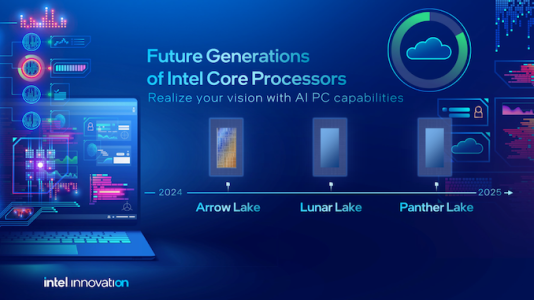
  • PantherLake.png
    PantherLake.png
    283.5 KB · Views: 24,049
  • LNL.png
    LNL.png
    881.8 KB · Views: 25,534
  • INTEL-CORE-100-ULTRA-METEOR-LAKE-OFFCIAL-SLIDE-2.jpg
    INTEL-CORE-100-ULTRA-METEOR-LAKE-OFFCIAL-SLIDE-2.jpg
    181.4 KB · Views: 72,443
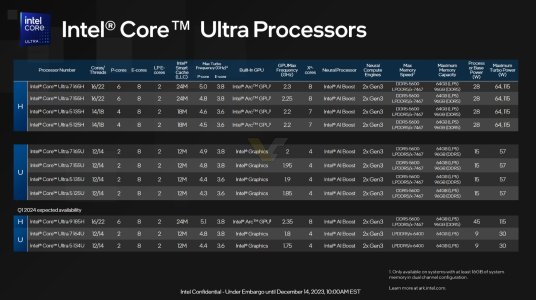
  • Clockspeed.png
    Clockspeed.png
    611.8 KB · Views: 72,329
Last edited:
5ghz was easily reachable since sandy bridge even no?

32nm?

sandy bridge was notorious for easy unlock +20% perf etc, was a superchip

edit: yeah quick search shows posts from 2020 saying "bro my sandy 2600k @5ghz still runs everything I throw at it just fine, no reason to upgrade"
 
It can possibly clock higher but the heat output must be getting out of hand. No point in shipping a CPU that immediately throttles with the kind of cooling they have in typical laptops.
 
The yields are not low tbh and it's always limited same for LNL real volume is Q1 26.
Well, it is literally the only product coming out of the much ballyhooed 18A process, and its a smallish tile, so I guess thats feasible, due in no small part to it being a chiplet. Ice Lake was 130mm2 monolithic, so ya.
 
Well, it is literally the only product coming out of the much ballyhooed 18A process, and its a smallish tile, so I guess thats feasible, due in no small part to it being a chiplet. Ice Lake was 130mm2 monolithic, so ya.
OFc it is There were only 2 products scheduled to launched for 2025 on 18A one of them got delayed so PTL is all that left feels kind of bad for Clearwater forest.
 
I don't know why everyone is going crazy with the ~5GHz clocks. There looks to be a ceiling around that Point for mobile CPUs, some reused Desktop Dies in AMD/Intel HX series do a bit more, but otherwise...

AMD had 4.8GHz in 2021 with Cezanne, now 4 Years later Strix (Halo) does 5.1GHz.

With Intel its kinda the same Story, just with a few MHz higher. Their performance SKUs have been around 5.4 GHz for years now, the more efficient ones are at these 5-5.1 GHz, no matter if N3B, Intel 4 or 18A.

Qualcomm is also slowly running against a wall now. First 8 Elite Gen 5 tests show 12W power draw for Single Core loads, in a phone SoC, thats more than the max overall power draw we had for these products like 2-3 years ago. Pretty sure that 5GHz on N3X cores (X Elite Gen2 Extreme) will use 25W+, thats no better than x86 cores.

I doubt any Medusa Mobile product will go beyond 5.4/5.5GHz, despite Desktop ZEN6 SKUs going 1GHz higher. There just seems to be a Point around 5 GHz, that doesn't make Laptop SKUs over it sufficient.
 
Last edited:
Qualcomm is also slowly running against a wall now. First 8 Elite Gen 5 tests show 12W power draw for Single Core loads, in a phone SoC, thats more than the max overall power draw we had for these products like 2-3 years ago. Pretty sure that 5GHz on N3X cores (X Elite Gen2 Extreme) will use 25W+, thats no better than x86 cores
It's 18-20W if you take Qcoms word for it
With Intel its kinda the same Story, just with a few MHz higher. Their performance SKUs have been around 5.4 GHz for years now, the more efficient ones are at these 5-5.1 GHz, no matter if N3B, Intel 4 or 18A.
Intel's '+' node goes to 5.3-5.4 GHz on mobile without blowing up.
 
I don't know why everyone is going crazy with the ~5GHz clocks. There looks to be a ceiling around that Point for mobile CPUs, some reused Desktop Dies in AMD/Intel HX series do a bit more, but otherwise...

I don't think we should want more than 5GHz in a vacuum, but the stagnant IPC with a growing IPC deficit to the ARM space means that without higher clocks there's little to no performance uplift. Like a new node with BSPD + GAAFET proudly delivering worse than Arrow Lake ST performance is just bad.
 
I don't think we should want more than 5GHz in a vacuum, but the stagnant IPC with a growing IPC deficit to the ARM space means that without higher clocks there's little to no performance uplift. Like a new node with BSPD + GAAFET proudly delivering worse than Arrow Lake ST performance is just bad.
There is only PPW uplift from the node Intel never gave up Tick Tock model they still use it for derisking.
 
Back
Top