Discussion Intel Meteor, Arrow, Lunar & Panther Lakes + WCL Discussion Threads

Page 871 - Seeking answers? Join the AnandTech community: where nearly half-a-million members share solutions and discuss the latest tech.

Tigerick

Senior member
Apr 1, 2022
941
857
106
Wildcat Lake (WCL) Specs

Intel Wildcat Lake (WCL) is upcoming mobile SoC replacing Raptor Lake-U. WCL consists of 2 tiles: compute tile and PCD tile. It is true single die consists of CPU, GPU and NPU that is fabbed by 18-A process. Last time I checked, PCD tile is fabbed by TSMC N6 process. They are connected through UCIe, not D2D; a first from Intel. Expecting launching in Q1 2026.
Intel Raptor Lake UIntel Wildcat Lake 15W?Intel Lunar LakeIntel Panther Lake 4+4+4
Launch DateQ1-2024Q2-2026Q3-2024Q1-2026
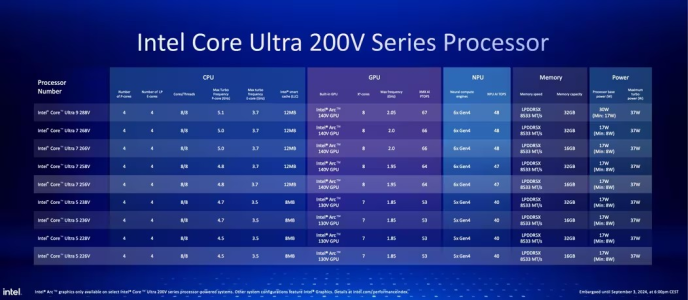
ModelIntel 150UIntel Core 7Core Ultra 7 268VCore Ultra 7 365
Dies2223
NodeIntel 7 + ?Intel 18-A + TSMC N6TSMC N3B + N6Intel 18-A + Intel 3 + TSMC N6
CPU2 P-core + 8 E-cores2 P-core + 4 LP E-cores4 P-core + 4 LP E-cores4 P-core + 4 LP E-cores
Threads12688
Max Clock5.4 GHz?5 GHz4.8 GHz
L3 Cache12 MB12 MB12 MB
TDP15 - 55 W15 W ?17 - 37 W25 - 55 W
Memory128-bit LPDDR5-520064-bit LPDDR5128-bit LPDDR5x-8533128-bit LPDDR5x-7467
Size96 GB32 GB128 GB
Bandwidth136 GB/s
GPUIntel GraphicsIntel GraphicsArc 140VIntel Graphics
RTNoNoYESYES
EU / Xe96 EU2 Xe8 Xe4 Xe
Max Clock1.3 GHz?2 GHz2.5 GHz
NPUGNA 3.018 TOPS48 TOPS49 TOPS


PPT1.jpg
PPT2.jpg
PPT3.jpg


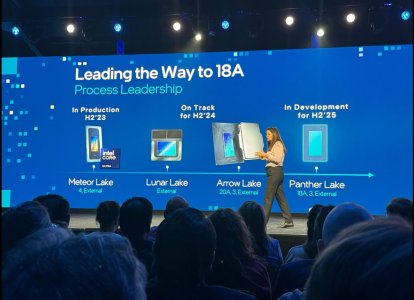
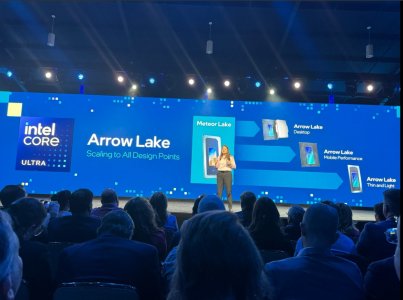
As Hot Chips 34 starting this week, Intel will unveil technical information of upcoming Meteor Lake (MTL) and Arrow Lake (ARL), new generation platform after Raptor Lake. Both MTL and ARL represent new direction which Intel will move to multiple chiplets and combine as one SoC platform.

MTL also represents new compute tile that based on Intel 4 process which is based on EUV lithography, a first from Intel. Intel expects to ship MTL mobile SoC in 2023.

ARL will come after MTL so Intel should be shipping it in 2024, that is what Intel roadmap is telling us. ARL compute tile will be manufactured by Intel 20A process, a first from Intel to use GAA transistors called RibbonFET.


LNL-MX.png
 

Attachments

  • PantherLake.png
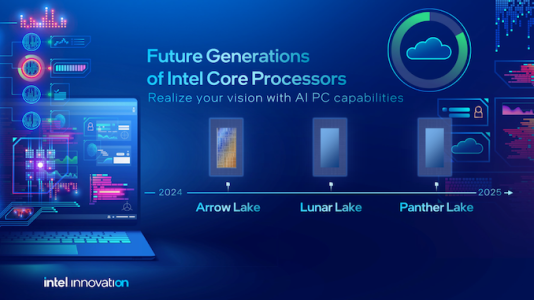
    PantherLake.png
    283.5 KB · Views: 24,042
  • LNL.png
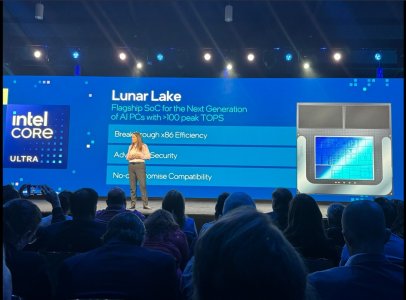
    LNL.png
    881.8 KB · Views: 25,531
  • INTEL-CORE-100-ULTRA-METEOR-LAKE-OFFCIAL-SLIDE-2.jpg
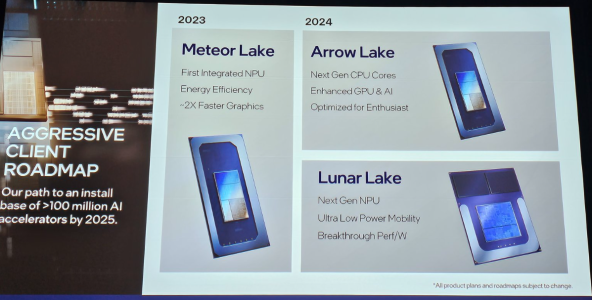
    INTEL-CORE-100-ULTRA-METEOR-LAKE-OFFCIAL-SLIDE-2.jpg
    181.4 KB · Views: 72,439
  • Clockspeed.png
    Clockspeed.png
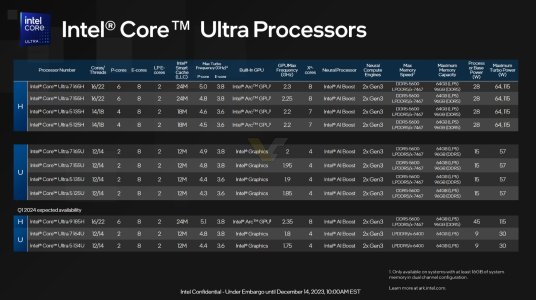
    611.8 KB · Views: 72,325
Last edited:

Magio

Senior member
May 13, 2024
205
242
76
There is only PPW uplift from the node Intel never gave up Tick Tock model they still use it for derisking.

If the node was a huge jump in transistor performance over N3B (far from TSMC's best node) one would assume it could have at least achieved better clocks at same power and that Intel would have preferred that to lower clocks (than ARL-H) at lower power. And of course to this point we don't even know if it actually is more efficient.
 

511

Diamond Member
Jul 12, 2024
5,373
4,781
106
If the node was a huge jump in transistor performance over N3B (far from TSMC's best node) one would assume it could have at least achieved better clocks at same power and that Intel would have preferred that to lower clocks (than ARL-H) at lower power. And of course to this point we don't even know if it actually is more efficient.
Increased xtor performance doesn't necessarily means Fmax increase.
For N3B and 18A comparison LNL is a solid baseline.
 

DrMrLordX

Lifer
Apr 27, 2000
23,191
13,275
136
No way man. Is this thing going to be Cannon Lake / Ice Lake 2.0?? ie an "investor requirement" launch??

Nah, we were warned about parametric yields, so no surprises there.

Probally going to be meme level volume. So they are being conservative on clocks.
Initial launch will probably be like that, yes. Who knows how long it will be before they can push more volume? Also parametric yields (see above). Personally I was guessing 5.1-5.3 Ghz but it looks like they didn't get enough to bin that high.
 

511

Diamond Member
Jul 12, 2024
5,373
4,781
106
Initial launch will probably be like that, yes. Who knows how long it will be before they can push more volume? Also parametric yields (see above). Personally I was guessing 5.1-5.3 Ghz but it looks like they didn't get enough to bin that high.
at least it's the same as LNL if it was <5.0 Ghz it would have been comedy 🤣 🤣. If you believe raichu it's 40-50% total yield in August since the event is going on it means the QS has been finalized.
1759224664787.png
 
Last edited:
  • Like
Reactions: Tlh97 and Joe NYC
Jul 27, 2020
28,173
19,210
146
They should start selling the defective dies as ornaments to recoup some of the cost.

A sneak peak at my marketing genius: 18A Nova Lake 52-core package keychain. It's real! Use a SEM to look at it and marvel at modern technology miracles! Maybe you find the secret code to claim an actual CPU! Get yours today while supplies last!
 
  • Haha
Reactions: MrMPFR

511

Diamond Member
Jul 12, 2024
5,373
4,781
106
tbf LNL for the longest time had very few 5.0+ bins available (268v almost didn't exist whatsoever).
that was on N3B that was very mature during LNL launch

They should start selling the defective dies as ornaments to recoup some of the cost.

A sneak peak at my marketing genius: 18A Nova Lake 52-core package keychain. It's real! Use a SEM to look at it and marvel at modern technology miracles! Maybe you find the secret code to claim an actual CPU! Get yours today while supplies last!
1759229352946.png
These exists for that reason
 

regen1

Senior member
Aug 28, 2025
320
394
96
Parametric yield can improve with time. In past with "plus" node frequencies got significant boost(esp. for same u-arch and design targets).
Intel 4 and Intel 3 could be considered same family of nodes. MTL-H and MTL-U got max of 5.1GHz and 4.9GHz respectively at launch with Intel 4.
ARL-U(Redwood cove P-cores as in MTL-U) on Intel 3 got max of 5.3GHz, 0.4GHz extra.
During Tigerlake's launch i7 1185G7(max 4.8GHz) was the top SKU but ~9months later i7 1195G7(max 5GHz) was launched on the same node(probably a new stepping iirc). Subsequent releases(12th,13th and refreshes) on Intel 10nm/7 family came with increased max frequencies.
Other factors could be if the design is focused on outright performance or perf/W, area efficiency.

tbf LNL for the longest time had very few 5.0+ bins available (268v almost didn't exist whatsoever).
Yeah, but to an extent that has been generally the case(for a long time) with top end i7/ultra 7 vPro SKUs(12700H v 12800h, 13700 v 13800H, 155H v 265H, 255H v 265H, 258V v 268v), they are clocked a little higher than the more mainstream i7/ultra 7and mostly available in business and some premium notebook designs.
 
  • Like
Reactions: 511

Meteor Late

Senior member
Dec 15, 2023
347
382
106
Parametric yield can improve with time. In past with "plus" node frequencies got significant boost(esp. for same u-arch and design targets).

That's all fine and dandy but not when frequencies don't improve over the previous base node. So if MTL-H gets 5.1GHz with base Intel 4 and then Panther Lake gets 5.1GHz with 18A base node, what's that if not a colossal failure?
 

regen1

Senior member
Aug 28, 2025
320
394
96
That's all fine and dandy but not when frequencies don't improve over the previous base node. So if MTL-H gets 5.1GHz with base Intel 4 and then Panther Lake gets 5.1GHz with 18A base node, what's that if not a colossal failure?
For sure it could be somewhat underwhelming to some. Not ruling out that it could be underwhelming relatively even after 18A-P.

Still a little too early to call failure though, different designs and peak frequency has not regressed. Many factors even aside from the node could be at play, even the design targets for PTL or a possible risk-averse first release on a node with 2 new tech(GAAFET and BSPDN). We'll know how bad or good 18A family is after reviews drop(esp. on perf/W and other factors plus we have to see 18A-P).
 
  • Like
Reactions: DKR

511

Diamond Member
Jul 12, 2024
5,373
4,781
106
That's all fine and dandy but not when frequencies don't improve over the previous base node. So if MTL-H gets 5.1GHz with base Intel 4 and then Panther Lake gets 5.1GHz with 18A base node, what's that if not a colossal failure?
Different uArch?

Also why are we talking MLIDs sensei seriously
 

ToTTenTranz

Senior member
Feb 4, 2021
913
1,524
136
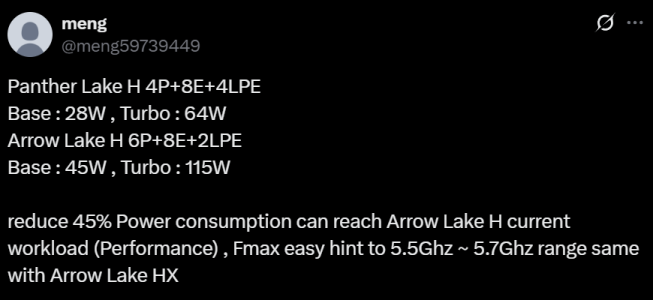
Hold your horses that's not true it's Memg doing meng things. The power efficiency part can be true that it can deliver ARL-H perf at LNL TDP but not the max clock.
Yes, I don't think PTL-H will have those clocks. But I also don't get why it's so important for people that a laptop CPU reaches 5.5GHz or has massive single-core performance.


Are people spending that much time running Geekbench 6 on their laptops? Or are they going to pair a 45W Panther Lake H with a RTX 5090 and they're afraid of hitting a CPU bottleneck? Were they planning on using PTL-H laptops to run servers for multiplayer games?

Power efficiency at lower clocks should be much more important for end users, and transistor density at those efficiency levels should be much more important for Intel. I don't know if Intel's 18A has performance libraries and then power-efficiency + transistor density libraries like TSMC does with their processes, but if they do then they probably went with the latter for Panther Lake.


And after power efficiency at general loads, what matters more for people will be how fast the Xe3 iGPU is for games or AI workloads. Being able to load up different LLMs or image generation models on AI Playground and running those with decent performance is bound to be a lot more important than reaching a 4600 ST score in geekbench 6.


It's not that I don't get the enthusiast PoV here. Hitting 5.7GHz would be cool. But if PTL-H is exclusively a mobile chip and Arrow Lake's desktop successor is only coming with Nova Lake, I'm not following on this "OMG 18A is horrible Intel is lost because the CPU cores in their mobile chips can't hit 5.5GHz" meme.
 

511

Diamond Member
Jul 12, 2024
5,373
4,781
106
And after power efficiency at general loads, what matters more for people will be how fast the Xe3 iGPU is for games or AI workloads. Being able to load up different LLMs or image generation models on AI Playground and running those with decent performance is bound to be a lot more important than reaching a 4600 ST score in geekbench 6.
~50% if it doesn't get botched by memory bandwidth in the game
 

LightningZ71

Platinum Member
Mar 10, 2017
2,673
3,372
136
Parametric yield can improve with time. In past with "plus" node frequencies got significant boost(esp. for same u-arch and design targets).
Intel 4 and Intel 3 could be considered same family of nodes. MTL-H and MTL-U got max of 5.1GHz and 4.9GHz respectively at launch with Intel 4.
ARL-U(Redwood cove P-cores as in MTL-U) on Intel 3 got max of 5.3GHz, 0.4GHz extra.
During Tigerlake's launch i7 1185G7(max 4.8GHz) was the top SKU but ~9months later i7 1195G7(max 5GHz) was launched on the same node(probably a new stepping iirc). Subsequent releases(12th,13th and refreshes) on Intel 10nm/7 family came with increased max frequencies.
Other factors could be if the design is focused on outright performance or perf/W, area efficiency.


Yeah, but to an extent that has been generally the case(for a long time) with top end i7/ultra 7 vPro SKUs(12700H v 12800h, 13700 v 13800H, 155H v 265H, 255H v 265H, 258V v 268v), they are clocked a little higher than the more mainstream i7/ultra 7and mostly available in business and some premium notebook designs.
For 14+... And for 10nm/Intel 7, they improved frequencies through successively reducing logic density by small increments (excluding super fin, which was an actual change in the XTOR shape).
 
  • Like
Reactions: MrMPFR