Discussion Intel Meteor, Arrow, Lunar & Panther Lakes + WCL Discussion Threads

Page 650 - Seeking answers? Join the AnandTech community: where nearly half-a-million members share solutions and discuss the latest tech.

Tigerick

Senior member
Apr 1, 2022
942
857
106
Wildcat Lake (WCL) Specs

Intel Wildcat Lake (WCL) is upcoming mobile SoC replacing Raptor Lake-U. WCL consists of 2 tiles: compute tile and PCD tile. It is true single die consists of CPU, GPU and NPU that is fabbed by 18-A process. Last time I checked, PCD tile is fabbed by TSMC N6 process. They are connected through UCIe, not D2D; a first from Intel. Expecting launching in Q1 2026.
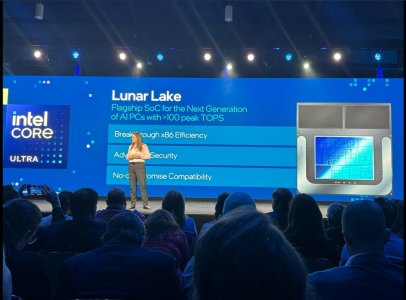
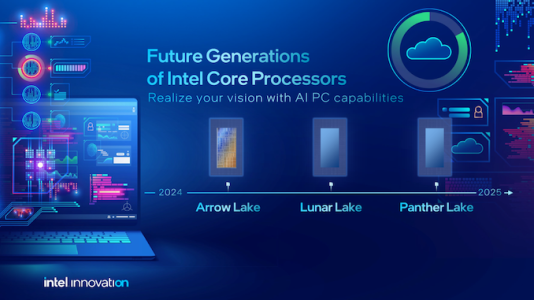
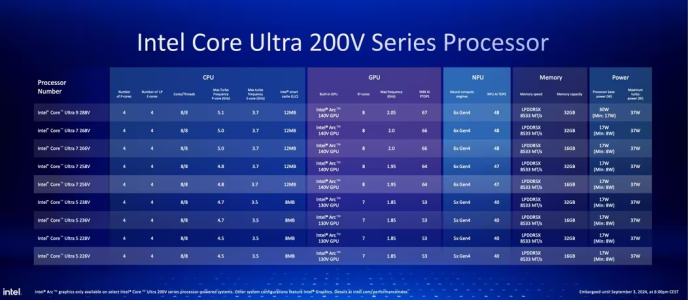
Intel Raptor Lake UIntel Wildcat Lake 15W?Intel Lunar LakeIntel Panther Lake 4+0+4
Launch DateQ1-2024Q2-2026Q3-2024Q1-2026
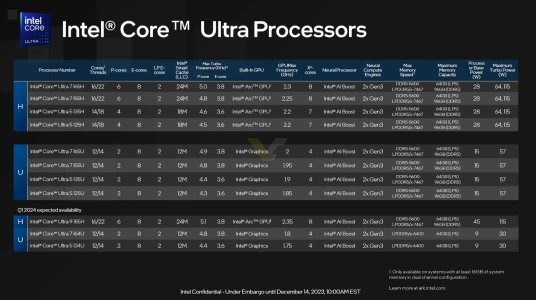
ModelIntel 150UIntel Core 7Core Ultra 7 268VCore Ultra 7 365
Dies2223
NodeIntel 7 + ?Intel 18-A + TSMC N6TSMC N3B + N6Intel 18-A + Intel 3 + TSMC N6
CPU2 P-core + 8 E-cores2 P-core + 4 LP E-cores4 P-core + 4 LP E-cores4 P-core + 4 LP E-cores
Threads12688
Max Clock5.4 GHz?5 GHz4.8 GHz
L3 Cache12 MB12 MB12 MB
TDP15 - 55 W15 W ?17 - 37 W25 - 55 W
Memory128-bit LPDDR5-520064-bit LPDDR5128-bit LPDDR5x-8533128-bit LPDDR5x-7467
Size96 GB32 GB128 GB
Bandwidth136 GB/s
GPUIntel GraphicsIntel GraphicsArc 140VIntel Graphics
RTNoNoYESYES
EU / Xe96 EU2 Xe8 Xe4 Xe
Max Clock1.3 GHz?2 GHz2.5 GHz
NPUGNA 3.018 TOPS48 TOPS49 TOPS


PPT1.jpg
PPT2.jpg
PPT3.jpg


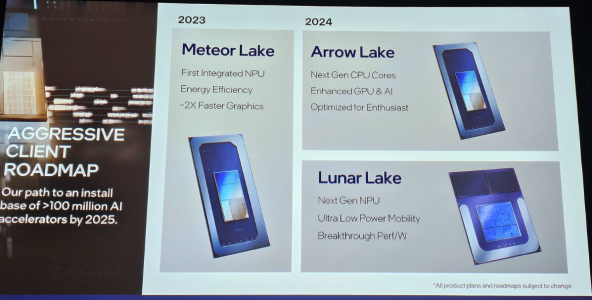
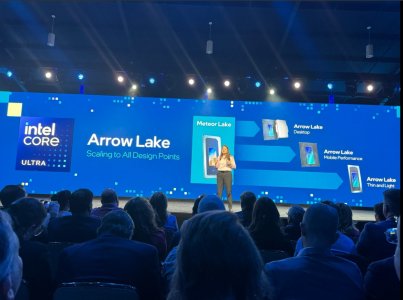
As Hot Chips 34 starting this week, Intel will unveil technical information of upcoming Meteor Lake (MTL) and Arrow Lake (ARL), new generation platform after Raptor Lake. Both MTL and ARL represent new direction which Intel will move to multiple chiplets and combine as one SoC platform.

MTL also represents new compute tile that based on Intel 4 process which is based on EUV lithography, a first from Intel. Intel expects to ship MTL mobile SoC in 2023.

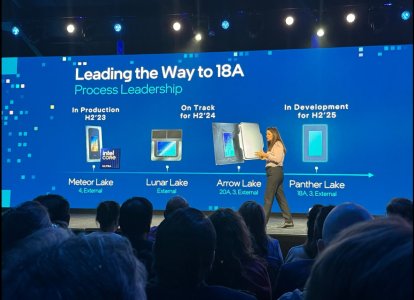
ARL will come after MTL so Intel should be shipping it in 2024, that is what Intel roadmap is telling us. ARL compute tile will be manufactured by Intel 20A process, a first from Intel to use GAA transistors called RibbonFET.


LNL-MX.png
 

Attachments

  • PantherLake.png
    PantherLake.png
    283.5 KB · Views: 24,044
  • LNL.png
    LNL.png
    881.8 KB · Views: 25,531
  • INTEL-CORE-100-ULTRA-METEOR-LAKE-OFFCIAL-SLIDE-2.jpg
    INTEL-CORE-100-ULTRA-METEOR-LAKE-OFFCIAL-SLIDE-2.jpg
    181.4 KB · Views: 72,440
  • Clockspeed.png
    Clockspeed.png
    611.8 KB · Views: 72,327
Last edited:

Joe NYC

Diamond Member
Jun 26, 2021
4,228
5,833
136
Would this be a decent option if I were to switch teams? I'm staying with mATX due to the fact that I have a case I really like that fits under my desk.

You see, my 1.3V underclock on my 14900K is not stable anymore so I downloaded the Intel microcode BIOS update. Yeah it's stable now but taking in quite a lot of volts and I've lost 300-400MHz at the same 200W I used to run at.
I think I'm done with Raptor Lake. I want to try a 9950X.

Probably throw a 7800XT or 4700 GPU in there as well. I don't game much but like the GPU power for other tasks.

I have one from the TUF series. While I like MicroATX, I wanted to get one with PCIe Gen5, so I went with TUF x670E, which is an ATX (for a few extra bucks)

The Gen 4 you are looking at is fine for the GPUs you are considering, but apparently, next gen graphics cards will be PCIe Gen 5.

The board you linked does have a PCIe Gen5 M.2 which is good, so with either one of those 2 GPUs it's probably just fine.

One of the nice things with this board are all the analog audio outputs - if you have a multi-speaker audio system...
 

OneEng2

Golden Member
Sep 19, 2022
1,011
1,211
106
In HWU testing, 7800X3D is already 20% faster than 285K, though, admittedly with RTX 4090. So unless the testing is radically different, this is really not good news for 9800X3D if these numbers are true. Many people expect like 10% gaming delta on average between 7800X3D and 9800X3D and that's probably not going to happen.
I expect the big jump isn't going to be just the out of box 9800X3D over 7800X3D (as you point out likely ~10% give or take), but rather the ability to clock higher and tweak it to levels more like 20%.

Only a few more days and we will know.
 

MoistOintment

Member
Jul 31, 2024
163
263
96
That's true. Just thinking they have the high clocks and probably good yields in Intel 7.
Honestly even Raptor Cove paired with Skymont on monolithic might have been a better option than ARL as we have it now. ST would have remained the same but MT would have gone through the roof with just a little larger die area.
ARL on Intel 7 would've been a disaster. The cores would've been monstrously large and power hungry. Intel learned their lesson with RKL to not backport to an old node.

Not to mention how much LNL changed with new industry standard PDKs and designs. Intel 7 is old. DTCO'd a lot for ADL/RPL requirements.

Intel 3 monolithic would've been the choice if they wanted both in house and monolithic.
 

511

Diamond Member
Jul 12, 2024
5,465
4,890
106
Intel 3 wasn't even certain upto a point also one of the engineer said they are happy with Intel 3 and how it turned out
 

Hulk

Diamond Member
Oct 9, 1999
5,403
4,110
136
ARL on Intel 7 would've been a disaster. The cores would've been monstrously large and power hungry. Intel learned their lesson with RKL to not backport to an old node.

Not to mention how much LNL changed with new industry standard PDKs and designs. Intel 7 is old. DTCO'd a lot for ADL/RPL requirements.

Intel 3 monolithic would've been the choice if they wanted both in house and monolithic.
Yes I agree, I changed my opinion. I was thinking Raptor Lake with Skymont instead of Gracemont, still on Intel 7.
Avoid the Lion Cove fiasco and having to go out to TSMC.

The only great tech Intel has produced lately is Skymont.

Anyway, "coulda, shoulda, woulda" is for kids. So it's pointless to look back.
 

Hitman928

Diamond Member
Apr 15, 2012
6,754
12,500
136
Lion Cove & Skymont use industry standard design tools that are compatible with Intel 20A/18A/TSMC/etc. Hence LNC & Skymont aren't backward compatible with Intel 7/4/3 which still use (proprietary) in-house design tools.

Intel 3 was being offered as an IFS offering, so they must have some level of industry standard tool support, though maybe it is a bit lacking/incomplete as no outside companies showed interest in using it.
 

desrever

Senior member
Nov 6, 2021
341
832
136
Intel 3 was being offered as an IFS offering, so they must have some level of industry standard tool support, though maybe it is a bit lacking/incomplete as no outside companies showed interest in using it.
Pat originally said there would be external users to Intel 4/3 but quietly stop talking about it and is only talking about 18A now.
 

Hitman928

Diamond Member
Apr 15, 2012
6,754
12,500
136
Pat originally said there would be external users to Intel 4/3 but quietly stop talking about it and is only talking about 18A now.

Yeah, there were some customers who "kicked the tires" on Intel 3, but no actual takers (none of any significance at least). If they can get the price down, maybe they'll attract some future customers who stay a few nodes back from the leading edge, but it's doubtful.

Pat has a tendency of acting like customer engagements (i.e., potential customers) are actual customers (i.e., signed agreements / purchase orders). He did the same thing with Gaudi.
 

Doug S

Diamond Member
Feb 8, 2020
3,840
6,795
136
There will be far better options from both companies the next year.

That's always true. Don't buy Arrow Lake, wait until they ship its 18A follow-on. Don't buy Zen 5 today, wait for the N3E version. Don't X Elite today, wait for their next generation core. Don't buy M4 Macs, wait for next year's M5 with multitronic technology!
 

Gideon

Platinum Member
Nov 27, 2007
2,044
5,103
136
Would this be a decent option if I were to switch teams? I'm staying with mATX due to the fact that I have a case I really like that fits under my desk.

You see, my 1.3V underclock on my 14900K is not stable anymore so I downloaded the Intel microcode BIOS update. Yeah it's stable now but taking in quite a lot of volts and I've lost 300-400MHz at the same 200W I used to run at.
I think I'm done with Raptor Lake. I want to try a 9950X.

Probably throw a 7800XT or 4700 GPU in there as well. I don't game much but like the GPU power for other tasks.
I'll refrain from more comments, but just wanted to add, that from my experience building AM5 rigs, the best kit out there for OOtB timings (at least for the 7-series) in terms of bang/buck is this one:

or if you really like RGB, then this (otherwise identical)

It's not on the qualification list of your mobo for the 9000 series, for some odd reason (probably due to the age of the product) but it is for the 7000 series:

1730405008558.png

In my country at least it can be had for a very good price and HWUB among others covered it, offering some of the best OOtB performance.
 

MoistOintment

Member
Jul 31, 2024
163
263
96
No customers in their right mind would use (Intel 3) proprietary tools to design their cpus knowing very well it's literally a dead end.
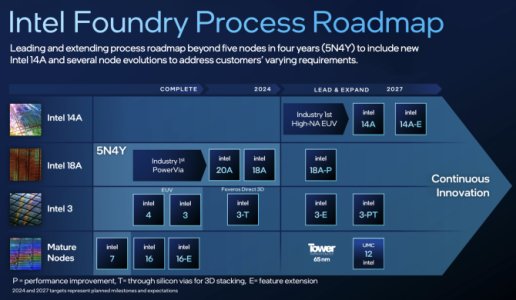
My understanding (Having trouble finding the original source where I read this) is that Intel 3-E and/or Intel 3-PT is supposed to introduce industry standard tools.

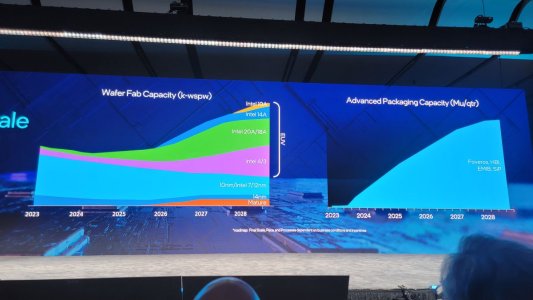
Intel 3 capacity is still quite limited:
iUo6natDCxZNAprYxFxg5M-1200-80.jpg


And 3-E and 3-PT are supposed to come later:
images-1.fill_.size_670x390.v1709133232.jpg
 
  • Like
Reactions: lightmanek

Rheingold

Member
Aug 17, 2022
72
204
76
Going from 8/16-24 to 6/24-30. 6 P cores and 24 E cores.
Going by your calculations, that 6+24/30 would have increased the performance from 8880 to 10848, a gain of +22.16%, while implementing HT with 10080 is just +13.51%. So, the switch to more E-cores is a better deal if the increase in die area is less than 1.64x of the increase when implementing HT.

With Arrow Lake, the rule of four E-cores for one P-Core no longer applies. A Skymont E-core cluster is around 33% bigger than a Lion Cove P-core. Switching two P-cores for two E-cores clusters would have increased the die size by roughly 6.4% which is around four times as much as implementing HT. That means it's not a better deal than implementing HT. As I said, it should have been a no-brainer.

That being said, it's still correct that E-cores provide much more performance per area than P-cores. That's the whole point of having them. But then why not go with just 32 or 40 E-cores, for maximum multi-core performance? Because it's a conscious decision to have 8 P-cores for Ultra 7 and Ultra 9. Marketing requires 8 of the fastest cores for the top SKUs.
 

Meteor Late

Senior member
Dec 15, 2023
347
382
106
Going by your calculations, that 6+24/30 would have increased the performance from 8880 to 10848, a gain of +22.16%, while implementing HT with 10080 is just +13.51%. So, the switch to more E-cores is a better deal if the increase in die area is less than 1.64x of the increase when implementing HT.

With Arrow Lake, the rule of four E-cores for one P-Core no longer applies. A Skymont E-core cluster is around 33% bigger than a Lion Cove P-core. Switching two P-cores for two E-cores clusters would have increased the die size by roughly 6.4% which is around four times as much as implementing HT. That means it's not a better deal than implementing HT. As I said, it should have been a no-brainer.

That being said, it's still correct that E-cores provide much more performance per area than P-cores. That's the whole point of having them. But then why not go with just 32 or 40 E-cores, for maximum multi-core performance? Because it's a conscious decision to have 8 P-cores for Ultra 7 and Ultra 9. Marketing requires 8 of the fastest cores for the top SKUs.

Because there are many workloads that use a limited number of cores, it's rare to find a workload that can use 12 cores and stops there, it's more common to find a workload like games that can use 6 or 8 cores and not more, or workloads like Cinebench that can use tons of cores, like 32 for example. That's why a limited number of fast cores is important, 8 seems to be the sweetspot, 6 at minimum.
 

DZero

Platinum Member
Jun 20, 2024
2,165
783
96
Because there are many workloads that use a limited number of cores, it's rare to find a workload that can use 12 cores and stops there, it's more common to find a workload like games that can use 6 or 8 cores and not more, or workloads like Cinebench that can use tons of cores, like 32 for example. That's why a limited number of fast cores is important, 8 seems to be the sweetspot, 6 at minimum.
If I am not wrong isn't excel capable to use 16 threads?
 

LightningZ71

Platinum Member
Mar 10, 2017
2,697
3,396
136
Tiering should be straight forward:
9K: 6+24
9:6+20
7k:4+20
7:4+16
5k:2+16
5:2+12
3:1+8

I know some will object to the low P core count, but at i3 and i5 speeds, the E cores are nearly as performance as the P cores.

Edit: I still strongly contend that, for most applications, there are usually just one or two threads that are performance critical. With the E cores doing so well, it won't really matter.