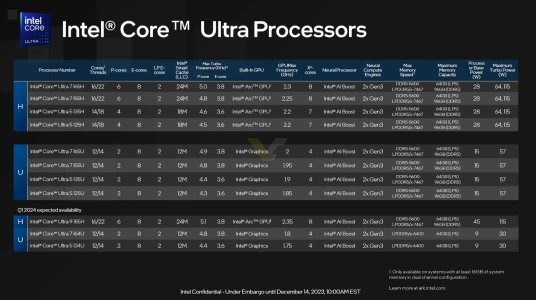
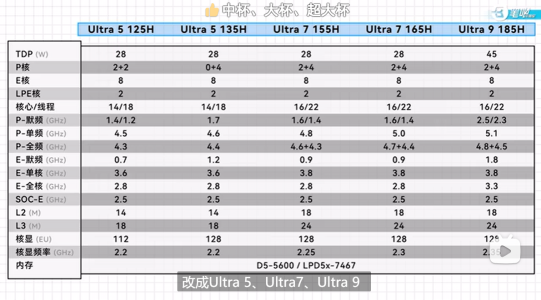
Discussion Intel Meteor, Arrow, Lunar & Panther Lakes + WCL Discussion Threads

Page 262 - Seeking answers? Join the AnandTech community: where nearly half-a-million members share solutions and discuss the latest tech.

Tigerick

Senior member
Apr 1, 2022
942
857
106
Wildcat Lake (WCL) Specs

Intel Wildcat Lake (WCL) is upcoming mobile SoC replacing Raptor Lake-U. WCL consists of 2 tiles: compute tile and PCD tile. It is true single die consists of CPU, GPU and NPU that is fabbed by 18-A process. Last time I checked, PCD tile is fabbed by TSMC N6 process. They are connected through UCIe, not D2D; a first from Intel. Expecting launching in Q1 2026.


Intel Raptor Lake UIntel Wildcat Lake 15W?Intel Lunar LakeIntel Panther Lake 4+0+4
Launch DateQ1-2024Q2-2026Q3-2024Q1-2026
ModelIntel 150UIntel Core 7Core Ultra 7 268VCore Ultra 7 365
Dies2223
NodeIntel 7 + ?Intel 18-A + TSMC N6TSMC N3B + N6Intel 18-A + Intel 3 + TSMC N6
CPU2 P-core + 8 E-cores2 P-core + 4 LP E-cores4 P-core + 4 LP E-cores4 P-core + 4 LP E-cores
Threads12688
Max Clock5.4 GHz?5 GHz4.8 GHz
L3 Cache12 MB12 MB12 MB
TDP15 - 55 W15 W ?17 - 37 W25 - 55 W
Memory128-bit LPDDR5-520064-bit LPDDR5128-bit LPDDR5x-8533128-bit LPDDR5x-7467
Size96 GB32 GB128 GB
Bandwidth136 GB/s
GPUIntel GraphicsIntel GraphicsArc 140VIntel Graphics
RTNoNoYESYES
EU / Xe96 EU2 Xe8 Xe4 Xe
Max Clock1.3 GHz?2 GHz2.5 GHz
NPUGNA 3.018 TOPS48 TOPS49 TOPS


PPT1.jpg
PPT2.jpg
PPT3.jpg


As Hot Chips 34 starting this week, Intel will unveil technical information of upcoming Meteor Lake (MTL) and Arrow Lake (ARL), new generation platform after Raptor Lake. Both MTL and ARL represent new direction which Intel will move to multiple chiplets and combine as one SoC platform.

MTL also represents new compute tile that based on Intel 4 process which is based on EUV lithography, a first from Intel. Intel expects to ship MTL mobile SoC in 2023.

ARL will come after MTL so Intel should be shipping it in 2024, that is what Intel roadmap is telling us. ARL compute tile will be manufactured by Intel 20A process, a first from Intel to use GAA transistors called RibbonFET.
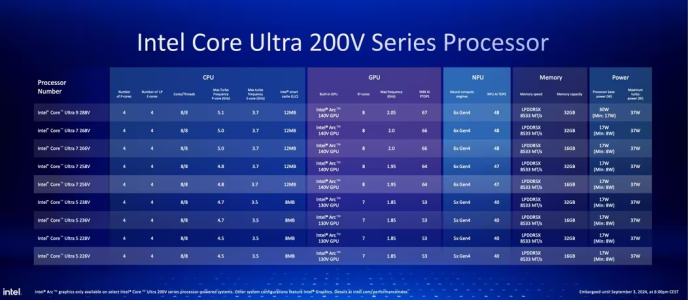


LNL-MX.png
 

Attachments

  • PantherLake.png
    PantherLake.png
    283.5 KB · Views: 24,044
  • LNL.png
    LNL.png
    881.8 KB · Views: 25,531
  • INTEL-CORE-100-ULTRA-METEOR-LAKE-OFFCIAL-SLIDE-2.jpg
    INTEL-CORE-100-ULTRA-METEOR-LAKE-OFFCIAL-SLIDE-2.jpg
    181.4 KB · Views: 72,439
  • Clockspeed.png
    Clockspeed.png
    611.8 KB · Views: 72,326
Last edited:

Schmide

Diamond Member
Mar 7, 2002
5,788
1,093
126
is that comic sans ?

Heat does affect resistance, but not by any measure that would change the timing in a processor. Sure at some heat point the switching frequency will fail, but until then hot or cool it's business at usual.
 

Hitman928

Diamond Member
Apr 15, 2012
6,754
12,500
136
Efficiency decreases & there is a very direct correlation. See above. It spells it out clearly.

Then it should be very easy for you to show the correlation between the efficiency of CPU "A" at 100C and CPU "B" at 50C (pick whatever temps you want that aren't close to each other). You can give a derivation or a real world example. . .
 

dullard

Elite Member
May 21, 2001
26,196
4,866
126
It really isn't that hard. Between different CPUs, you cannot tell efficiency from temperatures. Plain and simple.

But, for a given CPU, the higher the temperature, the lower the efficiency. The drop in efficiency with temperature is not drastic, but to claim this effect doesn't exist is ignorance. Plain and simple.
 

Geddagod

Golden Member
Dec 28, 2021
1,680
1,715
136
Then it should be very easy for you to show the correlation between the efficiency of CPU "A" at 100C and CPU "B" at 50C (pick whatever temps you want that aren't close to each other). You can give a derivation or a real world example. . .
"Another basic principle of silicon transistors is that they leak current across junctions and to the substrate(Kaushik, 2003). The amount of leakage current in a processor of a particular process type will vary largely by applied voltage and temperature and it can become quite significant in today's high-performance processors. This is because the same factors that are required to make transistors switch faster (i.e., achieve higher frequency) also increase leakage. All this leakage current creates additional power that must be counted as part of the device’s total power consumption. Naturally, leakage power effectively reduces the amount of the device’s total power envelope that can be consumed as active power (i.e., power used in transistor switching that does work)."


Is this not saying that increased temperature will lead to increased leakage power, leading to a decrease in power available for active power, meaning that either A) clocks decrease or B) power increases to maintain the same clock speed?
 

Hitman928

Diamond Member
Apr 15, 2012
6,754
12,500
136
"Another basic principle of silicon transistors is that they leak current across junctions and to the substrate(Kaushik, 2003). The amount of leakage current in a processor of a particular process type will vary largely by applied voltage and temperature and it can become quite significant in today's high-performance processors. This is because the same factors that are required to make transistors switch faster (i.e., achieve higher frequency) also increase leakage. All this leakage current creates additional power that must be counted as part of the device’s total power consumption. Naturally, leakage power effectively reduces the amount of the device’s total power envelope that can be consumed as active power (i.e., power used in transistor switching that does work)."


Is this not saying that increased temperature will lead to increased leakage power, leading to a decrease in power available for active power, meaning that either A) clocks decrease or B) power increases to maintain the same clock speed?

Yes, but that's not what I asked for.

@dullard your response is correct but no one was arguing increased temp doesn't effect efficiency, only that you can't tell the efficiency difference between 2 different types of CPUs based on their operating temperature. There's only been 1 poster saying (or at least strongly insinuating) that you can and everyone else saying you can't. That's it.
 

dullard

Elite Member
May 21, 2001
26,196
4,866
126
@dullard your response is correct but no one was arguing increased temp doesn't effect efficiency, only that you can't tell the efficiency difference between 2 different types of CPUs based on their operating temperature. There's only been 1 poster saying (or at least strongly insinuating) that you can and everyone else saying you can't. That's it.
The thing is you seem to have misread that poster's intent. Yes, his first post on the issue was not worded well. But everything after that shows that his intent was to say that high temperatures makes a specific CPU less efficient. So, we end up with the debate where you are arguing against something he didn't intend. He intended to say that a higher temperature reduces efficiency. See his clarifications below.
As temperature increases, a processor's efficiency decreases.

Claiming high temperature doesn't affect performance is outright silly

Higher operating temperatures reduces efficiency.
I think you were the one mostly making this into a debate of comparing two CPUs.
 

Hitman928

Diamond Member
Apr 15, 2012
6,754
12,500
136
The thing is you seem to have misread that poster's intent. Yes, his first post on the issue was not worded well. But everything after that shows that his intent was to say that high temperatures makes a specific CPU less efficient. So, we end up with the debate where you are arguing against something he didn't intend. He intended to say that a higher temperature reduces efficiency. See his clarifications below.

I don't think so, those posts are just trying to justify his original claim (which they don't as the original claim is nonsensical). . .

Some want to believe that even when the MacBook Air is running at 114°C, it's still efficient. And let them believe what they want, it's their choice. But I don't.
 
Last edited:
  • Like
Reactions: Tlh97

Hitman928

Diamond Member
Apr 15, 2012
6,754
12,500
136
Also this (added emphasis):

Efficiency does not decrease all that significantly with increased temperature and there is no correlation between operating temperature and efficiency between different chips.
Efficiency decreases & there is a very direct correlation. See above. It spells it out clearly.

There are additional examples as well. It wasn't just about decreasing efficiency of the same CPU with increasing temp. The argument was clearly for the Apple chip to be less efficient based solely on the fact that Apple let it operate at a higher temperature in a fanless design, which as I said in my original reply (which he argued with), makes no sense.
 

dullard

Elite Member
May 21, 2001
26,196
4,866
126
There are additional examples as well. It wasn't just about decreasing efficiency of the same CPU with increasing temp. The argument was clearly for the Apple chip to be less efficient based solely on the fact that Apple let it operate at a higher temperature in a fanless design, which as I said in my original reply (which he argued with), makes no sense.
It makes no sense because that isn't his intent.
Some want to believe that even when the MacBook Air is running at 114°C, it's still efficient. And let them believe what they want, it's their choice. But I don't.

This is intended to say that at 114°C it isn't as efficient as at lower temperatures. No where does it compare to other chips in the very quote you provide. Read it again: "Some want to believe that even when the MacBook Air is running at 114°C, it's still efficient. And let them believe what they want, it's their choice. But I don't."

I'm not seeing comparisons between chips there. Is this a comparison to the Via C3 CPU? The Qualcomm Snapdragon? It is comparing to the Zen 5? Please help me, as I'm not good at reading non-typed words. You make a very good argument. Sadly, it is a strawman argument. But, it is a compelling strawman argument.
 
Last edited:

moinmoin

Diamond Member
Jun 1, 2017
5,248
8,463
136
One dimension neglected in all this discussion is that the peak heat of hotspots in MBA likely exists for just a very short time span. Other manufacturers like Intel and AMD already moved on to reporting running average values instead since people tend to become hysterical about the high values otherwise.

Professors love them some Comic Sans.
And typography professors hate them for that.
 

Hitman928

Diamond Member
Apr 15, 2012
6,754
12,500
136
It makes no sense because that isn't his intent.


This is intended to say that at 114°C it isn't as efficient as at lower temperatures. No where does it compare to other chips in the very quote you provide. Read it again: "Some want to believe that even when the MacBook Air is running at 114°C, it's still efficient. And let them believe what they want, it's their choice. But I don't." I'm not seeing comparisons between chips there.

You have to put the quote in context. He mentioned the M3 in this context as compared to the competition multiple times and said that there is direct correlation between the temperature of 2 different CPUs and their efficiency (and argued against my statement on this more than once). That's the whole point, he's trying to say that because the M3 in the Macbook Air is running at such a high temp, that it is less efficient than the competition. If he wasn't saying these things, he wouldn't continue to reply to people saying you can't make that comparison and argue with them.
 

coercitiv

Diamond Member
Jan 24, 2014
7,483
17,882
136
Is this not saying that increased temperature will lead to increased leakage power, leading to a decrease in power available for active power, meaning that either A) clocks decrease or B) power increases to maintain the same clock speed?
It does say that, but you need the rest of the story:
  • leakage power is much smaller than dynamic power when CPU is under load, and then it linearly increases with temperature delta
  • thermal transfer to the cooling system also linearly increases with temperature delta over ambient
The higher you allow the CPU to go in terms of temps, the more power it can dissipate provided the cooling system can take it. This also leads to linearly higher heatsink efficiency, as long as ambient temps are not influenced by the heat exhaust (or the heatsink has some ceiling temp limit due to construction).

Case in point, if a heatsink is able to dissipate 10W when the CPU is only allowed to reach 50C with an ambient of 20C, then allowing the CPU to reach 80C will help the heatsink dissipate closer to 20W. (temp delta over ambient has doubled from 30C to 60C). So even if you had leakage power of around ~1W that gets doubled to 2W at higher temps, the limit for dynamic power has doubled from ~9W to 18W. There's obviously a lot of caveats here, but the benefits of allowing the CPU to reach high temps are big as long as one can do it safely.
 
  • Like
Reactions: lightmanek

Hitman928

Diamond Member
Apr 15, 2012
6,754
12,500
136

How about you start here and explain to me what he is saying if not what is in his direct quote?


dullard

Elite Member
May 21, 2001
26,196
4,866
126
How about you start here and explain to me what he is saying if not what is in his direct quote?

Lets start here then:
Lunar Lake, being a low-power SoC, should be a tad slower than MTL i think. And in no way it should be comparable to M3 by any standards. It shouldn't even be compared to ARL actually.
 

Hitman928

Diamond Member
Apr 15, 2012
6,754
12,500
136
Lets start here then:

Nice deflection, but anyway, maybe you missed this?

Also, now we can use M3 MacBook Air to heat water or coffee, and keep our room warm in winter, and can also use it for some cooking purposes as it runs hotter at 114°C (237°F) compared to raptor lake cpus!

Here' the link.

Looks like LNL may actually easily beat M3 in efficiency after all!

How is this not exactly what I and everyone else has been arguing against him about?
 

dullard

Elite Member
May 21, 2001
26,196
4,866
126
How about you start here and explain to me what he is saying if not what is in his direct quote?

Lets see about that direct quote:
"Efficiency decreases & there is a very direct correlation. See above. It spells it out clearly."

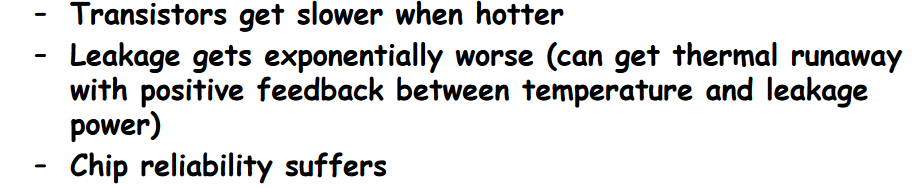
What was directly above? Oh yeah this: "Higher operating temperatures reduces efficiency. @igor_kavinski 's link spells it out clearly. Transistors get slower when hotter."

What is in that link?
1710171489928.png

That is quite some context. I can clearly see now that he is comparing this to the 8086 CPU. Thanks for your insight. Or is it the P4?
 
  • Haha
Reactions: igor_kavinski

Hitman928

Diamond Member
Apr 15, 2012
6,754
12,500
136
Lets see about that direct quote:
"Efficiency decreases & there is a very direct correlation. See above. It spells it out clearly."

What was directly above? Oh yeah this: "Higher operating temperatures reduces efficiency. @igor_kavinski 's link spells it out clearly. Transistors get slower when hotter."

What is in that link?
View attachment 95176

That is quite some context. I can clearly see now that he is comparing this to the 8086 CPU. Thanks for your insight. Or is it the P4?

I honestly don't know if you are just trolling at this point or what. . .

Are you arguing that he has no idea what he's talking about and should be ignored or that this quote somehow answers how 2 different CPUs can be compared for efficiency based solely on their temperature?
 

dullard

Elite Member
May 21, 2001
26,196
4,866
126
I honestly don't know if you are just trolling at this point or what. . .

Are you arguing that he has no idea what he's talking about and should be ignored or that this quote somehow answers how 2 different CPUs can be compared for efficiency based solely on their temperature?
Read it without thinking of comparing 2 different CPUs. Please take a few moments to relax and then come back and read all of his relevant posts in the context of "As temperature increases, a processor's efficiency decreases." Because it answers how "As temperature increases, a processor's efficiency decreases." and it only was ever intended to answer "As temperature increases, a processor's efficiency decreases."
 
  • Like
Reactions: SiliconFly

Hitman928

Diamond Member
Apr 15, 2012
6,754
12,500
136
Here, I'll make it very straight forward:

Also, now we can use M3 MacBook Air to heat water or coffee, and keep our room warm in winter, and can also use it for some cooking purposes as it runs hotter at 114°C (237°F) compared to raptor lake cpus!

Here' the link.

Looks like LNL may actually easily beat M3 in efficiency after all!

Efficiency does not decrease all that significantly with increased temperature and there is no correlation between operating temperature and efficiency between different chips.

there is a very direct correlation.

Make it make sense. . .
 

dullard

Elite Member
May 21, 2001
26,196
4,866
126
Make it make sense. . .
There is a very direct correlation between temperature and efficiency. That was his intent. You added "between different chips" to the conversation. Please read all of his posts without that addition. Yes, he spoke poorly. But please try to read what he intended. Clearly he missed your added words since he never intended your added words. I say "clearly" because he corrected himself in 3 different posts (all of which I linked above).
 
  • Like
Reactions: SiliconFly

Hitman928

Diamond Member
Apr 15, 2012
6,754
12,500
136
There is a very direct correlation between temperature and efficiency. That was his intent. You added "between different chips" to the conversation. Please read all of his posts without that addition. Yes, he spoke poorly. But please try to read what he intended. Clearly he missed your added words.

He made the comparison, not me. I said you can't compare different chips like that and he disagreed. If he didn't intend to tie temperature to efficiency between different chips, he had multiple opportunities to clarify. He was called out specifically on that and stood his ground over multiple posts and against multiple posters. Stop trying to gaslight people.