Discussion Intel Meteor, Arrow, Lunar & Panther Lakes + WCL Discussion Threads

Page 218 - Seeking answers? Join the AnandTech community: where nearly half-a-million members share solutions and discuss the latest tech.

Tigerick

Senior member
Apr 1, 2022
942
857
106
Wildcat Lake (WCL) Specs

Intel Wildcat Lake (WCL) is upcoming mobile SoC replacing Raptor Lake-U. WCL consists of 2 tiles: compute tile and PCD tile. It is true single die consists of CPU, GPU and NPU that is fabbed by 18-A process. Last time I checked, PCD tile is fabbed by TSMC N6 process. They are connected through UCIe, not D2D; a first from Intel. Expecting launching in Q1 2026.
Intel Raptor Lake UIntel Wildcat Lake 15W?Intel Lunar LakeIntel Panther Lake 4+0+4
Launch DateQ1-2024Q2-2026Q3-2024Q1-2026
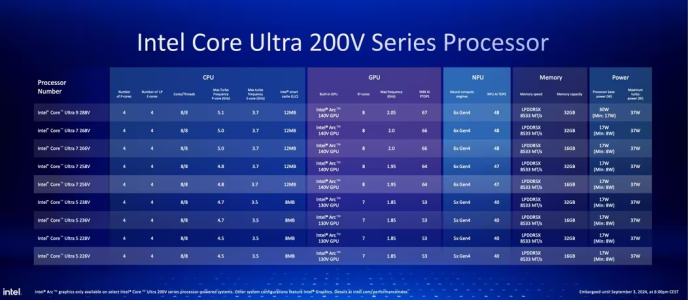
ModelIntel 150UIntel Core 7Core Ultra 7 268VCore Ultra 7 365
Dies2223
NodeIntel 7 + ?Intel 18-A + TSMC N6TSMC N3B + N6Intel 18-A + Intel 3 + TSMC N6
CPU2 P-core + 8 E-cores2 P-core + 4 LP E-cores4 P-core + 4 LP E-cores4 P-core + 4 LP E-cores
Threads12688
Max Clock5.4 GHz?5 GHz4.8 GHz
L3 Cache12 MB12 MB12 MB
TDP15 - 55 W15 W ?17 - 37 W25 - 55 W
Memory128-bit LPDDR5-520064-bit LPDDR5128-bit LPDDR5x-8533128-bit LPDDR5x-7467
Size96 GB32 GB128 GB
Bandwidth136 GB/s
GPUIntel GraphicsIntel GraphicsArc 140VIntel Graphics
RTNoNoYESYES
EU / Xe96 EU2 Xe8 Xe4 Xe
Max Clock1.3 GHz?2 GHz2.5 GHz
NPUGNA 3.018 TOPS48 TOPS49 TOPS


PPT1.jpg
PPT2.jpg
PPT3.jpg


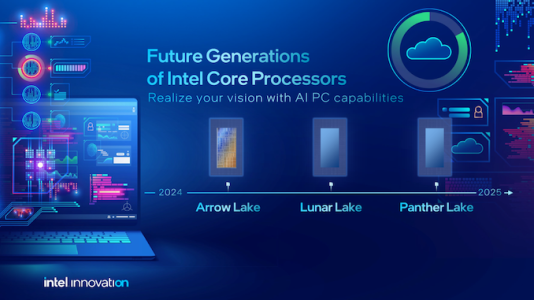
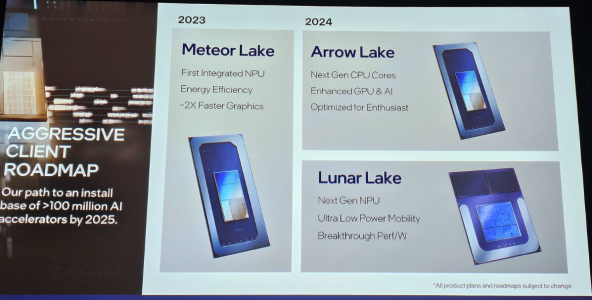
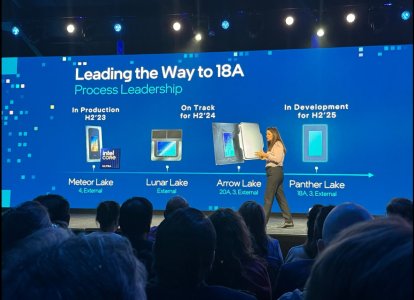
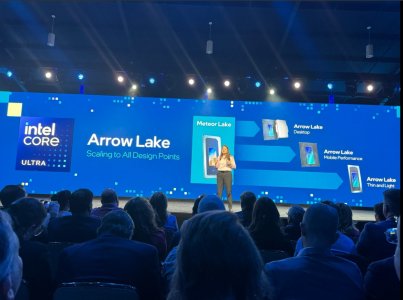
As Hot Chips 34 starting this week, Intel will unveil technical information of upcoming Meteor Lake (MTL) and Arrow Lake (ARL), new generation platform after Raptor Lake. Both MTL and ARL represent new direction which Intel will move to multiple chiplets and combine as one SoC platform.

MTL also represents new compute tile that based on Intel 4 process which is based on EUV lithography, a first from Intel. Intel expects to ship MTL mobile SoC in 2023.

ARL will come after MTL so Intel should be shipping it in 2024, that is what Intel roadmap is telling us. ARL compute tile will be manufactured by Intel 20A process, a first from Intel to use GAA transistors called RibbonFET.


LNL-MX.png
 

Attachments

  • PantherLake.png
    PantherLake.png
    283.5 KB · Views: 24,044
  • LNL.png
    LNL.png
    881.8 KB · Views: 25,531
  • INTEL-CORE-100-ULTRA-METEOR-LAKE-OFFCIAL-SLIDE-2.jpg
    INTEL-CORE-100-ULTRA-METEOR-LAKE-OFFCIAL-SLIDE-2.jpg
    181.4 KB · Views: 72,440
  • Clockspeed.png
    Clockspeed.png
    611.8 KB · Views: 72,327
Last edited:

gdansk

Diamond Member
Feb 8, 2011
4,789
8,083
136
It seems the only bits of MTL actually delivering upgrades are the TSMC-built tiles (SoC tile with LPE cores and GPU tile).

I will hold out hope for 20A or 18A bringing something nice.
 

H433x0n

Golden Member
Mar 15, 2023
1,224
1,606
106
It seems the only bits of MTL actually delivering upgrades are the TSMC-built tiles (SoC tile with LPE cores and GPU tile).

I will hold out hope for 20A or 18A bringing something nice.
The LPE Cores have performed terribly by all metrics.
 

gdansk

Diamond Member
Feb 8, 2011
4,789
8,083
136
The LPE Cores have performed terribly by all metrics.
Totally disagree. They're there to allow less power usage when watching videos or waking briefly from sleep to check messages. That's the upgrade, which appears in some reviews as long playback times. In CPU benchmarks there is little positive to say about MTL at all. Except at 5W where one doesn't actually do benchmark-like tasks.
 
Last edited:

H433x0n

Golden Member
Mar 15, 2023
1,224
1,606
106
Totally disagree. They're there to allow less power usage when watching videos or waking briefly from sleep to check messages. That's the upgrade, which appears in some reviews as long playback times. In CPU benchmarks there is little positive to say about MTL at all. Except at 5W where one doesn't actually do benchmark-like tasks.
That's the rub, it doesn't seem the lp e-cores have enough grunt to handle some of these background tasks. They're effectively useless.
 
  • Like
Reactions: CouncilorIrissa

gdansk

Diamond Member
Feb 8, 2011
4,789
8,083
136
That's the rub, it doesn't seem the lp e-cores have enough grunt to handle some of these background tasks. They're effectively useless.
Seems to work in some reviews. The YMMV factor is quite high with laptops in general but especially MTL.
 

Khato

Golden Member
Jul 15, 2001
1,381
491
136
That's the rub, it doesn't seem the lp e-cores have enough grunt to handle some of these background tasks. They're effectively useless.
While I wouldn't go so far as to call them useless, they definitely aren't what they could be. Kinda reminiscent of desktop ADL where all but the i9 skus only got 4 E-cores - enough to do something, but barely enough to justify their existence. In both cases I'd guess the intention is to provide some performance benefit at minimal risk/cost while, more importantly, enabling software development for the 'real' implementation coming with the next generation.

One area I haven't seen anything about which I'm hoping to see notable improvement on thanks to the LP-E-cores is modern standby power draw. After a decade of inflicting miserable modern standby upon us all it's well past time for it to be less bad.
 

mikk

Diamond Member
May 15, 2012
4,333
2,414
136
How were you able to come to this conclusion? LPE cores can run up to 1.7Ghz slower and lack access to L3 cache. For all we know, in certain SKUs and certain workloads, the E core might offer double the performance of an LPE core.


2.5 Ghz for the 155H. But does it even clock that high in real world? Because the performance difference seems huge.
 

SiliconFly

Golden Member
Mar 10, 2023
1,924
1,284
106
How were you able to come to this conclusion? LPE cores can run up to 1.7Ghz slower and lack access to L3 cache. For all we know, in certain SKUs and certain workloads, the E core might offer double the performance of an LPE core.
No. It's 2.5 GHz according to Intel. And it's more than sufficient for running background threads. LPE cores are not meant to replace or offset E cores or P cores. They are meant for idling without waking up the CPU tile. Only for higher power efficiency and nothing else.
 

coercitiv

Diamond Member
Jan 24, 2014
7,488
17,894
136
No. It's 2.5 GHz according to Intel. And it's more than sufficient for running background threads. LPE cores are not meant to replace or offset E cores or P cores. They are meant for idling without waking up the CPU tile. Only for higher power efficiency and nothing else.
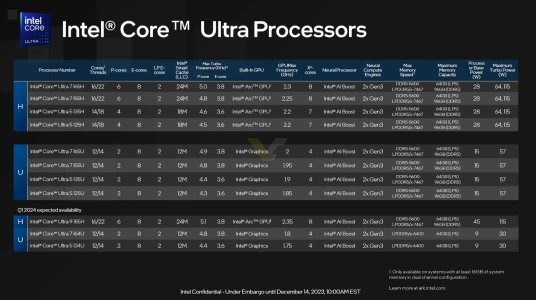
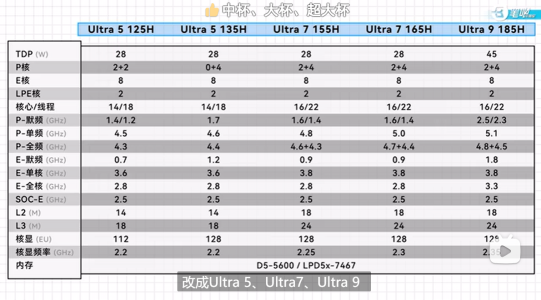
The lowest case is 2.1Ghz boost in the 155U, check my link above. Even at 2.5Ghz there's still a 1.3Ghz delta versus E core boost. That's a 50% difference in clocks alone, then we need to factor in L3.

And it's more than sufficient for running background threads.
This is not what you wrote in your previous post, the one I replied to:
I think the performance of the LPE cores are closer to that of the regular E cores.

Giving me a lecture on the purpose of LPE cores isn't going to change the accuracy of your quantitative estimates.
 

Glo.

Diamond Member
Apr 25, 2015
5,930
4,991
136
Which architecture, apart from Lunar Lake will use Battlemage architecture?

What is the consensus on the configuration of Arrow Lake iGPU? Is it 128 EUs?
 

coercitiv

Diamond Member
Jan 24, 2014
7,488
17,894
136
But does it even clock that high in real world? Because the performance difference seems huge.
I would expect the scheduler for these cores to be rather lazy, only boosting higher when the load is close to max. There's clear intent from Intel to keep power usage under a certain limit, otherwise we would not have this difference in boost of the LPE cores between U and H lines. (2.1Ghz vs. 2.5Ghz).

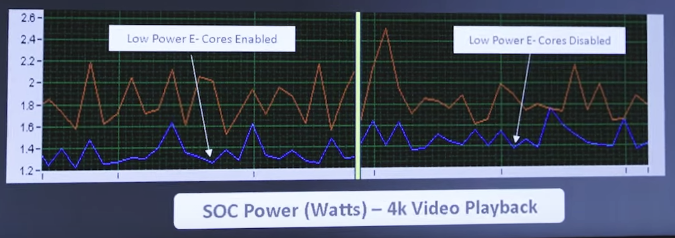
I think you posted a video yesterday with measurements from Intel for enabling/disabling LPE cores in video playback. Here's a screenshot from that video, specifically from the slide shown above the tech demo:

1705250686469.png

According to the Intel engineer, power delta between using LPE cores and using regular E cores in the compute tile to help with video playback is ~100-150mW, on that particular laptop design and platform. Since CPU load should be minimal for hardware accelerated video rendering, this is probably one of the more favorable cases for LPE usage, and yet the power savings are not that impressive. Maybe it would matter if MTL wasn't winning against Phoenix in video playback anyway, or maybe it will matter in other workloads or against other competing chips later in the product's life cycle.

For now though the LPE idea, as much as like it out of all things Intel did in the recent years, seems like it needs more iterations before it shines. Maybe what we'll see in LNL will be better suited for mobile usage, with more separation between P and E cores.
 

mikk

Diamond Member
May 15, 2012
4,333
2,414
136
Which architecture, apart from Lunar Lake will use Battlemage architecture?

What is the consensus on the configuration of Arrow Lake iGPU? Is it 128 EUs?


Not sure if Panther Lake will still use Battlemage or already Celestial. This leak hinted to Xe LPG Celestial for PTL. Nova Lake a year later is more likely to use Celestial. Maybe there isn't much with Battlemage. From what I heard ARL still uses 128 EUs yes.
 

Glo.

Diamond Member
Apr 25, 2015
5,930
4,991
136
Not sure if Panther Lake will still use Battlemage or already Celestial. This leak hinted to Xe LPG Celestial for PTL. Nova Lake a year later is more likely to use Celestial. Maybe there isn't much with Battlemage. From what I heard ARL still uses 128 EUs yes.
128EUs is irrelevant.

128 Alchemist EUs - 1024 ALUs.
128 Battlemage EUs - 2048 ALUs.

If its 128 EUs with BMG - its going to be game changer for iGPUs. If its the same Alchemist arch - its just meh.
 

Khato

Golden Member
Jul 15, 2001
1,381
491
136
It's certainly going to be slightly amusing if we get LNL with Xe2 launching a bit before ARL with mostly just a reuse of the MTL graphics tile. Clearly they could have upgraded ARL to use Xe2. I'd guess such would be done for reasons of cost and risk. Just will result in AMD taking the lead again in graphics against ARL whenever their next generation comes out. Also may well result in the mainstream platform skipping straight from Xe+ with ARL to Xe3 on PTL.

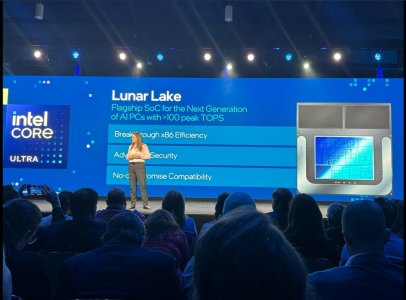
I do wonder LNL is going to end up more on the niche side of laptop designs or relegate MTL/ARL to budget and high-performance designs. 4P+4LPE configuration likely won't be too different from 2P+8E of the MTL/ARL U series leaving them as the budget option. Sure it'll be slower in heavy compute compared to 6P+8E, but I'd guess there aren't too many laptop use cases where the reduced core count is going to be an issue. Whereas going from 8xXe+ to 8xXe2 on graphics should be awesome. I guess there's also going to be a 'next generation' NPU to satiate the current TOPS craze as well.
 

Hitman928

Diamond Member
Apr 15, 2012
6,754
12,500
136
It's certainly going to be slightly amusing if we get LNL with Xe2 launching a bit before ARL with mostly just a reuse of the MTL graphics tile. Clearly they could have upgraded ARL to use Xe2. I'd guess such would be done for reasons of cost and risk. Just will result in AMD taking the lead again in graphics against ARL whenever their next generation comes out. Also may well result in the mainstream platform skipping straight from Xe+ with ARL to Xe3 on PTL.

I do wonder LNL is going to end up more on the niche side of laptop designs or relegate MTL/ARL to budget and high-performance designs. 4P+4LPE configuration likely won't be too different from 2P+8E of the MTL/ARL U series leaving them as the budget option. Sure it'll be slower in heavy compute compared to 6P+8E, but I'd guess there aren't too many laptop use cases where the reduced core count is going to be an issue. Whereas going from 8xXe+ to 8xXe2 on graphics should be awesome. I guess there's also going to be a 'next generation' NPU to satiate the current TOPS craze as well.

LNL is for ultra low power (for the x86 world) devices. It is targeted at <15 W operation. It can be pushed higher but it’s not really where it is intended to be used.
 

jpiniero

Lifer
Oct 1, 2010
17,200
7,576
136
LNL is for ultra low power (for the x86 world) devices. It is targeted at <15 W operation. It can be pushed higher but it’s not really where it is intended to be used.

Thing is, OEMs just don't seem to be that interested in that low of power in a premium device.
 

Hitman928

Diamond Member
Apr 15, 2012
6,754
12,500
136
Thing is, OEMs just don't seem to be that interested in that low of power in a premium device.
LNL should be much more capable in that power range than their previous efforts. We’ll see if they get a better reaction for it.
 

mikk

Diamond Member
May 15, 2012
4,333
2,414
136
It's certainly going to be slightly amusing if we get LNL with Xe2 launching a bit before ARL with mostly just a reuse of the MTL graphics tile. Clearly they could have upgraded ARL to use Xe2. I'd guess such would be done for reasons of cost and risk. Just will result in AMD taking the lead again in graphics against ARL whenever their next generation comes out. Also may well result in the mainstream platform skipping straight from Xe+ with ARL to Xe3 on PTL.

Intel is talking more about Lunar Lake than about Arrow Lake. At CES they didn't even talk about Arrow Lake mobile, they talked about Arrow Lake on desktop. Like they are more confident for Lunar Lake than for Arrow Lake mobile. Seems like Lunar Lake comes before Arrow Lake-H.
 
  • Like
Reactions: igor_kavinski

coercitiv

Diamond Member
Jan 24, 2014
7,488
17,894
136
Thing is, OEMs just don't seem to be that interested in that low of power in a premium device.
Most thin and light 13-14" devices are only equipped to cool 15-20W efficiently, after that the noise is not something you would want to hear. OEMs will get their performance profile where the chip designed for 12W operation will pull 28W, everyone will be happy.