Discussion Intel Meteor, Arrow, Lunar & Panther Lakes + WCL Discussion Threads

Page 917 - Seeking answers? Join the AnandTech community: where nearly half-a-million members share solutions and discuss the latest tech.

Tigerick

Senior member
Apr 1, 2022
911
829
106
Wildcat Lake (WCL) Preliminary Specs

Intel Wildcat Lake (WCL) is upcoming mobile SoC replacing ADL-N. WCL consists of 2 tiles: compute tile and PCD tile. It is true single die consists of CPU, GPU and NPU that is fabbed by 18-A process. Last time I checked, PCD tile is fabbed by TSMC N6 process. They are connected through UCIe, not D2D; a first from Intel. Expecting launching in Q2/Computex 2026. In case people don't remember AlderLake-N, I have created a table below to compare the detail specs of ADL-N and WCL. Just for fun, I am throwing LNL and upcoming Mediatek D9500 SoC.

Intel Alder Lake - NIntel Wildcat LakeIntel Lunar LakeMediatek D9500
Launch DateQ1-2023Q2-2026 ?Q3-2024Q3-2025
ModelIntel N300?Core Ultra 7 268VDimensity 9500 5G
Dies2221
NodeIntel 7 + ?Intel 18-A + TSMC N6TSMC N3B + N6TSMC N3P
CPU8 E-cores2 P-core + 4 LP E-cores4 P-core + 4 LP E-coresC1 1+3+4
Threads8688
Max Clock3.8 GHz?5 GHz
L3 Cache6 MB?12 MB
TDP7 WFanless ?17 WFanless
Memory64-bit LPDDR5-480064-bit LPDDR5-6800 ?128-bit LPDDR5X-853364-bit LPDDR5X-10667
Size16 GB?32 GB24 GB ?
Bandwidth~ 55 GB/s136 GB/s85.6 GB/s
GPUUHD GraphicsArc 140VG1 Ultra
EU / Xe32 EU2 Xe8 Xe12
Max Clock1.25 GHz2 GHz
NPUNA18 TOPS48 TOPS100 TOPS ?


PPT1.jpg
PPT2.jpg
PPT3.jpg


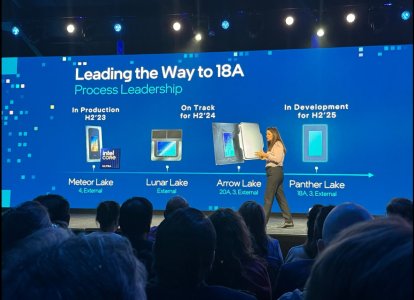
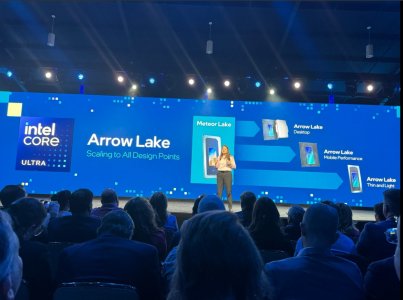
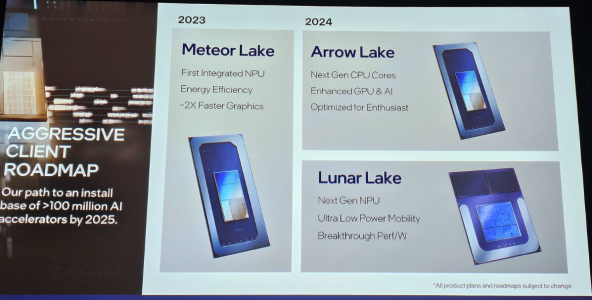
As Hot Chips 34 starting this week, Intel will unveil technical information of upcoming Meteor Lake (MTL) and Arrow Lake (ARL), new generation platform after Raptor Lake. Both MTL and ARL represent new direction which Intel will move to multiple chiplets and combine as one SoC platform.

MTL also represents new compute tile that based on Intel 4 process which is based on EUV lithography, a first from Intel. Intel expects to ship MTL mobile SoC in 2023.

ARL will come after MTL so Intel should be shipping it in 2024, that is what Intel roadmap is telling us. ARL compute tile will be manufactured by Intel 20A process, a first from Intel to use GAA transistors called RibbonFET.
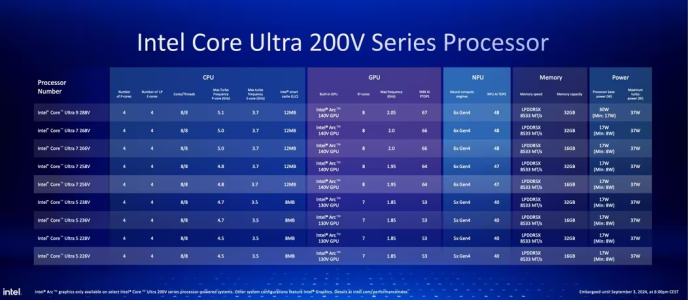


LNL-MX.png
 

Attachments

  • PantherLake.png
    PantherLake.png
    283.5 KB · Views: 24,034
  • LNL.png
    LNL.png
    881.8 KB · Views: 25,527
  • INTEL-CORE-100-ULTRA-METEOR-LAKE-OFFCIAL-SLIDE-2.jpg
    INTEL-CORE-100-ULTRA-METEOR-LAKE-OFFCIAL-SLIDE-2.jpg
    181.4 KB · Views: 72,435
  • Clockspeed.png
    Clockspeed.png
    611.8 KB · Views: 72,321
Last edited:

OneEng2

Senior member
Sep 19, 2022
951
1,163
106
It's 400Mhz lower clock 4.7 vs 5.1 has like 6% IPC Improvements so the best case is PTL will have same st as arl but lower power
In laptop and in DC applications, I believe the max performance will be strictly limited by power. In this regard, efficiency improvements should lead to better performance at the same power.
 

dullard

Elite Member
May 21, 2001
26,138
4,796
126
In laptop and in DC applications, I believe the max performance will be strictly limited by power. In this regard, efficiency improvements should lead to better performance at the same power.
While what you posted is correct, I just fail to see the compelling argument to buy a low-power ultra-light laptop for distributed computing. Will someone do it? Yes. But, that is basically an edge case.
 

LightningZ71

Platinum Member
Mar 10, 2017
2,625
3,308
136
Overall, lithography tends to push nT performance per sq/mm of core silicon as well as nT performance per watt of power over anything else. Denser XTORS let you make more complicated core designs, which certainly helps 1T performance, but nT performance always seems to increase by a greater degree. As we hit the limits of transporting heat away from those XTORS, nT performance scaling is going to suffer for a bit as clocks have to slow down.
 

DavidC1

Platinum Member
Dec 29, 2023
2,003
3,152
96
It depends on how it's designed, no? Why would parameterizing most of the design to work with an arbitrary number of decode clusters should be difficult? I'd guess that only a few blocks would require separate logic for each configuration. Would that really qualify as a different architecture? I know it would with old school design methodology, but with current design and synthesis flows it could be almost entirely reuse.
Remember we're looking at the mile-high level. There are countless engineering decisions that goes into making a core.

The simplest way of doing what you suggest is just adding more decode clusters. However, the gains of doing that will be small, in the region of few single digit %. Extra decode *must* come with expanding and innovation everywhere else. The few % gain of just adding decoders can be done in a much more power, area, and time efficient way, which is addressing bottlenecks in a targetted way. That in Intel term is called a Tick. Look at how small the scale of changes on Crestmont is.

So why do they add more decoders if it's so small of a gain? Because a trillion different teeny rocks end up being a beach. It's just part of a big picture. Thus a theoretical 5x3 would be a massive change over a 4x3.

Also, at the high end simplicity has always translated into making more complex in a more efficient way. So when they tell you it's 30% faster with a new design methodology, at the high end it'll be used for putting more performance in.
 
Last edited:
  • Like
Reactions: ashFTW and MrMPFR

poke01

Diamond Member
Mar 8, 2022
4,560
5,857
106
Panther Lake launch event: Jan 5, 2026 3 PM PST
I guess late jan or early feb to buy for countries other than USA and china.
 

regen1

Senior member
Aug 28, 2025
227
288
96
CQDIMM

Already announced on some Z890 platform
 
  • Like
Reactions: Elfear

dullard

Elite Member
May 21, 2001
26,138
4,796
126
Panther Lake is currently in production in Oregon. But, the Arizona fab should ramp up in Q1 2026 with better yields and lower costs:

"Initially on any new process, we take wafers from Oregon," said John Pitzer... "Oregon is where we do all of our technology development and then move into quasi high-volume manufacturing."

"Those wafers tend to be pretty expensive. Most, if not all, of the Panther Lake wafers this year are coming from Oregon. As we transition into Q1, you will start to see wafers coming in from Arizona [which] has a much better and different cost structure, and that ramps throughout the year," Pitzer said.
https://www.tomshardware.com/pc-com...eals-and-cutting-edge-18a-process-is-on-track
 
Last edited:

Khato

Golden Member
Jul 15, 2001
1,319
391
136
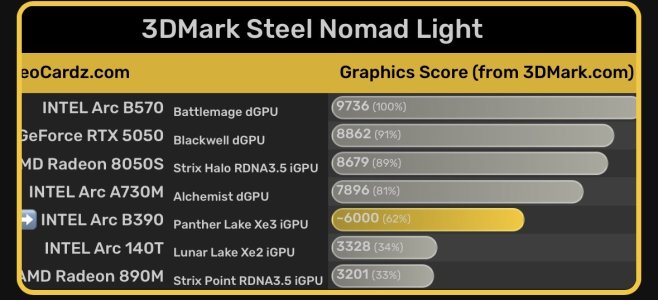
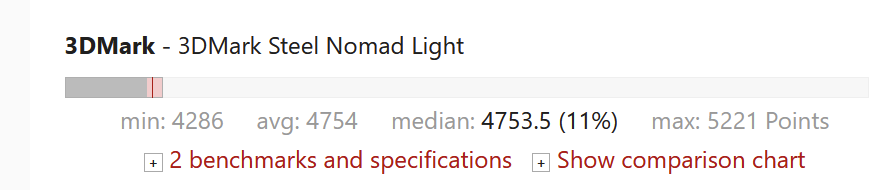
Probably results from a 45W configuration where it's nowhere near as efficient. Should be closer to 5k in Time Spy at 25W. Still nice to see the potential is there to scale up a fair amount when provided with more power.
 

511

Diamond Member
Jul 12, 2024
5,017
4,528
106
Probably results from a 45W configuration where it's nowhere near as efficient. Should be closer to 5k in Time Spy at 25W. Still nice to see the potential is there to scale up a fair amount when provided with more power.
i don't think it's 45W it's likely t be 40W imo
 

Magio

Member
May 13, 2024
194
231
76
Still nice to see the potential is there to scale up a fair amount when provided with more power.

From Intel's slides when they (sort of) unveiled PTL, that's the big difference vs ARL/LNL, the GPU is not a million times more performant than those at low power but it scales far higher.

For my own preferences I do hope it does well enough at the sub 30W range that manufacturers ship decent thin and lights at that TDP, but the upside on slightly chunkier designs that can handle 40+W is good news too.
 

DavidC1

Platinum Member
Dec 29, 2023
2,003
3,152
96
The iGPU Score is better than M5 but package power is unknown
View attachment 134352
Some of these benchmarks favor the mobile variants too much with FP16 vs FP32. The Aztec benchmark for example needs to add 30% for Intel/AMD GPUs versus ARM because of this. The only proper synthetic benchmark is Time Spy. It's not necessarily representative of gaming performance for iGPUs because it's too demanding, but can be if you play games that run at 20-30 fps.
 

poke01

Diamond Member
Mar 8, 2022
4,560
5,857
106
Some of these benchmarks favor the mobile variants too much with FP16 vs FP32. The Aztec benchmark for example needs to add 30% for Intel/AMD GPUs versus ARM because of this. The only proper synthetic benchmark is Time Spy. It's not necessarily representative of gaming performance for iGPUs because it's too demanding, but can be if you play games that run at 20-30 fps.
depends on the mobile GPU. Apple GPUs do poorly on GFXbench. It’s ARMs own Mali GPUs that do well.

In any case Steel nomad light isn’t a replacement for Time spy, it’s Steel Nomad which is much more demanding.
 

DavidC1

Platinum Member
Dec 29, 2023
2,003
3,152
96
depends on the mobile GPU. Apple GPUs do poorly on GFXbench. It’s ARMs own Mali GPUs that do well.

In any case Steel nomad light isn’t a replacement for Time spy, it’s Steel Nomad which is much more demanding.
I'm talking about x86 vs ARM comparisons. The mobile benchmarks run on FP16, and the PC GPUs run on FP32, even though Intel has been capable of FP16 since Bay Trail. That's a big part of why Apple GPUs underperform in games compared to Nvidia GPUs.
 

Josh128

Golden Member
Oct 14, 2022
1,505
2,256
106
There's more than enough N2p for everyone, plus HPC GPGPU sticks are HBM/packaging limited anyway.
Well this obviously incorrect statement has aged like warm milk and has now been proven to be false by TSMC's own CEO. TSMC was not able to forecast current demand in projections from 3+ years ago, and therefore did not size their bleeding edge fabs capacity anywhere close to meeting current demand, lol.


In their speeches, Wei Zhejia and Liu Deyin both reviewed the nearly 30 years of working together and emphasized that this honor belongs to the entire TSMC team. U.S. Secretary of Commerce Howard Lutnick also paid tribute through a pre-recorded video, bluntly stating that "your leadership at TSMC has changed the world" and promoted advanced manufacturing and global technological progress, and his speech received warm applause from the audience.

When talking about the demand for AI-driven advanced processes, Wei Zhejia's tone changed, pointing out that customer demand far exceeded expectations. He revealed that according to the product planning and growth expectations of major customers, "TSMC's existing production capacity is still about 3 times short", and the advanced process production capacity is "not enough, not enough, or still not enough". He even laughed and said that he originally wanted to wear a T-shirt with the words "No more wafer" on stage, implying that the demand for wafers was too strong to digest, which became one of the most high-profile conversations of the night.
 

LightningZ71

Platinum Member
Mar 10, 2017
2,625
3,308
136
No one was predicting the accounting tricks and level of imaginary money that would magically appear into existence to fund the unprecedented level of demand that they are seeing. There just wasn't enough money in existence to justify the level of build out needed for current demand. There still probably isn't.
 
  • Like
Reactions: Joe NYC and Doug S

Josh128

Golden Member
Oct 14, 2022
1,505
2,256
106
No one was predicting the accounting tricks and level of imaginary money that would magically appear into existence to fund the unprecedented level of demand that they are seeing. There just wasn't enough money in existence to justify the level of build out needed for current demand. There still probably isn't.
Which is exactly what I was telling him, and why AMD will prioritize wafers for AI and DC rather than DT. The insane demand materialized only in the last 2 years or so, not enough time to expand construction of fabs to meet it, therefore they cant produce enough to meet the demand.

If the demand is there , AMD'd have to be foolish not to prioritize allocation to AI and DC.
 

LightningZ71

Platinum Member
Mar 10, 2017
2,625
3,308
136
With demand at such ridiculous levels, the pricing of wafers as going to go through the roof. They likely can't make a profit case for client directed wafers at this point. We're going to see trailing node products for a long time because they are far less attractive to AI/DC.