Discussion Intel Meteor, Arrow, Lunar & Panther Lakes + WCL Discussion Threads

Page 887 - Seeking answers? Join the AnandTech community: where nearly half-a-million members share solutions and discuss the latest tech.

Tigerick

Senior member
Apr 1, 2022
941
857
106
Wildcat Lake (WCL) Specs

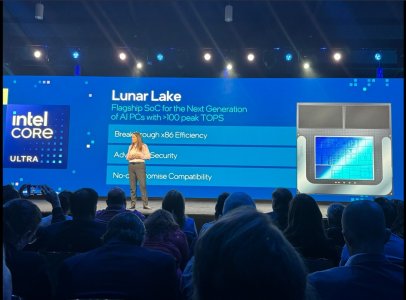
Intel Wildcat Lake (WCL) is upcoming mobile SoC replacing Raptor Lake-U. WCL consists of 2 tiles: compute tile and PCD tile. It is true single die consists of CPU, GPU and NPU that is fabbed by 18-A process. Last time I checked, PCD tile is fabbed by TSMC N6 process. They are connected through UCIe, not D2D; a first from Intel. Expecting launching in Q1 2026.
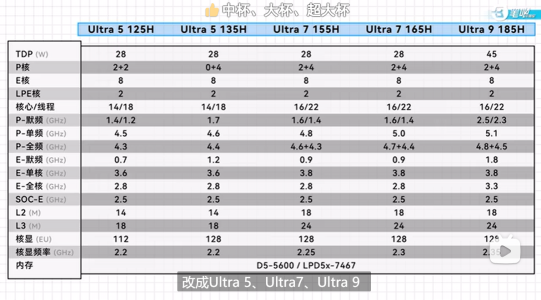
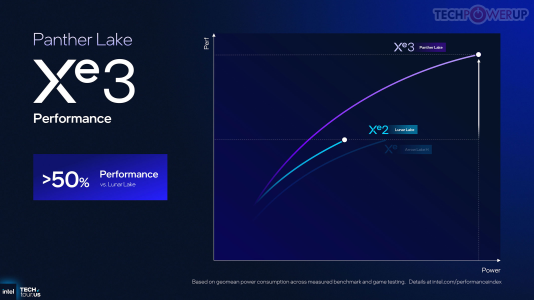
Intel Raptor Lake UIntel Wildcat Lake 15W?Intel Lunar LakeIntel Panther Lake 4+0+4
Launch DateQ1-2024Q2-2026Q3-2024Q1-2026
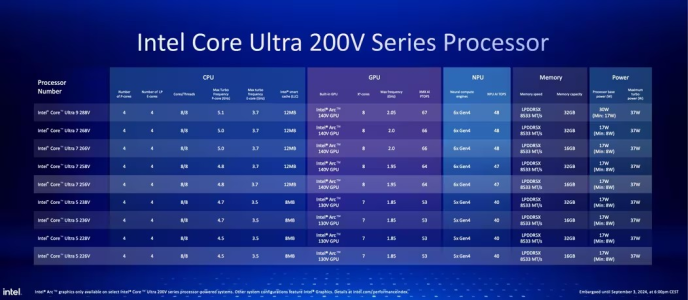
ModelIntel 150UIntel Core 7Core Ultra 7 268VCore Ultra 7 365
Dies2223
NodeIntel 7 + ?Intel 18-A + TSMC N6TSMC N3B + N6Intel 18-A + Intel 3 + TSMC N6
CPU2 P-core + 8 E-cores2 P-core + 4 LP E-cores4 P-core + 4 LP E-cores4 P-core + 4 LP E-cores
Threads12688
Max Clock5.4 GHz?5 GHz4.8 GHz
L3 Cache12 MB12 MB12 MB
TDP15 - 55 W15 W ?17 - 37 W25 - 55 W
Memory128-bit LPDDR5-520064-bit LPDDR5128-bit LPDDR5x-8533128-bit LPDDR5x-7467
Size96 GB32 GB128 GB
Bandwidth136 GB/s
GPUIntel GraphicsIntel GraphicsArc 140VIntel Graphics
RTNoNoYESYES
EU / Xe96 EU2 Xe8 Xe4 Xe
Max Clock1.3 GHz?2 GHz2.5 GHz
NPUGNA 3.018 TOPS48 TOPS49 TOPS


PPT1.jpg
PPT2.jpg
PPT3.jpg


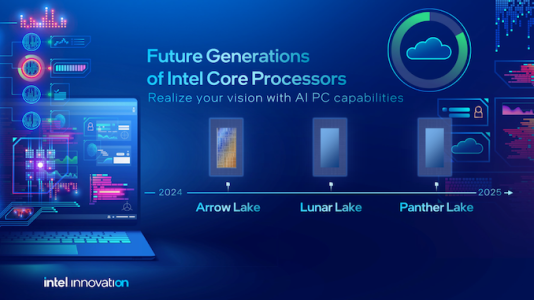
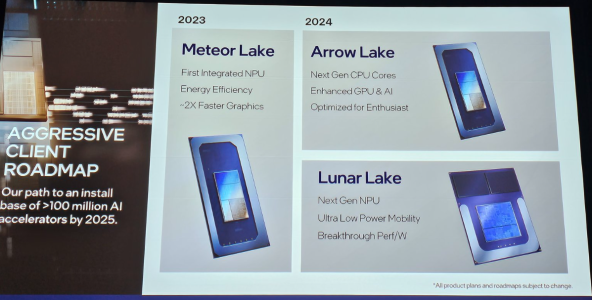
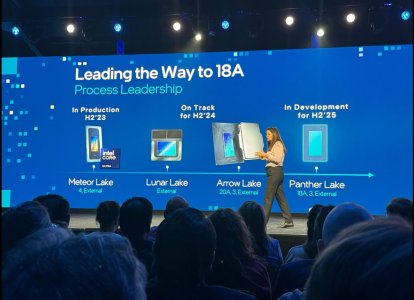
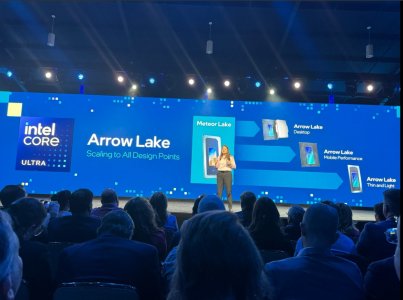
As Hot Chips 34 starting this week, Intel will unveil technical information of upcoming Meteor Lake (MTL) and Arrow Lake (ARL), new generation platform after Raptor Lake. Both MTL and ARL represent new direction which Intel will move to multiple chiplets and combine as one SoC platform.

MTL also represents new compute tile that based on Intel 4 process which is based on EUV lithography, a first from Intel. Intel expects to ship MTL mobile SoC in 2023.

ARL will come after MTL so Intel should be shipping it in 2024, that is what Intel roadmap is telling us. ARL compute tile will be manufactured by Intel 20A process, a first from Intel to use GAA transistors called RibbonFET.


LNL-MX.png
 

Attachments

  • PantherLake.png
    PantherLake.png
    283.5 KB · Views: 24,044
  • LNL.png
    LNL.png
    881.8 KB · Views: 25,531
  • INTEL-CORE-100-ULTRA-METEOR-LAKE-OFFCIAL-SLIDE-2.jpg
    INTEL-CORE-100-ULTRA-METEOR-LAKE-OFFCIAL-SLIDE-2.jpg
    181.4 KB · Views: 72,439
  • Clockspeed.png
    Clockspeed.png
    611.8 KB · Views: 72,326
Last edited:

LightningZ71

Platinum Member
Mar 10, 2017
2,690
3,390
136
IGPUs, if they can fit in the EXACT same power/thermal/physical envelope as their existing OEM designs can be a very attractive thing, because they require the OEM to not have to spend a single penny to modify their design to offer them.

Strix Halo had two very real problems: the whole processor package was expensive because it had to eat considerably R&D overhead, and because it was a lot of near leading edge silicon, AND it required a brand new motherboard design that fed four channels (well 8 LPDDR6 channels) to the processor. It has precious little volume to spread it's fixed costs around on as well. Add to that the fact that the IEM doesn't get to bleed you for a dGPU markup, and you have the perfect storm for a moribund product.

If AMD was serious about Strix Halo, they would have partnered with an OEM to develop a reference platform to launch the product with. From what I've read, they didn't really do that beyond the uSFF developer and production boards. It's got the basics to be a great product, but they refused to fund developing an ecosystem for it.

There is no physical reason that you should be able to buy 5070 laptops for less than the retail cost of Strix Halo laptops, but, it looks like that will be the case, should they ever hit the market. (And I don't count the convertible tablet and the modular ones)
 

DavidC1

Platinum Member
Dec 29, 2023
2,171
3,322
106
IGPUs, if they can fit in the EXACT same power/thermal/physical envelope as their existing OEM designs can be a very attractive thing, because they require the OEM to not have to spend a single penny to modify their design to offer them.

Strix Halo had two very real problems: the whole processor package was expensive because it had to eat considerably R&D overhead, and because it was a lot of near leading edge silicon, AND it required a brand new motherboard design that fed four channels (well 8 LPDDR6 channels) to the processor. It has precious little volume to spread it's fixed costs around on as well. Add to that the fact that the IEM doesn't get to bleed you for a dGPU markup, and you have the perfect storm for a moribund product.
I knew they would have similar reception as Intel's Iris parts. Looking at history always speaks for itself. Halo iGPUs always have a hard time for this reason. Cost. But people are like "no this time is different".

Halo iGPUs are desired because they have the perception that it's an iGPU so there's an unconscious connection that it must inherit all the advantages. Well, you aren't getting the cost part. If they got Ryzen 3 with Halo, it would cut $300 off the price and be closer to the $999 system mark. That would impact almost nothing on graphics performance but make it much more attractive.
Strix Halo had two very real problems: the whole processor package was expensive because it had to eat considerably R&D overhead, and because it was a lot of near leading edge silicon, AND it required a brand new motherboard design that fed four channels (well 8 LPDDR6 channels) to the processor. It has precious little volume to spread it's fixed costs around on as well. Add to that the fact that the IEM doesn't get to bleed you for a dGPU markup, and you have the perfect storm for a moribund product.

If AMD was serious about Strix Halo, they would have partnered with an OEM to develop a reference platform to launch the product with. From what I've read, they didn't really do that beyond the uSFF developer and production boards. It's got the basics to be a great product, but they refused to fund developing an ecosystem for it.

There is no physical reason that you should be able to buy 5070 laptops for less than the retail cost of Strix Halo laptops, but, it looks like that will be the case, should they ever hit the market. (And I don't count the convertible tablet and the modular ones)
Those are physical reasons.
 
Last edited:

LightningZ71

Platinum Member
Mar 10, 2017
2,690
3,390
136
It's not cheaper, you actually pay more(quite a bit more) to get the high iGPU because you are forced to pay the highest CPU. With dGPU they can pair it with Core Ultra 3 if they want. And even 12 Xe3 is going to perform like the lowest end dGPUs anyway, so why do you need Ultra 9 to get it?

Want to spread halo iGPU? Get a SKU out that doesn't waste money on high end CPU. Right now you are paying $250 CPU + $100 GPU. How about $100 CPU + $100 GPU?

AMD/Intel: "Pairs their GPU with 7 and 9 series GPUs

"Muh nobody ain't buying our halo graphics!"

Uhh, it's a $1500 system for x60 graphics.....

It doesn't matter that GTX 1050 Ti is not super duper faster than Lunarlake or Strix graphics. Especially in many newer games(where you need the frames), the iGPUs are often faster. That's the point, not that Heaven is relevant.

1GHz lower is almost nothing. One is running at 4GHz and the other is running at 5GHz, whoopdee doo. The biggest thing is the low CPU paired Halo will save you a bunch of money, which makes sense, rather than paying $600+ for x60 class performance. Of course the financially irresponsible can pair their RTX 5060 mobile with 9950X3D and 285K.
How much less do you think that i3 package costs than the i9 package? The difference, as long as it isn't wildcat lake, is a few tens of dollars of actual cost. That's NOT going to make a drastic difference in cost. As for i3 itself, I want at least 12 threads for modern gaming with no LPE cores in their own separate cache domain. There's no HT on Panther Lake, so that means at least 4+8+4.
 

Fjodor2001

Diamond Member
Feb 6, 2010
4,599
740
126
It's not cheaper, you actually pay more(quite a bit more) to get the high iGPU because you are forced to pay the highest CPU. With dGPU they can pair it with Core Ultra 3 if they want.
Yes, assuming you don't need the extra CPU perf.

But I was talking about the case when CPU perf is the same, and comparing what it then costs to get a certain GPU perf via either iGPU or dGPU.
 
Last edited:

DavidC1

Platinum Member
Dec 29, 2023
2,171
3,322
106
How much less do you think that i3 package costs than the i9 package?
You know better. I know you know better. Tell me how much the i9 config costs. Tell me how much i3 config costs. It's often $300+. Top bin i9 adds $100 on top of that.

And they can just emphasize on graphics. The marketers know how to package something free and charge money for minimal amounts(bottled water). Surely it's no problem to sell a good iGPU. The province of BC here sold something like a million Gallons of water to Nestle for few $.
Yes, assuming don't need the extra CPU perf.

But I was talking about the case when CPU perf is the same, and comparing what it then costs to get a certain GPU perf via either iGPU or dGPU.
It matters the first year, but after that it doesn't matter.

I regret buying the i7 config for my old XPS 12. The CPU made no difference after few years, since an i3 in 3 years is just as good anyway. A faster GPU on the other hand would have been the difference between some games being playable and some being not.
 

LightningZ71

Platinum Member
Mar 10, 2017
2,690
3,390
136
I knew they would have similar reception as Intel's Iris parts. Looking at history always speaks for itself. Halo iGPUs always have a hard time for this reason. Cost. But people are like "no this time is different".

Halo iGPUs are desired because they have the perception that it's an iGPU so there's an unconscious connection that it must inherit all the advantages. Well, you aren't getting the cost part. If they got Ryzen 3 with Halo, it would cut $300 off the price and be closer to the $999 system mark. That would impact almost nothing on graphics performance but make it much more attractive.

Those are physical reasons.
Those are R&D and fixed cost reasons. Those are NOT running cost reasons. For a 5070 laptop, which can be had for less than $1400, it has the whole processor package, the whole GPU package, the memory lanes for the CPU, expensive GDDR for the GPU, separate power delivery circuits for the GPU, double the metal for heat dissipation, more fans, and more airflow volume on the case.

No PHYSICAL reason, plenty of accounting ones though.
 

DavidC1

Platinum Member
Dec 29, 2023
2,171
3,322
106
Those are R&D and fixed cost reasons. Those are NOT running cost reasons. For a 5070 laptop, which can be had for less than $1400, it has the whole processor package, the whole GPU package, the memory lanes for the CPU, expensive GDDR for the GPU, separate power delivery circuits for the GPU, double the metal for heat dissipation, more fans, and more airflow volume on the case.

No PHYSICAL reason, plenty of accounting ones though.
It is physical reasons, more complex board, much less volume. You have to pay for them. It's physical. Because higher volume reduces the proportion of fixed costs.

Nvidia can amortize the costs using their much higher GPU sales volume. Using an existing platform. And designs can be optimized if they are mostly the same. A new design need more time and different parts. And they have to calculate how much they can buy and not overbuy(or even underbuy). Those are all costs.
 

LightningZ71

Platinum Member
Mar 10, 2017
2,690
3,390
136
It is physical reasons, more complex board, much less volume. You have to pay for them. It's physical. Because higher volume reduces the proportion of fixed costs.

Nvidia can amortize the costs using their much higher GPU sales volume. Using an existing platform. And designs can be optimized if they are mostly the same. A new design need more time and different parts. And they have to calculate how much they can buy and not overbuy(or even underbuy). Those are all costs.
To your earlier point: cost of i9 vs. i3... While their low tier package is on a smaller price of silicon, the 4+0+4 package, it also has the 4Xe core configuration to contribute to it's lower retail price. That silicon isn't drastically smaller than the 4+8+4 die because there's still other stuff there. The actual production cost difference between the two CPU core dice is likely less than $25 per unit. Also remember, you want the 12e core GPU die, meaning that you will HAVE to use the larger platform substrate package, meaning that you are paying for a more expensive substrate, so your cost is already more expensive than the base i3 package. Plus, now, you ALSO need to place a slab of structural silicon where the other half of the CCD was from the 16 core package for stability, which adds another placing step, costing more money and time. But, now you have a unique package process for a low cost SKU. Because it has an extra step, it's now a longer process, lowering throughput below the most expensive part! You lose volume to spread the cost over.

Your cost savings is LONG gone, for a part that will have problems on some newer games due to having only 4 fast threads and 4 "distant" threads.

On your board cost: how is a board that only has a processor socket and 8 LPDDR5 lanes to it with a single power section MORE complex than a board with a processor socket with two DDR5 socket channels AND a big GPU with 8 GDDR6 lanes and two complete power sections that MUST be physically larger to accommodate all of that? It's not. It just has lower volume to spread fixed costs over, fixed costs that D could have subsidized if they were serious about the platform.
 
  • Like
Reactions: Thunder 57

MoistOintment

Member
Jul 31, 2024
155
248
76
When discussing the value of a lower end dGPU vs a big GPU and the laptop prices involved, I think it misses an important factor: Many people, myself included, don't want a dGPU in their laptop. All else being equal, a laptop with a dGPU is thicker. It's heavier. It gets worse battery life, even when not in use. All negatives for what I and many other want out of a laptop.

I'm really excited for these big iGPUs because I want a laptop that is thin and light and has great battery, runs cool and silent on battery, etc. but the iGPU is capable enough that if I want to play some games when I'm traveling, I can. Don't need super high FPS. Don't need maxed out settings. I'm fine getting 60fps medium settings, whatever.

My big gripe with Strix Halo was how, outside of a need for high VRAM, it completely missed the point of this - when an ARL-HX + dGPU laptop is getting better light load battery life, then why would I possibly want an iGPU like that?

But If I can get a laptop that behaves like a standard thin and light, just with a little extra GPU compute, then that's what I want.

of course cost is important - I think PTL-X (?) has a good cost structure that they won't be outrageously priced like Strix Halo was.
 

adroc_thurston

Diamond Member
Jul 2, 2023
8,491
11,239
106
Many people, myself included, don't want a dGPU in their laptop
Lemme fix it for you: Many people, including myself, do not use gfx in their laptop.
of course cost is important - I think PTL-X (?) has a good cost structure that they won't be outrageously priced like Strix Halo was.
It also has none the perf. hope that helps.
 
  • Like
Reactions: Josh128

MoistOintment

Member
Jul 31, 2024
155
248
76
Lemme fix it for you: Many people, including myself, do not use gfx in their laptop.

It also has none the perf. hope that helps.
It can play every game I own at a sufficient frame rate if the graphics settings are modest. That's ideal if more performance necessitates sacrifices to weight, thickness, and light-load battery life.

Strix Halo is completely uninteresting as product because all of the sacrifices it requires in terms of design and cost just don't make sense because a dGPU would often be the better choice. In that case, comparisons to dGPUs are valid.

Products like PTL-X fill a good middleground between the boarderline useless iGPUs of the past and the formfactor compromises of dGPUs.
 

LightningZ71

Platinum Member
Mar 10, 2017
2,690
3,390
136
When discussing the value of a lower end dGPU vs a big GPU and the laptop prices involved, I think it misses an important factor: Many people, myself included, don't want a dGPU in their laptop. All else being equal, a laptop with a dGPU is thicker. It's heavier. It gets worse battery life, even when not in use. All negatives for what I and many other want out of a laptop.

I'm really excited for these big iGPUs because I want a laptop that is thin and light and has great battery, runs cool and silent on battery, etc. but the iGPU is capable enough that if I want to play some games when I'm traveling, I can. Don't need super high FPS. Don't need maxed out settings. I'm fine getting 60fps medium settings, whatever.

My big gripe with Strix Halo was how, outside of a need for high VRAM, it completely missed the point of this - when an ARL-HX + dGPU laptop is getting better light load battery life, then why would I possibly want an iGPU like that?

But If I can get a laptop that behaves like a standard thin and light, just with a little extra GPU compute, then that's what I want.

of course cost is important - I think PTL-X (?) has a good cost structure that they won't be outrageously priced like Strix Halo was.
A big iGPU package is still going to need significant cooling. Unless it's a thermally compromised 2 in 1 tablet, it's not going to be a true thin n light. It's also going to need more than a little power to hit dGPU performance, needing a decent battery. Even the handhelds for Strix Halo need chunky batteries.
 

adroc_thurston

Diamond Member
Jul 2, 2023
8,491
11,239
106
It can play every game I own at a sufficient frame rate if the graphics settings are modest. That's ideal if more performance necessitates sacrifices to weight, thickness, and light-load battery life.
It doesn't matter.
People do not play vidya games on non-gaming laptops at large.
Strix Halo is completely uninteresting as product because all of the sacrifices it requires in terms of design and cost just don't make sense because a dGPU would often be the better choice. In that case, comparisons to dGPUs are valid.
it's a morbidly efficient piece'o'kit which is the entire point.
Products like PTL-X fill a good middleground between the boarderline useless iGPUs of the past and the formfactor compromises of dGPUs.
Products like Llano fill a good middleground between the boarderline useless iGPUs of the past and the formfactor compromises of dGPUs.
only that it wasn't true
 
  • Like
Reactions: Josh128

MoistOintment

Member
Jul 31, 2024
155
248
76
A big iGPU package is still going to need significant cooling. Unless it's a thermally compromised 2 in 1 tablet, it's not going to be a true thin n light. It's also going to need more than a little power to hit dGPU performance, needing a decent battery. Even the handhelds for Strix Halo need chunky batteries.
The point is the laptop's ability to have good light load efficiency when not gaming. Laptops with dGPUs still struggle with light load battery life, even when just browsing the web. And even then, the total package power PL2 of PTL-X is still less than just a low end dGPU by itself.

It doesn't matter.
People do not play vidya games on non-gaming laptops at large.
Easy to say when the ability to even do so is a very recent development.

it's a morbidly efficient piece'o'kit which is the entire point.

Not sure I'm following what this means. The point is that unless you have specific needs for very large VRAM capacity, Strix Halo has a lot of the downsides of a dGPU without any of the benefits of an iGPU, while also being less performant than comparably priced dGPU laptops.

I don't know why you're pretending like better iGPUs aren't something the market would want.
 

poke01

Diamond Member
Mar 8, 2022
4,838
6,166
106
I think people need to realise that the 12 core SKUs will be very expensive.

The mainstream laptops will stick to 4 cores and dGPU SKUs and handhelds will go with the 12 core but will be expensive.

The <$999 will go with the U series PTL.
 

adroc_thurston

Diamond Member
Jul 2, 2023
8,491
11,239
106
Easy to say when the ability to even do so is a very recent development.
It's not recent at all.
Llano is almost 15 years old.
The point is that unless you have specific needs for very large VRAM capacity, Strix Halo has a lot of the downsides of a dGPU without any of the benefits of an iGPU, while also being less performant than comparably priced dGPU laptops.
It's more efficient than any comparable dGFX setup.
Price's the byproduct of it being a new swimlane with no relevant volume structure to make per-unit costs lower.
But that's a fixable issue.
I don't know why you're pretending like better iGPUs aren't something the market would want.
Because they ain't.
What people want is better 1t perf, better BL, better nT perf in that order.
 

Thunder 57

Diamond Member
Aug 19, 2007
4,269
7,068
136
I knew they would have similar reception as Intel's Iris parts. Looking at history always speaks for itself. Halo iGPUs always have a hard time for this reason. Cost. But people are like "no this time is different".

Halo iGPUs are desired because they have the perception that it's an iGPU so there's an unconscious connection that it must inherit all the advantages. Well, you aren't getting the cost part. If they got Ryzen 3 with Halo, it would cut $300 off the price and be closer to the $999 system mark. That would impact almost nothing on graphics performance but make it much more attractive.

Those are physical reasons.

Would you stop? What would this Ryzen 3 consist of, four cores? DoA. It would need at least six and who knows how much longer that will be viable for? Also how does AMD save money when they only make 8 core CCD's anyway? It would need the same die.
 

Khato

Golden Member
Jul 15, 2001
1,370
477
136
It's more efficient than any comparable dGFX setup.
First review I come across says otherwise - https://www.notebookcheck.net/Asus-...d-neck-with-the-RTX-4070-Laptop.963266.0.html Not only is it slightly behind the i9-13900H+RTX 4070 variant of the same model gaming performance, but it's doing so at 10% higher power.

It is unfortunate that Intel's take on the matter of NVL-AX is likely to be replaced with some NVIDIA variant. But that could still be quite interesting depending on the route they end up taking.
 

DavidC1

Platinum Member
Dec 29, 2023
2,171
3,322
106
Would you stop? What would this Ryzen 3 consist of, four cores? DoA. It would need at least six and who knows how much longer that will be viable for? Also how does AMD save money when they only make 8 core CCD's anyway? It would need the same die.
No I won't.

Why do people defend having a high end iGPU, that still has miserable performance only in the fastest and most expensive configurations? It makes NO sense. How many people would pair their RTX 5060 with a 9950X3D? And that's Strix Halo performance. Pantherlake is almost half that.

There should be an alternate configuration where a low end CPU is paired with the best GPU. It's not like even 12 Xe3 is going to play anything much more than low-med settings for most people anyway.
It doesn't matter.
People do not play vidya games on non-gaming laptops at large.
Then why do they bother making 12 Xe3 graphics anyway? There should be an alternate config where 3 CPU is paired with best GPU.

That's what people have been doing for years now. Not all of us need 500Hz gaming on AAA titles at ultra settings. "Just replace your GPU".
 
  • Like
Reactions: MoistOintment

Thunder 57

Diamond Member
Aug 19, 2007
4,269
7,068
136
No I won't.

Why do people defend having a high end iGPU, that still has miserable performance only in the fastest and most expensive configurations? It makes NO sense. How many people would pair their RTX 5060 with a 9950X3D? And that's Strix Halo performance. Pantherlake is almost half that.

There should be an alternate configuration where a low end CPU is paired with the best GPU. It's not like even 12 Xe3 is going to play anything much more than low-med settings for most people anyway.

If it has "miserable performance" would you want one for gaming at all? The lowest AMD could go is an 8 core with the full Halo iGPU. That would save them a few bucks because they could use a dummy CCD but it would still be an expensive die with very little volume, which means it would still cost a lot. Until peoples mindsets change and green sticker important are no longer things this won't change.
 
  • Like
Reactions: lightmanek

adroc_thurston

Diamond Member
Jul 2, 2023
8,491
11,239
106
First review I come across says otherwise - https://www.notebookcheck.net/Asus-...d-neck-with-the-RTX-4070-Laptop.963266.0.html Not only is it slightly behind the i9-13900H+RTX 4070 variant of the same model gaming performance, but it's doing so at 10% higher power.
It's not 10% higher power and it stops scaling past 60W anyway.
just a bad example of how to do it.
It is unfortunate that Intel's take on the matter of NVL-AX is likely to be replaced with some NVIDIA variant.
NVL-AX would be DOA because Intel gfx IP is just kinda bad.
Then why do they bother making 12 Xe3 graphics anyway?
They gotta win over AMD at some metric at least.