• We’re currently investigating an issue related to the forum theme and styling that is impacting page layout and visual formatting. The problem has been identified, and we are actively working on a resolution. There is no impact to user data or functionality, this is strictly a front-end display issue. We’ll post an update once the fix has been deployed. Thanks for your patience while we get this sorted.

Discussion Intel Meteor, Arrow, Lunar & Panther Lakes + WCL Discussion Threads

Page 799 - Seeking answers? Join the AnandTech community: where nearly half-a-million members share solutions and discuss the latest tech.

Tigerick

Senior member
Wildcat Lake (WCL) Specs

Intel Wildcat Lake (WCL) is upcoming mobile SoC replacing Raptor Lake-U. WCL consists of 2 tiles: compute tile and PCD tile. It is true single die consists of CPU, GPU and NPU that is fabbed by 18-A process. Last time I checked, PCD tile is fabbed by TSMC N6 process. They are connected through UCIe, not D2D; a first from Intel. Expecting launching in Q1 2026.
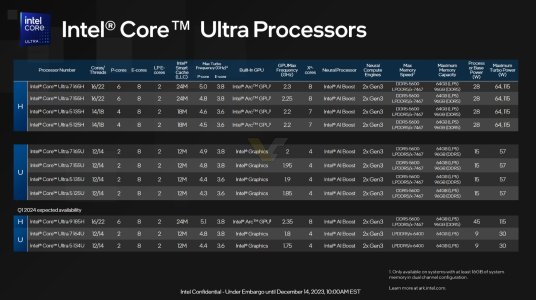
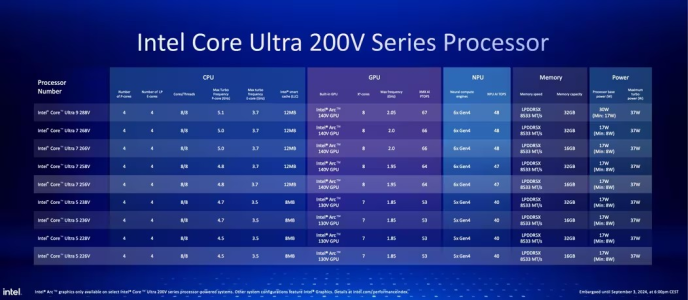
Intel Raptor Lake UIntel Wildcat Lake 15WIntel Lunar LakeIntel Panther Lake 4+0+4
Launch DateQ1-2024Q2-2026Q3-2024Q1-2026
ModelIntel 150UIntel Core 7 360Core Ultra 7 268VCore Ultra 7 365
Dies2223
NodeIntel 7 + ?Intel 18-A + TSMC N6TSMC N3B + N6Intel 18-A + Intel 3 + TSMC N6
CPU2 P-core + 8 E-cores2 P-core + 4 LP E-cores4 P-core + 4 LP E-cores4 P-core + 4 LP E-cores
Threads12688
Max Clock5.4 GHz4.8 GHz5 GHz4.8 GHz
L3 Cache12 MB6 MB12 MB12 MB
TDP15 - 55 W15 - 35 W17 - 37 W25 - 55 W
Memory128-bit LPDDR5-520064-bit LPDDR5x-7467128-bit LPDDR5x-8533128-bit LPDDR5x-7467
Size96 GB48 GB32 GB128 GB
Bandwidth83 GB/s60 GB/s136 GB/s120 GB/s
GPUIntel GraphicsIntel GraphicsArc 140VIntel Graphics
RTNoNoYESYES
EU / Xe96 EU2 Xe8 Xe4 Xe
Max Clock1.3 GHz2.6 GHz2 GHz2.5 GHz
NPUGNA 3.017 TOPS48 TOPS49 TOPS


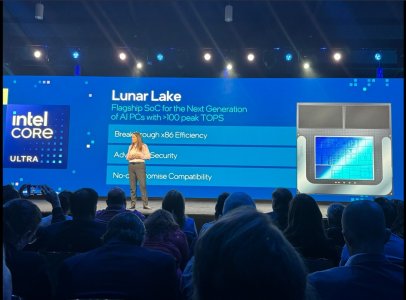
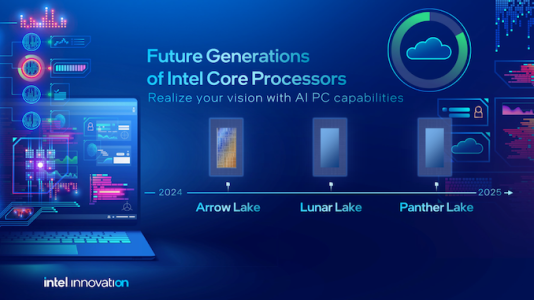
PPT1.jpg
PPT2.jpg
PPT3.jpg


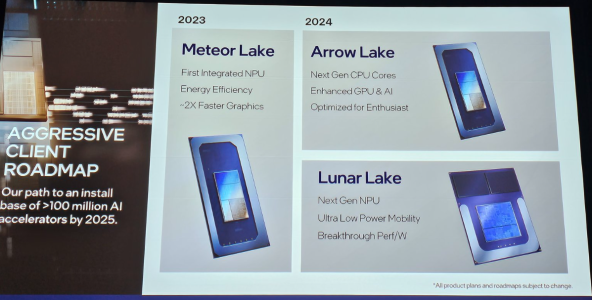
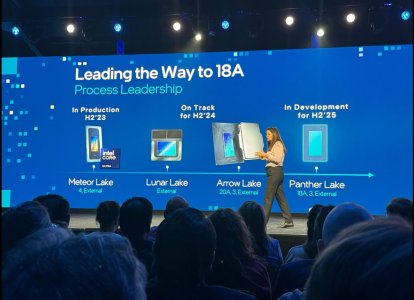
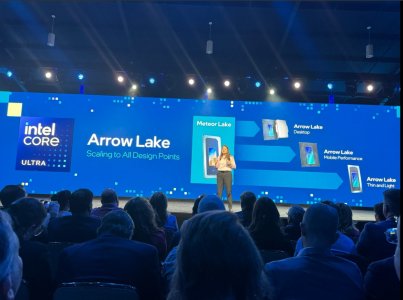
As Hot Chips 34 starting this week, Intel will unveil technical information of upcoming Meteor Lake (MTL) and Arrow Lake (ARL), new generation platform after Raptor Lake. Both MTL and ARL represent new direction which Intel will move to multiple chiplets and combine as one SoC platform.

MTL also represents new compute tile that based on Intel 4 process which is based on EUV lithography, a first from Intel. Intel expects to ship MTL mobile SoC in 2023.

ARL will come after MTL so Intel should be shipping it in 2024, that is what Intel roadmap is telling us. ARL compute tile will be manufactured by Intel 20A process, a first from Intel to use GAA transistors called RibbonFET.


LNL-MX.png
 

Attachments

  • PantherLake.png
    PantherLake.png
    283.5 KB · Views: 24,049
  • LNL.png
    LNL.png
    881.8 KB · Views: 25,534
  • INTEL-CORE-100-ULTRA-METEOR-LAKE-OFFCIAL-SLIDE-2.jpg
    INTEL-CORE-100-ULTRA-METEOR-LAKE-OFFCIAL-SLIDE-2.jpg
    181.4 KB · Views: 72,443
  • Clockspeed.png
    Clockspeed.png
    611.8 KB · Views: 72,329
Last edited:
xtor density metric doesn't really matter. You can't even compare them ISO anyway. Plus it varies tremendously with cache sizes.

Only thing that matters is the performance delivered per mm2. In that case Intel still sucks for Lion Cove and Battlemage. But Skymont for example is pretty damn good.
Directly or indirectly these factors are all related for a node.
HP Cell -> low xtor density -> lower perf/mm2 -> higher perf/xtor
HD Cell -> higher xtor density -> higher perf/mm2 -> lower perf/xtor
Which would really be weird since X3D is about gaming. What "ST" gaming is there nowadays?
Yeah it's basically has become a cache competition.

Edit: Fixed Typo
 
Last edited:
And when was Intel the consensus leader? In 2017 when they had the single thread and gaming crown. For 2026 how about AMD 12C/24T on a single CCD, with v-cache for the gaming champ? All this actually begs the question though, I seriously doubt Intel will actually produce the 16 + 32 core variant, with their limited resources and renewed interest in increasing margins. A 48 core will just be too expensive to produce and sell at a reasonable cost.
It is not tbh it's same strategy as AMD's Chippet design it entirely depends on the die size for their compute tile cause that is only external tile in NVL with IO.
 
Directly or indirectly these factors are all related for a node.
HP Cell -> low xtor density -> lower perf/mm2 -> higher perf/xtor
HD Cell -> higher xtor density -> lower perf/mm2 -> lower perf/xtor
You are right.

But we can't really determine xtor density at a chip level. It's almost impossible. The manufacturers use different metrics, and you can't compare between CPUs vs GPUs obviously. Perf/mm2, Perf/$, Perf/W, those are things we can actually test.
 
So nobody cared about the introduction of 1800X and the impact of that?

The 1800x represented a massive improvement in desktop processing power versus AMD's previous gen Bulldozer chips (not to speak of Steamroller and Excavator, which were too limited in scope). ST and MT performance went through the roof. In contrast, the 7700k was sort of the lame duck successor the the 6700k (due to 14nm delays).

Unless Nova Lake-S shows major ST and MT uplifts over Arrow Lake-S, it probably won't turn many heads. Flagship Zen6 will be a nice improvement over the 9950X and will definitely not be a warmed-over rehash product like the 7700k!

But who knows, maybe what people really want is a Cinebench accelerator.
 
But who knows, maybe what people really want is a Cinebench accelerator.
Which would be fine, if it compares well with AMD, their primary competitor. Super fast in embarassingly multi-threaded workloads, beats competition slightly in ST and gaming, and uses about the same power.

Sure, it wouldn't turn heads, but certainly a turnaround from today.
The 1800x represented a massive improvement in desktop processing power versus AMD's previous gen Bulldozer chips (not to speak of Steamroller and Excavator, which were too limited in scope).
AMD basically gave you Intel's expensive HEDT at a much lower price, while catching up dangerously close in less threaded applications. If 1800X wasn't that enormously faster than the 7700K in MT, then it wouldn't have been looked upon so fondly. But it was.
 
Btw I wonder what's the disadvantage of KF SKU vs K SKUs cause you get the display and media engine with KF AND K SKUs you don't need iGPU for display from motherboard.
 
The 1800x represented a massive improvement in desktop processing power versus AMD's previous gen Bulldozer chips (not to speak of Steamroller and Excavator, which were too limited in scope). ST and MT performance went through the roof. In contrast, the 7700k was sort of the lame duck successor the the 6700k (due to 14nm delays).

Unless Nova Lake-S shows major ST and MT uplifts over Arrow Lake-S, it probably won't turn many heads. Flagship Zen6 will be a nice improvement over the 9950X and will definitely not be a warmed-over rehash product like the 7700k!

But who knows, maybe what people really want is a Cinebench accelerator.
They went the way of removing HT If it doesn't achieve 10% ST improvement over Zen 6 than the P core team has to DIP themselves in a glass full of water without APX.
 
Hopefully people will fondly remember Intel's push for more MT performance while keeping ST perf competitive. I really hope that being competitive at gaming is not morphed into "is bad for gaming" or cannot game....
 
Last edited:
Yes, just like 54C NVL-S will give you expensive HEDT such as ThreadRipper at a much lower price. At least up to ~32C level of TR performance.


mmm Im skeptical of it matching 32C of Zen 5 TR in MT. TR has 350W+ of TDP to play with, basically double the power of a 9950X, which itself is 200W (170W TDP) of electrical power at stock. I mean, maybe, if its really 18A and they can pull some impressive perf/w efficiency out of that, but is Intel really that hellbent on dying on the 300W+ on desktop hill?
 
All this actually begs the question though, I seriously doubt Intel will actually produce the 16 + 32 core variant, with their limited resources and renewed interest in increasing margins. A 48 core will just be too expensive to produce and sell at a reasonable cost.
Well, cuz it's just an old rumor.

It seems that even some Intel employees don't know what would NVL-S look like when launch.
 
Not comparable. AMD's market share was crap back then. Intel still has the market share lead. Also, The 1800X was still behind in ST performance.
If you look at their revenue the company is being held up almost entirely by the client revenue not dropping much. Once they lose that, you'll see the revenue fall drastically.

AMD back then was also much leaner. Intel is not like that.
but is Intel really that hellbent on dying on the 300W+ on desktop hill?
They might have to. Surely new processes with fraction of the older gains isn't going to win you much. Also it's possible same is happening on the design side and that will flatline.
 
If you look at their revenue the company is being held up almost entirely by the client revenue not dropping much. Once they lose that, you'll see the revenue fall drastically.

AMD back then was also much leaner. Intel is not like that.

They might have to. Surely new processes with fraction of the older gains isn't going to win you much. Also it's possible same is happening on the design side and that will flatline.

So no fire sales other than the occasional Core Ultra 7 265k?
 
mmm Im skeptical of it matching 32C of Zen 5 TR in MT. TR has 350W+ of TDP to play with, basically double the power of a 9950X, which itself is 200W (170W TDP) of electrical power at stock. I mean, maybe, if its really 18A and they can pull some impressive perf/w efficiency out of that, but is Intel really that hellbent on dying on the 300W+ on desktop hill?
NVL has ~1.5 Node shrink and better cores as well i would not be surprised at 2X MT perf vs 285K.
 
No matter how much 52 cores are installed, it is unlikely that the TDP will exceed 300W by default...
Depends on the power settings preset But
 
Havent been following CPUs much lately, due to Intel not being very competitive. What is the consensus: Is NL going to really double the core counts, or is this just another rumor/hope that will ultimately get cancelled like so many other projects from Intel lately? It sounds great, but upon thinking about it, what would this accomplish? How would they manage the heat and power usage, unless the new core design is hugely more efficient. I know they will be on a more efficient process, but that couldnt possibly save enough power to double the core counts. The problem with ARL seems to be latency, not raw processing power anyway. If they do this, and can get the power and temps under control, it would obviously be a multi threading beast, but for gaming??
Core counts will only go up on specific products, and only because it is dead simple for them to add a second chiplet.
More importantly, is Intel gonna be here in 10 years? Is x86 gonna be a thing in 10 years? Very clouded the future is.
x86 isn’t going anywhere.
NVL-S 16+32 is 320-400W IIRC, which will probably still be power limited with so many cores, but enough to beat 24 core Zen6 in Cinebench which I assume is the goal.
When you count hyperthreading, they will be pretty close in terms of performance. Power limits and IPC will be the deciding factor.
LMAO this is a Workstation Class PL I thought it was ~300W a classic case of Intel being Intel.
I don't know how much turbo they want it to have.

bLLC exis for this comparison 🙂.

If it performs similarly why would they release it at a much lower price?
They won’t. It isn’t even confirmed to be a Core X part. It could end up being an Xeon workstation part.

If it ends up being a Core 9 or whatever Intel calls their stuff these days, it will probably be $750-$800
 
Back
Top