Discussion Intel Meteor, Arrow, Lunar & Panther Lakes + WCL Discussion Threads

Page 798 - Seeking answers? Join the AnandTech community: where nearly half-a-million members share solutions and discuss the latest tech.

Tigerick

Senior member
Apr 1, 2022
941
857
106
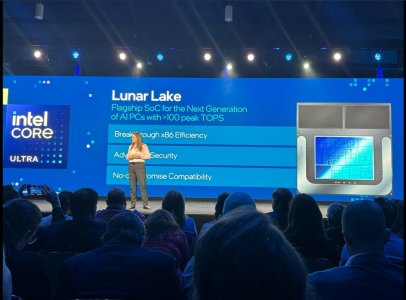
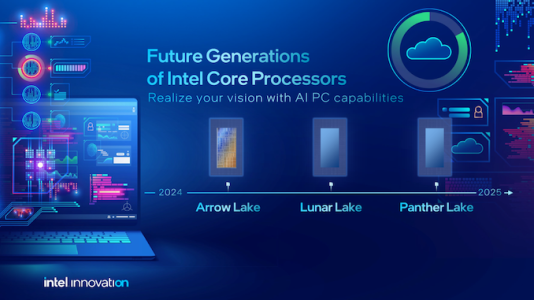
Wildcat Lake (WCL) Specs

Intel Wildcat Lake (WCL) is upcoming mobile SoC replacing Raptor Lake-U. WCL consists of 2 tiles: compute tile and PCD tile. It is true single die consists of CPU, GPU and NPU that is fabbed by 18-A process. Last time I checked, PCD tile is fabbed by TSMC N6 process. They are connected through UCIe, not D2D; a first from Intel. Expecting launching in Q1 2026.
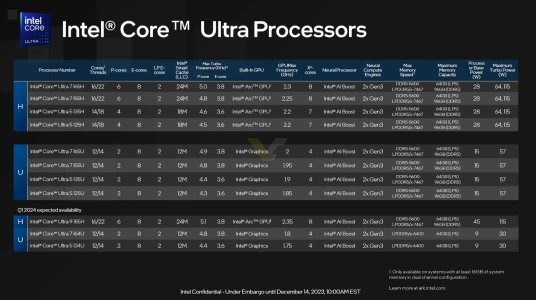
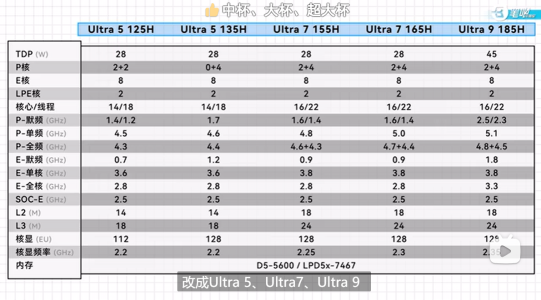
Intel Raptor Lake UIntel Wildcat Lake 15W?Intel Lunar LakeIntel Panther Lake 4+0+4
Launch DateQ1-2024Q2-2026Q3-2024Q1-2026
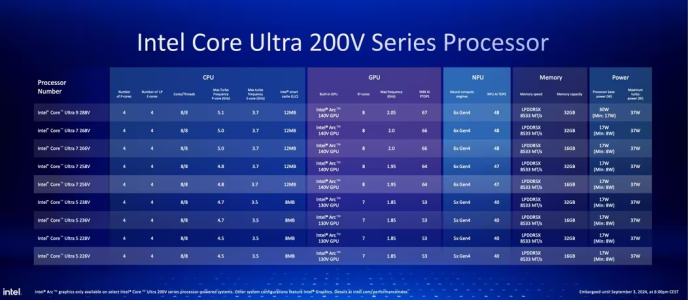
ModelIntel 150UIntel Core 7Core Ultra 7 268VCore Ultra 7 365
Dies2223
NodeIntel 7 + ?Intel 18-A + TSMC N6TSMC N3B + N6Intel 18-A + Intel 3 + TSMC N6
CPU2 P-core + 8 E-cores2 P-core + 4 LP E-cores4 P-core + 4 LP E-cores4 P-core + 4 LP E-cores
Threads12688
Max Clock5.4 GHz?5 GHz4.8 GHz
L3 Cache12 MB12 MB12 MB
TDP15 - 55 W15 W ?17 - 37 W25 - 55 W
Memory128-bit LPDDR5-520064-bit LPDDR5128-bit LPDDR5x-8533128-bit LPDDR5x-7467
Size96 GB32 GB128 GB
Bandwidth136 GB/s
GPUIntel GraphicsIntel GraphicsArc 140VIntel Graphics
RTNoNoYESYES
EU / Xe96 EU2 Xe8 Xe4 Xe
Max Clock1.3 GHz?2 GHz2.5 GHz
NPUGNA 3.018 TOPS48 TOPS49 TOPS


PPT1.jpg
PPT2.jpg
PPT3.jpg


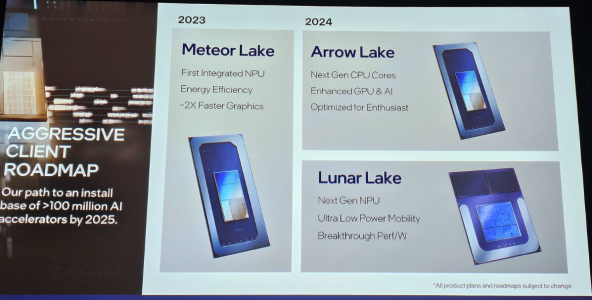
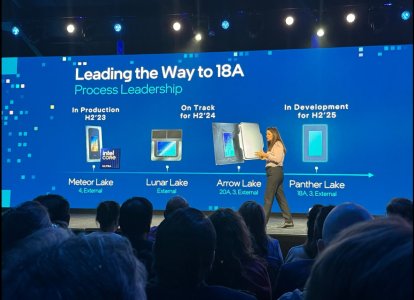
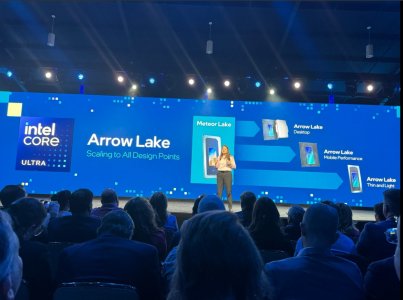
As Hot Chips 34 starting this week, Intel will unveil technical information of upcoming Meteor Lake (MTL) and Arrow Lake (ARL), new generation platform after Raptor Lake. Both MTL and ARL represent new direction which Intel will move to multiple chiplets and combine as one SoC platform.

MTL also represents new compute tile that based on Intel 4 process which is based on EUV lithography, a first from Intel. Intel expects to ship MTL mobile SoC in 2023.

ARL will come after MTL so Intel should be shipping it in 2024, that is what Intel roadmap is telling us. ARL compute tile will be manufactured by Intel 20A process, a first from Intel to use GAA transistors called RibbonFET.


LNL-MX.png
 

Attachments

  • PantherLake.png
    PantherLake.png
    283.5 KB · Views: 24,043
  • LNL.png
    LNL.png
    881.8 KB · Views: 25,531
  • INTEL-CORE-100-ULTRA-METEOR-LAKE-OFFCIAL-SLIDE-2.jpg
    INTEL-CORE-100-ULTRA-METEOR-LAKE-OFFCIAL-SLIDE-2.jpg
    181.4 KB · Views: 72,439
  • Clockspeed.png
    Clockspeed.png
    611.8 KB · Views: 72,326
Last edited:

511

Diamond Member
Jul 12, 2024
5,429
4,845
106
Thanks for the reply. As far as heat and power, seems like your point 4 would lead to lower clock speeds and possibly a sacrifice in gaming performance, which is my primary interest. I really dont think Intel can catch up in gaming until they come up with something analogous to v-cache. (Or make a huge Conroe like jump in P core performance, which seems very unlikely.)
The clock speed difference will depend entirely on V/F curve as far as Intel is concerned they push the V/F curve beyond the limit anyway. Clock speed hit would be a lot less considering 1-1.5 Node advantage.
 

Kepler_L2

Golden Member
Sep 6, 2020
1,081
4,669
136
Thanks for the reply. As far as heat and power, seems like your point 4 would lead to lower clock speeds and possibly a sacrifice in gaming performance, which is my primary interest. I really dont think Intel can catch up in gaming until they come up with something analogous to v-cache. (Or make a huge Conroe like jump in P core performance, which seems very unlikely.)
NVL-S 16+32 is 320-400W IIRC, which will probably still be power limited with so many cores, but enough to beat 24 core Zen6 in Cinebench which I assume is the goal.
 

poke01

Diamond Member
Mar 8, 2022
4,826
6,146
106
NVL-S 16+32 is 320-400W IIRC, which will probably still be power limited with so many cores, but enough to beat 24 core Zen6 in Cinebench which I assume is the goal.
I asume it will lag behind X3D Zen 6 in terms of perf/w, cost and gaming
 

511

Diamond Member
Jul 12, 2024
5,429
4,845
106
NVL-S 16+32 is 320-400W IIRC, which will probably still be power limited with so many cores, but enough to beat 24 core Zen6 in Cinebench which I assume is the goal.
LMAO this is a Workstation Class PL I thought it was ~300W a classic case of Intel being Intel.
I don't know how much turbo they want it to have.
I asume it will lag behind X3D Zen 6 in terms of perf/w, cost and gaming
bLLC exis for this comparison 🙂.
 

511

Diamond Member
Jul 12, 2024
5,429
4,845
106
It's not 3D stacked, just a larger CPU die
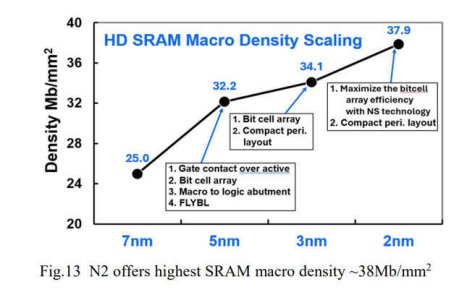
Well 108MB on N2 would be roughly 2.8mm2 for SRAM have to consider other logic I would say they would be able to do it in ~10mm2 extra die spcae not bad tbf.

108*8/38 = 22mm2 and plus additional logic i would say it would be 25-30mm2 larger die.

images(15).jpg
 
Last edited:

sgs_x86

Junior Member
Dec 20, 2020
17
26
91
  • What would this accomplish - Two things: halo product that brings some much needed attention (especially if it features a bigger LLC to help hide latency), test & learning vehicle for future products where they break the compute tile further. Even with the current tile setup, Intel's compute tile is huge in compared to the competition (~115mm2 vs 71mm2), they're probably exploring ways to lower cost and be more agile.
Shouldn't die size comparison be 115mm2 (ARL) vs 2 x 71 mm2 (Zen5)
 

coercitiv

Diamond Member
Jan 24, 2014
7,474
17,863
136
Shouldn't die size comparison be 115mm2 (ARL) vs 2 x 71 mm2 (Zen5)
Not when discussing yields and flexibility. If they pay the performance price for off-die mem controller, then might as well use multiple smaller tiles for better yields & better binning. Think of a P-tile and E-tile for example, both ~60mm2 each. They could generate their entire lineup with just 2 tile types (in theory, in practice I'm sure they would find reasons to make some more).
 

511

Diamond Member
Jul 12, 2024
5,429
4,845
106
Not when discussing yields and flexibility. If they pay the performance price for off-die mem controller, then might as well use multiple smaller tiles for better yields & better binning. Think of a P-tile and E-tile for example, both ~60mm2 each. They could generate their entire lineup with just 2 tile types (in theory, in practice I'm sure they would find reasons to make some more).
If only Int design doesn't focus on HPC performance/xtor they would have been able to do it like AMD
 

Fjodor2001

Diamond Member
Feb 6, 2010
4,598
739
126
NVL-S 16+32 is 320-400W IIRC, which will probably still be power limited with so many cores, but enough to beat 24 core Zen6 in Cinebench which I assume is the goal.
So we have this as top SKU on DT:

2017:
Intel 8700K: 6C/12T
AMD 1800X: 8C/16T
ST crown: Intel
MT crown: AMD

~2026:
Intel 285K successor: 48C/48T (or 52C/52T including LPE cores)
AMD 9950X(3D) successor: 24C/48T (or 26-28C/50-56T including LPE cores)
ST crown: AMD
MT crown: Intel

The tables have turned.
 
  • Like
Reactions: dangerman1337

coercitiv

Diamond Member
Jan 24, 2014
7,474
17,863
136
If only Int design doesn't focus on HPC performance/xtor they would have been able to do it like AMD
Not sure what you mean by that, I'm not arguing they should follow the same path as AMD. I'm saying their previous choices favor certain decisions, some because they lean on their strengths and others because they fix weaknesses.

My personal expectation was to see Intel revert to MC on the compute tile. Maybe they'll still do this on mobile products.
 

DavidC1

Platinum Member
Dec 29, 2023
2,166
3,307
106
~2026:
Intel 285K successor: 48C/48T (or 52C/52T including LPE cores)
AMD 9950X(3D) successor: 24C/48T (or 26-28C/50-56T including LPE cores)
ST crown: AMD
MT crown: Intel

The tables have turned.
Why would AMD lead in ST in 2026/2027? Do you know something we don't? Cause it sounds like they are roughly on par.
 
  • Like
Reactions: Io Magnesso

gdansk

Diamond Member
Feb 8, 2011
4,749
8,054
136
So we have this as top SKU on DT:

2017:
Intel 8700K: 6C/12T
AMD 1800X: 8C/16T
ST crown: Intel
MT crown: AMD

~2026:
Intel 285K successor: 48C/48T (or 52C/52T including LPE cores)
AMD 9950X(3D) successor: 24C/48T (or 26-28C/50-56T including LPE cores)
ST crown: AMD
MT crown: Intel

The tables have turned.
In fact nothing will change. In both comparisons, barring external factors like platform, the lower core count part will be a better buy if it offers more 1T performance at a similar price.

We're already near the point where only embarrassingly parallel work remains to benefit from more core spam. And that isn't a typical use for even the DIY crowd. And more threads matter in fewer and fewer workloads as the absolute number of threads increase.
 

LightningZ71

Platinum Member
Mar 10, 2017
2,690
3,384
136
I expect that the non-x3d parts will be somewhat faster in gaming ST due to the L3 being 50% larger on top of any core improvements.
 
  • Like
Reactions: Joe NYC

511

Diamond Member
Jul 12, 2024
5,429
4,845
106
Not sure what you mean by that, I'm not arguing they should follow the same path as AMD. I'm saying their previous choices favor certain decisions, some because they lean on their strengths and others because they fix weaknesses.

My personal expectation was to see Intel revert to MC on the compute tile. Maybe they'll still do this on mobile products.
I was talking about the design density like BMG their xtor density sucks even for CPUs.
 

DavidC1

Platinum Member
Dec 29, 2023
2,166
3,307
106
I was talking about the design density like BMG their xtor density sucks even for CPUs.
xtor density metric doesn't really matter. You can't even compare them ISO anyway. Plus it varies tremendously with cache sizes.

Only thing that matters is the performance delivered per mm2. In that case Intel still sucks for Lion Cove and Battlemage. But Skymont for example is pretty damn good.
I expect that the non-x3d parts will be somewhat faster in gaming ST due to the L3 being 50% larger on top of any core improvements.
Which would really be weird since X3D is about gaming. What "ST" gaming is there nowadays?
 
  • Like
Reactions: Io Magnesso

ondma

Diamond Member
Mar 18, 2018
3,320
1,709
136
So we have this as top SKU on DT:

2017:
Intel 8700K: 6C/12T
AMD 1800X: 8C/16T
ST crown: Intel
MT crown: AMD

~2026:
Intel 285K successor: 48C/48T (or 52C/52T including LPE cores)
AMD 9950X(3D) successor: 24C/48T (or 26-28C/50-56T including LPE cores)
ST crown: AMD
MT crown: Intel

The tables have turned.
And when was Intel the consensus leader? In 2017 when they had the single thread and gaming crown. For 2026 how about AMD 12C/24T on a single CCD, with v-cache for the gaming champ? All this actually begs the question though, I seriously doubt Intel will actually produce the 16 + 32 core variant, with their limited resources and renewed interest in increasing margins. A 48 core will just be too expensive to produce and sell at a reasonable cost.