Discussion Intel Meteor, Arrow, Lunar & Panther Lakes + WCL Discussion Threads

Page 711 - Seeking answers? Join the AnandTech community: where nearly half-a-million members share solutions and discuss the latest tech.

Tigerick

Senior member
Apr 1, 2022
909
828
106
Wildcat Lake (WCL) Preliminary Specs

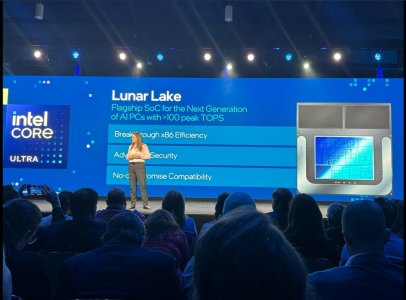
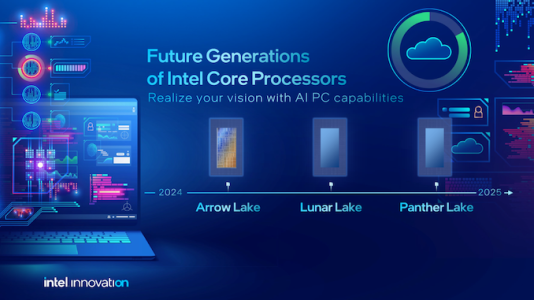
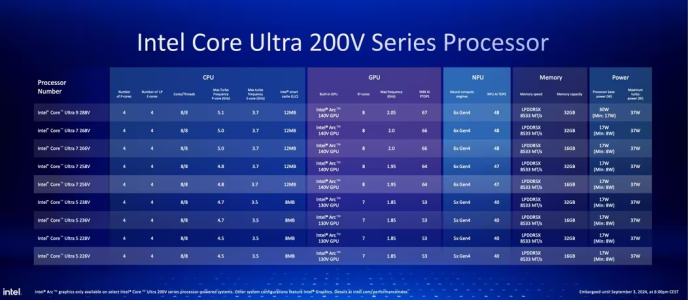
Intel Wildcat Lake (WCL) is upcoming mobile SoC replacing ADL-N. WCL consists of 2 tiles: compute tile and PCD tile. It is true single die consists of CPU, GPU and NPU that is fabbed by 18-A process. Last time I checked, PCD tile is fabbed by TSMC N6 process. They are connected through UCIe, not D2D; a first from Intel. Expecting launching in Q2/Computex 2026. In case people don't remember AlderLake-N, I have created a table below to compare the detail specs of ADL-N and WCL. Just for fun, I am throwing LNL and upcoming Mediatek D9500 SoC.

Intel Alder Lake - NIntel Wildcat LakeIntel Lunar LakeMediatek D9500
Launch DateQ1-2023Q2-2026 ?Q3-2024Q3-2025
ModelIntel N300?Core Ultra 7 268VDimensity 9500 5G
Dies2221
NodeIntel 7 + ?Intel 18-A + TSMC N6TSMC N3B + N6TSMC N3P
CPU8 E-cores2 P-core + 4 LP E-cores4 P-core + 4 LP E-coresC1 1+3+4
Threads8688
Max Clock3.8 GHz?5 GHz
L3 Cache6 MB?12 MB
TDP7 WFanless ?17 WFanless
Memory64-bit LPDDR5-480064-bit LPDDR5-6800 ?128-bit LPDDR5X-853364-bit LPDDR5X-10667
Size16 GB?32 GB24 GB ?
Bandwidth~ 55 GB/s136 GB/s85.6 GB/s
GPUUHD GraphicsArc 140VG1 Ultra
EU / Xe32 EU2 Xe8 Xe12
Max Clock1.25 GHz2 GHz
NPUNA18 TOPS48 TOPS100 TOPS ?


PPT1.jpg
PPT2.jpg
PPT3.jpg


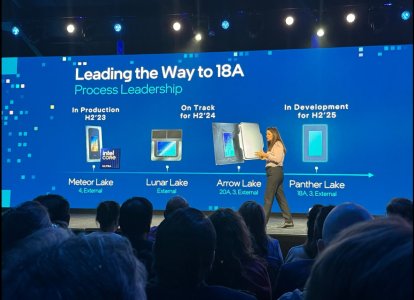
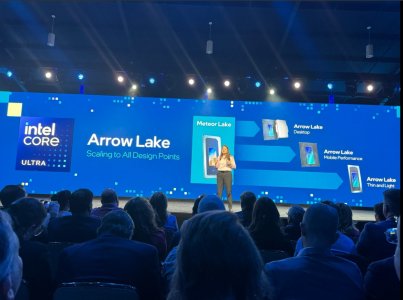
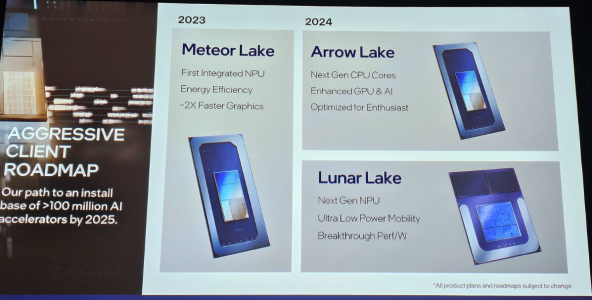
As Hot Chips 34 starting this week, Intel will unveil technical information of upcoming Meteor Lake (MTL) and Arrow Lake (ARL), new generation platform after Raptor Lake. Both MTL and ARL represent new direction which Intel will move to multiple chiplets and combine as one SoC platform.

MTL also represents new compute tile that based on Intel 4 process which is based on EUV lithography, a first from Intel. Intel expects to ship MTL mobile SoC in 2023.

ARL will come after MTL so Intel should be shipping it in 2024, that is what Intel roadmap is telling us. ARL compute tile will be manufactured by Intel 20A process, a first from Intel to use GAA transistors called RibbonFET.


LNL-MX.png
 

Attachments

  • PantherLake.png
    PantherLake.png
    283.5 KB · Views: 24,034
  • LNL.png
    LNL.png
    881.8 KB · Views: 25,527
  • INTEL-CORE-100-ULTRA-METEOR-LAKE-OFFCIAL-SLIDE-2.jpg
    INTEL-CORE-100-ULTRA-METEOR-LAKE-OFFCIAL-SLIDE-2.jpg
    181.4 KB · Views: 72,435
  • Clockspeed.png
    Clockspeed.png
    611.8 KB · Views: 72,321
Last edited:

ajsdkflsdjfio

Member
Nov 20, 2024
185
133
76
IDK why they can't do like a test without all the updates and with the current available updates and give a solid average over 50+ games or something like that. This performance improvement table is so vague...

Also even with a +10% performance improvement, the damage has been done with arrow lake's mindshare already.
 

Hulk

Diamond Member
Oct 9, 1999
5,206
3,838
136
IDK why they can't do like a test without all the updates and with the current available updates and give a solid average over 50+ games or something like that. This performance improvement table is so vague...

Also even with a +10% performance improvement, the damage has been done with arrow lake's mindshare already.
Because it's all BS. ARL is what it is. It's not terrible, it's not great.
 

ajsdkflsdjfio

Member
Nov 20, 2024
185
133
76
Because it's all BS. ARL is what it is. It's not terrible, it's not great.
They have like multiple 2-14% improvements and a 6-30% improvement like what are we expected to extrapolate from this data. I'm also thinking it might be BS in which case this is a horrible look for Intel.
 
  • Like
Reactions: Nothingness

DAPUNISHER

Super Moderator CPU Forum Mod and Elite Member
Super Moderator
Aug 22, 2001
32,185
32,801
146
Because it's all BS. ARL is what it is. It's not terrible, it's not great.
LMAO never say that

giphy.gif


We did just see 30%+ performance improvement in Cyberpunk. Ergo there are places where arrow lake can be massively improved, yes?
 

gdansk

Diamond Member
Feb 8, 2011
4,680
7,906
136

ajsdkflsdjfio

Member
Nov 20, 2024
185
133
76
It's not 2-14% or 6-30% overall improvement. He said in some specific cases (due to misconfigured motherboard bios from some vendors), there were slight to significant performance drops and it varies from vendor to vendor and model to model. This fix is supposed to address many such issues. Fixing these slight performance drops to significant ones, brings the overall performance across different motherboard vendors to expected levels, which they earlier mentioned is in upper single digit over previous gen.

He also mentioned that there is one brand new update "in-flight" that's expected to bring additional performance uplift (probably around +5% for games). Bringing the overall ARL-S performance to around ~10% over previous gen.
Yea I didn't assume it was, which is why I said they should have done a before vs after with a bunch of games/applications and taken the average to present to people, because 2-14% or 6-30% in specific scenarios tells us absolutely nothing. It just looks like they're trying to mislead people when they give vague performance numbers like that.
 
Last edited:
  • Like
Reactions: Hulk

Hulk

Diamond Member
Oct 9, 1999
5,206
3,838
136
Have you ever seen "Apocalypto?"

Perhaps we should start referring to Intel as "Almost."
 
Jul 27, 2020
28,173
19,203
146
It just looks like they're trying to mislead people when they give vague performance numbers like that.
They will publish a "performance digest" at CES showing what final ARL performance should look like after everything is patched. But overall, Hallock was more concerned about the wild variations in figures gotten by various reviewers than trying to paint the CPU as being competitive with its competition. So after all is said and done, it may still end up being boring. Just slightly less than before.

I read about someone hitting 9000 MT/s memory speed at Gear 2 comfortably. That's really nice but even that isn't supposed to give more than 15% extra perf in bandwidth starved situations and most likely only a few good bins will be able to go that high.
 
  • Like
Reactions: ajsdkflsdjfio

alcoholbob

Diamond Member
May 24, 2005
6,390
469
126
It's not 2-14% or 6-30% overall improvement. He said in some specific cases (due to misconfigured motherboard bios from some vendors), there were slight to significant performance drops and it varies from vendor to vendor and model to model. This fix is supposed to address many such issues. Fixing these slight performance drops to significant ones, brings the overall performance across different motherboard vendors to expected levels, which they earlier mentioned is in upper single digit over previous gen.

He also mentioned that there is one brand new update "in-flight" that's expected to bring additional performance uplift (probably around +5% for games). Bringing the overall ARL-S performance to around ~10% over previous gen.

Previous gen as in Meteor Lake? I thought Hallock originally said the entire patch was supposed to just bring us the performance they promised from the initial slides - which was *almost* 14900K performance.
 

coercitiv

Diamond Member
Jan 24, 2014
7,443
17,731
136
They have like multiple 2-14% improvements and a 6-30% improvement like what are we expected to extrapolate from this data. I'm also thinking it might be BS in which case this is a horrible look for Intel.
Thinks of it this way, there are workloads where ARL behaves unexpectedly bad, so bad many consider them outliers. That's where I expect to see double digit improvements. Those workloads, while important for some users, won't budge the needle much in terms of average performance, so the end result is still going to be single digit uplift.
 

Hulk

Diamond Member
Oct 9, 1999
5,206
3,838
136
Thinks of it this way, there are workloads where ARL behaves unexpectedly bad, so bad many consider them outliers. That's where I expect to see double digit improvements. Those workloads, while important for some users, won't budge the needle much in terms of average performance, so the end result is still going to be single digit uplift.
Exactly. If these were significant changes Intel would have provided data showing specific applications and workloads with before/after performance numbers. All of this "data" is couched in a blanket of purposely obfucated language. I wonder if the hours expended into the investigation of finding and correcting issues were equal to the time spent in trying to figure out how to disseminate what was learned in the best possible light and how to shade the findings that were especially negative to ARL architecture.
 
  • Like
Reactions: Thibsie

511

Diamond Member
Jul 12, 2024
5,008
4,522
106
Exactly. If these were significant changes Intel would have provided data showing specific applications and workloads with before/after performance numbers. All of this "data" is couched in a blanket of purposely obfucated language. I wonder if the hours expended into the investigation of finding and correcting issues were equal to the time spent in trying to figure out how to disseminate what was learned in the best possible light and how to shade the findings that were especially negative to ARL architecture.
The architecture was pretty horrible tbh no wonder Meteor Lake S was scrapped and they are going back 2 drawing board with PTL/NVL
 
  • Like
Reactions: ajsdkflsdjfio

511

Diamond Member
Jul 12, 2024
5,008
4,522
106
One of the key problems are those 2 silly Crestmont LPE cores in the MTL SoC tile (low power island). They're so horrible they caused more issues than they solved. The numbskulls at Intel should have at least given us a BIOS option to disable the LPE cores if we wanted. Would have solved a ton of the issues.
Or they should have made 4 cores like LNL to actually matter
 
  • Like
Reactions: Thibsie

alcoholbob

Diamond Member
May 24, 2005
6,390
469
126
Yea I didn't assume it was, which is why I said they should have done a before vs after with a bunch of games/applications and taken the average to present to people, because 2-14% or 6-30% in specific scenarios tells us absolutely nothing. It just looks like they're trying to mislead people when they give vague performance numbers like that.

Hallock even said the 6-30% performance drop is a result of the Balanced performance profile. If you used High Performance at day 1 of launch like many reviewers used, you already have received the benefit of this 6-30% performance boost.

There is some performance boost for a narrow group of APO titles in the 2-14% range coming with Windows 11 2611. There's also a 2-14% performance improvement in some situations already deployed from available 0x114 BIOS.

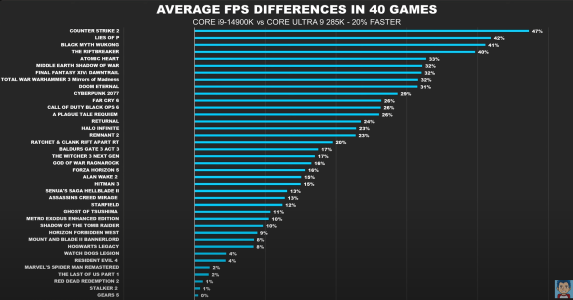
In other words, the only thing Intel is promising is single digit performance enhancements in January. It's still 7% slower than the 14900K in gaming now, if all we are expecting is vague single digit improvements in January, this update is not going to reach the parity with the 14900K they claimed at launch.

Also most benchmarks are with very slow RAM speeds, the gap between the 285K and 14900K is *huge* when both are paired with fast RAM in this review posted last week by DannyZReviews. We already knew tuned 14900Ks with fast RAM are faster than tuned 7800X3Ds, so it should not come as a huge surprise that the gap between the 14900K and 285K in an enthusiast system is basically insurmountable.

1734630477621.png
 
Last edited: