Discussion Intel Meteor, Arrow, Lunar & Panther Lakes + WCL Discussion Threads

Page 412 - Seeking answers? Join the AnandTech community: where nearly half-a-million members share solutions and discuss the latest tech.

Tigerick

Senior member
Apr 1, 2022
921
836
106
Wildcat Lake (WCL) Preliminary Specs

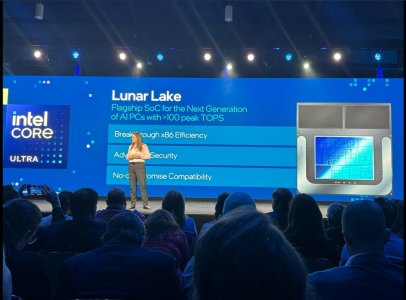
Intel Wildcat Lake (WCL) is upcoming mobile SoC replacing ADL-N. WCL consists of 2 tiles: compute tile and PCD tile. It is true single die consists of CPU, GPU and NPU that is fabbed by 18-A process. Last time I checked, PCD tile is fabbed by TSMC N6 process. They are connected through UCIe, not D2D; a first from Intel. Expecting launching in Q2/Computex 2026. In case people don't remember AlderLake-N, I have created a table below to compare the detail specs of ADL-N and WCL. Just for fun, I am throwing LNL and upcoming Mediatek D9500 SoC.

Intel Alder Lake - NIntel Wildcat LakeIntel Lunar LakeMediatek D9500
Launch DateQ1-2023Q2-2026 ?Q3-2024Q3-2025
ModelIntel N300?Core Ultra 7 268VDimensity 9500 5G
Dies2221
NodeIntel 7 + ?Intel 18-A + TSMC N6TSMC N3B + N6TSMC N3P
CPU8 E-cores2 P-core + 4 LP E-cores4 P-core + 4 LP E-coresC1 1+3+4
Threads8688
Max Clock3.8 GHz?5 GHz
L3 Cache6 MB?12 MB
TDP7 WFanless ?17 WFanless
Memory64-bit LPDDR5-480064-bit LPDDR5-6800 ?128-bit LPDDR5X-853364-bit LPDDR5X-10667
Size16 GB?32 GB24 GB ?
Bandwidth~ 55 GB/s136 GB/s85.6 GB/s
GPUUHD GraphicsArc 140VG1 Ultra
EU / Xe32 EU2 Xe8 Xe12
Max Clock1.25 GHz2 GHz
NPUNA18 TOPS48 TOPS100 TOPS ?


PPT1.jpg
PPT2.jpg
PPT3.jpg


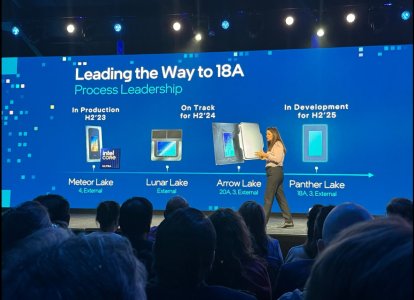
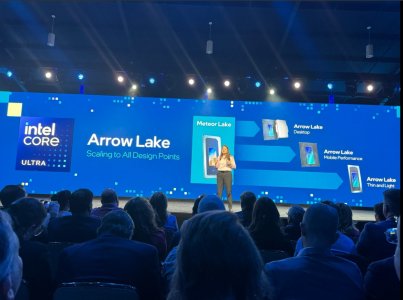
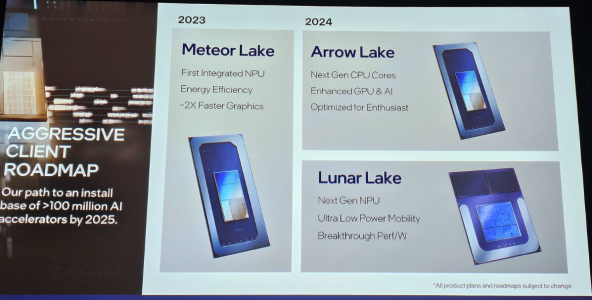
As Hot Chips 34 starting this week, Intel will unveil technical information of upcoming Meteor Lake (MTL) and Arrow Lake (ARL), new generation platform after Raptor Lake. Both MTL and ARL represent new direction which Intel will move to multiple chiplets and combine as one SoC platform.

MTL also represents new compute tile that based on Intel 4 process which is based on EUV lithography, a first from Intel. Intel expects to ship MTL mobile SoC in 2023.

ARL will come after MTL so Intel should be shipping it in 2024, that is what Intel roadmap is telling us. ARL compute tile will be manufactured by Intel 20A process, a first from Intel to use GAA transistors called RibbonFET.


LNL-MX.png
 

Attachments

  • PantherLake.png
    PantherLake.png
    283.5 KB · Views: 24,034
  • LNL.png
    LNL.png
    881.8 KB · Views: 25,527
  • INTEL-CORE-100-ULTRA-METEOR-LAKE-OFFCIAL-SLIDE-2.jpg
    INTEL-CORE-100-ULTRA-METEOR-LAKE-OFFCIAL-SLIDE-2.jpg
    181.4 KB · Views: 72,435
  • Clockspeed.png
    Clockspeed.png
    611.8 KB · Views: 72,321
Last edited:

511

Diamond Member
Jul 12, 2024
5,127
4,608
106
Double digits could be 15% or 50%. Would you say a single digit 1t and 20% nt are disappointing?
The biggest problem is the 18% leaked gains at 250W if the gains were at 177W like previous leaked PLs it would have been fine
 
Last edited:

techjunkie123

Member
May 1, 2024
158
345
96
Double digits could be 15% or 50%. Would you say a single digit 1t and 20% nt are disappointing?

I'm a little confused by why the nT gains are so low TBH. For i9 it's 8+16 vs 8+16, E cores are supposedly much improved, P cores slightly faster, and going from Intel 7 to N3B or 20 A. I guess the only impressive part would be if that +20% nT comes at -50% power compared to raptor lake?
 

inf64

Diamond Member
Mar 11, 2011
3,884
4,692
136
I'm a little confused by why the nT gains are so low TBH. For i9 it's 8+16 vs 8+16, E cores are supposedly much improved, P cores slightly faster, and going from Intel 7 to N3B or 20 A. I guess the only impressive part would be if that +20% nT comes at -50% power compared to raptor lake?
8 P cores in ARL lack SMT which costs 30% of performance, while probably having a bit lower all core Turbo versus Raptor Lake P cores.
 

511

Diamond Member
Jul 12, 2024
5,127
4,608
106
8 P cores in ARL lack SMT which costs 30% of performance, while probably having a bit lower all core Turbo versus Raptor Lake P cores.
It's not exactly 30% it varies by workload for some workload it's single digit
 
Last edited:

ondma

Diamond Member
Mar 18, 2018
3,316
1,708
136
True. It’s not exactly 30%, but upto 30% in certain workloads. In reality, it’s usually between 15% to 20%.
Yea, but we come back again to the fact that HT was supposedly removed to make ST performance better, yet the ST gains are apparently less than 10%. Gaming is the real test for me, and I fear that with the small ST gains and extra latency of chiplets, gaming may be a wash compared to RL or even a regression.
 
  • Like
Reactions: KompuKare

techjunkie123

Member
May 1, 2024
158
345
96
Yea, but we come back again to the fact that HT was supposedly removed to make ST performance better, yet the ST gains are apparently less than 10%. Gaming is the real test for me, and I fear that with the small ST gains and extra latency of chiplets, gaming may be a wash compared to RL or even a regression.
I thought HT was removed to save area (cost)... At least on lunar lake. I guess it's cheaper/better to add skymont cores than to enable HT on the P cores.

But you would think for desktop HT would be helpful and the core design is unique anyway. So not sure why they don't include it on arrow lake.
 

mikk

Diamond Member
May 15, 2012
4,316
2,399
136
On a low power client chip ST is certainly not the most important metric. As for Lunar Lake battery life and efficiency from low to high load will be the most important. Who cares if it has 5% better or worse ST than something else.
 

Wolverine2349

Senior member
Oct 9, 2022
525
179
86
Scheduling between P cores, E cores & LPE cores is rather difficult. Like I said before, when available, HT kicks in only when all physical cores are *already* fully saturated. HT scheduling is a lot easier compared to others.


Yes it is much easier because we have had HT and been an an SMP ecosystem with Windows NT operating systems for over 20 years now since November 2002 for HT,

E-cores and P cores heterogenous design is so new.
 

controlflow

Member
Feb 17, 2015
195
339
136

Terrible LNC IPC! It needed 940783930703872 MHz to get that performance :D

Should be interesting to see what the actual frequencies and power looked like. I assume this part has a 30W PL2. Looks promising.
In order to be successful, LNL really needs to nail performance at the sub 15-20W range and be able to maintain actually low power while doing light to moderate activity like web surfing.
 
  • Haha
Reactions: gdansk and 511

naukkis

Golden Member
Jun 5, 2002
1,030
854
136
Scheduling between P cores, E cores & LPE cores is rather difficult. Like I said before, when available, HT kicks in only when all physical cores are *already* fully saturated. HT scheduling is a lot easier compared to others.

It isn't. All other cores can be scheluded by their relative performance to each other - but when in Hybrid systems HT kicks in all previous scheluding need to be rechecked because HT will slow down previously fastest cores to be actually slowest ones. So when HT kicks in best performance cores will switch between non-HT reserved big cores and E-cores and that makes it pretty much impossible job to do right for best overall performance and responsivity as there will be additional overhead switching threads between best performing cores.

Scheluding hybrid cpu's where best performing cores have HT is like splitting tens on Blackjack. Most of the time it will result worse outcome so scheluder really does need to know well when splitting it's best performing cores. Best performing always working strategy is to not split them - ever. Intel was fool when they left HT on their hybrid cpu's at first place.
 
Last edited:

MarkPost

Senior member
Mar 1, 2017
378
794
136
Terrible LNC IPC! It needed 940783930703872 MHz to get that performance :D

Should be interesting to see what the actual frequencies and power looked like. I assume this part has a 30W PL2. Looks promising.
In order to be successful, LNL really needs to nail performance at the sub 15-20W range and be able to maintain actually low power while doing light to moderate activity like web surfing.
5.0GHz average

Code:
processor_frequency": {
        "frequencies": [
            5018,
            5047,
            5071,
            5049,
            4983,
            5047,
            5009,
            4950,
            5044,
            5035,
            5068,
            5064,
            5055,
            5046,
            4906,
            4969,
            5000,
            5054,
            5054,
            4957,
            5063,
            3717,
            4639,
            4077,
            5079,
            5065,
            4964,
            5038,
            5063,
            5063,
            5069,
            5058,
            5020,
            5053,
            4961,
            4943,
            4893,
            4358,
            5000,
            5038,
            4973,
            5039,
            4610,
            4925,
            5019,
            4892,
            5052,
            5015,
            5060,
            5049
 
Jul 13, 2024
70
75
46
Good ST but we're still waiting for a demonstration of what the 30W SKU can truly do in MT. This is clearly a bad outlier considering we've seen the 17W PL1 parts can do 11k but I'd like to know whether LNL can do meaningfully better than that with 30W sustained.
The 30 W Ultra 9 288V exists solely for giving the iGPU more oomph, and will therefore be used mainly in gaming-centric designs.

Also, the Prestige 13 Meteor Lake had pretty meh cooling.

I wouldn't hold my breath for any magical MT improvements. 12-13K in GB6 MT is the upper limit of what it may achieve.

Also, there is no '30 W sustained' or, for that matter any fixed power limit in Intel Mobile CPU land unless you disable DTT using Throttlestop. So comparisons of MT score, especially on different laptop models, is meaningless.