• We’re currently investigating an issue related to the forum theme and styling that is impacting page layout and visual formatting. The problem has been identified, and we are actively working on a resolution. There is no impact to user data or functionality, this is strictly a front-end display issue. We’ll post an update once the fix has been deployed. Thanks for your patience while we get this sorted.

Discussion Intel Meteor, Arrow, Lunar & Panther Lakes + WCL Discussion Threads

Page 404 - Seeking answers? Join the AnandTech community: where nearly half-a-million members share solutions and discuss the latest tech.

Tigerick

Senior member
Wildcat Lake (WCL) Specs

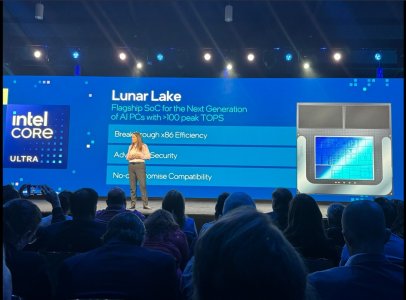
Intel Wildcat Lake (WCL) is upcoming mobile SoC replacing Raptor Lake-U. WCL consists of 2 tiles: compute tile and PCD tile. It is true single die consists of CPU, GPU and NPU that is fabbed by 18-A process. Last time I checked, PCD tile is fabbed by TSMC N6 process. They are connected through UCIe, not D2D; a first from Intel. Expecting launching in Q1 2026.
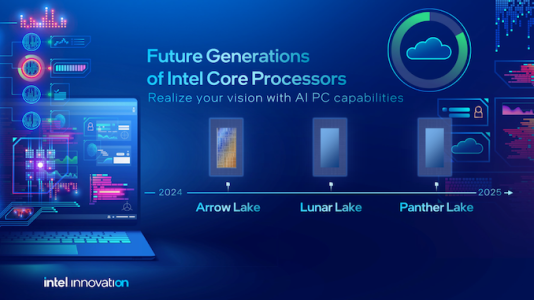
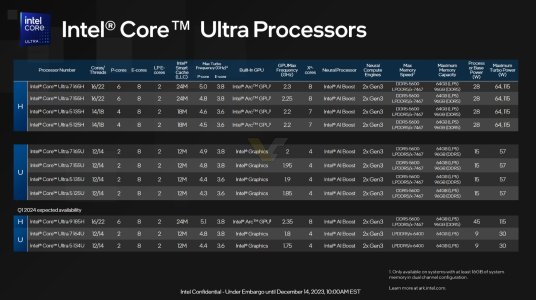
Intel Raptor Lake UIntel Wildcat Lake 15WIntel Lunar LakeIntel Panther Lake 4+0+4
Launch DateQ1-2024Q2-2026Q3-2024Q1-2026
ModelIntel 150UIntel Core 7 360Core Ultra 7 268VCore Ultra 7 365
Dies2223
NodeIntel 7 + ?Intel 18-A + TSMC N6TSMC N3B + N6Intel 18-A + Intel 3 + TSMC N6
CPU2 P-core + 8 E-cores2 P-core + 4 LP E-cores4 P-core + 4 LP E-cores4 P-core + 4 LP E-cores
Threads12688
Max Clock5.4 GHz4.8 GHz5 GHz4.8 GHz
L3 Cache12 MB6 MB12 MB12 MB
TDP15 - 55 W15 - 35 W17 - 37 W25 - 55 W
Memory128-bit LPDDR5-520064-bit LPDDR5x-7467128-bit LPDDR5x-8533128-bit LPDDR5x-7467
Size96 GB48 GB32 GB128 GB
Bandwidth83 GB/s60 GB/s136 GB/s120 GB/s
GPUIntel GraphicsIntel GraphicsArc 140VIntel Graphics
RTNoNoYESYES
EU / Xe96 EU2 Xe8 Xe4 Xe
Max Clock1.3 GHz2.6 GHz2 GHz2.5 GHz
NPUGNA 3.017 TOPS48 TOPS49 TOPS


PPT1.jpg
PPT2.jpg
PPT3.jpg


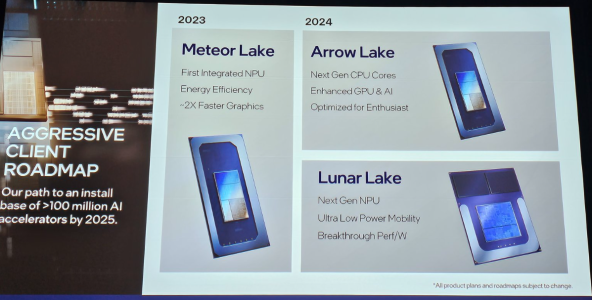
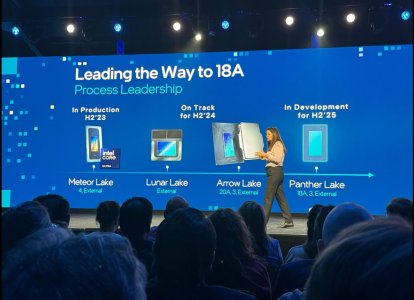
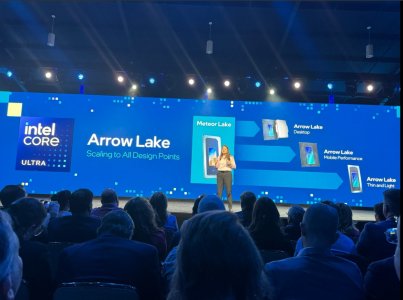
As Hot Chips 34 starting this week, Intel will unveil technical information of upcoming Meteor Lake (MTL) and Arrow Lake (ARL), new generation platform after Raptor Lake. Both MTL and ARL represent new direction which Intel will move to multiple chiplets and combine as one SoC platform.

MTL also represents new compute tile that based on Intel 4 process which is based on EUV lithography, a first from Intel. Intel expects to ship MTL mobile SoC in 2023.

ARL will come after MTL so Intel should be shipping it in 2024, that is what Intel roadmap is telling us. ARL compute tile will be manufactured by Intel 20A process, a first from Intel to use GAA transistors called RibbonFET.


LNL-MX.png
 

Attachments

  • PantherLake.png
    PantherLake.png
    283.5 KB · Views: 24,049
  • LNL.png
    LNL.png
    881.8 KB · Views: 25,534
  • INTEL-CORE-100-ULTRA-METEOR-LAKE-OFFCIAL-SLIDE-2.jpg
    INTEL-CORE-100-ULTRA-METEOR-LAKE-OFFCIAL-SLIDE-2.jpg
    181.4 KB · Views: 72,443
  • Clockspeed.png
    Clockspeed.png
    611.8 KB · Views: 72,329
Last edited:
PL1+PL2= 15W
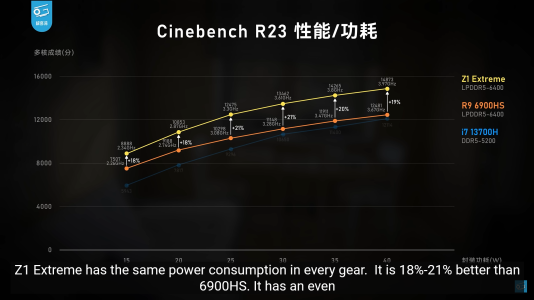
If that is the case, and if LNL preliminary estimated perf in CB 23 is +50% over MTL-U which scores ~6700 at the same power levels, then LNL is already ahead of Phoenix:

1721302107134.png

This is from Geekerwan.

Note that Intel's own nodes till Intel 7 don't scale well at low power, and LNL is on N3(B?) - which means that power scaling at the low end is going to be similar to competition.

So LNL should be doing 6700*1.5 ~= 10000 pts in CB R23 with MTP and PBP both capped at 15W (or 17W if you include the MoP).
 
  • Like
Reactions: 511
If that is the case, and if LNL preliminary estimated perf in CB 23 is +50% over MTL-U which scores ~6700 at the same power levels, then LNL is already ahead of Phoenix:

View attachment 103379

This is from Geekerwan.

Note that Intel's own nodes till Intel 7 don't scale well at low power, and LNL is on N3(B?) - which means that power scaling at the low end is going to be similar to competition.

So LNL should be doing 6700*1.5 ~= 10000 pts in CB R23 with MTP and PBP both capped at 15W (or 17W if you include the MoP).
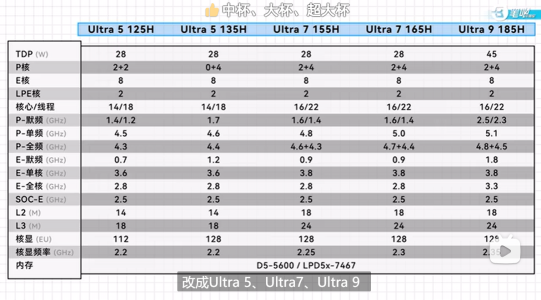
I have Ultra 9 185H i can try restricting it to 15W with 2P+8E+2LPE
 
I'm not sure if this was posted or how reliable it is (but it looks very much in line with the expectations):

If true, that would be at the top of the single core list, above the i-9 14900KS (143) and M3 Pro (142): https://www.cpu-monkey.com/en/cpu_benchmark-cinebench_2024_single_core

And basically in the middle of the i-9 14900K (2177) and i-9 14900KS (2252): https://www.cpu-monkey.com/en/cpu_benchmark-cinebench_2024_multi_core

According to this slightly different list, it would be the top of the single core and just below the i-9 14900K (2211): https://www.cgdirector.com/cinebench-2024-scores/
 
Last edited:
If true, that would be at the top of the single core list, above the i-9 14900KS (143) and M3 Pro (142): https://www.cpu-monkey.com/en/cpu_benchmark-cinebench_2024_single_core

And basically in the middle of the i-9 14900K (2177) and i-9 14900KS (2252): https://www.cpu-monkey.com/en/cpu_benchmark-cinebench_2024_multi_core

According to this slightly different list, it would be the top of the single core and just below the i-9 14900K (2211): https://www.cgdirector.com/cinebench-2024-scores/
We also have these two tweets:

One more model with 5.9Ghz ST boost

Zen 5 9950X ES scoring the same at ST at the same clock 🙂
 
If true, that would be at the top of the single core list, above the i-9 14900KS (143) and M3 Pro (142): https://www.cpu-monkey.com/en/cpu_benchmark-cinebench_2024_single_core

And basically in the middle of the i-9 14900K (2177) and i-9 14900KS (2252): https://www.cpu-monkey.com/en/cpu_benchmark-cinebench_2024_multi_core

According to this slightly different list, it would be the top of the single core and just below the i-9 14900K (2211): https://www.cgdirector.com/cinebench-2024-scores/
Would put it at an around ~16-17% IPC uplift compared to the 5.8GHz 13900k, not bad.
 
The leaked ARL's MT performance is disappointing, as it should be higher than the ST gains. So still have to wait.
Surprised no one saw this tweet:
Or for those who dont wanna click on the link
View attachment 103453
It seems to be one rare generation where the BTB size didn't increase. That might explain less-than expected gains.

Skymont didn't get BTB increase either, but it benefits from the changes made to enhance the clustered decode scheme further.
 
The leaked ARL's MT performance is disappointing, as it should be higher than the ST gains. So still have to wait.

It seems to be one rare generation where the BTB size didn't increase. That might explain less-than expected gains.

Skymont didn't get BTB increase either, but it benefits from the changes made to enhance the clustered decode scheme further.
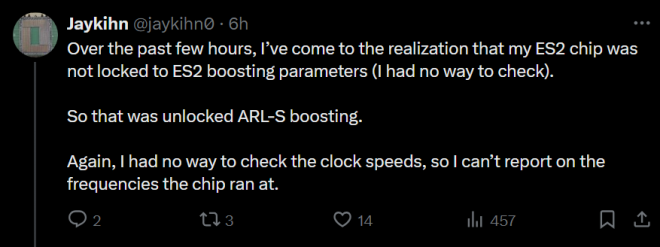
last time i saw,the es frequency is 4.7g. We don’t know what is the frequency that r24 run at.
 
Agree, this result is a fake. We have an actual 9950X ES @5.65GHz scoring 143 in the Zen 5 thread. The same Haytam guy posted like 153 for 9950X ES a few days before that. Scores seem made up-- I dont believe Haytam is a reliable source. Plus, the guys handle has the word "meld" in it. Instant skepticism just from that. 🙂
 
last time i saw,the es frequency is 4.7g. We don’t know what is the frequency that r24 run at.
The 4.7GHz ES you are talking about is DIFFERENT from this ES, as the ST performance is up to par.

But people are calling him out as fake, so there it is.
 
Look, no x86 CPU(Zen5 or ARL) is going above 150 ST (Cinebench 2024) at stock. Only one non-x86 CPU will, that would be Apple's M4 Max(4.5GHz) now that its got a ~17% ST boost over M3 Max.

If AMD or Intel boosted above 5.7GHz this gen, then yes 150 would have been possible.
 
Look, no x86 CPU(Zen5 or ARL) is going above 150 ST (Cinebench 2024) at stock. Only one non-x86 CPU will, that would be Apple's M4 Max(4.5GHz) now that its got a ~17% ST boost over M3 Max.

If AMD or Intel boosted above 5.7GHz this gen, then yes 150 would have been possible.
Just to follow up, it’s the M4 series in general that will be over 150 points. Based on geekbench (I know it’s not ideal), the M4 gets 19% better single-core scores compared to the M3 (it is cross OS, but the M2 differences aren’t much when using each OS). If that improvement remains the same, then the M4 should score around 170 points in Cinebench 2024.
 
Just to follow up, it’s the M4 series in general that will be over 150 points. Based on geekbench (I know it’s not ideal), the M4 gets 19% better single-core scores compared to the M3 (it is cross OS, but the M2 differences aren’t much when using each OS). If that improvement remains the same, then the M4 should score around 170 points in Cinebench 2024.
It will not cross 170 cause the geekbench inflation is due to the Matrix extension it will be around 165
 
Also i winded what happens if Cinebench ran on Linux than we would have both the macos and Linux with posix thread model minimising the difference
 
Last edited:
Back
Top