Discussion Intel Meteor, Arrow, Lunar & Panther Lakes + WCL Discussion Threads

Page 384 - Seeking answers? Join the AnandTech community: where nearly half-a-million members share solutions and discuss the latest tech.

Tigerick

Senior member
Apr 1, 2022
911
829
106
Wildcat Lake (WCL) Preliminary Specs

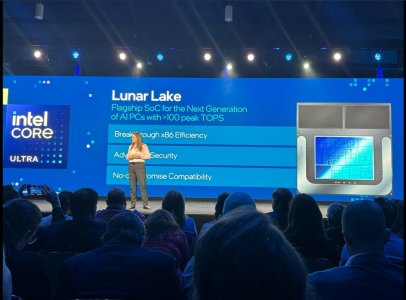
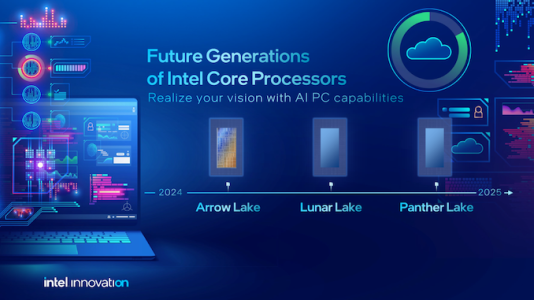
Intel Wildcat Lake (WCL) is upcoming mobile SoC replacing ADL-N. WCL consists of 2 tiles: compute tile and PCD tile. It is true single die consists of CPU, GPU and NPU that is fabbed by 18-A process. Last time I checked, PCD tile is fabbed by TSMC N6 process. They are connected through UCIe, not D2D; a first from Intel. Expecting launching in Q2/Computex 2026. In case people don't remember AlderLake-N, I have created a table below to compare the detail specs of ADL-N and WCL. Just for fun, I am throwing LNL and upcoming Mediatek D9500 SoC.

Intel Alder Lake - NIntel Wildcat LakeIntel Lunar LakeMediatek D9500
Launch DateQ1-2023Q2-2026 ?Q3-2024Q3-2025
ModelIntel N300?Core Ultra 7 268VDimensity 9500 5G
Dies2221
NodeIntel 7 + ?Intel 18-A + TSMC N6TSMC N3B + N6TSMC N3P
CPU8 E-cores2 P-core + 4 LP E-cores4 P-core + 4 LP E-coresC1 1+3+4
Threads8688
Max Clock3.8 GHz?5 GHz
L3 Cache6 MB?12 MB
TDP7 WFanless ?17 WFanless
Memory64-bit LPDDR5-480064-bit LPDDR5-6800 ?128-bit LPDDR5X-853364-bit LPDDR5X-10667
Size16 GB?32 GB24 GB ?
Bandwidth~ 55 GB/s136 GB/s85.6 GB/s
GPUUHD GraphicsArc 140VG1 Ultra
EU / Xe32 EU2 Xe8 Xe12
Max Clock1.25 GHz2 GHz
NPUNA18 TOPS48 TOPS100 TOPS ?


PPT1.jpg
PPT2.jpg
PPT3.jpg


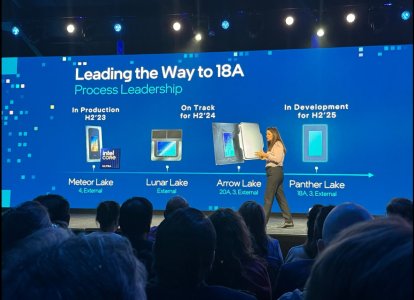
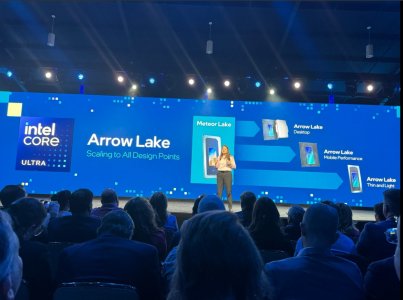
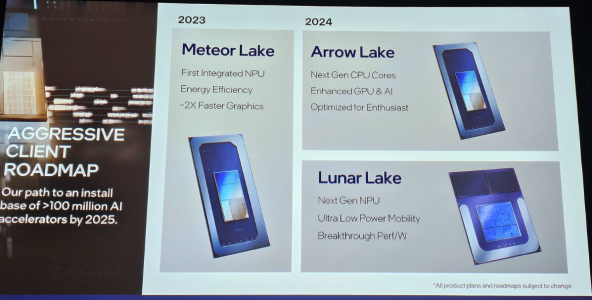
As Hot Chips 34 starting this week, Intel will unveil technical information of upcoming Meteor Lake (MTL) and Arrow Lake (ARL), new generation platform after Raptor Lake. Both MTL and ARL represent new direction which Intel will move to multiple chiplets and combine as one SoC platform.

MTL also represents new compute tile that based on Intel 4 process which is based on EUV lithography, a first from Intel. Intel expects to ship MTL mobile SoC in 2023.

ARL will come after MTL so Intel should be shipping it in 2024, that is what Intel roadmap is telling us. ARL compute tile will be manufactured by Intel 20A process, a first from Intel to use GAA transistors called RibbonFET.
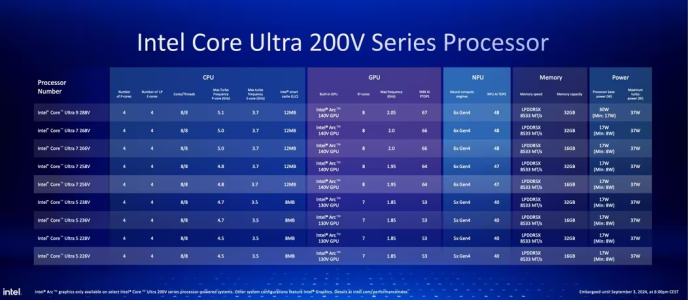


LNL-MX.png
 

Attachments

  • PantherLake.png
    PantherLake.png
    283.5 KB · Views: 24,034
  • LNL.png
    LNL.png
    881.8 KB · Views: 25,527
  • INTEL-CORE-100-ULTRA-METEOR-LAKE-OFFCIAL-SLIDE-2.jpg
    INTEL-CORE-100-ULTRA-METEOR-LAKE-OFFCIAL-SLIDE-2.jpg
    181.4 KB · Views: 72,435
  • Clockspeed.png
    Clockspeed.png
    611.8 KB · Views: 72,321
Last edited:

Doug S

Diamond Member
Feb 8, 2020
3,727
6,588
136
What are the prospects for Nova Lake? Is it still a thing? I thought it (Nova Lake link) was supposed to be the biggest architectural change in Intel's history, and expected to bring a huge IPC gain (up to 50%)? Intel definitely needs to step up their game on the P core front.

Nobody is making a 50% IPC gain in a single generation, that's simply not possible.

It also doesn't make sense they'd use TSMC N2 when 18A is supposed to be ready before it (if not 14A!) and they keep claiming they are going to achieve process leadership. That article reads like someone's wet dream about what they want to happen, much like how people here were building up all this hype for Zen 5 to gain 40% or more IPC.
 

Magio

Member
May 13, 2024
194
231
76
It also doesn't make sense they'd use TSMC N2 when 18A is supposed to be ready before it (if not 14A!) and they keep claiming they are going to achieve process leadership
I generally agree with what you said regarding the article being make-believe and 50% IPC a pipe dream, but just regarding this: Even if/when Intel regains process leadership (potentially with 18A) and even if/when that lead is significant (potentially with 14A or 10A), they will be continuing to leverage TSMC nodes long term.

Even if they could, which is not a certainty, ramp their leading edge nodes fast enough to cover their entire (high end) product line within reasonable time frames, they couldn't do that *and* have capacity to spare for foundry contracts with major players which are a key aspect of their new strategy.

So for the foreseeable future it will continue to make sense for Intel to have certain products, including halo products in certain segments, built on TSMC nodes partially or completely.
 

Hulk

Diamond Member
Oct 9, 1999
5,208
3,838
136
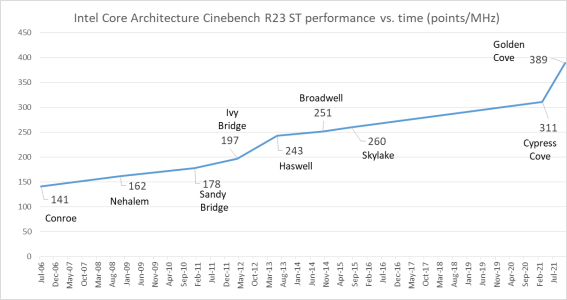
I realize that Cinebench R23 ST isn't representative of a variety of software but I have this data that I believe is semi-reliable so I thought I would present this graph I created.

Intel was slowly "tick-tocking" along up until Skylake. The trouble with 10nm and a big rush to get Cypress Cove and Golden Cove out the door!

edit - Should be points/GHz, not MHz

1719789551740.png
 
Last edited:

Doug S

Diamond Member
Feb 8, 2020
3,727
6,588
136
Exactly! Intel's own leading edge nodes are gonna take a year or two to ramp up to full volume (and also improve yield). Until then they won't have the capacity they need and have to rely on external foundries to fulfill their own client/server orders that are on leading edge nodes.

"As you adequately put, the problem is capacity!". -The Architect. :)

Its a really bad look if Intel's premium chips are coming out on someone else's process. They are supposedly looking at $15 billion in external foundry business by the end of the decade versus nearly $100 billion in internal volume, so it isn't as if they have a ton of external business pushing them to TSMC. They used to be able to supply their own needs - and they had a larger market share in those pre Zen days. So what happened? Do they have fewer fabs than they did 10 years ago?

I could see using TSMC for lower end/volume Celeron/Pentium/i3 type stuff, lower tier GPU chiplets, and the like but this is a rumor about some fabled new architecture that's going to let Intel from the wilderness and drive a stake in AMD's heart (or at least it would if that 50% was even close to real) Surely they could devote their best capacity to THAT, and use TSMC for all the trash that gets put into PCs costing $500 and under.
 

jpiniero

Lifer
Oct 1, 2010
16,985
7,386
136
Its a really bad look if Intel's premium chips are coming out on someone else's process. They are supposedly looking at $15 billion in external foundry business by the end of the decade versus nearly $100 billion in internal volume, so it isn't as if they have a ton of external business pushing them to TSMC. They used to be able to supply their own needs - and they had a larger market share in those pre Zen days. So what happened? Do they have fewer fabs than they did 10 years ago?

Um... this has been discussed just in this thread multiple times. Intel doesn't have the money.
 

coercitiv

Diamond Member
Jan 24, 2014
7,443
17,731
136
Saw this on Videocardz, a diagram for 800 series and Arrow Lake-S I/O capabilities:
ARROW-LAKE-Z890.jpg


The good news is we're apparently getting another bundle of PCIe lanes that can be used for a second SSD connected directly to the CPU.
 
  • Like
Reactions: Elfear

dullard

Elite Member
May 21, 2001
26,135
4,792
126
Desktop arrow lake will have lp cores according to mild
Then he's very wrong. Unless he got some hot off the press info
MLID claims the LP-E cores are in Arrow Lake. But he didn't specify desktop, mobile, or both. https://videocardz.com/newz/intel-r...-refresh-featuring-8p32e-cores-for-2025-debut

WCCFTech claims that mobile Arrow Lake will have LP-E cores--Crestmont based, not Skymont based. https://wccftech.com/intel-arrow-la...ke-h-16-core-cpus-spotted-higher-base-clocks/ and https://wccftech.com/intel-arrow-lake-cpu-core-ultra-200-branding-raptor-lake-h-refresh-core-200h/

TechSpot (via Golden Pig) claims mobile Arrow Lake will have LP-E cores, but not desktop. https://www.techspot.com/news/102149-intel-arrow-lake-s-desktop-processors-ditch-lp.html
 
  • Like
Reactions: Henry swagger

TwistedAndy

Member
May 23, 2024
159
150
76
MLID claims the LP-E cores are in Arrow Lake. But he didn't specify desktop, mobile, or both.

It appears that both the desktop (ARL-S and ARL-S) and mobile (ARL-H) will have LP-E cores. They are not necessary for desktops but might be pretty useful for ARL-H and ARL-HX. The same can be said about two embedded TB4 controllers.

It looks like Intel is going to make ARL-HX more mobile-friendly while using the unified design with desktop ARL-S.
 
  • Like
Reactions: Henry swagger

TwistedAndy

Member
May 23, 2024
159
150
76
Wonder what the performance impact is changing the layout of the cores?

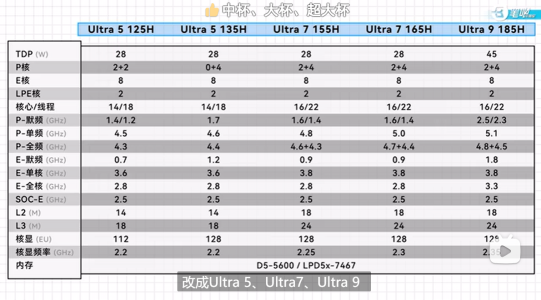
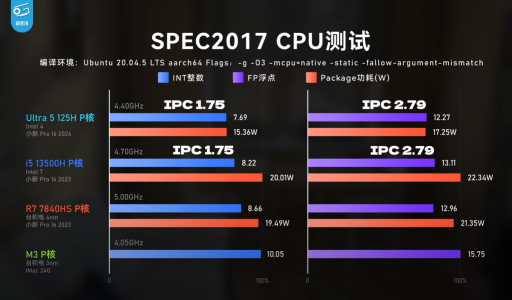
The performance impact of moving the IMC to the SoC tile will be minimal (0-5% IPC). Here's a comparison of Raptor Lake (13500H) to Meteor Lake (125H):


Attachments

  • 1719848334859.png
    1719848334859.png
    576.3 KB · Views: 10
  • 1719848572097.png
    1719848572097.png
    453.4 KB · Views: 10

DavidC1

Platinum Member
Dec 29, 2023
2,003
3,152
96
2. If #2 is not the case (the sequential nature of the code isn't the main bottleneck) then could it be that the current P core architecture has maxed out from an IPC point-of-view and a completely new and different direction is required, something more along direction of Skymont?
It can't be the limit, because clearly Apple is way higher.

Based on David Huang's analysis, Zen 5 is a regression in structure size for many aspects, looking more like a careful(attempted?) balance to increase performance.

That's likely the reason for why Zen 5 didn't increase in performance so much. Smaller uop cache, reduced performance in certain instructions and the clustered decode setup akin to Tremont but a more niche implementation that doesn't work as often in ST and is tailored for more MT performance. It's probably better for perf/watt but not outright performance.

We can't say sure for Lion Cove yet, but we don't know the full details on why the gain is only 16% for such a big on paper improvement. Think of RDNA3 how on paper it looked impressive but turned out to be a situational benefit and it was done to save area with the dual issue unit. It could be the Lion Cove core just like Zen 5 and RDNA3 took steps to reduce gains in transistor count thus the performance ended up middling.

Also don't discount the possibility that the team could simply not be executing that well.
MLID claims the LP-E cores are in Arrow Lake. But he didn't specify desktop, mobile, or both. https://videocardz.com/newz/intel-r...-refresh-featuring-8p32e-cores-for-2025-debut
It's useless in Meteorlake, so it'll be worse in Arrowlake. They probably didn't bother changing the SoC Tile much from the MTL version if it indeed is found to have the LPE cores. The utopian idea that chiplets/tiles will allow changing every block with no consequence is probably just that - a dream.

Hopefully at least it's more power efficient rather than the amazing 150mW savings only possible when it's a best case scenario.
 
Last edited:
  • Like
Reactions: coercitiv

dullard

Elite Member
May 21, 2001
26,135
4,792
126
It's already kinda established that those 2 Crestmont LPE cores in MTL SoC tile aren't powerful enough to handle the background tasks. If the same cores are gonna feature in ARL, they're still not gonna be very useful. Or am I missing something crucial?
I think there were two main issues with the Meteor Lake's LP-E implementation.

1) There were 4 types of ways to run a thread. Threads ran on (1) P cores, (2) E cores, (3) LP-E cores, and (4) hyperthreading on the P cores. Scheduling this was not as good as Intel hoped. Too many options and not enough software written yet to specify which core to run on.

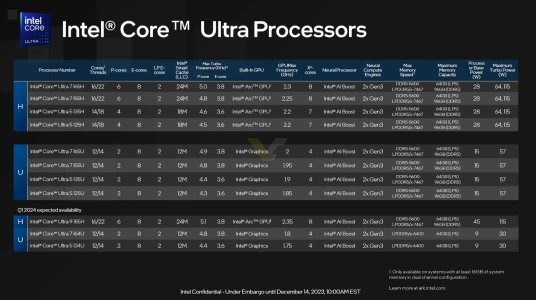
2) The LP-E cores were just clocked too low. The goal was to be as low of power as possible, but Intel went too low. Depending on the CPU, the LP-E cores in Meteor Lake had a base clock of 400 MHz to 1 GHz! When was the last time you ever felt 400 MHz to be sufficient? Turbo clocks were also pretty low: 2.1 GHz to 2.5 GHz and that is if there was thermal and power headroom to do turbo.

If (and this is an if that seems likely) Arrow Lake ditches hyperthreading, then the scheduling does get significantly easier to get right. And if the much smaller node lets them run faster, then I think the LP-E cores could actually perform how they were intended.
 
Last edited:
  • Like
Reactions: Henry swagger

DavidC1

Platinum Member
Dec 29, 2023
2,003
3,152
96
2) The LP-E cores were just clocked too low. The goal was to be as low of power as possible, but Intel went too low. Depending on the CPU, the LP-E cores in Meteor Lake had a base clock of 400 MHz to 1 GHz! When was the last time you ever felt 400 MHz to be sufficient? Turbo clocks were also pretty low: 2.1 GHz to 2.5 GHz and that is if there was thermal and power headroom to do turbo.
The Skymont cores on Lunarlake runs 10% faster clocks with twice the amount of cores while performing 38%/68% faster per clock for MT, and runs 70% faster in ST, meaning it gets both uarch benefit and clock increases.

Meteorlake's measurements show that the LPE cores were useless, consuming more power than the E cores at all frequency levels. The E core was more efficient than the "LP" E cores and not by a small amount.

I am not sure if they really need a third cluster and if they could just make it work with two clusters like with Lunar Lake. It would be easier to just disable a cluster completely if low power operation is needed from a scheduling point of view.
 

TESKATLIPOKA

Platinum Member
May 1, 2020
2,696
3,260
136
No one seems to mind that LNL iGPU performance shown in two least representative 3DMark tests, TS and WLE.
At least with ARC, TS score has little to do with gaming performance. The same goes for Nomad

The Fire Strike Extreme is way more suitable for comparing Intel and AMD GPUs in real-world gaming tasks.
LNL has a new GPU architecture, so we don't know If TS score will be inflated or not or by how much compared to MTL.
On the other hand, even If It is inflated, It is not a low value.
If It was TS Graphics, It would be better, but whatever.

TS score(Highest for the given TDP from notebookcheck database):
15/15W 8840U -> 2688 (100%)
17W LNL -> 3438 (128%)
64/20W MTL 185H -> 3537 (132%)

32/27W 8840HS -> 3203 (99%)
54
/28W 7840U -> 3232 (100%)
64/28W MTL 155H -> 3710 (115%)
30W LNL -> 4151 (128%)

At low TDPs It looks the most impressive. If Intel will keep improving their drivers, then It could be interesting.

edit: added PL2 for Phoenix and 8840HS.
 
Last edited: