Discussion Intel Meteor, Arrow, Lunar & Panther Lakes + WCL Discussion Threads

Page 345 - Seeking answers? Join the AnandTech community: where nearly half-a-million members share solutions and discuss the latest tech.

Tigerick

Senior member
Apr 1, 2022
911
829
106
Wildcat Lake (WCL) Preliminary Specs

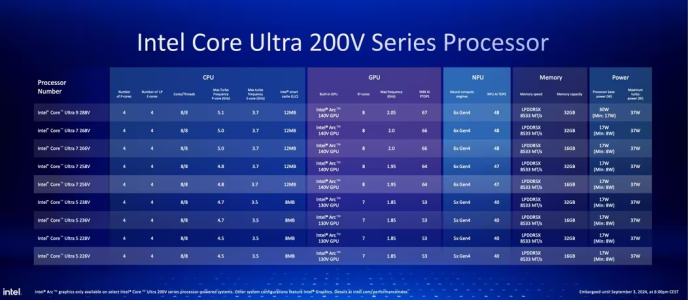
Intel Wildcat Lake (WCL) is upcoming mobile SoC replacing ADL-N. WCL consists of 2 tiles: compute tile and PCD tile. It is true single die consists of CPU, GPU and NPU that is fabbed by 18-A process. Last time I checked, PCD tile is fabbed by TSMC N6 process. They are connected through UCIe, not D2D; a first from Intel. Expecting launching in Q2/Computex 2026. In case people don't remember AlderLake-N, I have created a table below to compare the detail specs of ADL-N and WCL. Just for fun, I am throwing LNL and upcoming Mediatek D9500 SoC.

Intel Alder Lake - NIntel Wildcat LakeIntel Lunar LakeMediatek D9500
Launch DateQ1-2023Q2-2026 ?Q3-2024Q3-2025
ModelIntel N300?Core Ultra 7 268VDimensity 9500 5G
Dies2221
NodeIntel 7 + ?Intel 18-A + TSMC N6TSMC N3B + N6TSMC N3P
CPU8 E-cores2 P-core + 4 LP E-cores4 P-core + 4 LP E-coresC1 1+3+4
Threads8688
Max Clock3.8 GHz?5 GHz
L3 Cache6 MB?12 MB
TDP7 WFanless ?17 WFanless
Memory64-bit LPDDR5-480064-bit LPDDR5-6800 ?128-bit LPDDR5X-853364-bit LPDDR5X-10667
Size16 GB?32 GB24 GB ?
Bandwidth~ 55 GB/s136 GB/s85.6 GB/s
GPUUHD GraphicsArc 140VG1 Ultra
EU / Xe32 EU2 Xe8 Xe12
Max Clock1.25 GHz2 GHz
NPUNA18 TOPS48 TOPS100 TOPS ?


PPT1.jpg
PPT2.jpg
PPT3.jpg


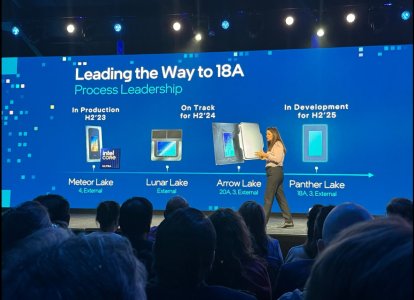
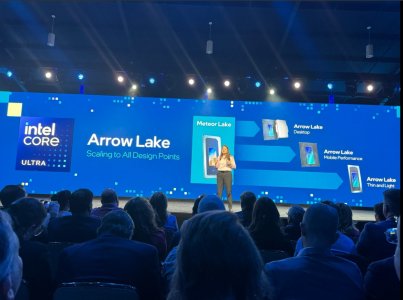
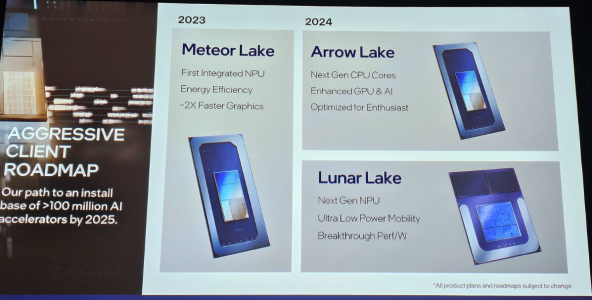
As Hot Chips 34 starting this week, Intel will unveil technical information of upcoming Meteor Lake (MTL) and Arrow Lake (ARL), new generation platform after Raptor Lake. Both MTL and ARL represent new direction which Intel will move to multiple chiplets and combine as one SoC platform.

MTL also represents new compute tile that based on Intel 4 process which is based on EUV lithography, a first from Intel. Intel expects to ship MTL mobile SoC in 2023.

ARL will come after MTL so Intel should be shipping it in 2024, that is what Intel roadmap is telling us. ARL compute tile will be manufactured by Intel 20A process, a first from Intel to use GAA transistors called RibbonFET.


LNL-MX.png
 

Attachments

  • PantherLake.png
    PantherLake.png
    283.5 KB · Views: 24,034
  • LNL.png
    LNL.png
    881.8 KB · Views: 25,527
  • INTEL-CORE-100-ULTRA-METEOR-LAKE-OFFCIAL-SLIDE-2.jpg
    INTEL-CORE-100-ULTRA-METEOR-LAKE-OFFCIAL-SLIDE-2.jpg
    181.4 KB · Views: 72,435
  • Clockspeed.png
    Clockspeed.png
    611.8 KB · Views: 72,321
Last edited:
Jun 4, 2024
116
146
71
It is not, Computerbase provided a comparison at same frequency, and in all cases excepted CBR20 Zen 4 has better MT IPC than the P cores used in the 12900K, how is this possible if ST IPC was lower by 10%..?..

And before one comes for a theorical better SMT scaling of Zen 4 that s just moot, because 5% better ST IPC cant be compensated in MT by marginaly better SMT yield, let alone with 10% better ST IPC as proven by the estimation below.

If a core has say 100 ST IPC and 30% SMT yield it will perform at 130 in MT.
A core that has just 5% better IPC and only 25% SMT yield is at 131.5 in MT.
Now a core at 110 with only 25% SMT yield would do 137.5.

SMT yields of AMD and Intel are not as far apart as in this exemple, so it s obvious that Intel having better IPC is just an urban legend that doesnt pass the most basic examination, actually it s the contrary.
Cinebench R20 uses AVX512
 

deasd

Senior member
Dec 31, 2013
606
1,038
136
Because SPEC is best.
Ahhh. This reply reminds me of a very shocking reading from several months ago.


SPEC sometimes is not reliable. It heavily relies on the person who do the test, which means results may vary terribly.
But I find it more terrible is even being get caught, today Intel use SPEC as if nothing has happened before..?
 
  • Like
Reactions: lightmanek

Abwx

Lifer
Apr 2, 2011
11,912
4,890
136
Cinebench R20 uses AVX512

It doesnt, and as said it s the only bench where Intel s P cores do better than Zen 4.

There lots of reviews at Computerbase, not only straight comparison at same frequencies but in the the benches there s also a 12900K with e cores disabled and with all the 241W power budget allocated to the P cores.

Despite higher all cores frequency it barely match a 88W 7700, RPL could have slightly better IPC than the 12900K P cores but this was lost on MTL wich is the comparison for Intel s next big core.
 

gdansk

Diamond Member
Feb 8, 2011
4,680
7,906
136
Ahhh. This reply reminds me of a very shocking reading from several months ago.


SPEC sometimes is not reliable. It heavily relies on the person who do the test, which means results may vary terribly.
But I find it more terrible is even being get caught, today Intel use SPEC as if nothing has happened before..?
The rule of thumb is look for gcc.
 

eek2121

Diamond Member
Aug 2, 2005
3,441
5,094
136
Raptor cove is around 2-3% faster than Zen 4, while RWC is around ~3% slower than Raptor cove (so RWC and Zen 4 are ~even). Zen 5 should end up having a slight edge over Lion Cove if both IPC projections are confirmed in reality. In AVX512 optimized stuff Zen 5 should have a big advantage though.
Arrow Lake should be around 20% faster than Raptor Cove for single core stuff. That is more than enough to beat Zen 5 in many benchmarks.

Multicore? Hah we’ll see, it will come down to power and how accurate Intel has been with reveals. I am expecting Intel to walk all over AMD for multicore as well.

Of course X3D will change things up a bit.
 

Hitman928

Diamond Member
Apr 15, 2012
6,746
12,468
136
Ahhh. This reply reminds me of a very shocking reading from several months ago.


SPEC sometimes is not reliable. It heavily relies on the person who do the test, which means results may vary terribly.
But I find it more terrible is even being get caught, today Intel use SPEC as if nothing has happened before..?

Vendor compilers have been overly optimizing (i.e., cheating) on SPEC for many years. You shouldn't pay attention to those, just look at the ones compiled with GCC or LLVM based that have reasonable compiler flags. Anandtech had been pretty consistent with this for years, though after Andrei and Ian left, we haven't been as blessed.
 

Hitman928

Diamond Member
Apr 15, 2012
6,746
12,468
136
Arrow Lake should be around 20% faster than Raptor Cove for single core stuff. That is more than enough to beat Zen 5 in many benchmarks.

Multicore? Hah we’ll see, it will come down to power and how accurate Intel has been with reveals. I am expecting Intel to walk all over AMD for multicore as well.

Of course X3D will change things up a bit.

Where do you get 20% from?
 
  • Like
Reactions: Tlh97 and inf64

deasd

Senior member
Dec 31, 2013
606
1,038
136
The rule of thumb is look for gcc.
Vendor compilers have been overly optimizing (i.e., cheating) on SPEC for many years. You shouldn't pay attention to those, just look at the ones compiled with GCC or LLVM based that have reasonable compiler flags. Anandtech had been pretty consistent with this for years, though after Andrei and Ian left, we haven't been as blessed.
Now I understand why not all vendor preview use SPEC as a metric. Third party SPEC test is important. Wait until hit the shelves.
 

inf64

Diamond Member
Mar 11, 2011
3,884
4,692
136
Arrow Lake should be around 20% faster than Raptor Cove for single core stuff. That is more than enough to beat Zen 5 in many benchmarks.

Multicore? Hah we’ll see, it will come down to power and how accurate Intel has been with reveals. I am expecting Intel to walk all over AMD for multicore as well.

Of course X3D will change things up a bit.
Based on what exactly (20%)? Is that your hopium/copium or you base that on some benchmarks? We already have a chart from intel that shows Lunar Lake vs RWC (which has lower IPC than RPC) and the chart is ~14% average, with even a regression in some benchmarks.

From AMD, we have a very vague average with very conservative workload selection that shows 16% improvement. I'm very confident that Zen 5 will have no problem beating Arrow Lake in ST stuff and gaming, while MT stuff remains open due to E cores and huge uplift they bring.
 

inf64

Diamond Member
Mar 11, 2011
3,884
4,692
136
ARL-S P cores are slightly different with more L2$ and HT present (although maybe not enabled).

Based on the disparity of how transparent IPC was calculated for both - I would wait for 3rd party reviews before saying anything conclusively.
If you check intel's presentation, they even mentioned that they gained ST IPC due to removal of HT related structures. If ARL-S has a form of HT, even if disabled, I don't see how that can help ST IPC, on the contrary. Bigger L2 can help but not much - maybe a percent or two at best.
 
  • Like
Reactions: Racan

Hitman928

Diamond Member
Apr 15, 2012
6,746
12,468
136
Now I understand why not all vendor preview use SPEC as a metric. Third party SPEC test is important. Wait until hit the shelves.

Vendors don't have to use their own compilers, they could present numbers with independent compilers as well, but even then, you should always take vendor provided numbers with a grain of salt. BTW, I should have been a little more careful with my wording earlier as Intel and AMD have vendor compilers based on LLVM now.
 

H433x0n

Golden Member
Mar 15, 2023
1,224
1,606
106
I'm very confident that Zen 5 will have no problem beating Arrow Lake in ST stuff and gaming, while MT stuff remains open due to E cores and huge uplift they bring.
How do you get to that math? What 1T benchmarks?
 

Hulk

Diamond Member
Oct 9, 1999
5,211
3,839
136
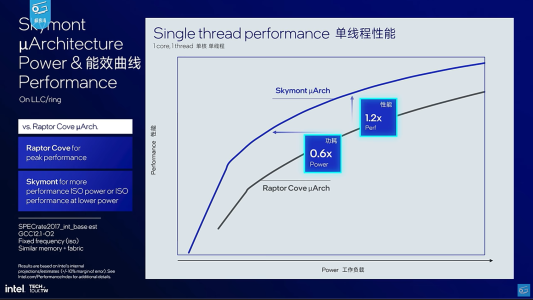
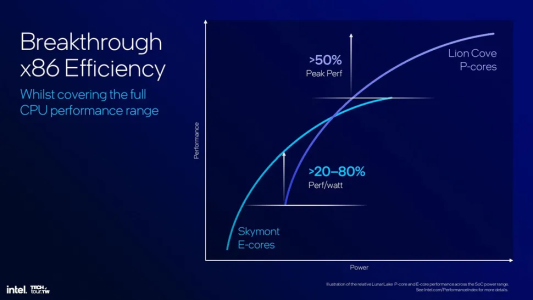
The 38% Integer and 68% Floating Point IPC improvements Intel is touting are a comparison against the Low Power Island E cores in Meteor Lake, not the E cores that have access to the L3 cache.

Do we know what the cache structure of the Meteor Lake LPE island is and how the IPC of the LPE island compares to the Crestmont clusters in Meteor Lake in order to put some context into these 38% and 68% improvements?

What is the sizes of the Skymont/Lion Cove L1 Instructions caches? I assume unchanged?

Will LL and ARL be considered 15th generation?
 
Last edited:

Det0x

Golden Member
Sep 11, 2014
1,476
5,046
136
Arrow Lake should be around 20% faster than Raptor Cove for single core stuff. That is more than enough to beat Zen 5 in many benchmarks.
How do you come to this number ?
Like i showed in my previous post, Arrow Lake need a IPC increase of minimum +30% to reach this number (best case)

Do you expect Arrow Lake to have over +30% ST IPC increase compared to Raptor Lake ?
Going by the latest leak from wccftech (i know)

Thats a 9% or 13% clockspeed deficitt depending on if you compare against 14900K or the KS, that you need to overcome with purely IPC
  • For the 285K to reach +20% ST performance over 13900K they need a IPC increase of ~31%
  • For the 285k to reach +20% ST performance over 13900KS they need a IPC increase of ~35%

*edit*

If the 285k runs at 5.7ghz ST:
  • ..then it need a IPC increase of ~26% to reach the 14900K +20%
  • ...then it need a IPC increase of ~30% to reach the 14900KS +20%
 

inf64

Diamond Member
Mar 11, 2011
3,884
4,692
136
How do you get to that math? What 1T benchmarks?
I get it based on what AMD shared (albeit very limited set of benchmarks) and what intel shared (~14% vs RWC). Mainly SPECint2017 and SPECfp2017 1T and GB 6.3 1T.
 

ondma

Diamond Member
Mar 18, 2018
3,316
1,708
136
Arrow Lake should be around 20% faster than Raptor Cove for single core stuff. That is more than enough to beat Zen 5 in many benchmarks.

Multicore? Hah we’ll see, it will come down to power and how accurate Intel has been with reveals. I am expecting Intel to walk all over AMD for multicore as well.

Of course X3D will change things up a bit.
Dont forget there will be a clock speed regression of 5-10% at least, and a IPC 20% seems a bit high. So final result, I would think 10% faster than RC ST would be an acceptable result. As for MT, if the E cores are as good as the predictions, there should be plenty of horsepower for a good MT performance. It will depend on temps and power usage, i.e. what clocks they can hold in full core load.
 

H433x0n

Golden Member
Mar 15, 2023
1,224
1,606
106
I get it based on what AMD shared (albeit very limited set of benchmarks) and what intel shared (~14% vs RWC). Mainly SPECint2017 and SPECfp2017 1T and GB 6.3 1T.
There was no specint or specfp figure provided by AMD. Nor was there any GB5 or GB6 1T number provided.

You may be right that it ends up being close in Specint & Specfp. If you take their numbers at face value for the popular client 1T benchmarks (WebXprt, Speedometer & CB R23), it won't be that close in those metrics.