• We’re currently investigating an issue related to the forum theme and styling that is impacting page layout and visual formatting. The problem has been identified, and we are actively working on a resolution. There is no impact to user data or functionality, this is strictly a front-end display issue. We’ll post an update once the fix has been deployed. Thanks for your patience while we get this sorted.

Discussion Intel Meteor, Arrow, Lunar & Panther Lakes + WCL Discussion Threads

Page 210 - Seeking answers? Join the AnandTech community: where nearly half-a-million members share solutions and discuss the latest tech.

Tigerick

Senior member
Wildcat Lake (WCL) Specs

Intel Wildcat Lake (WCL) is upcoming mobile SoC replacing Raptor Lake-U. WCL consists of 2 tiles: compute tile and PCD tile. It is true single die consists of CPU, GPU and NPU that is fabbed by 18-A process. Last time I checked, PCD tile is fabbed by TSMC N6 process. They are connected through UCIe, not D2D; a first from Intel. Expecting launching in Q1 2026.
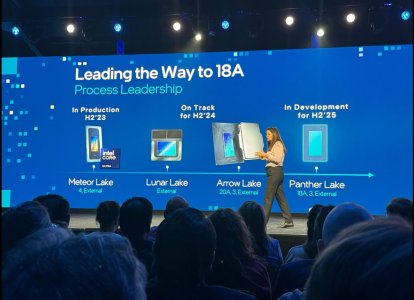
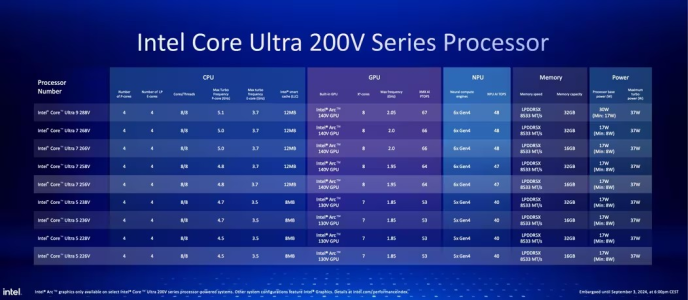
Intel Raptor Lake UIntel Wildcat Lake 15WIntel Lunar LakeIntel Panther Lake 4+0+4
Launch DateQ1-2024Q2-2026Q3-2024Q1-2026
ModelIntel 150UIntel Core 7 360Core Ultra 7 268VCore Ultra 7 365
Dies2223
NodeIntel 7 + ?Intel 18-A + TSMC N6TSMC N3B + N6Intel 18-A + Intel 3 + TSMC N6
CPU2 P-core + 8 E-cores2 P-core + 4 LP E-cores4 P-core + 4 LP E-cores4 P-core + 4 LP E-cores
Threads12688
Max Clock5.4 GHz4.8 GHz5 GHz4.8 GHz
L3 Cache12 MB6 MB12 MB12 MB
TDP15 - 55 W15 - 35 W17 - 37 W25 - 55 W
Memory128-bit LPDDR5-520064-bit LPDDR5x-7467128-bit LPDDR5x-8533128-bit LPDDR5x-7467
Size96 GB48 GB32 GB128 GB
Bandwidth83 GB/s60 GB/s136 GB/s120 GB/s
GPUIntel GraphicsIntel GraphicsArc 140VIntel Graphics
RTNoNoYESYES
EU / Xe96 EU2 Xe8 Xe4 Xe
Max Clock1.3 GHz2.6 GHz2 GHz2.5 GHz
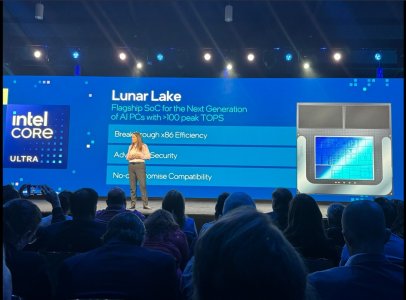
NPUGNA 3.017 TOPS48 TOPS49 TOPS


PPT1.jpg
PPT2.jpg
PPT3.jpg


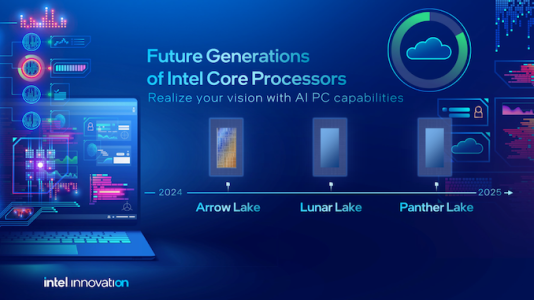
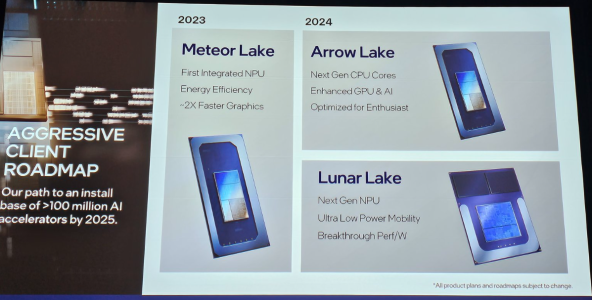
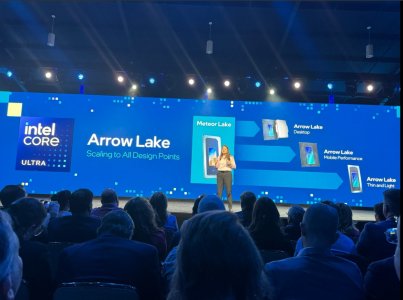
As Hot Chips 34 starting this week, Intel will unveil technical information of upcoming Meteor Lake (MTL) and Arrow Lake (ARL), new generation platform after Raptor Lake. Both MTL and ARL represent new direction which Intel will move to multiple chiplets and combine as one SoC platform.

MTL also represents new compute tile that based on Intel 4 process which is based on EUV lithography, a first from Intel. Intel expects to ship MTL mobile SoC in 2023.

ARL will come after MTL so Intel should be shipping it in 2024, that is what Intel roadmap is telling us. ARL compute tile will be manufactured by Intel 20A process, a first from Intel to use GAA transistors called RibbonFET.


LNL-MX.png
 

Attachments

  • PantherLake.png
    PantherLake.png
    283.5 KB · Views: 24,049
  • LNL.png
    LNL.png
    881.8 KB · Views: 25,534
  • INTEL-CORE-100-ULTRA-METEOR-LAKE-OFFCIAL-SLIDE-2.jpg
    INTEL-CORE-100-ULTRA-METEOR-LAKE-OFFCIAL-SLIDE-2.jpg
    181.4 KB · Views: 72,443
  • Clockspeed.png
    Clockspeed.png
    611.8 KB · Views: 72,329
Last edited:

MSI Handheld with 155H. Really intrigued to see the performance and battery life on this one.
Let's welcome MSI CLAW.
MSI-CLAW-HANDHELD.jpg

MSI-CLAW-CHINA.jpg

It looks like It will have up to 32GB RAM, nice.
 

MSI Handheld with 155H. Really intrigued to see the performance and battery life on this one.
Performance I can agree on, battery life with gaming handhelds is less about the chip involved and more about the power limits it runs at, which is usually 15W. So far MTL iGPU results at 15W have been a lot less impressive than that at 28W, but hopefully that can be fixed with future firmware improvements?
 
I am skeptical if the level of "IPC regression" is big as that test shows. This is one issue of only having mobile chips. You can never do a proper test. And even if you can have them at the same frequency, the desktop chip will outperform the mobile one by few %.

@Geddagod While you say both tests show similar regression, the E cores show a significant difference between the two tests.

Also, unless something is really messed up, scaling between chips do not vary that drastically, so much so that just 10% clock increase would result in IPC shifting upwards of 3-4%.
So far MTL iGPU results at 15W have been a lot less impressive than that at 28W, but hopefully that can be fixed with future firmware improvements?
Based on the curve it seems MTL/Intel 4 still has the same curve that existed since 10nm SF in the pursuit of ultra high frequencies. That means even with firmware improvements, at such low power levels it'll underperform.

The curve is a compromise between the two - if you want to reach the maximum frequency, Intel's way is the way to go. But you lose on the low power. To me, the rumors of Arrowlake having noticeably(even substantially) reduced clocks makes sense, because 1) it's unsustainable 2) it hurts mobile and server.

The curve can be optimized at both process and chip level. This is why the -U chips require more power at the same frequency compared to -H. The decision is deliberate. The -H needs extra clocks, while -U needs low leakage for battery life.
 
Last edited:
Let's welcome MSI CLAW.
MSI-CLAW-HANDHELD.jpg

MSI-CLAW-CHINA.jpg

It looks like It will have up to 32GB RAM, nice.
I will stick with my Steam Deck.

These guys are forgetting the software part of the equation. The Steam Deck “just works” and it works well. Would I like to see Valve move to Zen 4 + RDNA3 or possibly Meteor Lake? Of course.

Actually those LPe cores in MTL would be great for running the SteamOS frontend/UI. Shoot, could run the entire OS on them…Even at 2.5ghz the *mont cores are performant.
 
I will stick with my Steam Deck.

These guys are forgetting the software part of the equation. The Steam Deck “just works” and it works well. Would I like to see Valve move to Zen 4 + RDNA3 or possibly Meteor Lake? Of course.

Actually those LPe cores in MTL would be great for running the SteamOS frontend/UI. Shoot, could run the entire OS on them…Even at 2.5ghz the *mont cores are performant.
What's performance difference between E and LPe cores? Same IPC?
 
Based on the curve it seems MTL/Intel 4 still has the same curve that existed since 10nm SF in the pursuit of ultra high frequencies. That means even with firmware improvements, at such low power levels it'll underperform.
Crestmont seems to outperform everything at 5-6W (incl Zen 4). Disagree on the RWC curve too, its scaling (especially for 6VT) is a lot less linear.

I am worried about battery life for the MSI handheld though since it seems it falls off a cliff in gaming below 25W.
 
Performance I can agree on, battery life with gaming handhelds is less about the chip involved and more about the power limits it runs at, which is usually 15W. So far MTL iGPU results at 15W have been a lot less impressive than that at 28W, but hopefully that can be fixed with future firmware improvements?

Not just firmware, Golden pig said there is a test driver in the works with improved low power performance.
 
I don't know why you talk like Crestmont outperforming Zen 4 in perf/watt is a new thing. Alderlake's Gracemont did too, even with the heavy uncore. And I am not sure if anyone did MTL-like comparisons on mobile Alder/Raptor parts. Mobile chips would have lower overhead, thus a better comparison.

By the way that graph is representative of the pre-firmware update.

That's why we need a desktop, because laptops have all sort of unknowns that screws up the result. Even in desktops, it's only after dozens of reviews and months and months of arguing before people come to a consensus.
 
Last edited:
How are we still having a discussion about Meteor Lake vs. any competition? At least on a per-core basis, Meteor Lake should be the most advanced x86 mobile SoC on the market. It should clearly win ST performance versus its competition and older Intel SoCs, and it should use at least a little less power doing so. Without firmware updates and such. And yet here we are.
 
How are we still having a discussion about Meteor Lake vs. any competition? At least on a per-core basis, Meteor Lake should be the most advanced x86 mobile SoC on the market. It should clearly win ST performance versus its competition and older Intel SoCs, and it should use at least a little less power doing so. Without firmware updates and such. And yet here we are.

It does use less power to achieve the same performance. Proven over and over again. Even in the first benchmarks. The pcore update just adds more margin between 13th gen and MTL.
 
How are we still having a discussion about Meteor Lake vs. any competition? At least on a per-core basis, Meteor Lake should be the most advanced x86 mobile SoC on the market. It should clearly win ST performance versus its competition and older Intel SoCs, and it should use at least a little less power doing so. Without firmware updates and such. And yet here we are.
It definitely uses less power than previous gen to achieve similar performance.
 
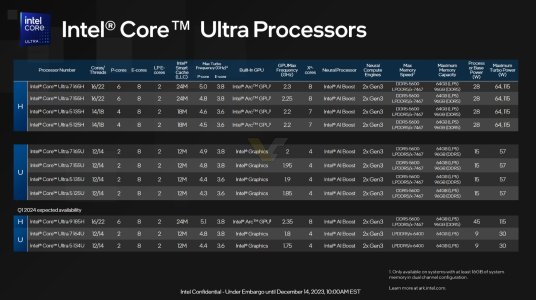
Hey, Dell finally has a Meteor Lake laptop available for sale. Only the i7 155H and starts at a grand. Delivery not for another 3 weeks though.
 
no, I was going off of David Huang's Specint data.
You mean this?
gcu2dcgbwaakmh9-jpg.91289

Then Phoenix at 5W is comparable, at 6W is better. E-core at <5W is better.
I really want to know how he measured It.
I have PHX laptop and Ryzen Master is not working, the same for AMD Overdrive. Not sure about MTL and Extreme Tuning Utility.
 
It does use less power to achieve the same performance. Proven over and over again. Even in the first benchmarks. The pcore update just adds more margin between 13th gen and MTL.

Except in the benchmarks where it uses more power. As much as I hate to say it, take a look at the Phoronix review. It's quite bad for Meteor Lake.

edit: also the perf/watt charts make Meteor Lake look pretty bad.
 
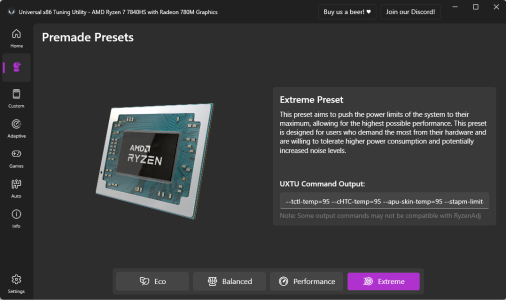
Could you check, if this utility will work with your laptop?
https://amdaputuningutility.com/index.html
The app starts, that's already a good signal and It detects my APU.
Premade presets work, but you have to set Extreme Performance in Lenovo Vantage or you will be limited to max 30W power limit, regardless of which preset you choose.
Screenshot_7.png
Didn't play with It any more.
If MTL works I don't know, but for that you should use Intel's own APP considering this is mainly for AMD.
 
Last edited:
Except in the benchmarks where it uses more power. As much as I hate to say it, take a look at the Phoronix review. It's quite bad for Meteor Lake.

edit: also the perf/watt charts make Meteor Lake look pretty bad.

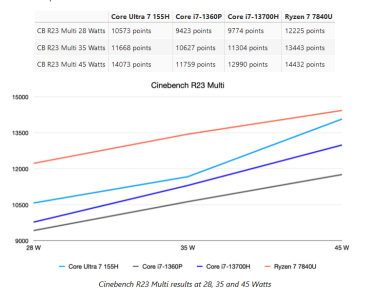
No it didn't. Even in the first Notebookcheck review, which everyone used to tell us MTL was a failure, it beat the 13th gen at all tested power levels.

Captura de pantalla 2024-01-07 111929.png
 
It should clearly win ST performance versus its competition and older Intel SoCs, and it should use at least a little less power doing so.
Respectfully disagree.

If AMD/Intel released a chip tomorrow that had the same performance as Zen 4, but a half the power, I would call that a win.

If they managed to release a chip that was 10% slower, but consumed 1/3rd the power, that is still a win.

Cost, power consumption, and performance are all unique metrics that can independently make a successful product.

Meteor Lake isn’t perfect, but it is a win for Intel because it substantially improves perf/watt.

It is likely going to do well in terms of sales, especially if designs are compatible with Arrow Lake.
 
Back
Top