Intel & AMD: Rated TDP vs. Actual TDP?

Page 3 - Seeking answers? Join the AnandTech community: where nearly half-a-million members share solutions and discuss the latest tech.

witeken

Diamond Member
Dec 25, 2013
3,899
193
106
One, a 3770 is not a J1900 and two Computerbase did the measurements themselves while Anand just repeated numbers provided by Intel in an Intel office and wich are not the total power comsumption anyway..

It was at IDF and Anand (and a bunch of other people) saw how it was measured.
 

ViRGE

Elite Member, Moderator Emeritus
Oct 9, 1999
31,516
167
106
This thread has been cleansed and reopened. The OP is currently serving time for trolling.

With that said, despite the fact that he created this thread to troll, I am leaving it open under the belief that those of you who remain can discuss the issue in good faith. Please adhere to those standards and stay on topic, or I will need to close the thread and/or issue infractions once again.

And I would like to remind everyone that attacking another poster (even a troll) is not appropriate for a technical forum. Report the post and then move on; we'll hand the rest.

-ViRGE
 
Last edited:

Piroko

Senior member
Jan 10, 2013
905
79
91
In the case of Kabini, it idles at 0.77W, which is about what a single Silvermont thread consumes under load, so the conclusion that Silvermont uses much less energy than Kabini/Jaguar is an extremely easy one to make.
This argument doesn't make any sense at all. Seriously, take a step back and look at what you just compared and concluded.

Anyways, so far I haven't seen a single review that manages to mimic a realistic setup and draw correct conclusions. Reasons:
- obviously bad PSU picks
- comparing low spec boards vs. full feature ones (especially if the latter one has two whole power circuits
- picking bad benchmarks to mimic 'real' loads.
How hard can it be?
 

witeken

Diamond Member
Dec 25, 2013
3,899
193
106
This argument doesn't make any sense at all. Seriously, take a step back and look at what you just compared and concluded.
I mean Silvermont uses less energy in idle.

If a Z3770 chip with 1 core at 2.4GHz uses something like 0.8W, then it will obviously use a lot less than that (and less than the 0.77W of Jaguar) at idle.
 

TreVader

Platinum Member
Oct 28, 2013
2,057
2
0
I mean Silvermont uses less energy in idle.

If a Z3770 chip with 1 core at 2.4GHz uses something like 0.8W, then it will obviously use a lot less than that (and less than the 0.77W of Jaguar) at idle.

What is this "per core" stuff you're pitching? Where are you measuring power draw INSIDE the silicon?


Seriously what you're talking about makes zero sense whatsoever.The only thing that matters is what it draws from the socket, and silvermont is a joke when it comes to idle power usage and really not all that impressive under load. Whatever gains it has on load power usage it loses with horrendous FP and integer performance. Intel is to Mobile what VIA is to X86.
 

Piroko

Senior member
Jan 10, 2013
905
79
91
I mean Silvermont uses less energy in idle.

If a Z3770 chip with 1 core at 2.4GHz uses something like 0.8W, then it will obviously use a lot less than that (and less than the 0.77W of Jaguar) at idle.
But the number you found isn't total soc/platform power consumption with a single thread load, instead it's just the delta between 'no load' and 'single thread load' as far as I see. That's why your conclusion eludes me.

So far my impression is that Intels Haswell platform has very decent idle consumption numbers given the feature level, Intels Atom platform seems bad in comparison and AMDs Kabini platform could probably do even better but does quite well.
Compared to all of them anything prior to 2013 does quite a lot worse.
 
Feb 15, 2014
119
0
76
Talking about my desktop i5 2400, TDP is 95W.. the highest CPU Power I have seen (Linpack) is 60W for CPU. GPU maxes out at ~9W. So... 69W out of 95W seems pretty conservative to me!

But yeah, I have seen examples where Crystal well equipped parts with a 65W TDP have guzzled 85W.. so my guess is that Intel is trying to clamp them down by reducing their headroom, and so they boost for some time and then TDP stuff comes into effect.
 

witeken

Diamond Member
Dec 25, 2013
3,899
193
106
What is this "per core" stuff you're pitching? Where are you measuring power draw INSIDE the silicon?

You run a single threaded benchmark and measure SoC power consumption with 1 of Intel's fancy tools.


Seriously what you're talking about makes zero sense whatsoever.The only thing that matters is what it draws from the socket, and silvermont is a joke when it comes to idle power usage and really not all that impressive under load. Whatever gains it has on load power usage it loses with horrendous FP and integer performance. Intel is to Mobile what VIA is to X86.
It does make sense. Total platform power consumption has nothing to do with the CPU/SoC itself, which is what Intel determines its TDP for.


But the number you found isn't total soc/platform power consumption with a single thread load, instead it's just the delta between 'no load' and 'single thread load' as far as I see. That's why your conclusion eludes me.
It is (total SoC power consumption with a single thread load).
 
Aug 11, 2008
10,451
642
126
What is this "per core" stuff you're pitching? Where are you measuring power draw INSIDE the silicon?


Seriously what you're talking about makes zero sense whatsoever.The only thing that matters is what it draws from the socket, and silvermont is a joke when it comes to idle power usage and really not all that impressive under load. Whatever gains it has on load power usage it loses with horrendous FP and integer performance. Intel is to Mobile what VIA is to X86.

Seriously?? What percent does Intel have of the x86 mobile market?? 80 plus I am sure.
 

Enigmoid

Platinum Member
Sep 27, 2012
2,907
31
91
Seriously what you're talking about makes zero sense whatsoever.The only thing that matters is what it draws from the socket, and silvermont is a joke when it comes to idle power usage and really not all that impressive under load. Whatever gains it has on load power usage it loses with horrendous FP and integer performance. Intel is to Mobile what VIA is to X86.

Silvermont mobile has absolutely no problem when it comes to idle power.
 

Bolshoi Booze

Member
Mar 7, 2014
33
0
0
What is this "per core" stuff you're pitching? Where are you measuring power draw INSIDE the silicon?


Seriously what you're talking about makes zero sense whatsoever.The only thing that matters is what it draws from the socket, and silvermont is a joke when it comes to idle power usage and really not all that impressive under load. Whatever gains it has on load power usage it loses with horrendous FP and integer performance. Intel is to Mobile what VIA is to X86.

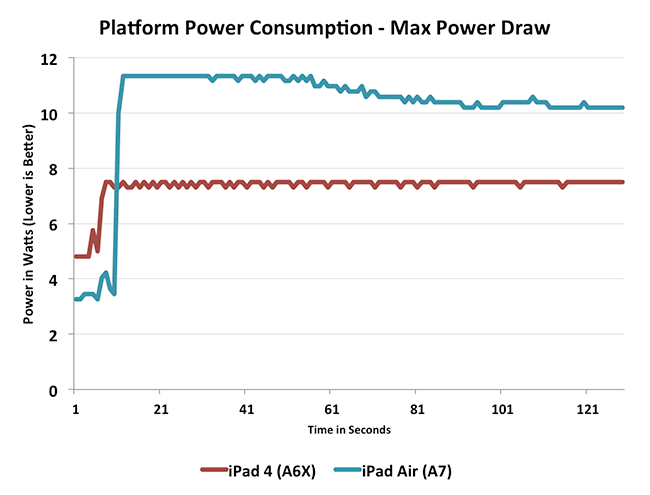
your posts about BT and tegra are really depressing.. silvermont can deliver similar/better MT CPU performance than apple a7 at lower power levels
the only thing ''horrendous'' is a7's power draw under load... next to A7 even nvidia K1 Jetson's 11W dont look that bad

maxpower2sm.png
 

Piroko

Senior member
Jan 10, 2013
905
79
91
It is (total SoC power consumption with a single thread load).
Well, I'll accept that and I do believe your argument to be correct, however calling a cited 770mW and a measured 800~1200mW 'about the same' is stretching it thin. Kind of ironic, given that this thread is revolving around inaccuracies...
 

witeken

Diamond Member
Dec 25, 2013
3,899
193
106
your posts about BT and tegra are really depressing.. silvermont can deliver similar/better MT CPU performance than apple a7 at lower power levels
the only thing ''horrendous'' is a7's power draw under load... next to A7 even nvidia K1 Jetson's 11W dont look that bad

maxpower2sm.png

You should read the text below that graph. Power consumption isn't as bad as this graph states, but it's still not good.

Well, I'll accept that and I do believe your argument to be correct, however calling a cited 770mW and a measured 800~1200mW 'about the same' is stretching it thin. Kind of ironic, given that this thread is revolving around inaccuracies...

I can give you more specific measurements:

I was invited to a Bay Trail benchmarking session earlier this week at which I was able to see real time power measurements of Bay Trail while it ran a bunch of different workloads. In most "tablet"-like workloads, the system-on-chip typically consumed about 1W. In fact, on a per-core basis, a "Silvermont" at full tilt only consumed 750mw - 850mw (it varied). With all four cores loaded to their maximum in a PC-based benchmark (Cinebench), the SoC did not consume more than 2.5W (although from what I could tell the maximum was really more like 2.2W - 2.3W).

(source)

Of course 1 Silvermont core doesn't consume minus 20 to 70mW (else that would be very good still!), cause 3 more cores consume another ~1.55W (if you do the math, that's 1.55W for 3 cores, meaning 0.52W per core, and 0.85W-0.52W means a maximum idle power consumption of 0.33W).
 

TerryMathews

Lifer
Oct 9, 1999
11,464
2
0
Seriously?? What percent does Intel have of the x86 mobile market?? 80 plus I am sure.

You're using different definitions of "mobile". He is referring to the embedded space: phones, tablets, cars, refrigerators, toasters, Teddy Ruxpins. You are referring to laptops and high-function tablets like the Microsoft Surface Pro. Completely different markets, different consumers, and different price points.
 

shady28

Platinum Member
Apr 11, 2004
2,520
397
126
your posts about BT and tegra are really depressing.. silvermont can deliver similar/better MT CPU performance than apple a7 at lower power levels
the only thing ''horrendous'' is a7's power draw under load... next to A7 even nvidia K1 Jetson's 11W dont look that bad

maxpower2sm.png


That graph is all fine and dandy, but maybe the discussion should be on "Faults and fallacies of current power measuring methodologies"

The iPad 4 that shows lower power consumption in your graph, has a ~42WH battery vs the iPad Air (A7) ~32WH.

Yet the iPad Air has longer battery life than the A6 powered iPad 4 on a whole host of tests.

So your graph is showing the chip in a tablet that has ~25% larger battery, but gets ~10% less run time in actual usage, as being more efficient.

That basically tells me that, from a user standpoint, your graph means nothing for real-life situations.

It looks to me like the whole industry has no good way to "benchmark" power usage in such a way that it is reflective of any real-life usage scenario, or would be of any real value to a user (or possibly OEM) making a purchase decision.


59436.png


59435.png


59412.png
 

TrulyUncouth

Senior member
Jul 16, 2013
213
0
76
I didn't post anything as facts.

I'll let you answer yourself on that one.

Here you have the facts.


In the case of Kabini, it idles at 0.77W, which is about what a single Silvermont thread consumes under load, so the conclusion that Silvermont uses much less energy than Kabini/Jaguar is an extremely easy one to make.

You say that his post was more factual. Let's take a look...


1. Kabini uses less power at idle.
A few lines above, I already showed that that is false (and it is also mentioned in the preview of Puma+).

2. Jaguar uses the same power under load (while outperforming Silvermont).
Unfortunately, we don't have precise measurement of Jaguar under load. However, we can compare the idle/load delta. And since the chips idle at less than 1W and the delta of Kabini is like 5W bigger than Silvermont, we can again safely conclude that Silvermont uses less energy under load.

However, we made it much too difficult. This is not rocket science, we can reduce the question to a much simpler version. Silvermont has 22nm Tri-Gate transistors, while Kabini is made on regular 28nm transistors. Of course Silvermont consumes less energy at idle and load.

I think where most of your confusion and wrong conclusions come is the a lack of understanding about binning. The same architecture can have chips with the same performance and very different power consumption. You have read a single limited power test on a SINGLE CPU that was hand-picked to show off to the press. You are making entirely too many assumptions based on that. Especially when tests have been done outside of Intel's control that show a different story for CERTAIN Baytrail SOC's.

I know you are capable of admitting when you've misunderstood something from our discussion in the Tegra thread- so please look at the information, I think you'll see you are misstating the facts.

I don't see how you come to that conclusion, but I'm very sure it's wrong.

I explained the source for the information I used for that conclusion- I can only lead you to water... you must take the first sip. But what the hell, I'll explain it again. The computerbase review clearly shows that a poorly binned Baytrail CAN have worse power usage than a Kabini. It also shows that Baytrail doesn't use SO much power above 10W that its something worth the AMD fans getting up in arms about.

If this doesn't explain it to you, then I am afraid I am incapable of breaking it down much further. Perhaps someone can explain it in a different way that is more clear.
 

Idontcare

Elite Member
Oct 10, 1999
21,110
64
91
It looks to me like the whole industry has no good way to "benchmark" power usage in such a way that it is reflective of any real-life usage scenario, or would be of any real value to a user (or possibly OEM) making a purchase decision.

Ha! I remember the exact same arguments being made 20+ yrs ago in Computer Shopper magazine reviews of laptops.

The argument is as valid now as it was before, but the solution continues to elude both industry and consumer.
 

witeken

Diamond Member
Dec 25, 2013
3,899
193
106
Shady28, please note that the iPad Air has an IGZO display. The power consumption of iPad 4 vs iPad Air at maximum brightness is 7.0W vs 4.8W. At 200 nits, which is half of Air's 411, the difference in power consumption is still 1.1W. For example, that's 11Wh in the web browsing test, which makes up for the 10Wh difference in battery capacity. You can also see in that graph that the difference in idle power consumption is about 1.25W, so the Air uses just a little bit (0.15W) less power consumption besides the display.
 
Aug 11, 2008
10,451
642
126
You're using different definitions of "mobile". He is referring to the embedded space: phones, tablets, cars, refrigerators, toasters, Teddy Ruxpins. You are referring to laptops and high-function tablets like the Microsoft Surface Pro. Completely different markets, different consumers, and different price points.

Exactly, the comparison is a non-sequitor chosen obviously to take a swipe at intel. One could just as well call ARM the Via of laptops and desktops.
 

witeken

Diamond Member
Dec 25, 2013
3,899
193
106
I'll let you answer yourself on that one.
Let me clear this up. Piesquared claimed that it was a fact that "Kabini uses significantly less power at idle and practically even under load while outperformaing bay trail."

He based that fact on some graphs where the total system power is measured with different motherboards etc. You can't call that a (scientific) fact at all. I then showed him a quote from Anand, with real measurements. Maybe the bold text was wrong in the context of the text under it ("Here you have the facts."), but Anand's conclusion wasn't what I meant with facts, although I think it's a very logical conclusion and most likely correct.


I think where most of your confusion and wrong conclusions come is the a lack of understanding about binning. The same architecture can have chips with the same performance and very different power consumption. You have read a single limited power test on a SINGLE CPU that was hand-picked to show off to the press. You are making entirely too many assumptions based on that.
I didn't realize that, true, although we don't know for sure if it was specifically hand-picked to put the tests in Intel's favor. But how much could the difference be, anyway? What I do then, to calculate the 0.3W idle power consumption, isn't based on "many assumptions" but just the measurements of 1 core and 4 cores at load and taking worst-case numbers. Occam's razor doesn't rule out my calculation.

And even ignoring all those calculations, based on 1 core load power consumption, isn't it safe to assume idle power consumption is less than Kabini's 0.77W?

Especially when tests have been done outside of Intel's control that show a different story for CERTAIN Baytrail SOC's.
Which tests do you mean, because I don't see them. As other people already noted, when you're talking about idle power consumption of less than 1W, measuring total platform power consumption isn't really going to be accurate enough. For load power consumption, using the delta of idle/load power consumption isn't that bad, so I guess the difference and advantage of Silvermont is very clear then.

I know you are capable of admitting when you've misunderstood something from our discussion in the Tegra thread- so please look at the information, I think you'll see you are misstating the facts.

Do you mean this discussion?


I think I've carefully considered all facts, and it doesn't lead me to the conclusion that the Kabini SoC has lower power consumption than Bay Trail at idle or load.

And BTW, the difference at idle is probably something like 0.4W at most, so why should we actually do such a serious discussion about a few milliwatts?

I explained the source for the information I used for that conclusion- I can only lead you to water... you must take the first sip. But what the hell, I'll explain it again. The computerbase review clearly shows that a poorly binned Baytrail CAN have worse power usage than a Kabini. It also shows that Baytrail doesn't use SO much power above 10W that its something worth the AMD fans getting up in arms about.

If this doesn't explain it to you, then I am afraid I am incapable of breaking it down much further. Perhaps someone can explain it in a different way that is more clear.

http://www.computerbase.de/2014-04/amd-athlon-5350-kabini-sockel-fs1b-test/3/

I looked a few minutes at that table, but I couldn't find a power delta that's less than Kabini's, unfortunately...

 

TreVader

Platinum Member
Oct 28, 2013
2,057
2
0
Silvermont mobile has absolutely no problem when it comes to idle power.

Silvermont in its fastest "desktop" form is about as fast as the A7 I have in my cell phone and the gpu is actually slower. It has a problem if you want it to be mobile.
 

Exophase

Diamond Member
Apr 19, 2012
4,439
9
81
Well, the TDP cannot be measured from power consumption graphs. It is the same thing with the FX CPUs that people got fascinated with a few months ago.

Difference between idle and load power consumption isn't a perfect proxy for CPU power consumption, especially if looking at systems that only use a few W under load like phones. But if it's both dozens of % and dozens of W higher than the rated TDP that's kind of a red flag. And that's what people were seeing with those high end FX (and aren't seeing here...)

The thing there is that I don't think AMD ever specified what the temperature had to be at to get that TDP. Cooler chips use less power, which is kind of an important component of those SDP numbers Intel has been using.
 

Exophase

Diamond Member
Apr 19, 2012
4,439
9
81
Seriously what you're talking about makes zero sense whatsoever.The only thing that matters is what it draws from the socket, and silvermont is a joke when it comes to idle power usage and really not all that impressive under load. Whatever gains it has on load power usage it loses with horrendous FP and integer performance. Intel is to Mobile what VIA is to X86.

When you say from the socket you mean from the wall socket? Why would that be the only measurement that makes sense when so many other components contribute to that? Who's to say that there aren't much more efficient motherboards that could be used? What about Silvermont in a tablet or phone? It's no fair to penalize it because of inefficiencies in the motherboard. Measuring rails at the SoC input is actually useful information.
 

thunng8

Member
Jan 8, 2013
167
72
101
Talking about my desktop i5 2400, TDP is 95W.. the highest CPU Power I have seen (Linpack) is 60W for CPU. GPU maxes out at ~9W. So... 69W out of 95W seems pretty conservative to me!

But yeah, I have seen examples where Crystal well equipped parts with a 65W TDP have guzzled 85W.. so my guess is that Intel is trying to clamp them down by reducing their headroom, and so they boost for some time and then TDP stuff comes into effect.

And Apple's MBP with Crystalwell which is supposedly 47W can greatly exceed 47W for long periods of time. Can't seem to find the link right now, but I remember in the ballpark of 70W.

Intel's TDP numbers seems to be all over the place.
 

Enigmoid

Platinum Member
Sep 27, 2012
2,907
31
91
Silvermont in its fastest "desktop" form is about as fast as the A7 I have in my cell phone and the gpu is actually slower. It has a problem if you want it to be mobile.

You cannot make a comparison due to different software ecosystems. The two are not even in the same market.

BT competes with Kabini, Temash, Mullins, Meema, Qualcomms and Samsung's products, and Possible Haswell/IVY.

Of course 1 Silvermont core doesn't consume minus 20 to 70mW (else that would be very good still!), cause 3 more cores consume another ~1.55W (if you do the math, that's 1.55W for 3 cores, meaning 0.52W per core, and 0.85W-0.52W means a maximum idle power consumption of 0.33W).

There are parts of the SOC that do not scale perfectly with core count. The igp, I/O, RAM interface are going to consume proportionately more on a single core load than a MT load.

http://www.anandtech.com/show/6529/busting-the-x86-power-myth-indepth-clover-trail-power-analysis/2

Nicely shows idle power for clovertrail.

~36.4 mW on CPU and 155 mW on GPU (refreshing start screen).
A maximum idle power of 330 mW would be high but not unheard of. Its likely to be lower though.