• We’re currently investigating an issue related to the forum theme and styling that is impacting page layout and visual formatting. The problem has been identified, and we are actively working on a resolution. There is no impact to user data or functionality, this is strictly a front-end display issue. We’ll post an update once the fix has been deployed. Thanks for your patience while we get this sorted.

Discussion Geekbench 6 released and calibrated against Core i7-12700

Page 40 - Seeking answers? Join the AnandTech community: where nearly half-a-million members share solutions and discuss the latest tech.
Last edited:
Last edited:
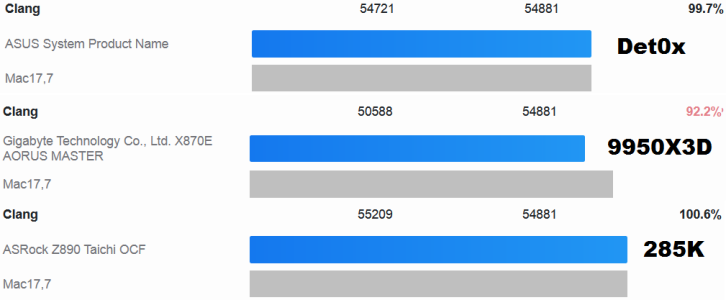
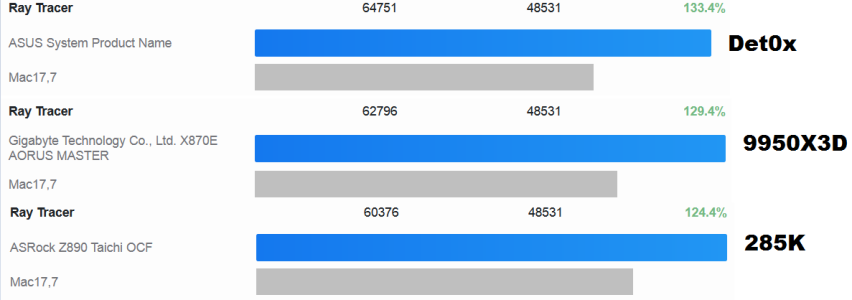
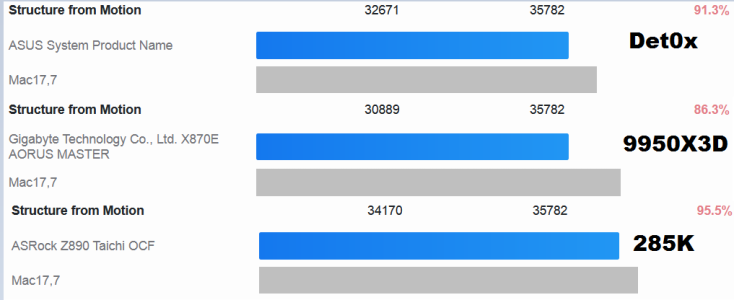
Det0x's Zen 5 ES vs. M5 Max: https://browser.geekbench.com/v6/cpu/compare/11007418?baseline=16884909

An above average 9950X3D: https://browser.geekbench.com/v6/cpu/compare/16874620?baseline=16884909

Above average 285K: https://browser.geekbench.com/v6/cpu/compare/16706397?baseline=16884909

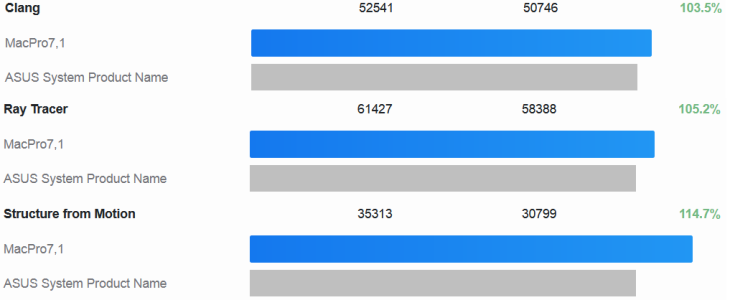
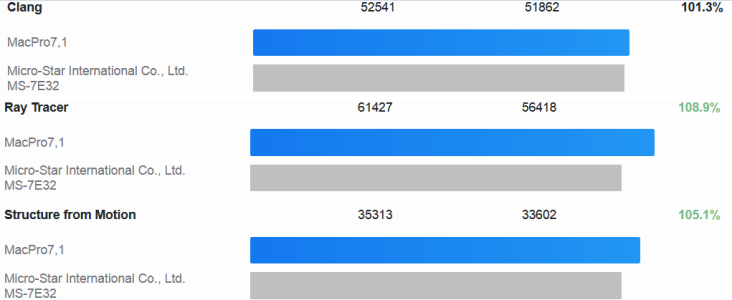
Clang MT

View attachment 139357

Raytracer MT

View attachment 139358

Structure in motion MT

View attachment 139359

Det0x RAM overclock

View attachment 139360

9950X3D RAM overclock

View attachment 139361

285K RAM speed info not available but since it's the Z890 OCF mobo, it's probably also above 9000 MT/s.
wish it was linux but RAM Speed is in similar ballpark to M5 which is 9600MT/s also SME will influence the score a bit but still impressive that M5 is achieving that with stock config
 
Last edited:
Is it? Or it is just the MT/s but the width of the interface is different. Otherwise people wouldn't buy macs in droves for local LLMs 😉.
Not remotely. M5 Max is 8 channel, Pro is quad, Ultra is 16 channel. Are any of those comparisons higher than dual?
 
Is it? Or it is just the MT/s but the width of the interface is different. Otherwise people wouldn't buy macs in droves for local LLMs 😉.
M5 achives nearly the same single core score it's MT where this will make a difference
 
M5 achives nearly the same single core score it's MT where this will make a difference
Geekbench doesn't care about memory bandwidth as evidenced from the M5 Pro vs Max benchmarks - they're nearly identical despite the Max having 2x the memory bandwidth so you can't infer anything here.
 
Geekbench doesn't care about memory bandwidth as evidenced from the M5 Pro vs Max benchmarks - they're nearly identical despite the Max having 2x the memory bandwidth so you can't infer anything here.
I was mostly inferring the ST part that all three Base/Pro/Max achieve nearly the same score for ST. Geekbench 6 MT is just bad we have a 256C GNR System scoring lower than LNL
 
I was mostly inferring the ST part that all three Base/Pro/Max achieve nearly the same score for ST. Geekbench 6 MT is just bad we have a 256C GNR System scoring lower than LNL
Nobody should be running Geekbench on server CPUs.
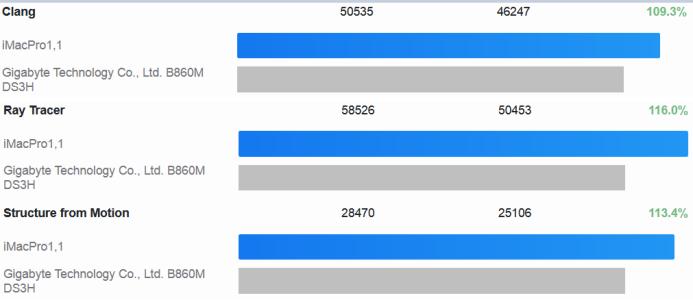
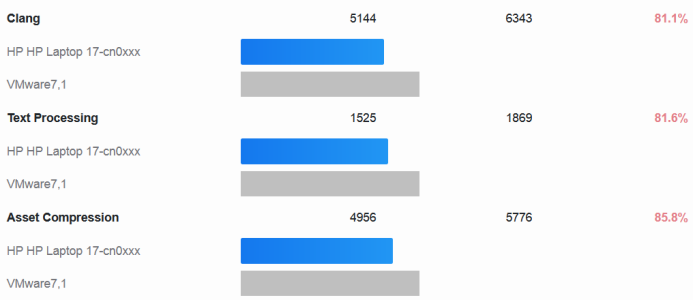
MacOS showing better multicore performance in Clang, Raytracer and Structure in Motion: https://browser.geekbench.com/v6/cpu/compare/16923081?baseline=16856653

View attachment 139465
isnt that known? You have to compare with Linux.

Also the Arrow Lake scheduler is optimised for the latest macOS.
 
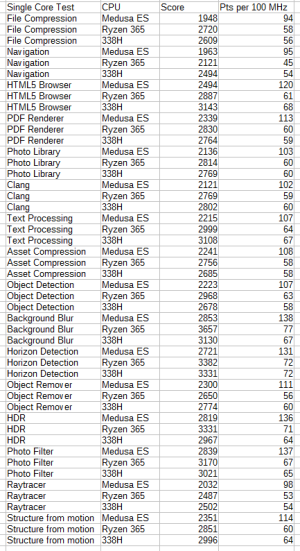
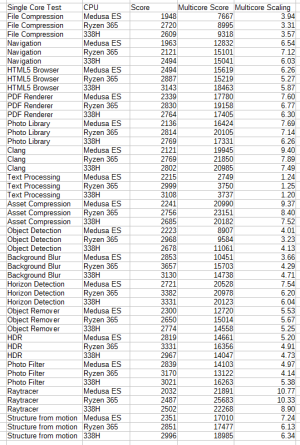
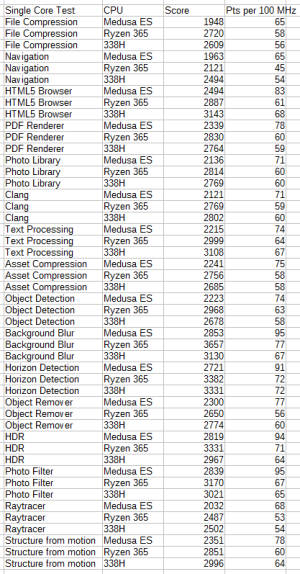
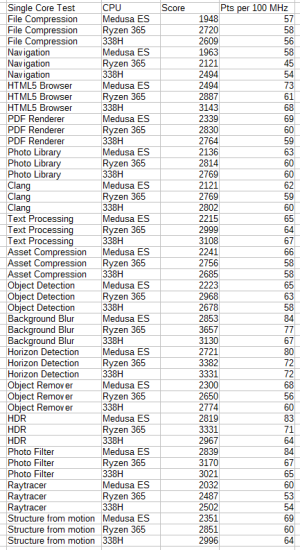
Medusa ES @ 2070 MHz: https://browser.geekbench.com/v6/cpu/17130734
Ryzen 365 @ 4720 MHz: https://browser.geekbench.com/v6/cpu/17177556
Core Ultra 338H @ 4650 MHz: https://browser.geekbench.com/v6/cpu/16982967


1774109650469.png

1774109748375.png

Unless there is a frequency reporting error, Medusa ES is showing almost double single core points per 100 MHz compared to Zen 5 and Panther Lake.

Look at the Medusa multicore scaling in Clang, Raytracer and Structure from motion. Either Medusa has much higher memory bandwidth or SMT efficiency has been improved considerably.
 
Back
Top