
AtenRa
Lifer
20nm bulk-Si then?
Could be yes, they(AMD) said no Server/Desktop update until 2014

20nm bulk-Si then?

I did read at Hardware.fr that according to an engineer Glofo has working
28nm with all devellopement tools finalized so designs can be started but
the electrical caracteristics are not definitive and will be updated later.
From my understanding , one can design a circuit but simulations at higher
frequencies , the ones of interest , wont be accurate in respect of the real
world implementation , so it is likely that large scale 28nm production at the NY facility , wich was announced to debut currently , is still not in track for deliveries in H1 13.
Back in 2009 the NY fab was to ship 22nm in 2012 for revenue and 28nm in 2011. Now its 2013...
TSMC should also have shipped 28nm in what, H2 2010?
Foundry announcements are really to be taken with a grain of salt.

No, it was meant to start 28nm production late 2012
We were talking about NY Fab 2 not Dresden. Fab 2 was meant to be i full production in 2014 from the start.
The facility will ramp toward 22nm production in 2012, though it will be taking orders for 32nm and 28nm designs early on. Presently
My first official meeting with GF came just this past week, in Saratoga County, NY. That’s the site where its brand new post-AMD fab will be constructed and it’s sort of a big deal. I was there for the ceremonial ground breaking, but concrete doesn’t get poured until September, the shell won’t be finished until 2010 and the fab won’t be done until 2011. Globalfoundries won’t be able to ship revenue generating wafers until 2012.
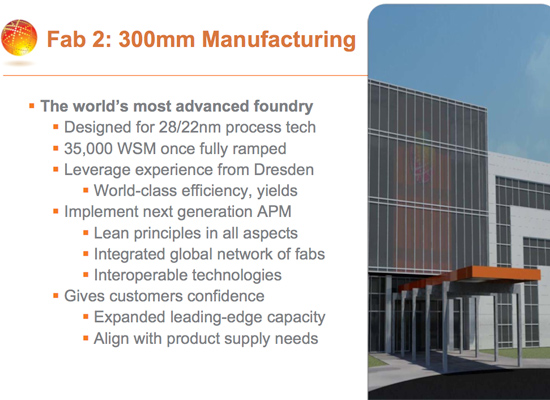
When Fab 2 comes on line in 2012 it'll be a 28nm/22nm fab, with the bulk of its production hopefully being 22nm.
Back in 2009 the NY fab was to ship 22nm in 2012 for revenue and 28nm in 2011. Now its 2013...
TSMC should also have shipped 28nm in what, H2 2010?
Foundry announcements are really to be taken with a grain of salt.
And ?..
Apart from using those datas to trash glofo/amd , as usual ,
what is your point ?.

They are still more in line with their announcements than the one
of 10Ghz CPUs that we should be using for 7 years according to an
announcement that is not still fullfiled to this day...
Yes i know they said Kaveri will be 28nm, i was talking about Server/Desktop (FX) SteamRoller.
Could be yes, they(AMD) said no Server/Desktop update until 2014
Dec 11, 2000 1:00 AM
It will take powerful transistors to build such a system, says Intel--which takes a step in that direction by unveiling on Monday a high-speed transistor technology designed to produce 10-GHz CPUs in five to ten years
Saw this at EETimes:
I really enjoyed the embedded video at the end of the article, direct link here, as it did a great job highlighting some basic xtor functions that are of interest to people.
Even if you don't care about FD-SOI, watching the video can be educational.
If the numbers are true and not just hype, and the ease-of-porting existing 28nm bulk designs to 28nm FD-SOI is true, then AMD could really see a boost in their 28nm products by migrating to FD-SOI at GloFo 🙂
Hartmann said Fab 1 in Dresden, Germany, would be a logical place for Globalfoundries' to host FDSOI as it is already the where the foundry manufactures 32/28-nm bulk CMOS. "If we start this month or in February Globalfoundries could be in production in the fourth quarter of 2013," said Hartmann.
Hasnt anyone thought about the future radeon series. It will run 28nm process and could potencially use this. This would revelucionise gpu power
ARM reports 45-nm SOI test chip with 40% power-saving
The results show that 45-nm high-performance SOI technology can provide up to 40 percent power savings and a 7 percent circuit area reduction compared to bulk CMOS low-power technology, operating at the same speed. This same implementation also demonstrated 20 percent higher operating frequency capability over bulk while saving 30 percent in total power in specific test applications.
[URL="http://www.eetimes.com/showArticle.jhtml?articleID=220301622"]http://www.eetimes.com/showArticle.jhtml?articleID=220301622[/URL]
As usual , Phynaz............
Wasnt it Intel that was first , when launching the P4..?...
http://www.pcworld.com/article/36348/article.html
As usual , Phynaz............
Wasnt it Intel that was first , when launching the P4..?...
The relevant process nodes were delivered on the following
years but not the 10Ghz frequency.
Lets try again. NY fab:
And now we stand here in 2013. Only to look back on 2012 for a year with more hot talk and no results.

As you said: "node", however FD-SOI 28nm is still 28nm ;-)But the specs alone don't ensure AMD will use the node for simple fact that the timing is rather off. Usually a design team needs a good 2-3 years beforehand to design and optimize an IC for the specific electrical parametrics of a given node.
I wont doubt them, I have read that statement now several times from different people. An ARM engineer had a presentation where he stated that *theoretically* the conversion should be doable automatically with tools, however he doubts it. Practically, I would assume that it means that it cannot be not too complicated if done by hand, 1y might be enough...If ST Micro is only just now making its 28nm FD-SOI node available to IC designers then it starts that 2-3 yrs clock ticking now...unless the 28nm bulk-Si -> 28 FD-SOI porting process really is as straightforward easy as they claim it to be.
http://chipdesignmag.com/display.php?articleId=5199As part of its technology offerings, GlobalFoundries plans to offer two versions of FD-SOI: minimum and maximum. The maximum version is a technology tuned for a specific application. IBM and STMicroelectronics are examples of companies that would utilize maximum versions of FD-SOI. Meanwhile, the minimum version is a simple and an out of the box FD-SOI technology, said Subramani Kengeri, head of advanced technology architecture at GlobalFoundries.
So you say that the next server processors will be 28nm Piledriver cores? Not really believable if they already taped-out SR-cores for Kaveri, and Richland is still only a 32nm Piledriver design. However AMD has not stated anything explicit so far, so I'll give the 28nm-Piledriver-idea an outsider's chance of 10% ;-)Yes i know they said Kaveri will be 28nm, i was talking about Server/Desktop (FX) SteamRoller.


