Question DEGRADING Raptor lake CPUs

Page 10 - Seeking answers? Join the AnandTech community: where nearly half-a-million members share solutions and discuss the latest tech.

Kocicak

Golden Member
Jan 17, 2019
1,177
1,232
136
I noticed some reports about degrading i9 13900K and KF processors.

I experienced this problem myself, when I ran it at 6 GHz, light load (3 threads of Cinebench), at acceptable temperature and non extreme voltage. After only few minutes it crashed, and then it could not run even at stock setting without bumping the voltage a bit.

I was thinking about the cause for this and I believe the problem is, that people do not appreciate, how high these frequencies are and that the real comfortable frequency limit of these CPUs is probably at something like 5500 or 5600 MHz. These CPUs are made on a same process (possibly improved somehow) on which Alder lake CPUs were made. See the frequencies 12900KS runs at. The frequency improvement of the new process tweak may not be so high as some people presume.

Those 13900K CPUs are probably highly binned to be able to find those which contain some cores which can reliably run at 5800 MHz. Some of the 13900K probably have little/no OC reserve left and pushing them will cause them to degrade/break.

The conclusion for me is that the best you can do to your 13900K or 13900KF is to disable the 5800 MHz peak, which will allow you to offset the voltage lower, and then set all core maximal frequency to some comfortable level, I guess the maximum level could be 5600 MHz. With lowered voltage this frequency should be gentler to the processor than running it at original 5500 MHz at higher voltage. You can also run it at lower frequencies, allowing for even higher voltage drop, but then the CPU is slowly loosing its sense (unless you want some high efficiency CPU intended for heavy multithread loads).

Running it with some power consumption limit dependent on your cooling solution to keep the CPU at sensible temperature will help too for sure.
 
Last edited:

ikjadoon

Senior member
Sep 4, 2006
241
519
146
As posted in the other thread, via oxidation has also been confirmed by an Intel employee.


Some CPUs with stability issues were hit by that fabrication issue. Should’ve been fixed in 2023 batches.

No idea what weeks of production were affected and which dies and which fabs.

They seem to acknowledge the via oxidation, but claim it isn’t related to this stability problem (another problem? How serious is that?).
 

DAPUNISHER

Super Moderator CPU Forum Mod and Elite Member
Super Moderator
Aug 22, 2001
32,434
33,436
146
As posted in the other thread, via oxidation has also been confirmed by an Intel employee.


Some CPUs with stability issues were hit by that fabrication issue. Should’ve been fixed in 2023 batches.

No idea what weeks of production were affected and which dies and which fabs.

They seem to acknowledge the via oxidation, but claim it isn’t related to this stability problem (another problem? How serious is that?).
Thanks for the excellent updates.

This is tuning into the old commercial about how many licks it takes to get to the tootsie roll center of a tootsie pop? The world may never know.
 

Markfw

Moderator Emeritus, Elite Member
May 16, 2002
27,403
16,253
136
It seems to be two separate issues.
Permanent damage vs simply not working in games.
I personally think they are related enough to only deserve one thread. But as big as the issues are, its fine with me as two threads.

I also think its really bad. People have the option to buy defective/degrading Intel CPUs, or Intel modified CPUs/bios to make them run a lot slower or AMD. While I currently prefer AMD, that choice does not spread good competition. Not good for the industry.
 

DAPUNISHER

Super Moderator CPU Forum Mod and Elite Member
Super Moderator
Aug 22, 2001
32,434
33,436
146
I bumped this old thread because though not everyone agrees he deserves any credit, the OP's thread is the OG on degradation of raptor lake. How he got there may be controversial but here we are.
 

Hulk

Diamond Member
Oct 9, 1999
5,403
4,110
136
Also, this "fix" is only a fix if your CPU hasn't already degraded!

Finally I'm wondering if the CPU's will perform as well before and after the "fix" and more importantly up to Intel advertised specs.

I'm not sure this is over for Intel. I wonder if Intel over specified frequency on these parts and need to feed huge damaging voltage to all but the best bins for them to work for the long term.

If this is the case people will figure it out and then CAL will follow.
 

Kocicak

Golden Member
Jan 17, 2019
1,177
1,232
136
I do not get this.

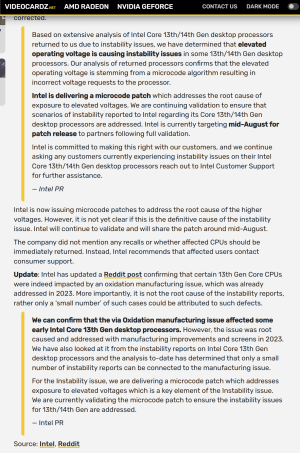
Intel new stability statements end of july.png

How does this "elevated operating voltage" depend on the frequencies you make the CPUs run at, Intel?

It has been reported that the CPUs are at first stable and become unstable after some time, probably due the degradation, so you let the CPUs degrade for almost one more month? How many more CPUs will you need to change just due to this delay?

Is this information even true, or is it just buying some time for one more month? How is the situation going to get eny better in this extra time without solving anything?

It is really reasuring and calming to read that the oxidation problem is long solved. Everybody believes this.... :rolleyes:
 
Last edited:

Markfw

Moderator Emeritus, Elite Member
May 16, 2002
27,403
16,253
136
I do not get this.

View attachment 103629

How does this "elevated operating voltage" depend on the frequencies you make the CPUs run at, Intel?

It has been reported that the CPUs are at first stable and decome unstable after some time, probably due the degradation, so you let the CPUs degrade for almost one more month? How many more CPUs will you need to change just due to this delay?

Is this information even true, or is just buying some time for one more month? How is the situation going to get eny better in this extra time without solving anything?

It is really reasuring and calming to read that the oxidation problem is long solved. Everybody believes this.... :rolleyes:
More vcore is almost always required to overclock, hence more voltage quite often = more mhz. Intel has not fixed anything yet, but they are stalling IMO.
 

cebri1

Senior member
Jun 13, 2019
373
405
136
I do not get this.

View attachment 103629

How does this "elevated operating voltage" depend on the frequencies you make the CPUs run at, Intel?

It has been reported that the CPUs are at first stable and become unstable after some time, probably due the degradation, so you let the CPUs degrade for almost one more month? How many more CPUs will you need to change just due to this delay?

Is this information even true, or is it just buying some time for one more month? How is the situation going to get eny better in this extra time without solving anything?

It is really reasuring and calming to read that the oxidation problem is long solved. Everybody believes this.... :rolleyes:
The last thing you want now is them releasing an improperly tested microcode. Whether you believe them or not, it’s still a lot more expensive to replace bricked CPUs, recall the microcode and lose any confidence left, than to wait another 3 weeks.
 

coercitiv

Diamond Member
Jan 24, 2014
7,486
17,891
136
An issue so big it cannot be discussed in one thread alone. We need two.
It's only fitting as so far we know there are at least three causes for system instability with RPL CPUs:
  1. messed up BIOS settings with disabled safety features and poorly configure AC Load Line
  2. oxidation leading to CPU degradation, allegedly affecting only some CPUs produced in 2023
  3. high voltages due to a faulty microcode algo
So we probably need a third thread now! :p
 

Kocicak

Golden Member
Jan 17, 2019
1,177
1,232
136
The last thing you want now is them releasing an improperly tested microcode. Whether you believe them or not, it’s still a lot more expensive to replace bricked CPUs, recall the microcode and lose any confidence left, than to wait another 3 weeks.
Is there any left? I am running my 14900K at a "snail tempo" with 5/4 GHz limits hoping that it can last a couple more years. I am not even sure it can make it. BTW the CPU is very nicely efficient and cool at these frequencies and I never got the CPU to run at break neck speeds, but just to have a complete die with the most cores available. So these slower frequencies themselve do not bother me at all.
 
Last edited:
  • Like
Reactions: Tlh97 and carancho

yottabit

Golden Member
Jun 5, 2008
1,672
874
146
I wonder if these are transient spikes Intel is talking about that are too fast for the normal reporting sensors to pick up

Or either way, some kind of disconnect from the reported voltages and actual. Is it possible for voltage to vary within the chip? I wouldn’t think so but I’m not too familiar with how voltage regulation works on a CPU. Does the CPU just request a specific voltage from the VRMs on the mobo?

I just feel like if the issue was “just” voltage enthusiasts would have solved it long ago
 

Kocicak

Golden Member
Jan 17, 2019
1,177
1,232
136
Hundreds of engineers have been developing, testing and validating the power supply of the CPUs, various states of the CPU, ensuring that the CPUs have everything they need for stable operation. There is long term experience of the engineers, and of course work done in developing a particular CPU.

If there is a real voltage (power supply) problem,

1) Intel engineers are INEPT

or

2) the CPUs are run SO HARD that there is stuff happening which nobody expected and experienced before.
 
Last edited:
Jul 27, 2020
28,174
19,218
146
Is there any left? I am running my 14900K at a "snail tempo" with 5/4 GHz limits hoping that is can last a couple more years.
Have you tested in different monitoring software as well as BIOS that it is respecting those limits and not opportunistically boosting beyond those limits?
 

Kocicak

Golden Member
Jan 17, 2019
1,177
1,232
136
Have you tested in different monitoring software as well as BIOS that it is respecting those limits and not opportunistically boosting beyond those limits?
I had no idea that I need to do that, if I make a change in BIOS I just briefly open HW-info to see, what is the CPU doing and nothing else.
 
Jul 27, 2020
28,174
19,218
146
I had no idea that I need to do that, if I make a change in BIOS I just briefly open HW-info to see, what is the CPU doing and nothing else.
I would run Geekbench 6 and monitor the max frequency in HWinfo during the ST portion of the benchmark to see if it is staying within enforced limits.
 

Wolverine2349

Senior member
Oct 9, 2022
538
188
86
The news is everywhere now. Raptor Lake CPUs especially high end ones are a mess.

Sounds like degradation likely and design flaw voltage issues and much more. Or who knows the full story and what's going on.


DrMrLordX

Lifer
Apr 27, 2000
23,223
13,303
136
Professional, in one domain, doesn't mean they know what they are doing in another...

Under the circumstances, people probably shouldn't be throwing shade at Wendel like that.

They seem to acknowledge the via oxidation, but claim it isn’t related to this stability problem (another problem? How serious is that?).

Wouldn't oxidation of the vias explain the cluster/ring bus interconnect problems responsible for memory and I/O errors?

It seems to be two separate issues.
Permanent damage vs simply not working in games.

What hasn't been explained (to my satisfaction) is how this alleged problem with the IVR (that is the problem isn't it?) relates to the observed crash data. Many of the crash errors documented are not necessarily related to improper core voltage. It isn't clear which voltage domains were receiving excess voltage.

It almost seems like Intel is pointing out one problem with Raptor Lake to distract people from deeper hardware problems that would be unfixable. Never mind that several months (or years) of operation with a faulty IVR would probably make a chip an instant RMA anyway.

It has been reported that the CPUs are at first stable and become unstable after some time, probably due the degradation, so you let the CPUs degrade for almost one more month? How many more CPUs will you need to change just due to this delay?

Also many Raptor Lakes were just bad out of the gate. Remember the anonymous OEM source saying that conservatively 10-25% of Raptor Lakes weren't even fit to be sold in client machines?

It is really reasuring and calming to read that the oxidation problem is long solved. Everybody believes this.... :rolleyes:
No matter how you slice it, it looks like Intel is going to be on the hook for a lot of replacement CPUs.
 

Kocicak

Golden Member
Jan 17, 2019
1,177
1,232
136
I wonder if all these different theories about what is going on are not just superflous and the real culprit is simply the frequency itself. If the real safe frequency ensuring long term reliability for intensive 24/7 workloads on this manufacturing process is say 4,6 GHz, no wonder that things are breaking when you run the CPUs 1GHz quicker.

How I already wrote every technology has its limits and the problematic Intel 10nm process even after all the improvements may not be able to handle high frequencies, due to its higher tendency to degradation at high temperatures (or high current density or both).
 
Last edited:
  • Like
Reactions: Tlh97 and Hulk

alcoholbob

Diamond Member
May 24, 2005
6,390
470
126
I wonder if all these different theories about what is going on are not just superflous and the real culprit is simply the frequency itself. If the real safe frequency ensuring long term reliability for intensive 24/7 workloads on this manufacturing process is say 4,6 GHz, no wonder that things are breaking when you run the CPUs 1GHz quicker.

How I already wrote every technology has its limits and the problematic Intel 10nm process even after all the improvements may not be able to handle high frequencies, due to its higher tendency to degradation at high temperatures (or high current density or both).

In the overclocking community there was always the concept of a "unsafe voltage" for Intel CPUs where degradation was expected over time if you sat above it. That was usually in the >1.5V range going back to even the mid 2000s. And those days you were looking at mid-3ghz clocks at that voltage that you wouldn't expect to exceed unless you were doing exotic cooling.
 
  • Like
Reactions: Tlh97 and coercitiv

Kocicak

Golden Member
Jan 17, 2019
1,177
1,232
136
In the overclocking community there was always the concept of a "unsafe voltage" for Intel CPUs where degradation was expected over time if you sat above it. That was usually in the >1.5V range going back to even the mid 2000s. And those days you were looking at mid-3ghz clocks at that voltage that you wouldn't expect to exceed unless you were doing exotic cooling.
Perhaps the flaky Intel 10nm process cannot long term with intensive loads handle more than 1,2V or even less.

At least my 14900K sample does not exceed such voltage at 5/4 GHz.
At 4,5/3,6 GHz is runs at 1,1V, most of the time a bit less than that.

Here are the Geekbench 6 scores for above limits:


If the CPU has expected longevity and reliability at say maximal 1,2V, and above that various problems occur, it IMO makes no sense to waste time researching all those various problems, lying and misleading customers, etc, just admit that the CPUs cannot run as fast as originally sold, sell them only at frequencies they can handle and just pull all other previously sold CPUs off the market by either fully reimbursing the customers or providing them the new reliable and slower replacements. I cannot imagine there is another thing to do. It will cost Intel a lot of money directly and indirectly in damaged reputation.
 
Last edited:
  • Like
Reactions: igor_kavinski

coercitiv

Diamond Member
Jan 24, 2014
7,486
17,891
136
Perhaps the flaky Intel 10nm process cannot long term with intensive loads handle more than 1,2V or even less.
Most Alder Lake chips run above 1.2V, the 12700K will run at 1.3-1.4V when close to fmax.

Here's a plotted v/f curve for ADL from Skaterbencher. For the last 4 speed bins voltage stays at 1.368V because these are VID values for the OC Ratio, the CPU is not supposed to reach these clocks at stock.
https://forums.anandtech.com/attachments/1721989213965-png.103894/