• We’re currently investigating an issue related to the forum theme and styling that is impacting page layout and visual formatting. The problem has been identified, and we are actively working on a resolution. There is no impact to user data or functionality, this is strictly a front-end display issue. We’ll post an update once the fix has been deployed. Thanks for your patience while we get this sorted.

California to stop allowing new internal combustion light vehicles in 2035

Page 5 - Seeking answers? Join the AnandTech community: where nearly half-a-million members share solutions and discuss the latest tech.
From what I read this does not ban ownership of ICE cars, nor does it ban the sale of used ICE cars.

Anyone who thinks Cal will be all electric in 2035 is getting pretty far ahead of themselves.

True, but more importantly, this executive order won't stand. It will get dismantled by the next governor, the voters, or the Feds. However, it will be endlessly entertaining watching people argue about it until then. 🙂

-KeithP
 
I sincerely hope so.

Unfortunately, burning fossil fuels is still how we generate most of the electricity needed to charge electric vehicles.

Currently, in most of the U.S. a Tesla is a coal powered automobile.
No not really. From February:
Natural Gas: 38%
Coal: 23%
Nuclear: 19%
Renewables: 17%
Coal looks even worse this summer.
images

Is this not a given? You can buy a decent ICE vehicle new for < $20k. Can't say the same really for electric / Plug-ins

That - and any repairs related to electric stuff (battery, in particular) is incredibly costly.

The most efficient cars are ICE vehicles from the likes of Japanese manufacturers (Toyota/Honda). That isn't even questionable.
I wouldn’t say the cars below $20K are all that great acceptable maybe a few probably make decent.
https://www.autoweek.com/news/g32332812/15-new-cars-under-20000-dollars/

besides 50mpg + hybrids have come way down.
Hyundai has one starting at $22.3K that gets around 59mpg. I don’t see an issue with having similarly cheap BEV 15 years from now.
 
No not really. From February:
Natural Gas: 38%
Coal: 23%
Nuclear: 19%
Renewables: 17%
Coal looks even worse this summer.
images


I wouldn’t say the cars below $20K are all that great acceptable maybe a few probably make decent.
https://www.autoweek.com/news/g32332812/15-new-cars-under-20000-dollars/

besides 50mpg + hybrids have come way down.
Hyundai has one starting at $22.3K that gets around 59mpg. I don’t see an issue with having similarly cheap BEV 15 years from now.


I stand corrected, using that graph, let me restate; Currently a Tesla runs on 61% fossil fuels.

My point is we are moving way too slowly from fossil fuels and current projections don't paint a happy picture.
 
  • Like
Reactions: pmv
I stand corrected, using that graph, let me restate; Currently a Tesla runs on 61% fossil fuels.

My point is we are moving way too slowly from fossil fuels and current projections don't paint a happy picture.
All fossil fuels are not created equal.
Natural gas produces about 25% less CO2 than gasoline. In addition BEVs are a lot more efficient than gas engine so less is used overall.

Also as renewables increase BEVs improve.

Quite frankly I can buy 100% wind power right now.

Edit, I agree the transition needs to be quicker.
 
Quite frankly I can buy 100% wind power right now.

lol No you can't.

No matter what your electricity comes through CenterPoint Energy (or Texas New Mexico for certain areas). No amount of signing up for "100% renewable" changes the fact that everything that what goes into your home from CenterPoint isn't renewable.


EDIT: Also - to your point on how more efficient natural gas is... You can thank fracking for that. But no one ever does acknowledge that.
 
lol No you can't.

No matter what your electricity comes through CenterPoint Energy (or Texas New Mexico for certain areas). No amount of signing up for "100% renewable" changes the fact that everything that what goes into your home from CenterPoint isn't renewable.
Electrons like money are fungible. That’s the whole point of the Texas ERCOT.

While you are correct my power comes from the local power plant. If I pay for 2000kwh from Green Mountain wind I get 2000kwh because they put 2000kwh onto the grid and effectively trade with the 2000kwh that comes from my local plant.
 
Electrons like money are fungible. That’s the whole point of the Texas ERCOT.

While you are correct my power comes from the local power plant. If I pay for 2000kwh from Green Mountain wind I get 2000kwh because they put 2000kwh onto the grid.

I'm with Green Mountain as well for the "doing good" points, but I honestly don't buy that for every kwH I use that they produce an equal amount.

Feel free to prove me wrong though.
 
I'm with Green Mountain as well for the "doing good" points, but I honestly don't buy that for every kwH I use that they produce an equal amount.

Feel free to prove me wrong though.
Well the sum of the kWh’s Texans use has to be generated. I couldn’t tell you how the interconnect agreements work.

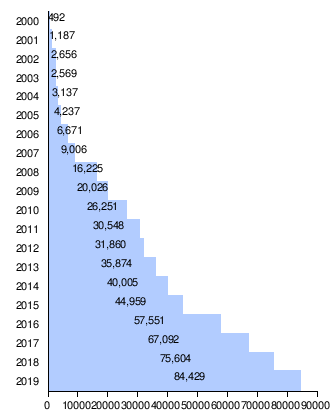
Wind power does account for 17% of the power on ERCOT or 28GW nameplate

(1000’s of MWH)
4a38b648d5d9f68bf27c5e11a053b013.png


So if they sold more than 84,429,000 MWh of wind electricity in 2019 the excess was coming from another source.
 
No not really. From February:
Natural Gas: 38%
Coal: 23%
Nuclear: 19%
Renewables: 17%
Coal looks even worse this summer.
images


I wouldn’t say the cars below $20K are all that great acceptable maybe a few probably make decent.

is this a graph for ants?
 
That - and any repairs related to electric stuff (battery, in particular) is incredibly costly.
even if that is correct (which i doubt, go watch chrisfix replace a prius battery and flip the car), electric stuff is generally dead simple compared to ICE, which means it lasts much longer. there's a tesla rental company that's put half a million miles on a fleet of cars out in socal. results? maintenance costs are much cheaper than ICE vehicles. as is the fuel.
 
even if that is correct (which i doubt, go watch chrisfix replace a prius battery and flip the car), electric stuff is generally dead simple compared to ICE, which means it lasts much longer. there's a tesla rental company that's put half a million miles on a fleet of cars out in socal. results? maintenance costs are much cheaper than ICE vehicles. as is the fuel.
Battery, and motor are the expensive part, but wear well. No transmission. Forgot the controller module.
 
even if that is correct (which i doubt, go watch chrisfix replace a prius battery and flip the car), electric stuff is generally dead simple compared to ICE, which means it lasts much longer. there's a tesla rental company that's put half a million miles on a fleet of cars out in socal. results? maintenance costs are much cheaper than ICE vehicles. as is the fuel.
Yep. I picked up a used Nissan leaf a year ago for a little over $5,000. Other than the age and a little battery degredation, its basically in mint condition. Yes, the range is only about 50 miles (its a 2011), but that doesn't matter since I have my minivan if I need to leave town. Electric cars are glorious. Zero dollars in maintenance since I've bought it. Long term, the only routine maintenance is rotating the wheels and replacing the tires, changing the cabin filter, brakes (although this is way less frequent than an ICE due to regenerative braking) and replacing the auxiliary battery every four or five years. It is so amazing never having to stop at a gas station, never having to change the oil or other fluids. I don't even have a level 2 charger for it, a level one is plenty if you're driving 50 miles per day or less. Although I have an outlet right there in the garage that the previous owner of the house used for a welder that I could easily convert to a level 2. Just hasn't been worth the effort.
 
All fossil fuels are not created equal.
Natural gas produces about 25% less CO2 than gasoline. In addition BEVs are a lot more efficient than gas engine so less is used overall.

Also as renewables increase BEVs improve.

Quite frankly I can buy 100% wind power right now.

Edit, I agree the transition needs to be quicker.

We're gonna have to adjust those figures. Recently a recording from people in that industry showed they've been full on lying about their emissions. They're leaking shit tons of methane in the atmosphere and don't give a shit other than they know it makes them look bad so they just lie about it instead.

 
Seems like a reasonable goal. It will be interesting to see how the infrastructure holds up. Right now PG&E shuts down the power if it's hot and windy, and we have rolling brownouts on very hot summer days. This leads me to believe that the system is at capacity. Perhaps the answer will be a simple switch that allows you to run your AC or charge your car, but not both.
 
Seems like a reasonable goal. It will be interesting to see how the infrastructure holds up. Right now PG&E shuts down the power if it's hot and windy, and we have rolling brownouts on very hot summer days. This leads me to believe that the system is at capacity. Perhaps the answer will be a simple switch that allows you to run your AC or charge your car, but not both.
Or you have 15 years to invest in the necessary infrastructure.
 
Seems like a reasonable goal. It will be interesting to see how the infrastructure holds up. Right now PG&E shuts down the power if it's hot and windy, and we have rolling brownouts on very hot summer days. This leads me to believe that the system is at capacity. Perhaps the answer will be a simple switch that allows you to run your AC or charge your car, but not both.
If PG&E had followed SDG&E in aggressively burying power lines they wouldn’t have to do that. Hopefully the last few years have served as a wake up call.
 
If PG&E had followed SDG&E in aggressively burying power lines they wouldn’t have to do that. Hopefully the last few years have served as a wake up call.
Burying power lines addresses the high wind issues, but exacerbates the capacity issue as the cables can't shed heat as efficiently. At this point, it's all about cost. No one wants to pay for the transition.
 
Back
Top