AMD to Cut 5% of Workforce

Page 9 - Seeking answers? Join the AnandTech community: where nearly half-a-million members share solutions and discuss the latest tech.

ShintaiDK

Lifer
Apr 22, 2012
20,378
146
106
So you consider Contra Revenue fair play?

AMD would have to ship with even higher contra revenue to sell any chips. No matter if Intel did it or not. Then you can argue from now on to ragnarok if its fair or not. AMD wouldn't sell any chips either way.

If Intel's wafer costs really would be lower, why aren't Samsung/Apple/AMD/etc lining up to get their chips produced at the Intel foundry fabs?

Because Intel selects its customers. And being the best in the world you can charge extra. Plenty of customers at Intels foundries. You confuse cost and margins. TSMCs cost for 16FF wafers isn't 15000$ either, but they can charge it as long as Apple is willing to pay. And AMD is way back in the line with its tiny pockets.
 
Last edited:

tential

Diamond Member
May 13, 2008
7,348
642
121
AMD's economical situation is stopping them from doing the same.

But still, you're not answering the question. Do you consider it fair play or not?
It's legal, it's fair play. (and if it's not it's a calculated risk) That's business my friend it's ruthless. I didn't wake up today and suggest to my boss we price match competitors. I woke up and said let's lower prices, margins be damned, we need to enter this new market first by any means necessary. We can make money later, but we'll never make any if we don't establish presence first.

I play to win, full stop.

And I don't see Mullins as a better product. Provide me some power consumption numbers in a tablet form factor and I'll change my mind.
 

tential

Diamond Member
May 13, 2008
7,348
642
121
AMD would have to ship with even higher contra revenue to sell any chips. No matter if Intel did it or not. Then you can argue from now on to ragnarok if its fair or not. AMD wouldn't sell any chips either way.


Because Intel selects its customers. Plenty of customers at Intels foundries.
Intel making amd chips? These suggestions are almost as bad as the suggestions our politicians make in America.
 

dahorns

Senior member
Sep 13, 2013
550
83
91
If Intel's wafer costs really would be lower, why aren't Samsung/Apple/AMD/etc lining up to get their chips produced at the Intel foundry fabs?

Even though Intel's wafer costs may be lower, it isn't going to offer the best prices to potential competitors. Instead, it'll charge a premium to those potential competitors, which is consistent with management's statements that they'll consider any foundry deal, but that the terms have to be right.

AMD's economical situation is stopping them from doing the same.

But still, you're not answering the question. Do you consider it fair play or not?

Why does your concept of "fair play" matter? Honestly, the thought that Intel instituted its contra-revenue program to counter a threat from AMD is laughable. AMD has been a non-entity for quite a while. The much more logical thought is that Intel had to use contra-revenue to attack a market saturated by the ARMy vendors, especially considering that Intel did not have a product designed for that particular market (thus causing the higher BoM).
 

tential

Diamond Member
May 13, 2008
7,348
642
121
As expected, you don't know what fair play means.

If everything that is legal also would be fair play, then the term "fair play" would not be needed to begin with.
Then you probably shouldn't run a business as you'll be trampled over.
Similar to how amd is now.
 

ShintaiDK

Lifer
Apr 22, 2012
20,378
146
106
If the world was "fair", then AMD execs would have taken a pay cut so these people wouldn't be fired. But this is capitalism and competition after all. So the 5% have to go.
 

Fjodor2001

Diamond Member
Feb 6, 2010
4,542
727
126
Then you probably shouldn't run a business as you'll be trampled over.
Similar to how amd is now.

I think you're missing my point. What I'm saying is that is incorrect to dismiss Intel's contra revenue as an explanation for AMD's lack of success in that segment despite having a superior technological product.

If Ford would sell their cars for $1000 they would sell a lot more than BMW. But does that mean that Ford would be technologically superior? Or course not.
 

ShintaiDK

Lifer
Apr 22, 2012
20,378
146
106
I think you're missing my point. What I'm saying is that is incorrect to dismiss Intel's contra revenue as an explanation for AMD's lack of success in that segment despite having a superior technological product.

Multiple flaws:
1. You assume AMD had the superior product. They didn't. Hint, power consumption. (No power consumption tests allowed.)
2. You assume AMD wouldn't have to use contra revenue to sell devices. Hint, AMD would have to use an even higher contra revenue due to worse BOM cost due to lack of integration and ecosystem.
3. You completely forget ARM. Hint, 100% tablet market share before Intel began.
 

Fjodor2001

Diamond Member
Feb 6, 2010
4,542
727
126
Multiple flaws:
1. You assume AMD had the superior product. They didn't. Hint, power consumption. (No power consumption tests allowed.)
There seems to be different opinions on that. And regardless, all I have said is that AMD's lack of success cannot definitely be used to determine that Intel has product that is better technologically, since Contra Revenue comes into play. Again, it's hard to compete with stuff that is free or subsidized.
2. You assume AMD wouldn't have to use contra revenue to sell devices. Hint, AMD would have to use an even higher contra revenue due to worse BOM cost due to lack of integration and ecosystem.
What integration and ecosystem does Intel have that AMD doesn't? Anyway, it sounds like your just speculating as usual. Otherwise show us the numbers to back that up.
3. You completely forget ARM. Hint, 100% tablet market share before Intel began.
So you're concluding that before AMD and Intel entered the tablet segment, they did not have any market share in that segment. What a revolutionary discovery. :rolleyes:
 

ShintaiDK

Lifer
Apr 22, 2012
20,378
146
106
There seems to be different opinions on that. And regardless, all I have said is that AMD's lack of success cannot definitely be used to determine that Intel has product that is better technologically, since Contra Revenue comes into play. Again, it's hard to compete with stuff that is free or subsidized.

What integration and ecosystem does Intel have that AMD doesn't? Anyway, it sounds like your just speculating as usual. Otherwise show us the numbers to back that up.

So you're concluding that before AMD and Intel entered the tablet segment, they did not have any market share in that segment. What a revolutionary discovery. :rolleyes:

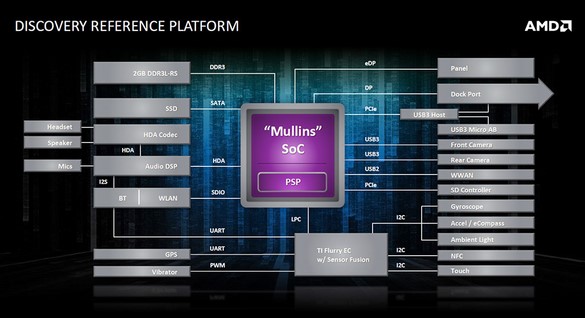
Even AMD themselves showed how much is lacking.
small_discovery-platform.jpg


And do I have to mention Android?

Get over your Intel hate and accept this was just another fail from AMD.

If Mullins was so good as you try to make out. It would be used in high end tablets. Go take a wild guess on why it isn't.
 
Last edited:

superstition

Platinum Member
Feb 2, 2008
2,219
221
101
Why does your concept of "fair play" matter?
Standard Oil.

Monopolization, the goal of all companies, destroys competition and becomes a form of socialism (corporate welfare). So, it's up to the public to make sure their politicians are protecting a competitive marketplace.

The attitude that companies that cheat should be congratulated and rewarded is socialist, anti-capitalist — because the end result is artificially high prices and slowed innovation. The company gets a bigger and bigger hoard which makes it increasingly difficult for anyone to reestablish a competitive market (astroturf, buying politicians, etc.).

There are some benefits to monopolization (like Nintendo's NES system that stabilized a video game market that blew up due to excessive competition, reduced the number of redundant consoles people needed to buy, and did a decent job of reducing the number of poor-quality games in the market) but in a high-innovation area like CPUs and GPUs, the drawbacks outweigh them. (Casual console video gaming, by contrast, benefits some from more platform stability because the software quality is generally more important than the hardware. Casual gamers do not want to have to juggle half a dozen consoles in order to play 1st-party titles, nor is it good for the environment.)
 
Last edited:

MiddleOfTheRoad

Golden Member
Aug 6, 2014
1,123
5
0
Multiple flaws:
1. You assume AMD had the superior product. They didn't. Hint, power consumption. (No power consumption tests allowed.)
2. You assume AMD wouldn't have to use contra revenue to sell devices. Hint, AMD would have to use an even higher contra revenue due to worse BOM cost due to lack of integration and ecosystem.
3. You completely forget ARM. Hint, 100% tablet market share before Intel began.

I think you are pretty much alone on this thought. Almost every rational person would acknowledge that Mullins was the better performer compared to the equivalent Atoms at the time.

It was indeed Intel's contra revenue that sealed Mullins fate. If people are offered a box of Kellogg's Rice Crispies for the price of $10 or the offer to get paid $20 to take a box of the generic store brand Rice Crispies instead.... People are going home with the store brand every time. They don't care how bad the generic store brand tastes -- they just got paid twenty bucks.
 

Puffnstuff

Lifer
Mar 9, 2005
16,255
4,928
136
I think that it's time to face the fact that AMD hasn't exhibited any real performance leadership since the original slot a Athlon which ruled the roost for a very short amount of time. With that said amd's accounting equation isn't a pretty one and when sales revenue isn't present something has to be done to counter costs.
 

ShintaiDK

Lifer
Apr 22, 2012
20,378
146
106
I think you are pretty much alone on this thought. Almost every rational person would acknowledge that Mullins was the better performer compared to the equivalent Atoms at the time.

Performance/watt? Or just some reference heavy tablet nobody was allowed to do any power tests on.

It was indeed Intel's contra revenue that sealed Mullins fate. If people are offered a box of Kellogg's Rice Crispies for the price of $10 or the offer to get paid $20 to take a box of the generic store brand Rice Crispies instead.... People are going home with the store brand every time. They don't care how bad the generic store brand tastes -- they just got paid twenty bucks.

Contra revenue didn't seal Mullins fate. ARM already did. Remember ARM had both ecosystem and no extra BOM cost. The only thing contra revenue did was to place BT on the same playing field as ARM. Unless AMD was willing to do the same, then nobody would buy AMDs Mullins. They would keep buying ARM products.
 
Last edited:

dahorns

Senior member
Sep 13, 2013
550
83
91
Standard Oil.

Monopolization, the goal of all companies, destroys competition and becomes a form of socialism (corporate welfare). So, it's up to the public to make sure their politicians are protecting a competitive marketplace.

The attitude that companies that cheat should be congratulated and rewarded is socialist, anti-capitalist — because the end result is artificially high prices and slowed innovation. The company gets a bigger and bigger hoard which makes it increasingly difficult for anyone to reestablish a competitive market (astroturf, buying politicians, etc.).

There are some benefits to monopolization (like Nintendo's NES system that stabilized a video game market that blew up due to excessive competition, reduced the number of redundant consoles people needed to buy, and did a decent job of reducing the number of poor-quality games in the market) but in a high-innovation area like CPUs and GPUs, the drawbacks outweigh them. (Casual console video gaming, by contrast, benefits some from more platform stability because the software quality is generally more important than the hardware. Casual gamers do not want to have to juggle half a dozen consoles in order to play 1st-party titles, nor is it good for the environment.)

Monopolies aren't necessarily bad. And cheating only exists to the extent that some agreed upon rule has been violated, else it is called strategy.

Intel violated no rule or law and thus did not cheat. It simply executed a business strategy, one that successful bought it (and by extension X86) market share. AMD did not have equivalent resources, and thus could not exercise a similar strategy.

I think you are pretty much alone on this thought. Almost every rational person would acknowledge that Mullins was the better performer compared to the equivalent Atoms at the time.

I don't think this has ever been established. The top-end performance of Mullins may have been better than the Atoms, but we really never saw anything related to power consumption, which seems like a big deal.

It was indeed Intel's contra revenue that sealed Mullins fate. If people are offered a box of Kellogg's Rice Crispies for the price of $10 or the offer to get paid $20 to take a box of the generic store brand Rice Crispies instead.... People are going home with the store brand every time. They don't care how bad the generic store brand tastes -- they just got paid twenty bucks.

Yeah, but the OEMs don't consume processors, they re-sell them in devices. And if the processors suck, or if they can sell other processors for more, they will. AMD's product simply wasn't competitive with Intel's or--importantly--ARM's, else you would have expected to see it in higher-end tablets where $30 of contra-revenue would have hardly mattered.
 

superstition

Platinum Member
Feb 2, 2008
2,219
221
101
Monopolies aren't necessarily bad.
In a high-innovation areas like CPUs and GPUs they necessarily are.
And cheating only exists to the extent that some agreed upon rule has been violated, else it is called strategy.
Cheating is anything that is anti-competitive because it promotes socialism and undermines capitalist competition.
Intel violated no rule or law and thus did not cheat.
lol
 

superstition

Platinum Member
Feb 2, 2008
2,219
221
101
That's assuming you naively believe there is such a thing as fair play, especially in business.
Fair play is when a company abides by laws that are designed to maintain competition.

That includes the spirit of the laws, too. The lie of omission is a type of lie. A lie is a lie, not something else.
 

RampantAndroid

Diamond Member
Jun 27, 2004
6,591
3
81

So I'm guessing the simple fact that you "loled" instead of providing a list of laws broken means....that is just your opinion, nothing based in fact?

Fact is, if ARM did the $30 discount, it'd be anti-competitive since they have a majority share in that space. Intel had virtually no share, and was getting into the market.
 

tential

Diamond Member
May 13, 2008
7,348
642
121
Apparently AMD does.

That's assuming you naively believe there is such a thing as fair play, especially in business.
Seriously. No company plays fair including amd. So naive.
Amd is poorly run. I don't expect them to be around much longer unless they play the same game everyone else is.
 

RampantAndroid

Diamond Member
Jun 27, 2004
6,591
3
81
Fair play is when a company abides by laws that are designed to maintain competition.

That includes the spirit of the laws, too. The lie of omission is a type of lie. A lie is a lie, not something else.

Laws meant to deal with market leaders. Intel isn't a market leader in mobile - certainly not enough to get the FTC interested in them. Meanwhile, Qualcom has been investigated by a bunch of governments now.