AMD to Cut 5% of Workforce

Page 8 - Seeking answers? Join the AnandTech community: where nearly half-a-million members share solutions and discuss the latest tech.

RampantAndroid

Diamond Member
Jun 27, 2004
6,591
3
81
I think in this case it's more a question of to what extent Intel is responsible for their own failings, having to resort to contra revenue to be competitive.

Wait, did a thread that started at "AMD isn't doing so good, so they're laying people off" just become about "Intel's failings"?

OK...
 

DrMrLordX

Lifer
Apr 27, 2000
23,182
13,266
136
Nonsense. Bay Trail was far more power efficient in CPU workloads and integrated more of the critical tablet-oriented IP (i.e. image signal processor) than Temash/Mullins did.

Temash? Eh, okay. But Mullins? I'd much rather have a Mullins product than one featuring Bay Trail-T. About the only area where I expect the Bay Trail product to beat Mullins is in battery life which is a feat it accomplishes by being slower (depending on which Mullins we're talking about here . . . there are many variants, not all of them suitable for tablets).

You're also ignoring the fact that some cheapo off-brand OEMs have been offering Bay Trail-T in products such as set-top boxes and other devices for which they were never really intended. Anyone operating in that space felt the pinch of competing against subsidized hardware. Including Intel itself!

Layoffs suck. Even if you survive, you're basically looking at an ever greater work load. Then again, what has America been these past 15 years if not more and more work for less and less pay?

It isn't just in the United States. We might be on the leading edge, mind you.
 

Fjodor2001

Diamond Member
Feb 6, 2010
4,558
727
126
Wait, did a thread that started at "AMD isn't doing so good, so they're laying people off" just become about "Intel's failings"?

OK...

I think the discussion went a bit off topic / side topic. My comment was regarding the Intel chips being tied to the contra revenue (which were brought up), not AMD's layoffs in general. Threads take turns as the discussion in it progresses...
 

Sweepr

Diamond Member
May 12, 2006
5,148
1,143
136
Temash? Eh, okay. But Mullins? I'd much rather have a Mullins product than one featuring Bay Trail-T. About the only area where I expect the Bay Trail product to beat Mullins is in battery life which is a feat it accomplishes by being slower (depending on which Mullins we're talking about here . . . there are many variants, not all of them suitable for tablets).

The only Mullins faster than BT-T is the A10-6700T (CPU-wise), and when I say faster it's based on the AMD-approved previews from that ugly reference platform with a thick profile, 11.6'' chassis and plugged in compared to actual BT-T products. If that thing was noticeably faster than Bay Trail-T inside a thin, light and small tablet while delivering top-notch perf/watt AMD would have allowed power consumption measurements in the previews. And you can bet they would be bragging about it in their marketing slides (look at Carrizo vs Broadwell-U).

Also when it comes to the iGPU Mullins graphics performance advantage is greatly reduced stepping down from the fastest model, due to much lower clocks (300-350MHz vs 500MHz).
 
Last edited:
Mar 10, 2006
11,715
2,012
126
The only Mullins faster than BT-T is the A10-6700T (CPU-wise), and when I say faster it's based on the AMD-approved previews from that ugly reference platform with a thick profile, 11.6'' chassis and plugged in compared to actual BT-T products. If that thing was noticeably faster than Bay Trail-T inside a thin, light and small tablet while delivering top-notch perf/watt AMD would have allowed power consumption measurements in the previews. And you can bet they would be bragging about it in their marketing slides (look at Carrizo vs Broadwell-U).

Also when it comes to the iGPU Mullins graphics performance advantage is greatly reduced stepping down from the fastest model, due to much lower clocks (300-350MHz vs 500MHz).

:thumbsup:
 

dark zero

Platinum Member
Jun 2, 2015
2,655
140
106
The only Mullins faster than BT-T is the A10-6700T (CPU-wise), and when I say faster it's based on the AMD-approved previews from that ugly reference platform with a thick profile, 11.6'' chassis and plugged in compared to actual BT-T products. If that thing was noticeably faster than Bay Trail-T inside a thin, light and small tablet while delivering top-notch perf/watt AMD would have allowed power consumption measurements in the previews. And you can bet they would be bragging about it in their marketing slides (look at Carrizo vs Broadwell-U).

Also when it comes to the iGPU Mullins graphics performance advantage is greatly reduced stepping down from the fastest model, due to much lower clocks (300-350MHz vs 500MHz).
Clocks are not the most important thing... is the performance...
See Intel vs AMD...
 

AtenRa

Lifer
Feb 2, 2009
14,003
3,362
136
The only Mullins faster than BT-T is the A10-6700T (CPU-wise), and when I say faster it's based on the AMD-approved previews from that ugly reference platform with a thick profile, 11.6'' chassis and plugged in compared to actual BT-T products.

AT reviews were both using the AMD and Intel reference platforms.

AMD Beema/Mullins AT review

Intel BayTrail-T AT review

63085.png


If that thing was noticeably faster than Bay Trail-T inside a thin, light and small tablet while delivering top-notch perf/watt AMD would have allowed power consumption measurements in the previews. And you can bet they would be bragging about it in their marketing slides (look at Carrizo vs Broadwell-U).

AT review of Baytrail-T didnt include power measurements.

Also when it comes to the iGPU Mullins graphics performance advantage is greatly reduced stepping down from the fastest model, due to much lower clocks (300-350MHz vs 500MHz).

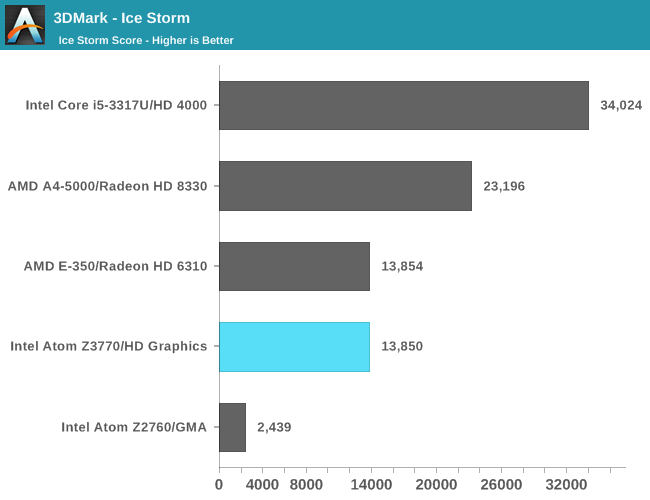
The performance difference at the Top SoC models is almost doubled (2x) between Mullins and BayTraul-T. Lower Mullins clocks will not make BayTrail-T perform faster, it will still be miles away.

58065.png


63100.png
 

Sweepr

Diamond Member
May 12, 2006
5,148
1,143
136
AT reviews were both using the AMD and Intel reference platforms.

AMD Beema/Mullins AT review

Intel BayTrail-T AT review

63085.png

Oh look, he conveniently picked the ST result, because he knows MT performance is much closer between the 2.

63086.png


63084.png


AT review of Baytrail-T didnt include power measurements.


*Preview

I had Intel measure SoC power at the board level while running a single threaded Cinebench 11.5 run on the Atom Z3770 and saw a range of 800mW - 1.2W.

Multithreaded performance puts Bay Trail and AMD's Kabini at similar performance levels. Once again, looking at SoC power however the Atom Z3770 pulls around 2.5W in this test. Looking at the increase in platform power for the A4-5000 here, I'm assuming that the equivalent data for AMD would put Kabini in the 6W range. Multithreaded performance comes very close to the Pentium 2020M, but that's really overstating the strength of Bay Trail here as the Atom Z3770 has twice as many cores as the Pentium 2020M.

If AMD had an edge here they would either provide some data like Intel did, allow tests or make their usual marketing claims. They didn't, because their know their top bin Mullins running at Turbo clocks wouldn't look pretty next to the competition.

The performance difference at the Top SoC models is almost doubled (2x) between Mullins and BayTraul-T. Lower Mullins clocks will not make BayTrail-T perform faster, it will still be miles away.

http://images.anandtech.com/graphs/graph7314/58065.png

http://images.anandtech.com/graphs/graph7974/63100.png

Thanks for proving my point. 60-65% the iGPU clocks coupled with either 2 cores or much lower CPU clocks, yup, wouldn't be far from BT-T (especially refreshed models like the Atom Z3775 with ~17% higher graphics Turbo clocks).

Get over it AtenRa, you're beating a dead horse. I've spent a lot of time on this subject @ BT/CT thread, won't derail this thread any further.
 

AtenRa

Lifer
Feb 2, 2009
14,003
3,362
136
Oh look, he conveniently picked the ST result, because he knows MT performance is much closer between the 2.

Now ST in Cinebench is not the metric of performance ?? :rolleyes:

Thanks for proving my point. 60-65% the iGPU clocks coupled with either 2 cores or much lower CPU clocks, yup, wouldn't be far from BT-T (especially refreshed models like the Atom Z3775 with ~17% higher graphics Turbo clocks).

Even at 300MHz for the iGPU, Mullins is 50% or more faster than BT-T

Mullins was both faster in CPU and especially in iGPU at almost the same TDP. The irony is that BT-T was produced with the more expensive 22nm FF and Mullins at the way cheaper 28nm Planar process and still Mullins was the better product.
Without the Contra-Revenue AMD would not be forced to abandon Mullins and the Cat-based APUs.

The sad part is that Intel with Contra-Revenue clearly made a point of how the x86 landscape would be if they were the only player (monopoly). AMD Mullins was the better product with excellent CPU performance and 2x faster in iGPU performance. Consumers would had the choice to get a Mullins Tablet with Windows 8.1 and have way better experience with the AMD Mullins than the Intel BayTrail-T tablets.
Instead, with Contra-Revenue AMD was forced to get out of the x86 Tablet market and Consumers only left with a single choice with the worst product, the Intel BT-T and its horrendous iGPU performance and the incompatibilities with Android.
Not only that, but Intel lied saying Contra-Revenue would only be for a single year (2014) and no more Contra-Revenue for 2015. As everyone knows, Intel still using Contra-Revenue for BT-T and i bet they will use it at least in early 2016.
 

mrmt

Diamond Member
Aug 18, 2012
3,974
0
76
If AMD had an edge here they would either provide some data like Intel did, allow tests or make their usual marketing claims. They didn't, because their know their top bin Mullins running at Turbo clocks wouldn't look pretty next to the competition.

Bay Trail is cheaper to manufacture than Mullins and it has a cheaper BoM for notebooks, that's why it wiped the cat family without contra-revenue on the bottom market, but despite these advantages it can't break into the tablet market without contra-revenue. That said, it isn't a huge analytical leap to understand that Mullins had 0 chance on tablets, regardless of Intel contra-revenue, especially because OEMs can do math far better than AMD resellers, and are also immune to AMD's marketing kool-aid.
 

AtenRa

Lifer
Feb 2, 2009
14,003
3,362
136
Bay Trail is cheaper to manufacture than Mullins and it has a cheaper BoM for notebooks, that's why it wiped the cat family without contra-revenue on the bottom market

Really ???

same die size, more expensive 22nm FF vs 28nm Planar that was on the market longer with higher yields, both SoCs, same TDPs.

Are you trolling or what ??

Also, for x86 Windows 8.1, 10" to 11.6" Tablets Mullins was the undisputed champion at the price and TDP.
 
Mar 10, 2006
11,715
2,012
126
Really ???

same die size, more expensive 22nm FF vs 28nm Planar that was on the market longer with higher yields, both SoCs, same TDPs.

Are you trolling or what ??

Also, for x86 Windows 8.1, 10" to 11.6" Tablets Mullins was the undisputed champion at the price and TDP.

I don't even...no, never mind. Believe whatever you want.
 

ShintaiDK

Lifer
Apr 22, 2012
20,378
146
106
Lol, Mullins in tablets. I see the same nonsense continues. Yet another flawless AMD product not used because of all the other evil companies.
 

Sweepr

Diamond Member
May 12, 2006
5,148
1,143
136
Now ST in Cinebench is not the metric of performance ?? :rolleyes:

Even at 300MHz for the iGPU, Mullins is 50% or more faster than BT-T

Your own numbers say otherwise, less than 2x the 3DMark score, 60-65% that score would be far from 50% faster than launch BT-T, let alone BT-T refresh (~17% higher Turbo). I'm going to ask for a source, preferrably using Bay Trail-T refresh numbers (778MHz iGPU). Even if that's true, 50% isn't saying much because BT-T is far from a grahics powerhouse, especially if Mullins draws more power while at it.

Mullins was both faster in CPU and especially in iGPU at almost the same TDP. The irony is that BT-T was produced with the more expensive 22nm FF and Mullins at the way cheaper 28nm Planar process and still Mullins was the better product.
Without the Contra-Revenue AMD would not be forced to abandon Mullins and the Cat-based APUs.

No it wasn't. At iso power levels it would be provide slower CPU performance and (probably) better but still less than stellar GPU performance. Far from the ridiculous previews inside a Surface Pro-like chassis, that's for sure. :)

The sad part is that Intel with Contra-Revenue clearly made a point of how the x86 landscape would be if they were the only player (monopoly). AMD Mullins was the better product with excellent CPU performance and 2x faster in iGPU performance.

Only the top SKU, at unknown power levels and under optimal conditions (plugged in, probably with a generous heatsink and inside a 11.6'' chassis). Kiss the preview numbers goodbye if that thing was ever put inside a cheapo 7-8'' device like some of the most popular BT-T products.

Consumers would had the choice to get a Mullins Tablet with Windows 8.1 and have way better experience with the AMD Mullins than the Intel BayTrail-T tablets.
Instead, with Contra-Revenue AMD was forced to get out of the x86 Tablet market and Consumers only left with a single choice with the worst product, the Intel BT-T and its horrendous iGPU performance and the incompatibilities with Android.

Intel fixed that putting a much better iGPU in Cherry Trail. Contra-revenue or not OEMs don't give a damn about Mullins right now. Let the poor thing die.

Not only that, but Intel lied saying Contra-Revenue would only be for a single year (2014) and no more Contra-Revenue for 2015. As everyone knows, Intel still using Contra-Revenue for BT-T and i bet they will use it at least in early 2016.

They are backing away from it, at least in tablets.

Have a nice day.


Bay Trail is cheaper to manufacture than Mullins and it has a cheaper BoM for notebooks, that's why it wiped the cat family without contra-revenue on the bottom market, but despite these advantages it can't break into the tablet market without contra-revenue. That said, it isn't a huge analytical leap to understand that Mullins had 0 chance on tablets, regardless of Intel contra-revenue, especially because OEMs can do math far better than AMD resellers, and are also immune to AMD's marketing kool-aid.

Good point. ;)


Lol, Mullins in tablets. I see the same nonsense continues. Yet another flawless AMD product not used because of all the other evil companies.

Same as always.
 
Last edited:
Mar 10, 2006
11,715
2,012
126
Really, please enlightens us

Give us numbers to support that BT-T is cheaper to produce than Mullins in 2014.

OK.

Intel's yields are generally the best in the business, so it's probably not fair to assume that yields on Mullins/Temash were better than those of Bay Trail-T when both chips made it to the marketplace. I would be inclined to assume that Intel's yields are better, but for the sake of this argument I'll assume that they were roughly equivalent.

Next, if we are talking about cost to produce for AMD , keep in mind that TSMC/GloFo need to get their cut of the action. Intel, on the other hand, need not hand over any such "cut" because it owns and runs its own factories.
 

AtenRa

Lifer
Feb 2, 2009
14,003
3,362
136
OK.

Intel's yields are generally the best in the business, so it's probably not fair to assume that yields on Mullins/Temash were better than those of Bay Trail-T when both chips made it to the marketplace. I would be inclined to assume that Intel's yields are better, but for the sake of this argument I'll assume that they were roughly equivalent.

Intel 22nm FF manufacturing cost is higher than the 28nm planar. That means cost to bake the wafer is higher at Intels 22nm FF process than 28nm Planar.

So even with the same yields, BT-T chip would be more expensive than Mullins since they are almost the same die size.

Next, if we are talking about cost to produce for AMD , keep in mind that TSMC/GloFo need to get their cut of the action. Intel, on the other hand, need not hand over any such "cut" because it owns and runs its own factories.

We have talk about that before,

Intels 22nm FF process and fabs are not free. Intel spends lots of Billions of dollars for R&D to create the process, Intel also have to operate and maintain the FABs and that cost money.
Intel sells its Chips at high margins for that reason, the price includes the R&D and operation/maintenance of the FABs.

Also in 2014, 28nm planar was in production for more than 3 years (28nm started in 2011). Wafer cost at TSMC was significantly lower than that of 22nm FF at Intel. All AMD would have to do to be competitive was to lower a little bit its margins and they would be more than fine.
But you cannot compete against a product sold at lower than manufacturing cost and that is what Intel did with Contra-Revenue.
 
Last edited:

ShintaiDK

Lifer
Apr 22, 2012
20,378
146
106
are not free[/B]. Intel spends lots of Billions of dollars for R&D to create the process, Intel also have to operate and maintain the FABs and that cost money.
Intel sells its Chips at high margins for that reason, the price includes the R&D and operation/maintenance of the FABs.

You act like the same isn't true for TSMC/GloFo/Samsung.

No matter if you want to accept it or not. Mullins wasn't an attractive product. Despite what you try to portrait it at.

Also in 2014, 28nm planar was in production for more than 3 years (28nm started in 2011). Wafer cost at TSMC was significantly lower than that of 22nm FF at Intel. All AMD would have to do to be competitive was to lower a little bit its margins and they would be more than fine.
But you cannot compete against a product sold at lower than manufacturing cost and that is what Intel did with Contra-Revenue.

Please document this.

Also it doesn't matter how Mullins performs, if it cant fit into the products with the power consumption that follows.

And since you mention contra revenue again. I assume you completely forget the BOM cost that Mullins would have. Or the complete lack of software ecosystem.
 
Last edited:

NTMBK

Lifer
Nov 14, 2011
10,520
6,037
136
Intels 22nm FF process and fabs are not free. Intel spends lots of Billions of dollars for R&D to create the process, Intel also have to operate and maintain the FABs and that cost money.

Same applies to the foundries. They have to pay down their investment in R&D and capital, which is factored into the cost they charge to customers... but they also skim a healthy profit off the top of that.

EDIT: Also, Mullins was produced at GloFo, not TSMC. GloFo's 28nm was much newer and less well proven than TSMC; not sure what its yields were like at that point.
 

Phynaz

Lifer
Mar 13, 2006
10,140
819
126
Oh look, he conveniently picked the ST result, because he knows MT performance is much closer between the 2.

And after he railed on about CB not being a valid test between AMD and Intel CPU's.

I have to admit he is very good at cherry picking and moving goalposts when it suits him.
 
Mar 10, 2006
11,715
2,012
126
Same applies to the foundries. They have to pay down their investment in R&D and capital, which is factored into the cost they charge to customers... but they also skim a healthy profit off the top of that.

EDIT: Also, Mullins was produced at GloFo, not TSMC. GloFo's 28nm was much newer and less well proven than TSMC; not sure what its yields were like at that point.

It's funny that he'd use this argument because the 22nm process was more or less paid for will billions of dollars of Ivy Bridge/Haswell PC processors shipped by the time Bay Trail-T hit the scene. I doubt GloFo had anywhere close to that kind of 28nm volume ;)
 

Fjodor2001

Diamond Member
Feb 6, 2010
4,558
727
126
If Intel's wafer costs really would be lower, why aren't Samsung/Apple/AMD/etc lining up to get their chips produced at the Intel foundry fabs?
 
Last edited: