• We’re currently investigating an issue related to the forum theme and styling that is impacting page layout and visual formatting. The problem has been identified, and we are actively working on a resolution. There is no impact to user data or functionality, this is strictly a front-end display issue. We’ll post an update once the fix has been deployed. Thanks for your patience while we get this sorted.

【Maxon】Cinebench R20 Benchmark Thread

Page 7 - Seeking answers? Join the AnandTech community: where nearly half-a-million members share solutions and discuss the latest tech.
Brand new 3700X

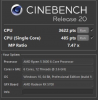
Single: 426
Multi: 4316

I am having a mixed feeling about this chip. (Not just because of this benchmark) I will take time to study what is going on before I decide what to do with it.

There is definitely something off with that score. My 2700x gets a single core of 426.
 
@lopri @Markfw
If your score is that low, I am betting you are using an old early June BIOS using AGESA version 1.0.0.1

Also known as the pre-release BIOS AMD intentionally crippled to prevent early performance leaks - you can't even clock your memory past 2666 on it. 🙄
 
@lopri @Markfw
If your score is that low, I am betting you are using an old early June BIOS using AGESA version 1.0.0.1

Also known as the pre-release BIOS AMD intentionally crippled to prevent early performance leaks - you can't even clock your memory past 2666 on it. 🙄
Actually I can, but it locks up and does all sorts of odd things. Since its part of bios, no way to use the new one without a new bios ??
 
Apparently undervolting can also cause Matisse to produce abnormally low benchmark scores. It will say that it is running at such-and-such clockspeed, but lowering voltage through offsets or static undervolts will cause the system to reduce the total current limit for the chip, reducing performance.
 
@lopri @Markfw
If your score is that low, I am betting you are using an old early June BIOS using AGESA version 1.0.0.1

Also known as the pre-release BIOS AMD intentionally crippled to prevent early performance leaks - you can't even clock your memory past 2666 on it. 🙄

That could explain his results.

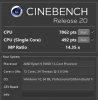
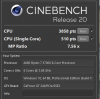
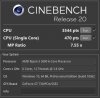
Just for the record here's my 3600's

1563303262458.png
 
Referencing the above post on undervolting, on Reddit, the discussion seems to be focusing more on just setting total package power limits and instead of letting the CPU run itself to its hard limits, limiting it to the advertised TDP numbers, or even lower. IT seems to pull temperatures back nicely, keeps voltages restrained, and doesn't have near the impact on total performance numbers. The likely culprit is the fact that the processors themselves are constantly trying to maximize their own performance for their given thermal/power envelope. This causes them to pull HIGHER amps when the volts are dialed back. This MAY be taking them out of their targeted internal efficiency curve for power conditioning for each core and causes excessive heat internally as a result. Again, the chips are trying to hit a given wattage target, and, remembering my EE classes, W=V*A. If you reduce the V, but want to maintain the same W, you have to increase the A. If your circuitry is optimized for a particular target voltage, messing with that will make it operate in an inefficient amperage range. That's my theory.

 
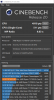
3900X locked to 4500MHz ST = 519 CB:
cinebench-r20-3900x-st-4500mhz-png.8583


Yes, that is actually beating my OC'd 8700K.
 

Attachments

  • Cinebench R20 3900X ST 4500MHz.png
    Cinebench R20 3900X ST 4500MHz.png
    2 MB · Views: 318
Brand new 3700X

Single: 426
Multi: 4316

I am having a mixed feeling about this chip. (Not just because of this benchmark) I will take time to study what is going on before I decide what to do with it.
Something is definitely off here, it seems to be throttling, perhaps check/reapply your thermal paste? I decided to upgrade my 1700x to 3700x on my ancient MSI B350 with beta bios and my multithreaded results are:

Stock: 4742
PBO: 4916

Compared to 3478 on 1700x. Your scores are much too low
 
The likely culprit is the fact that the processors themselves are constantly trying to maximize their own performance for their given thermal/power envelope. This causes them to pull HIGHER amps when the volts are dialed back. This MAY be taking them out of their targeted internal efficiency curve for power conditioning for each core and causes excessive heat internally as a result. Again, the chips are trying to hit a given wattage target, and, remembering my EE classes, W=V*A. If you reduce the V, but want to maintain the same W, you have to increase the A. If your circuitry is optimized for a particular target voltage, messing with that will make it operate in an inefficient amperage range. That's my theory.
This is an intriguing theory but I am not sure I'm understanding correctly. What do you mean by "excessive internal heat?"
 
Something is definitely off here, it seems to be throttling, perhaps check/reapply your thermal paste? I decided to upgrade my 1700x to 3700x on my ancient MSI B350 with beta bios and my multithreaded results are:

Stock: 4742
PBO: 4916

Compared to 3478 on 1700x. Your scores are much too low
Thx. I think I've fixed it to a degree but it remains to be seen whether the chip will maintain the performance level all the time.
 
Referencing the above post on undervolting, on Reddit, the discussion seems to be focusing more on just setting total package power limits and instead of letting the CPU run itself to its hard limits, limiting it to the advertised TDP numbers, or even lower. IT seems to pull temperatures back nicely, keeps voltages restrained, and doesn't have near the impact on total performance numbers. The likely culprit is the fact that the processors themselves are constantly trying to maximize their own performance for their given thermal/power envelope. This causes them to pull HIGHER amps when the volts are dialed back. This MAY be taking them out of their targeted internal efficiency curve for power conditioning for each core and causes excessive heat internally as a result. Again, the chips are trying to hit a given wattage target, and, remembering my EE classes, W=V*A. If you reduce the V, but want to maintain the same W, you have to increase the A. If your circuitry is optimized for a particular target voltage, messing with that will make it operate in an inefficient amperage range. That's my theory.

Pretty much, these Zen2 chips are mostly driven by temps / how good power delivery there is on the mobo.

And, Cb20 is a much *lighter* (? phrasing) workload than prime95 testing, so, it looks good to test with?

I dunno.

Still impressed with the 3900X on the Asus Prime B350-Plus, lol, but I think the BIOS were setup to be on the safe side and not do full 4.6 single core boost for lower end boards.

Basically, if not X570, it may be damaged with max max perf enabled. Don't want stuff getting nuked (low end boards) because it was run out of spec automatically.

So I figured this out this morning: IF any of these is maxed out, you will never get max boost, you will get close Not all parameters, just any single one.
1563459492267.png

prime95 blend test
1563461437670.png

Cinebench R20 CPU0 VS prime95 small fft 1 thread / CPU0

Cinebench R20 CPU0
1563460165700.png

prime95 small fft 1 thread / CPU0
1563460101861.png

CB20 all core
1563460834753.png

prime95 small fft all core
1563461042346.png
 

Attachments

  • 1563459987699.png
    1563459987699.png
    192.2 KB · Views: 4
  • 1563460489630.png
    1563460489630.png
    578.1 KB · Views: 4
  • 1563461376398.png
    1563461376398.png
    496.7 KB · Views: 4
@ 4300 1.39v all cores I got to 4983 last night on my 3700x.

Going to play with it some more, but it doesnt seem to matter if I even go to 1.45v I can't get to 4400.
 
3.7 GHz Prime95? Ouch. That's below the base clock.

Ah, it is not an issue per se. Board is a basic B350 on 1.0.0.2, and small fft is the worst case scenario bench / test load.

CB20 behaves differently. Look at the rest of what I posted.

Again, this is all just some testing shenanigans until I get around to X570 setup and all the things I have to do for that.
 
OK, I just got my Ryzen 1600 to flash my x370 Taichi to be ready for a 3000 series. Not going to even post a picture (embarrassing) but multi = 2253, single = 329

At least its ready for a new chip.....
 
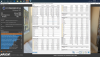
R5 3600 stock settings, PBO off, b-die tweaked to 3600 CL14.

Data in the graph was captured just before the single core test ended. Core #2 instantly locked on and maintained maximum boost throughout the entire run.

1563762349009.png
 
Back
Top