• We’re currently investigating an issue related to the forum theme and styling that is impacting page layout and visual formatting. The problem has been identified, and we are actively working on a resolution. There is no impact to user data or functionality, this is strictly a front-end display issue. We’ll post an update once the fix has been deployed. Thanks for your patience while we get this sorted.

Zhaoxin's ZX-F/KX-7000/KH-40000 and beyond

Page 19 - Seeking answers? Join the AnandTech community: where nearly half-a-million members share solutions and discuss the latest tech.
The OS still has the use a scheduler that synchronizes with hardware. Just because it is x86 doesn't mean the OS knows what instructions to feed it.
 
Why would it need one? It's a PC.
Tomshardware would have used a normal Windows build if that had been the case. Windows needs to recognize the CPU to be able to boot from it. I don't think it can go past the hardware enumeration process unless the CPU is recognized. All the emulators emulate specific CPUs and chipsets for baseline hardware support in Windows guests. Otherwise, Windows will bluescreen during hardware enumeration. It is possible that China has forbidden Microsoft from detecting the Zhaoxin CPUs in anything other than the Chinese Government Edition of Windows.
 
Tomshardware would have used a normal Windows build if that had been the case. Windows needs to recognize the CPU to be able to boot from it. I don't think it can go past the hardware enumeration process unless the CPU is recognized. All the emulators emulate specific CPUs and chipsets for baseline hardware support in Windows guests. Otherwise, Windows will bluescreen during hardware enumeration. It is possible that China has forbidden Microsoft from detecting the Zhaoxin CPUs in anything other than the Chinese Government Edition of Windows.


This Tomshardware article? The one where it says they don't have access to Windows 10 China Government Edition and IPL'd a vanilla Windows 10 Pro?
 
The more interesting thing is that China is on a pursuit to replace most foreign hardware and software with domestic ones.

Back in 2019 the goal was to reduce all to 20% by the end of 2022.

Due to all the success that was extended to mid-2024 last year then.

So Windows compatibility would likely be only a temporary solution in that grand scheme of Chinese gov plans anyway.
 
From what I understand in regards to China's OS...

"These two operating systems have a 90% market share of the government sector in China." ,, Which should be 100% only Kylin since end of 2022.

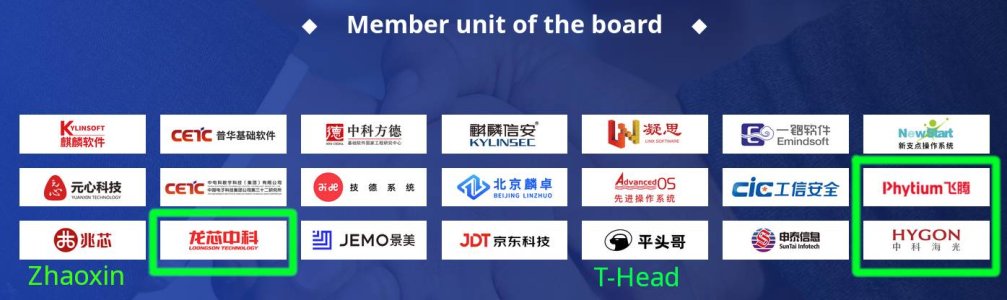
OpenKylin board-mems with some texted or highlighted being CPU-manu groups.
openkylinboardmems.jpeg

KX-7000 should run best on OpenKylin(official consumer/desktop OS), not on Windows(unofficial consumer/desktop OS). While, the government-roled KX-7000 would be using another variant of Kylin.
 
Notebookcheck and Wccftech have been trying to claim that KX-7000 is secretly a rebadged Alder Lake-N. It's not the worst take I've heard this year, but it's probably in the top five.
 
Notebookcheck and Wccftech have been trying to claim that KX-7000 is secretly a rebadged Alder Lake-N. It's not the worst take I've heard this year, but it's probably in the top five.
Wouldn't it be easy to confirm or deny that allegation by just prying off the lid and looking at the die?
 
Wouldn't it be easy to confirm or deny that allegation by just prying off the lid and looking at the die?

It's already easy to deny it by the fact that Zhaoxin has their own uarch group and a long-standing partnership with VIA, and the KX-7000 specs look absolutely nothing like ADL-N.
 
Are there any good sources for what process KX-7000 and/or KH-50000 are built with? A lot of sources are saying it was slated for TSMC N7 but AFAIK Zhaoxin's parent entity got put on the Entity List late last year, so are we looking at SMIC N+1 or N+2?
 
Are there any good sources for what process KX-7000 and/or KH-50000 are built with? A lot of sources are saying it was slated for TSMC N7 but AFAIK Zhaoxin's parent entity got put on the Entity List late last year, so are we looking at SMIC N+1 or N+2?
No info yet...
https://www.zhaoxin.com/prod_view.aspx?nid=3&typeid=582&id=2411 -- KH-40000
https://www.zhaoxin.com/prod_view.aspx?nid=3&typeid=129&id=327 -- KX-6000
https://www.zhaoxin.com/prod_view.aspx?nid=3&typeid=581&id=2410 -- KX-6000G

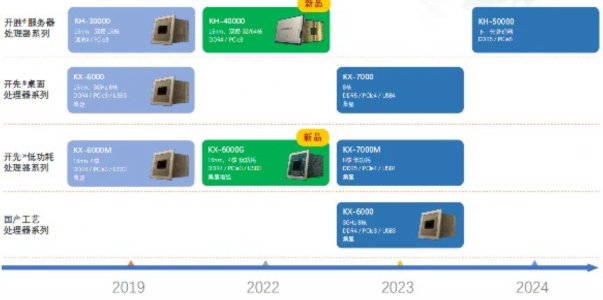
All have "16nm工艺", while KX-7000 doesn't;
https://www.zhaoxin.com/prod_view.aspx?nid=3&typeid=593&id=2757 -- KX-7000

If it doesn't update to 16nm, then it is likely going to be SMIC(now SMSC) N+2. If so, then KH-50000 will use the same node.

SMSC, A joint venture called SMSC => held by SMIC with 50.1 percent and 27.04 and 22.86 percent by China IC Fund and Shanghai IC Fund, respectively. Everything 14nm and below is being handled by SMSC. SICF(latter fund) and SAIL(joint-venture with VIA) are basically the same fund group.

N+2 is going to get an additional ~60k wafer per month by Mid-2024(June/July completetion). SMSC's peak wpm is 95K N+2 wafers, if they upgrade all module/sub-Fabs just for it.
 
Last edited:
Are there any good sources for what process KX-7000 and/or KH-50000 are built with? A lot of sources are saying it was slated for TSMC N7 but AFAIK Zhaoxin's parent entity got put on the Entity List late last year, so are we looking at SMIC N+1 or N+2?
It is speculated that KX-7000 uses TSMC 6nm.

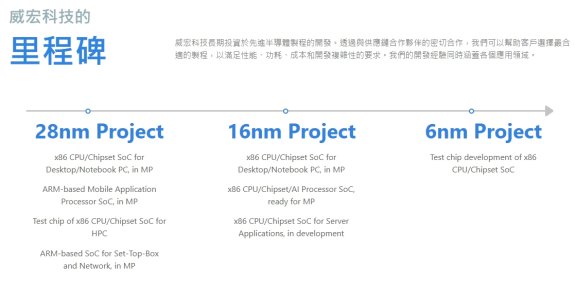
The official website of VIA Next shows x86 6nm testing, and VIA-related news also talks about 6nm tape-out and mass production next year.
 

Attachments

  • 864b3a26d2f042e39e73b21c9ea06087.jpg
    864b3a26d2f042e39e73b21c9ea06087.jpg
    208.4 KB · Views: 43
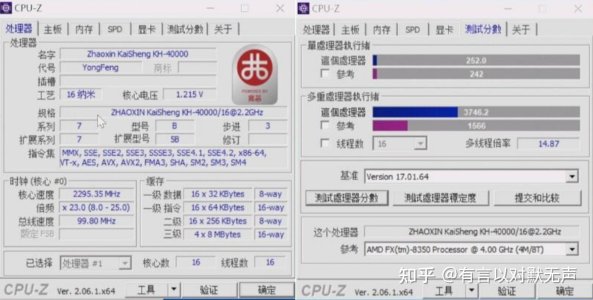
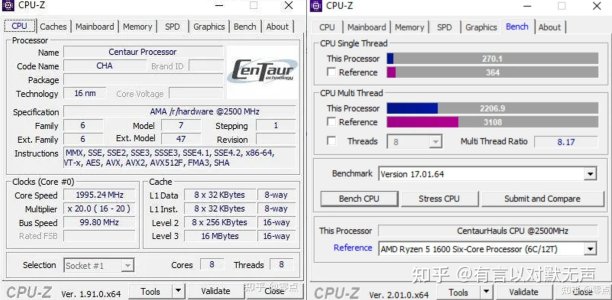
What makes many people unbelievable is that zx-f/cns is not completely designed by Centaur, and zx-g/yongfeng is not designed by Centaur either.

zx-h/Century Avenue is based on Yongfeng micro-architecture. Yongfeng's vector unit width is 128 bits. zx-f/cns is 256 bits.

zx-f/cns, in the non-execution unit part, that is, the front-end part, some modules are designed by Zhaoxin, such as branch predictors, instruction fetchers and decoders.

zx-f has 16-entry L0 btb and round-robin predictor and round-robin queue in Lujiazui architecture.

The storage queue of zx-g is 48, while the storage queue of zx-f is 44.

The load queue of zx-g is 64, while the load queue of zx-f is 72.

The IPC of zx-g is similar to that of ivy, while the IPC of zx-f is similar to that of haswell.

The architecture design time of zx-f was from 2015 to 2017, while the design time of zx-g was about a year later.

The zx-g is entirely made in China, while the zx-f is not entirely a Centaur design.

This information comes from a Chinese tester who owns these chips

 

Attachments

  • 1703964219458.jpeg
    1703964219458.jpeg
    186 KB · Views: 41
  • 1703964214825.jpeg
    1703964214825.jpeg
    234 KB · Views: 38
Back
Top