• We’re currently investigating an issue related to the forum theme and styling that is impacting page layout and visual formatting. The problem has been identified, and we are actively working on a resolution. There is no impact to user data or functionality, this is strictly a front-end display issue. We’ll post an update once the fix has been deployed. Thanks for your patience while we get this sorted.

Question Zen 6 Speculation Thread

Page 405 - Seeking answers? Join the AnandTech community: where nearly half-a-million members share solutions and discuss the latest tech.
How many units over say 5 year period?
That's hard to guess in advance, but it'll certainly be many millions.

Because what they're imo doing here is actually competing with mainstream OEM and DIY gaming PCs, not PS6.
And most of those gaming PCs they're competing with will be either slower, more VRAM-limited, or much more expensive.

Think about it: Even at a price of $999, $1099 or even $1199, they'd still seriously undercut most new gaming PCs of similar performance in price.

If you can get an entire Xbox PC for the price of a single 5080/6080, a lot of people will be going XbPC.
I mean, good luck getting a decent mobo, PSU, NVMe SSD, 12C Zen6, 32GB RAM and 5080-class GPU (and a legal Win11 license) for about $1K total in 2027.
Nevermind that this Xbox PC will have the advantage of a shared memory pool, so the GPU might have more than 16-18 GB at its disposal in games that need it.
With Xbox PC, MS can also ask a much higher price for the same hardware than they could for a "pure" console, and still be hella price-competitive vs. "normal" PCs.
In console-only space, they'd have a hard time against PS6, due to lack of exclusives and lack of graphics edge. But in PC space, they might be competing against PCs with 8C + 8-12GB gfx cards on price, yet against 12C + 5080+ on performance.

In fact, that might be one of the reasons AMD killed AT1:
They knew of MS' plans, and knew almost nobody would buy a 48WGP AMD dGPU at $1k+ anymore if - in addition to potentially strong competition from 6070Ti/6080 - people could get an entire XboxPC with a 34WGP GPU and large shared memory pool for the same money.

 
That's hard to guess in advance, but it'll certainly be many millions.
We know that they've sold roughly 2 mln Xbox Series X per year in the first 5 years when brand was mostly still cool, and price for it was - $499.

Now Xbox brand is irreversibly damaged, new price will definitely be >$1000, pretty likely >$1200 (thanks for the memories), would that even sell 1 mln per year? Bear in mind it won't be released in a vacuum - everybody will know that PS6 is coming soon and by all accounts it will be fast enough.

Think about it: Even at a price of $999, $1099 or even $1199, they'd still seriously undercut most new gaming PCs of similar performance in price.

Now that's an argument for a new market - PC gaming market basically, and initially it might be good, so first year sales might be 2-3 mln, but consoles are designed for 6-7 and now looks like even 8 year lifecycles, but PCs evolve, so this PC will be fixed in time few years after release, sales will drop to near zero. Plus it's competing against big OEMs who make far more boxes and get far better economies of sale than something that will sell at best level of Steam Deck (8 mln units).

One big negative is that form factor will be limiting upgrades, so it's not real desktop that can last for a while, doubt a lot of PC gamers will be interested - it's basically neither here nor there, and in 2027/28 when this things comes out RDNA5 dGPU will be available for decent upgrades in PCs.

Also there is question of margin - they won't sell it at a loss or even break even, so we might see $1200-$1500 range with the way memory inflation gone: 32 GB GDDR7 won't be cheap.

PS6 will kill it.

and a legal Win11 license
$12-15 max

If you can get an entire Xbox PC for the price of a single 5080/6080, a lot of people will be going XbPC.

$1000-1200 dGPU market is dead - only works below or top end, even Nvidia could not sell -80s.
 
Also interesting question is how "native" Win11 mode work on next Xbox - games on PCs don't expect unified memory, so it would need to be partitioned for that mode somehow, and voila - 32 GBs turn into something like 16+16? That's pretty low numbers really when split like that.

And if you play some new gen game that uses lots of VRAM, and then want to switch to your Excel then what - 32 GB get swapped in and out for like 5-6 seconds?

And here is the kicker - GDDR7 latency will be higher than DDR5, and this ain't gonna have large 3D cache. This might work for games that specifically target the Xbox architecture, but how well will that work for PC games?

Oh, and if you can't run Steam on it well then it's DoA for sure.
 
Last edited:
And here is the kicker - GDDR7 latency will be higher than DDR5, and this ain't gonna have large 3D cache. This might work for games that specifically target the Xbox architecture, but how well will that work for PC games?

It is (at least in theory) using the same tile that the top AMD RDNA5 dGPU will use.
 
Now Xbox brand is irreversibly damaged, new price will definitely be >$1000, pretty likely >$1200 (thanks for the memories), would that even sell 1 mln per year? Bear in mind it won't be released in a vacuum - everybody will know that PS6 is coming soon and by all accounts it will be fast enough.
None of that is a problem.
They just need to have games.
 
I dare say that the next XBox, if it is to have competitive specs with decent gaming rigs and the PS6, will have a VERY difficult time coming in under $999. With things like FSR/DLSS, modest 8GB VRAM rigs will be "good enough" for gaming in 4K on performance, and HD at quality/ultra. It just won't be very price competitive if MS doesn't decide to eat a big loss on each unit. Look at the Steam Box. Those are VERY modest specs and it's having big time issues staying reasonably priced.
 
It is (at least in theory) using the same tile that the top AMD RDNA5 dGPU will use.
Yes, but dGPU by definition will have CPU with DDR5 with lower latency for CPU related stuff that can benefit it, plus large 3D cache.
None of that is a problem.
They just need to have games.
It won't have exclusives, so any "console" targeted game will be available on PS5/6, there is zero point in Xbox now, other than finally getting PC DirectX closer to console version, which is a good thing for PC gaming.
 
Yes, but dGPU by definition will have CPU with DDR5 with lower latency for CPU related stuff that can benefit it, plus large 3D cache.

It won't have exclusives, so any "console" targeted game will be available on PS5/6, there is zero point in Xbox now, other than finally getting PC DirectX closer to console version, which is a good thing for PC gaming.
Even a 7500x3d would be too expensive for a console.
 
I dare say that the next XBox, if it is to have competitive specs with decent gaming rigs and the PS6, will have a VERY difficult time coming in under $999. With things like FSR/DLSS, modest 8GB VRAM rigs will be "good enough" for gaming in 4K on performance, and HD at quality/ultra. It just won't be very price competitive if MS doesn't decide to eat a big loss on each unit. Look at the Steam Box. Those are VERY modest specs and it's having big time issues staying reasonably priced.
My point is:

The hardware in the next "Xbox" will be the same, whether sold as pure console for $799 as PS6 competitor, or as PC/console hybrid for $999+.
But in the latter case, especially if they allow Steam etc., it can potentially both reach a broader audience and justify a higher price than a pure, closed-ecosystem console could have.

I also disagree about FSR/DLSS making 8GB cards "good enough", especially AMD 8GB cards from RDNA3 and older.
That will heavily depend on the game.
Some devs will use FSR/DLSS as excuse to do less performance and memory footprint optimization, too.
It also doesn't do much for CPU requirements, and there's still plenty of PC gamers with CPUs that may no longer cut it for games like GTA6.
The Xbox PC might still be the best bang-for-buck upgrade in 2027, even if it costs like 1200.

Steam Box is using off-the-shelf hardware, while MS probably sealed contracts in advance.
Pretty sure MS is getting much better pricing for their hardware, relative to the specs.
 
Even a 7500x3d would be too expensive for a console.
Launched at $269 - can easily be afforded in an "Xbox" PC sold for >$1000.
Pretty sure MS is getting much better pricing for their hardware, relative to the specs.
It's not getting better pricing because it is on N3 which is in very high demand, memory sold out for 2026 and most (if not all) 2027.

The hardware in the next "Xbox" will be the same, whether sold as pure console for $799 as PS6 competitor, or as PC/console hybrid for $999+.
At $799 vs PS6 it won't sell at all, given that $499 Series X sold only 10 mln over 5 years, most of which brand wasn't damaged. And why would PC be $200 more expensive? Microsoft won't subsidise console by that amount, zero chance, and they'd expect to have at least 15-20% margin: in 2023 it was reported that Microsoft mandated gaming division to deliver 30% profit margins.
 
Last edited:
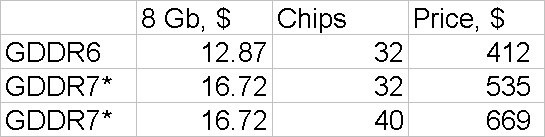
I just looked at current spot prices for GDDR6, using last average session price for 8 Gbit chip, so 32 for 32 GB:

1775321458611.png
40 GB is certainly dead in the water.

* - estimated to be +30%, which is probably conservative right now.

This ain't going to fly - Sony certainly won't release theirs till 2028, and if Microsoft wants to commit seppuku releasing this then it's fine by them.
 
  • Like
Reactions: 511
Could you elaborate on that?
I don't know how much there is to elaborate on. AVX10 doesn't do anything differently that would make it easier to support in a CPU with hybrid architecture (p-cores and e-cores). Intel could've made a hybrid architecture CPU that supports AVX512.

I don't want to speak for OneEng2, but he seems to be conflating the width of the vectors in the instructions with the width of the execution unit. As other commenters have said, you can execute a 512-bit instruction with a "double-pumped" 256-bit execution unit.
 
Back
Top