techjunkie123
Member
Who hit 6.7 on N3X???6.7 you can get on N3X.
They have something better instead.
My bet is a hair under 7, so probably 6.95 or something.

Who hit 6.7 on N3X???6.7 you can get on N3X.
They have something better instead.
My bet is a hair under 7, so probably 6.95 or something.
7.75Who hit 6.7 on N3X???
That's nearly half of what you can do for a dense design on N3E they must have relaxed the density for more clocks

That's why they'll go tell her only 6.9 Ghz is possible:C'mon, that's a bad bet. You don't think if the engineers told Lisa that they could only must 6.95 GHz that Lisa wouldn't immediately ask, "What? No, get to a clean 7 GHz for marketing purposes"?

Oh my, it's going to be this. I can feel it.everyone going out of their mind because Zen 6 has "obviously missed it's clock target"

It's always this since the K5. We expect it by now.Oh my, it's going to be this. I can feel it.

Well, no.Reminder to everyone, AMD has set extremely aggressive clock targets for pretty much the entire Zen line. They always miss the target. They probably will this time too. 6.5 would still be pretty nice.
Well we're talking stable clocks. Not raptor lake zoom zoom into boom boom.Well, no.
Zen5 was 6.0 (at 1.42v).

Engineer: We've done it! Zen6 clocks to 7GHz!
Lisa Su: drop it to 6.9Ghz
Engineer: Bu- but I, we managed to-
Lisa Su: I said lower it.

I'm not falling for the Zen 5 hype again, when we have a slide that described zen 5 perfectly accurately (and zen 6 almost certainly as well).6250mhz max
If we extrapolate from the Computerbase test, and using the 70W lower bound to not overestimate the calculation, then this Strix Point ES perform 26% better than a 7940HS@70W and about 52% better than a 7940HS@45W, so assuming a run at 45W that would make 1.52x the perf with 1.5x the core count, and this would also imply 20% better perf/clock.
You're close!
Very close.
Isn't 20% more IPC kinda low? You said something around 30-40 if I remember correctly? So were you wrong or what happened?
Whichever way you slice it, 20% better perf per core is a "run of the mill" incremental update from AMD. It's nowhere near "Osborning everything before it" or if it were, Zen4 with its 30% ST perf uplift would have been a bigger deal
Man this is the worst attempt to own me in eons.
Those were the stable clocks.Well we're talking stable clocks. Not raptor lake zoom zoom into boom boom.
If they hit 6.5+ on Zen 6 it'll be great.
Everyone is pumping a mix of meth and paint thinner.All in all I'd much rather see wider and slower cores than stupidly high clock speeds
Nope.7 GHz ain't gonna translate to laptops anyway. There we'd still be at 5.5 - 6 Ghz in ST loads
Good luck cooling that thing on mobileNope.
7G 1.35v DT means mobile with the same CCD sits at like 6.7.

- If you're comparing to Apple, then AMD of course stands no chance against a competitor who has owns all of their stack.guzzing 5x more energy than the ARM competition to perform worse (this specifically in ST, while being competitive in MT wrokloads perf/watt).
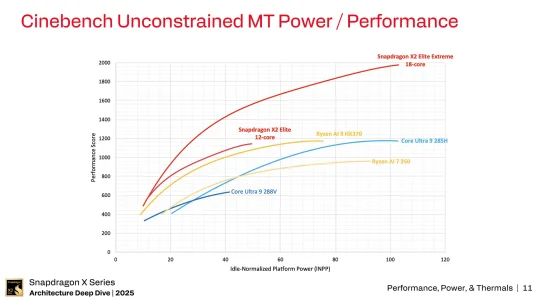
Single-threaded the Oryon v4 will beat Zen6. At much lower power draw. Multi-thread that’s tbd, still likely quite a bit less power draw.- If you're comparing to Apple, then AMD of course stands no chance against a competitor who has owns all of their stack.
- If you're comparing to Crapdragon, pfft, no way.

If all these Zen6 7ghz rumours pan out, then it's possible the top desktop part might beat Oryon v4. Besides, Oryon V4 won't be coming to PC, will it?Single-threaded the Oryon v4 will beat Zen6.
It seems SMT is helping AMD here.At much lower power draw. Multi-thread that’s tbd, still likely quite a bit less power draw.
They already ship 1.3v parts in mobile. Works pretty dang well you see.Good luck cooling that thing on mobile
atta boy. Fun's about to start.Single-threaded the Oryon v4 will beat Zen6. At much lower power draw. Multi-thread that’s tbd, still likely quite a bit less power draw.
"stack" is a meme. Apple just has fatter cores.- If you're comparing to Apple, then AMD of course stands no chance against a competitor who has owns all of their stack.
Not with that density nopeThey already ship 1.3v parts in mobile. Works pretty dang well you see.
It's back to Zen4 core area.Not with that density nope
i meant xtor density which is quite a bit dense than N4P hence you need better cooling in mobileIt's back to Zen4 core area.
Good thing that process shrinks also provide incremental Cac reduction.i meant xtor density which is quite a bit dense than N4P hence you need better cooling in mobile
"stack" is a meme. Apple just has fatter cores.
Yes they do.but Apple never has to worry whether their OS will be aware of some aspect of the CPU design that might restrict performance.
nope, CPPC2 is ancient and works very well.Meanwhile there have been numerous cases where Zen loses performance on Windows because the scheduler doesn't understand the way the CPU is designed and makes bad choices.
L1's are larger.The larger caches almost certainly play a big part in this as well for certain workloads.
We're still there years after it's been demonstrated that Apple ST performance is excellent even for workloads compiled by users.- If you're comparing to Apple, then AMD of course stands no chance against a competitor who has owns all of their stack.


