
adroc_thurston
Diamond Member
Z5 clocked 5.05 in actuality so 13% it is.13% was for IPC, frequency was up by 16.3% from 4.9 to 5.7GHz.

Z5 clocked 5.05 in actuality so 13% it is.13% was for IPC, frequency was up by 16.3% from 4.9 to 5.7GHz.

? it works fine for other CPUs.New result and the clock in gb6 are cooked

If that was 2Ghz it would be the highest IPC core in the world by strong double digits.? it works fine for other CPUs.
And this looks fine as well for an early sample. Actually that score is really good for ~2GHz. Now that it’s consistently above 2GHz this score can be compared with other CPUs running at 2GHz.
Looking at the logs it does say 2.1GHz but yeah I guess a couple more for confirmation would be niceIf that was 2Ghz it would be the highest IPC core in the world by strong double digits.
No good.
Just pretend it doesn't exist for now.Looking at the logs it does say 2.1GHz but yeah I guess a couple more for confirmation would be nice
u do realize 2 of those people are the same people rightMLID says 7ghz
TDevilfish says 7ghz
Kepler_L2 says 7ghz
adroc_thurston says 7.2ghz
Is 7ghz even possible for Zen 6?
.gb6 dumps aren't that reliable either.Looking at the logs it does say 2.1GHz but yeah I guess a couple more for confirmation would be nice

I think Kepler_L said it's some sort of goal but not that it has to be or is very likely to be reached (which of course, is about the maximum you can probably safely say now).MLID says 7ghz
TDevilfish says 7ghz
Kepler_L2 says 7ghz
adroc_thurston says 7.2ghz
Is 7ghz even possible for Zen 6?
Zen60%If that was 2Ghz it would be the highest IPC core in the world by strong double digits.
No good.
If you say that as well we might make it to breaking news 🤣🤣Can't wait to see that for today's news

It's a derived core.Zen 6 developed from scratch/ground-up on a TSMC N2(2nm) process.
That's every Zen ever, forever.Zen 6 has architecture changes and improvement as per generation as usual, but changes more focused on server marker & professional market then consumer.
They're all IF.Interconnect between CCD(s), IO and GPU dies on CPU's and APU's going from Infinity Fabric (SERDES PHYs) to D2D (Sea-of-Wires) to improve latency, speed and power reduction.
Their renamer is already 8wide.wider 8-slot instruction distribution unit
Please stop spamming chatGPT garbage here.

Ah ok, it's just LLMs love that formatting style.@adroc_thurston First off all I'm not spamming chatGPT garbage here , but information found in various articles from:
tomshardware.com - AMD EPYC Venice boasts 256 cores and bandwidth galore — next-gen server CPUs arrive in 2026
guru3d.com - AMD Zen 6 Architecture Surfaces With 8-Wide Dispatch and 512-Bit Vector Support.
wccftech.com - AMD to Pivot from SERDES to a “Sea-of-Wires” D2D Interconnect in Next-Gen Zen 6 CPUs, Bringing Major Power-Efficiency and Latency Gains
overclock3d.net - AMD Zen 6 to get “sea of wires” interconnect upgrade?
techpowerup.com - AMD D2D Interconnect in "Zen 6" Gets Sea-of-Wires Upgrade.
hothardware.com - AMD Reveals New Zen 6 Details In First Official Document.
hothardware.com - AMD Zen 6 CPUs Look Poised For A Major Interconnect Upgrade
amd.com - Performance Monitor Counters for AMD Family 1Ah Model 50h-57h Processors (69163) via @InstLatX64 on twitter #AMD released the first official #Zen6 doc: "Performance Monitor Counters for AMD Family 1Ah Model 50h-57h Processors" 69163 v1.00 which meany websites refer also to.
amd.com - Simultaneous Multithreading: Driving Performance and Efficiency on AMD EPYC CPUs
Don't ask me for links as i get a message from "Anandtech SPAMFILTER!!"
View attachment 140258
No Its my own way to place info, as said I'm not an expert. You stamped it as chatGPT garbage/LLMs format.Ah ok, it's just LLMs love that formatting style.
AMD usually has a different rated (printed in specs) boost clock and actual maximum boost clock the CPU can use (for single thread tasks/on preferred cores of course). In chips like 5950X, 7950X and 9950X, there's 150 MHz "extra clock" the chip may achieve. But it tends to depend on load, temperature and other factors, which is probably why they officially give a lower rating.Zen 3 5950X clocked at 5050?

“Zen 6 will dominate the competition, according to 3 sources.”u do realize 2 of those people are the same people right
(kinda even 3 lmao)
Yes all me.“Zen 6 will dominate the competition, according to 3 sources.”
The 3 sources: Me, Myself, and I.
I mean… it’s already generated clickbait articles from the usual:Can't wait to see that for today's news
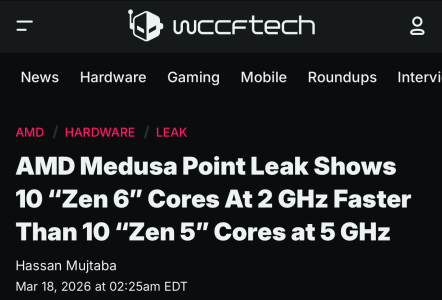
AMD usually has a different rated (printed in specs) boost clock and actual maximum boost clock the CPU can use (for single thread tasks/on preferred cores of course). In chips like 5950X, 7950X and 9950X, there's 150 MHz "extra clock" the chip may achieve. But it tends to depend on load, temperature and other factors, which is probably why they officially give a lower rating.
When I used a 5950X, I was getting above 5000 MHz at least according to the maximum clocks logged in HWiNFO.
Getting the extra 150 MHz has (IIRC) gotten harder (need to get the temperature almost impossibly low, like 50C, or something?) on Zen 4 and Zen 5, but technically they can also go to 5.85 GHz in stock configuration. It's always a question how to factor the viability of that extra clock range into 1T comparisons and IPC guessing, exactly.


