• We’re currently investigating an issue related to the forum theme and styling that is impacting page layout and visual formatting. The problem has been identified, and we are actively working on a resolution. There is no impact to user data or functionality, this is strictly a front-end display issue. We’ll post an update once the fix has been deployed. Thanks for your patience while we get this sorted.

Question Zen 6 Speculation Thread

Page 201 - Seeking answers? Join the AnandTech community: where nearly half-a-million members share solutions and discuss the latest tech.
Halo iGPUs lose one of the attractive features that make people wish for a halo iGPU, which is price.
Yep. There has been lots of discussion here that ignores this .... pretty critical point.
Not nearly double the work but yeah considerable effort also N2 is going to be a price gouge for such a large die and 200mm2+300mm2 for relatively minor improvement in PPA Characteristics of N3P.
I am still betting that most (if not all) of the non-DC Zen 6 products end up utilizing N3P.... but of course, my guess flies in the face of MLID so perhaps I should change my tune in the face of such headwinds 😉.

I know lots of people here would love to see a complete N2P 7Ghz Zen 6 lineup.... it just seems unreasonable. I do actually hope I am wrong though.
This is why it won't happen. They aren't going to make such a large die SoC that requires a whole new expensive board and sell it at $1000.
I agree. The reason that Nintendo made such a splash with very old tech when the original PS3 and XBOX came out was that it was priced right.

Right now, <$500 seems to be the pain point of a home gaming system. $1K gaming system is just a pipe dream IMO.
 
Didn't bother to look up the data myself, just used Bing Co-Pilot and got these Geekbench 5 scores for comparison (there can be variation from different submissions, clearly).

Zen 6 ST 3,186, MT 36,645
9700X ST 2,800, MT 16,100
9950X ST 2,795, MT 30,050
M3 Ultra ST 2,388, MT 41,859 (32 cores)
M4 Max ST 2,932, MT 27,635
285K ST 2,458, MT 27,376
 
Anyway one should always look at subtests anyway.

The Ray tracer test in GB6 uses Intel libraries which is not as fair for AMD and even more unfair for ARM CPUs.
Just checked it's using Intel embree which a fully open sourced library ARM/AMD are more than welcome to contribute if it was MKL it would be problematic but if they don't use embree than it would be bad cause embree is used in Blender/Vray and many 3D renders.
 
Just checked it's using Intel embree which a fully open sourced library ARM/AMD are more than welcome to contribute if it was MKL it would be problematic but if they don't use embree than it would be bad cause embree is used in Blender/Vray and many 3D renders.
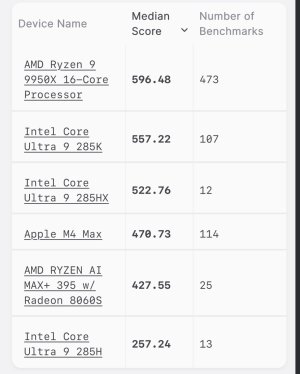
Nope. It uses SSE2NEON which is a translator. It is problematic for ARM CPUs. You ever wondered why Apple’s chips do poorly in this subtest vs native Blender where they beat Intels equivalent. This subtest doesn’t reflect real applications because of outdated code.

AMD also beats Intel in Blender but loses in Cinebench R23.

GB6 probably uses an old build or some very badly optimised build of Intel Embree.
The Blender open test shows that GB6 Ray tracer test isn’t indicative of real world performance.

In fact it shows how behind Intel is in FP when it can’t feed more watts to its cores.

IMG_2296.jpeg
 
Nope. It uses SSE2NEON which is a translator. It is problematic for ARM CPUs. You ever wondered why Apple’s chips do poorly in this subtest vs native Blender where they beat Intels equivalent. This subtest doesn’t reflect real applications because of outdated code.

AMD also beats Intel in Blender but loses in Cinebench R23.

GB6 probably uses an old build or some very badly optimised build of Intel Embree.
The Blender open test shows that GB6 Ray tracer test isn’t indicative of real world performance.

In fact it shows how behind Intel is in FP when it can’t feed more watts to its cores.

View attachment 127420
There is no guarantee that Intel's ray tracing library is optimized for Intel's own products.
If you want to make a clue, check the contents of the embee library yourself...
There's a convenient open source thing, so it wouldn't be strange to use it, right?
 
Anyway one should always look at subtests anyway.

The Ray tracer test in GB6 uses Intel libraries which is not as fair for AMD and even more unfair for ARM CPUs.

At the point when the score increases due to the ARM SME instruction
There's no fairness or unfairness on the geek bench, right?
 
There is no guarantee that Intel's ray tracing library is optimized for Intel's own products.
If you want to make a clue, check the contents of the embee library yourself...
There's a convenient open source thing, so it wouldn't be strange to use it, right?
Don’t need do. I have Blender open benchmark for that, after all it’s also open source and much more real world.
 
Didn't bother to look up the data myself, just used Bing Co-Pilot and got these Geekbench 5 scores for comparison (there can be variation from different submissions, clearly).

Zen 6 ST 3,186, MT 36,645
9700X ST 2,800, MT 16,100
9950X ST 2,795, MT 30,050

M3 Ultra ST 2,388, MT 41,859 (32 cores)
M4 Max ST 2,932, MT 27,635
285K ST 2,458, MT 27,376
Let me just clarify that both of those scores are exceedingly high outliers for GB 5. That 9950X MT is top 0.01%. Both ST scores are top .1% or better.

For reference, I had the top GB6 9900X score for several months at least (havent checked lately but Im sure its been surpassed), I ran GB5 using the same setup.


GB5
1753007149494.png

GB6
1753007190967.png
 
Back
Top