
- Mar 3, 2017
- 1,779
- 6,798
- 136



Hmm. 4.44GHz is awfully close to the 4.47GHz I predicted below @ 200W. 🤣 However, Im still telling you guys right now that near linear core speed scaling will not end at 200W and therefore AMD will not be putting out the 24C SKU with 200W default TDP. Im thinking the chip will readily continue to scale frequencies north of 300W but AMD has to stop it at some point. 230W-250W+ default TDP is a lock and may get you close to or slightly above 5GHz all core speeds. Keep in mind that presumably MUCH lower idle power draw makes such Zen 5 vs Zen 6 comparisons like comparing apples to oranges. Its because of this that I feel my prediction is very much on the conservative side.I have some questions regarding extrapolating clockspeed.
If Zen 5 runs at 5GHz, 200W, all cores loaded on a particular workload running 16/32, what clockspeed would a theoretical 24/48 Zen 5 on the same process node at 200W, running the same (perfectly MT scaling) workload run?
Core count is increased by 50% or a factor of 1.5. Assuming linear scaling that would give us a low estimate of 3.33GHz, correct? In reality, might that number be ~3.7GHz?
Assuming a 20% efficiency boost on the new node might we see 4.44GHz at 200W for Zen 6 for a similar workload?
For 24 core--
@200W :
41K*1.5 = 61,500 R23 nT
4.47 GHz average nT clockspeeds
Power doesnt scale linearly with frequency, that s a fundamental characteristic of mosfet transistors that at best it scale close to a square of frequency within reasoneable clocks, from 4 to 5Ghz this is rather a 2.5 exponent, so that makes about 4.25GHz for a 24C Zen 5 to get to 200W assuming that the 16C clock at 5GHz for 200W.I have some questions regarding extrapolating clockspeed.
If Zen 5 runs at 5GHz, 200W, all cores loaded on a particular workload running 16/32, what clockspeed would a theoretical 24/48 Zen 5 on the same process node at 200W, running the same (perfectly MT scaling) workload run?
Core count is increased by 50% or a factor of 1.5. Assuming linear scaling that would give us a low estimate of 3.33GHz, correct? In reality, might that number be ~3.7GHz?
Assuming a 20% efficiency boost on the new node might we see 4.44GHz at 200W for Zen 6 for a similar workload?

Do you think 250W might be tough to cool with "regular Joe" cooling? I mean it seems like these cores are going to be really tiny, which makes them harder to cool.Hmm. 4.44GHz is awfully close to the 4.47GHz I predicted below @ 200W. 🤣 However, Im still telling you guys right now that near linear core speed scaling will not end at 200W and therefore AMD will not be putting out the 24C SKU with 200W default TDP. Im thinking the chip will readily continue to scale frequencies north of 300W but AMD has to stop it at some point. 230W-250W+ default TDP is a lock and may get you close to or slightly above 5GHz all core speeds. Keep in mind that presumably MUCH lower idle power draw makes such Zen 5 vs Zen 6 comparisons like comparing apples to oranges. Its because of this that I feel my prediction is very much on the conservative side.
Despite the popular notion, calories x surface area x thermal conductivity are the only things that matter for heat dissipation/cooling. If you have a 1cm x 1cm piece of silicon, if it puts out X amount of calories of heat, it doesnt matter if its got 100K or 100B components taking up the surface area, if the contact surface has the same thermal conductivity, a given heatsink will dissipate the heat the same regardless. This is on a 2D plane. If you start increasing component count via 3D stacking, that changes things.Do you think 250W might be tough to cool with "regular Joe" cooling? I mean it seems like these cores are going to be really tiny, which makes them harder to cool.
230W-250W+ default TDP is a lock and may get you close to or slightly above 5GHz all core speeds. Keep in mind that presumably MUCH lower idle power draw makes such Zen 5 vs Zen 6 comparisons like comparing apples to oranges. Its because of this that I feel my prediction is very much on the conservative side.
That assumes perfect thermal conductivity in the 1cm square. In the real world there will be hotspots.Despite the popular notion, calories x surface area x thermal conductivity are the only things that matter for heat dissipation/cooling. If you have a 1cm x 1cm piece of silicon, if it puts out X amount of calories of heat, it doesnt matter if its got 100K or 100B components taking up the surface area, if the contact surface has the same thermal conductivity, a given heatsink will dissipate the heat the same regardless. This is on a 2D plane. If you start increasing component count via 3D stacking, that changes things.

Is there any realistic way to track those figures?The Strix Halo handhelds are probally doing 10-20k sales combined.
Then it will be 230W, but you will have all kinds of new mobos with crazy VRMs to allow for 300+ OCs.230W is the max power of AM5, so that settle the question, there wont be 250W chips,
that would be too risky and a recipe for a disaster a la RPL with the difference that it would be the MBs that would bust.
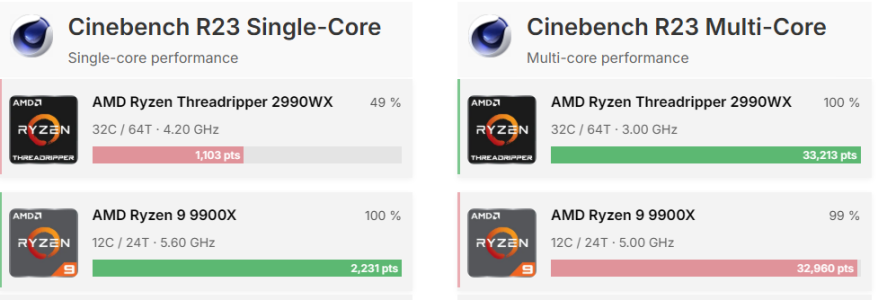
Wow, GB6 says 9900X is twice as fast even in MT.Not sure if I realized before and forgot and realized again, or if I mentioned it before, but the 9900X is roughly equal to the 2990WX in nT, and double in 1T. Pretty spiffy.
View attachment 133792
Wow, GB6 says 9900X is twice as fast even in MT.
Things are really improving fast these days.
Hey now. Don't be a negative nancy. I'm trying to help justify purchases here. Any benchmark which makes new part look even better should always be used.GB6 shouldn’t be used to compare high core count processors.
Hey now. Don't be a negative nancy. I'm trying to help justify purchases here. Any benchmark which makes new part look even better should always be used.


The hell will freeze over before Dell / Alienware offers AMD Ryzen CPU in its gaming box?

Alienware Area-51 Gaming Desktop - AMD Ryzen 9000 Seriesâ | Dell USA
Shop the Alienware Area-51 gaming desktop with AMD Ryzen 9000 series CPUs, AMD X870E chipset & liquid cooling technology.www.dell.com

100% software reading issue. Very common occasion for multi-cluster CPUs.Gorgon Point gets L3 change? 3x 16MB?? This would be an upgrade from Strix Point if true, or is this just a misread by the software?? Almost certain this has to be an error in the software reporting as that could be a doubling of L3 vs Strix Point, huge change in silicon.
View attachment 134167

I'm like the bad news guy but MALL is gone across AMD starting next year.Gorgon Point taking away the NPU to make the GPU run tensor ops instead and put Infinity Cache in the space left by the NPU would've been stuff from dreams.
I'm like the bad news guy but MALL is gone across AMD starting next year.
Idk he's not selling server CPUs or laptop SoCsAlso, it appears that Huang cant be stopped and is dragging Lisa with him, lol.
Grace Blackwell is a thing, a big thing. In any case, he doesnt need to. His earnings just moved AMD +4% in AH trading on the second day of -3.5%.Idk he's not selling server CPUs or laptop SoCs




 Facebook
 Twitter