DisEnchantment
Golden Member
Speculate at will
Last edited:


PTS is a combination of 1T and nT loads.Only 12% higher for 33% more threads?
Let's ignore the benchmarks for a moment. I want AMD accountable for Zen 5 dual CCD CPUs showing higher inter-core communication latency. That should be reason enough to get worried that something went very, very wrong. Unless I see the "fixed" latency chart, either fixed through AGESA, Windows driver/software or new stepping, I will keep my nose up.What benchmarks do you see that the extra latency is hurting?
Let's ignore the benchmarks for a moment. I want AMD accountable for Zen 5 dual CCD CPUs showing higher inter-core communication latency. That should be reason enough to get worried that something went very, very wrong. Unless I see the "fixed" latency chart, either fixed through AGESA, Windows driver/software or new stepping, I will keep my nose up.
AMD needs to clarify that this is what's happening and that's why synthetic benchmarks are seeing the increased latency.If AMD can save power while not effecting performance outside of a completely synthetic scenario that never appears in real loads, what is the issue?
AMD needs to clarify that this is what's happening and that's why synthetic benchmarks are seeing the increased latency.
Right now, I'm assuming that something in Zen 5 dual CCD CPUs is broken and I don't feel like recommending them to anyone.
Agree - The need to have a special driver to park cores (i.e. disable one chiplet), that was not needed for the 7950x, is a huge red flag for me as well.AMD needs to clarify that this is what's happening and that's why synthetic benchmarks are seeing the increased latency.
Right now, I'm assuming that something in Zen 5 dual CCD CPUs is broken and I don't feel like recommending them to anyone.
Agree - The need to have a special driver to park cores (i.e. disable one chiplet), that was not needed for the 7950x, is a huge red flag for me as well.
Yes. And many apps just don't scale beyond a certain point (or even not at all), no matter whether there's a memory bottleneck or not. Lock contention might be a software issue. Even parallel compilation can be "broken" if the makefile is poorly implemented or if you're being hit by Amdahl's law where the linker does a lot of work or some of the files take a disproportionate time to compile (heavily templatized source for instance).Ever consider that there may be an actual explanation for it, like it may be running into memory bottlenecks or the previously discussed anomalous results are bringing down the average?
So Linux results are generally better than Windows... yet again. Looks like even though facing head on Microsoft's abyssmal Windows scheduler since Zen 1 (remember the first Threadripper gen?) AMD still manages to surprise itself, reviewers and all of the audience how bad the scheduler really is and how completely unprepared for it AMD continues to be.
It's like the tired running gag of Lucy not letting Charlie Brown kick the ball.
when mobos with new AMD X870 and X870E motherboard chipsets will be released ?

 www.geekbench.com
 browser.geekbench.com
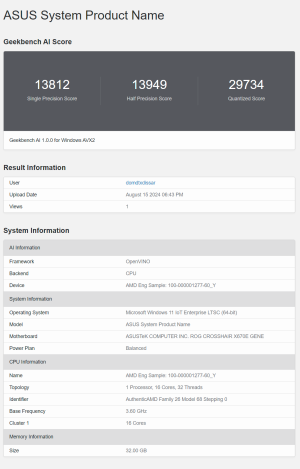

Stock 7950X 6400/2133: https://browser.geekbench.com/ai/v1/4729New Apple AI benchmark released
Download Geekbench AI
No idea if this is a good or bad score for Zen5 16core
View attachment 105414ASUS System Product Name - Geekbench
Benchmark results for an ASUS System Product Name with an AMD Eng Sample: 100-000001277-60_Y processor.
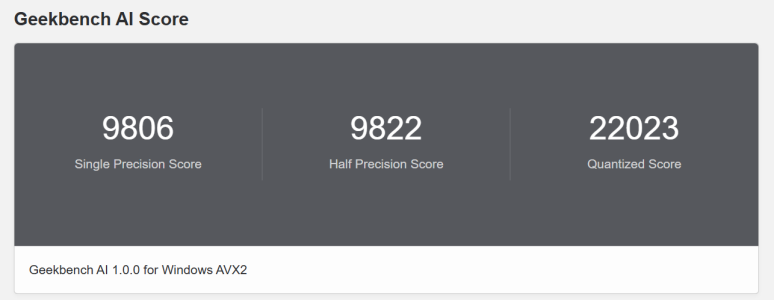 browser.geekbench.com


I remember the Zen 4 release very differently then. The major consensus was that Zen 4 had great performance, but hitting 95C had people screaming at the top of their lungs. It was a major focal point surrounding the release for weeks.AMD shouldn't go around trying to please everyone. There wasn't anything very wrong with Zen 4...
Are you using Win11 or Win10? Might be it's Win11 specific issue.No idea what they've did, but I've (re)enabled Admin account, run CP2077 integrated benchmark and got the same result I have on my normal (admin) account (720p with extreme upscaling enabled). But I've got VBS etc disabled as well as UAC disabled. Maybe switching to admin removed some bloatware from the auto startup or something.
The thing is, you don't know if there is a need as nobody has tested without the driver enabled afaik. I think they are unable to do anything about CCD to CCD latency and therefore were afraid that for low threaded games it might hurt performance. Problem is games are not created equal, some might have already had mitigations for 2 CCD latency issue [it's still 3 times bigger than inter CCD latency on Zen4] or are spawning worker threads that are doing independent tasks where limiting the number of threads will make it worse. That is why I hope reviewers will follow-up with Core Parking on/off scenario so we could see if there really is a need.Agree - The need to have a special driver to park cores (i.e. disable one chiplet), that was not needed for the 7950x, is a huge red flag for me as well.
The charts got the classic disclaimer attached. So the marketing ppl might have simply lied.What I would like is AMD to come out and explain how they got the application Performance numbers they showed in the charts (which is not reproducible by anyone else right now). There is no way they achieved those numbers and everyone else is doing something wrong.
Yes there was that. But it subsided when people actually used it and saw that their CPU didn't die and instead worked happily ever after.I remember the Zen 4 release very differently then. The major consensus was that Zen 4 had great performance, but hitting 95C had people screaming at the top of their lungs. It was a major focal point surrounding the release for weeks.
Part of me thinks they tried to right the ship with this release. It would have been fine if there was a performance uplift in addition to the decreased temps and power consumption. But there isn't.
New Apple AI benchmark released
Download Geekbench AI
No idea if this is a good or bad score for Zen5 16core
View attachment 105414ASUS System Product Name - Geekbench
Benchmark results for an ASUS System Product Name with an AMD Eng Sample: 100-000001277-60_Y processor.
Cant find a single 13900k / 14900k result, crashing all these systems ? 🤣
Didn't see the comparison between 9950X and 7950X? That uplift isn't from a generational IPC bump.Judging by the name, it seems like there is no AVX-512 support which is a shame. I don't know what this bench is doing, but there are multiple AVX-512 instructions specifically for speeding up AI tasks.
I had an X670E Tomahawk for a brief time and it had this "High Efficiency" feature with my 7950X. I experimented with all the different settings (relaxed, balanced, tighter, tightest) and it was garbage. Inconsistent and unstable results.
@Det0x , is this just plain crap or some truth to it?
Didn't see the comparison between 9950X and 7950X? That uplift isn't from a generational IPC bump.
AVX-512 is very much being used.