
- Mar 3, 2017
- 1,779
- 6,798
- 136




GB6 pretty consistently shows 15-17% uplift for both Strix and GNR tbh. Too bad it's mostly dragged up by SIMD-heavy tests.Here we are getting excited to even see a single actual +16% uplift vs 7950X, when Zen 5 is supposed to average +16% vs Zen 4 in IPC uplift-- the sad reality is that it seems to fall quite a bit short of that. When looking at absolute performance we've already seen it definitely falls well short of +16% average vs Zen 4, SKU vs SKU.
Zen 5 has been consistently weak in Navigation subtest, you're not beating Zen 4 in this particular subtest iso-clock.
Seems like it will take a 9950X3D to beat this annoying 7950X in every subtest.
Yeah. Even with higher frequency, it's gonna be hard for Zen 5 but I'm rooting for 9950X3D to manage it.Zen 5 has been consistently weak in Navigation subtest, you're not beating Zen 4 in this particular subtest iso-clock.


Didn't Geekbench pause and start its loads? I think that was exactly the scenario where Intel could be affected because the VID cap fix could affect the speed of boost ramping. Continuous 1T load could be unaffected, bursty loads affected. Also, if TVB is fixed to actually not allow the highest clocks over 70C temperature as it is supposed to be, then that could worsen Intel's 1T score. The effect of Inte default settings is a separate thing, actual 253W PL2 likely only affects MT score, but the settings were touching other things too...
Seriously that entire page has no predictive value on the Zen5 x3d boast clock as it's not temp/power being the limit.After seeing the efficiency graphs @ techpowerup I have less hope for higher clocked 3D cache version of zen5 over zen4, unless the redesigned core somehow can dissipate heat better.
AMD Ryzen 7 9700X Review - The Magic of Zen 5
The AMD Ryzen 7 9700X boasts a robust eight-core design and exceptional single-threaded performance with great power efficiency. In our review we saw good gains with PBO overclocking and TDP increases. Unfortunately, the $360 price tag is steep, and there are several good alternatives available.www.techpowerup.com
Oh, and I don't regret buying a 7800X3D
Maybe some will do it at some point after the launch. But not at launch. They receive samples very shortly before the review publishing embargo ends, and after they got the samples, they continue to receive one wonky beta BIOS after another. Yet on the other hand, there is that certain pressure to have the report ready immediately when the embargo ends. My impression is this has gotten worse over time.I wish the tech press would get more into the mindset they had 2018/2019, where people were tuning the nuts off of their rigs and analyzing things like overclocking and ram to the finest detail.

Technically the Geekbench thing is a combo of several tests so it is a bit better than just "single actual uplift", that result is an average of a few. Similarly SPEC (which is SPECINT + SPECFPU and those both have several subtests that are averaged into the scores). Of course, they are still more aiming to be approximations of real software than being real software themselves.Here we are getting excited to even see a single actual +16% uplift vs 7950X, when Zen 5 is supposed to average +16% vs Zen 4 in IPC uplift-- the sad reality is that it seems to fall quite a bit short of that. When looking at absolute performance we've already seen it definitely falls well short of +16% average vs Zen 4, SKU vs SKU.
Of course. But lets be real- when AMD announced +16% average IPC and +17% Cinebench R23 perf, nobody expected LESS THAN +14% and 10% for R23 ST and MT actual performance uplifts, SKU vs SKU. I certainly didnt. Even with PBO it doesnt come close to +17% R23 perf. As it stands, 9950X will score less than 14900KS in ST R23.Technically the Geekbench thing is a combo of several tests so it is a bit better than just "single actual uplift", that result is an average of a few. Similarly SPEC (which is SPECINT + SPECFPU and those both have several subtests that are averaged into the scores). Of course, they are still more aiming to be approximations of real software than being real software themselves.

There are way more over 16% than under 16% based on application performance.When 16% is the average, there should be just as many results over 16% as there is under 16%. Sadly, it is just not the case.
Of course. But lets be real- when AMD announced +16% average IPC and +17% Cinebench R23 perf, nobody expected LESS THAN +14% and 10% for R23 ST and MT actual performance uplifts, SKU vs SKU. I certainly didnt. Even with PBO it doesnt come close to +17% R23 perf. As it stands, 9950X will score less than 14900KS in ST R23.
When 16% is the average, there should be just as many results over 16% as there is under 16%. Sadly, it is just not the case.
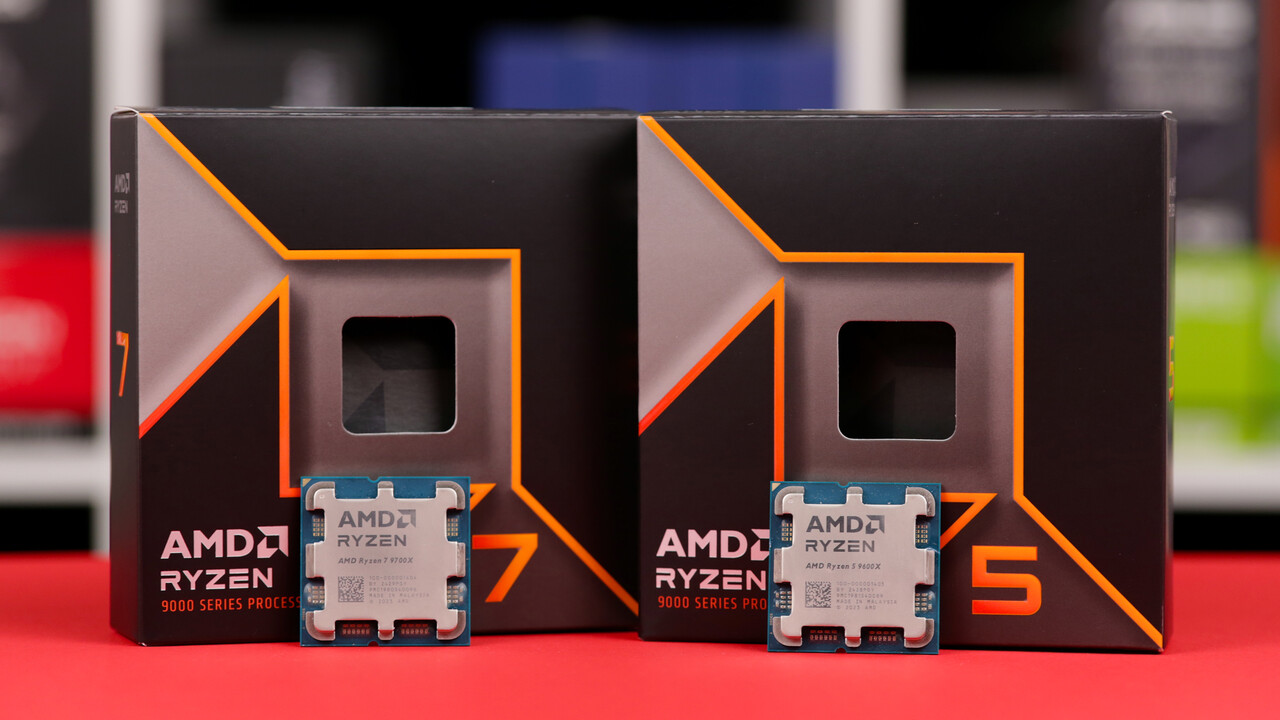

this depends on what applications you run. Again, it may not equal what AMD used. Example: ifs all but proven based on SOME benchmarks that the avx-512 performance is twice what it was on Zen 4. Most people don't care about it, but I am actually buying one JUST for that purpose. I want to see phoronix, and especially if they include good benchmarks on that.There are way more over 16% than under 16% based on application performance.
 www.anandtech.com
I never said one cant arrive at the IPC number. I said perf. Without manual OC, its literally impossible to actually get +17% ST R23 perf on 9700X vs 7700X.7700X run at 5.28Ghz in Cinebench 2024 while the stock 9700X run at 4.35GHz and is still 2% faster.
528/435 x 1.02 = 23.8% better IPC.
AMD Ryzen 5 9600X und Ryzen 7 9700X im Test: IPC, Caches, RAM, AVX-512, TDP, Kernverbrauch und mehr
Ryzen 5 9600X & Ryzen 7 9700X im Test: IPC, Caches, RAM, AVX-512, TDP, Kernverbrauch und mehr / AMD Ryzen 7 9700X mit 65 Watt TDP im Fokuswww.computerbase.de

that would technically be median not average (mean)When 16% is the average, there should be just as many results over 16% as there is under 16%. Sadly, it is just not the case.
I never said one cant arrive at the IPC number. I said perf. Without manual OC, its literally impossible to actually get +17% ST R23 perf on 9700X vs 7700X.
He confuse perf and efficency.Gamers Nexus did a video on Zen 5 power efficiency.
TLDR; 9700X is slightly less efficient than its Zen 4 counterparts in gaming and compression/decompression workloads.
However, there are perf/watt improvements in blender at default TDP (roughly ~10%).
I’m guessing in your hypothetical, fuel is power measured in watts. If that’s the case, you often state it the other way for non gaming workloads.He confuse perf and efficency.
What he s saying is that car A travel 100km at 111km/H ithin 0.9H all while using say 11 litres to do so.
And he compare it to car B wich travel 100km at 100km/H within 1H and 10 litres to do so.
That s performance, not efficency.
Efficency is to measure the distance that is traveled with 10 litres, or wich is the same, the quaNtity of gasoline necessary to travel 100km at 100km/H.
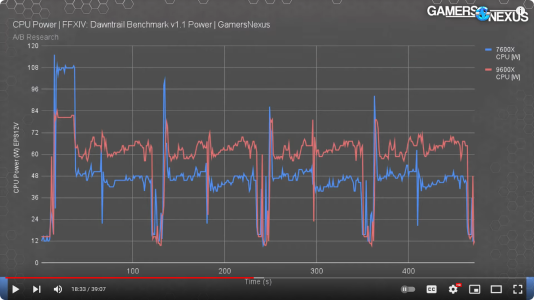
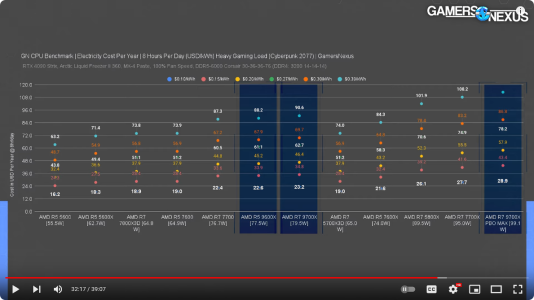
I’m guessing in your hypothetical, fuel is power measured in watts. If that’s the case, you often state it the other way for non gaming workloads.

Upgrading from AM3+ to AM5, will be good performance jump. Patiently waiting on X3D info.AMD didn't make the 9950X to excel at Geekbench. I think AMD knows pretty well that it will be hard to get existing AM5 users to upgrade. They are most likely hoping for AM4 stragglers with 5900X/5950X to make the jump to Zen 5. And now add to that thousands of Intel users who will be wary of Core series CPUs after the Raptor Lake fiasco.
People also underestimate the usefulness of AVX-512. While it is not the easiest to add in support for, it provides fantastic speedups for the relevant workloads. With Zen 4 and Zen 5 becoming mainstream, developers have more incentive to add support for it. Especially as Intel continues to falter.this depends on what applications you run. Again, it may not equal what AMD used. Example: ifs all but proven based on SOME benchmarks that the avx-512 performance is twice what it was on Zen 4. Most people don't care about it, but I am actually buying one JUST for that purpose. I want to see phoronix, and especially if they include good benchmarks on that.




 Facebook
 Twitter