Discussion Zen 5 Speculation (EPYC Turin and Strix Point/Granite Ridge - Ryzen 9000)

Page 725 - Seeking answers? Join the AnandTech community: where nearly half-a-million members share solutions and discuss the latest tech.

gdansk

Diamond Member
Feb 8, 2011
4,789
8,083
136
Bulldozer was a departure from Intel-like cores and it suffered on Windows way more than on Linux. For some reason Zen 5 seems to behave similarly.
I do not think it is operating system related. It's mainly the tested workloads.
Bulldozer was better in Linux because of its unusual scheduling requirements. That's not the case here. From the operating systems perspective these 1 CCD 1 CCX parts need no scheduling changes. It is effectively the same structure since 2020 with Zen 3.
 

gdansk

Diamond Member
Feb 8, 2011
4,789
8,083
136
Even ignoring that some people had some out-of-this-world expectations, something really does need to be done about AMD marketing.
They are also setting inaccurate expectations for their products with no one else to blame. These are not gaming leadership parts. Maybe shut up about gaming until X3D parts show up next time.
 

Hitman928

Diamond Member
Apr 15, 2012
6,754
12,500
136
AFAIK the cache increase only actually helps if the game is moving data resources around significantly in flight.

Some game engines are better than others at managing data movement, so it's completely within reason that some games will benefit far less from cache increases like X3D.

Basically V cache is highlighting lazy programmers as much as anything else.

I'd be interested to see V$ benefits on day 1 games vs after a couple years of patches to refine perf.

I can't remember seeing any tests where the V-cache didn't provide a gaming benefit. There are tests where it wasn't enough benefit to overcome the frequency advantage of the non-Vcache parts. I'm sure there are outliers though.
 

soresu

Diamond Member
Dec 19, 2014
4,252
3,756
136
I can't remember seeing any tests where the V-cache didn't provide a gaming benefit. There are tests where it wasn't enough benefit to overcome the frequency advantage of the non-Vcache parts. I'm sure there are outliers though.
Do they not just fix clock frequency on both to get an accurate reading on the perf delta?

Also I was under the impression that while the 5800X3D clock regression issue was very significant that the 7x00X3D SKUs were much better for this?
 

BigIronOnHis

Junior Member
Jul 24, 2024
5
11
41
Well, looks like it will be great for EPYC. Shouldn't really be a surprise that the architecture would be great for data center and an afterthought for desktop.
 

Hitman928

Diamond Member
Apr 15, 2012
6,754
12,500
136
Do they not just fix clock frequency on both to get an accurate reading on the perf delta?

Also I was under the impression that while the 5800X3D clock regression issue was very significant that the 7x00X3D SKUs were much better for this?

Vast majority did not test iso clock, maybe someone did.

Frequency gap between vanilla and Vcache parts grew from Zen 3 to Zen 4.
 
Last edited:

CakeMonster

Golden Member
Nov 22, 2012
1,663
843
136
I was pretty adamant on getting a 9950X, even if the gain over 7950X was mediocre. Now I'm in a bit of a bind though, because I really dislike the dual-CCX thread prioritization mess and I still consider it very likely that a 9950X3D would have heterogenous cores.
 

Mopetar

Diamond Member
Jan 31, 2011
8,531
7,795
136
Consolation prize is that overclocking becomes a thing again with these reduced TDP parts.

AMD chips have never done particularly well with obscene amounts of power being thrown at them. They've tended to fall off pretty hard once you go past their stock levels.

It's not that surprising either given that AMD is designing their core with server in mind and likely as their primary target.

I think they're much better off not chasing higher and higher power. The extra few percentage points aren't worth it and we can see where it has led Intel.


Not surprising. It's ~14% better than the 7700X while using significantly less power in their testing.

In another note, maybe someone should start pasting Intel stock charts in here to ward off the smug doomposters who wouldn't even consider buying a Ryzen, even after their 4th RMA.

Is Zen 5 earth shattering? No, not really, but it's hardly the disappointment that some wish to paint it as either. For some particular niches it does look to be a must buy. Anyone who can make heavy AVX-512 use should probably consider calling their doctor because it has been about 4 hours since reviews started dropping.
 

IEC

Elite Member
Super Moderator
Jun 10, 2004
14,608
6,094
136

Per Phoronix:

When taking the geometric mean of those nearly 400 raw benchmark results, it sums up the greatness of Zen 5 with the Ryzen 5 9600X and Ryzen 7 9700X processors. The Ryzen 7 9700X delivered 1.195x the performance of the Core i5 14600K competition or 1.15x the performance of the prior generation Ryzen 7 7700X. The Ryzen 5 9600X came in at 1.35x the performance of the Core i5 14500 and 1.25x the performance of the Ryzen 5 7600X. Or if still on Zen 3 for comparison, the Ryzen 5 9600X was 1.82x the performance of the Ryzen 5 5600X.

Those are some impressive numbers and suggest Zen 5 server parts are going to be beastly. Since the architectural changes seem to favor work more so than gaming.
9700x is 15% better than the 7700X despite 65W TDP (88W PPT).
9600x is 25% better than the 7600X. And a full 82% better than the 5600X.
 

carancho

Member
Feb 24, 2013
55
45
91
The parts are also considerably cheaper, at MSRP and adjusting for inflation. (MSRP is the better way to measure this, as all tech products are gradually discounted with time.) You pay about 20% less for 5-15% more performance and ¿40%? less energy consumption. It's not nothing, considering how the true enabler of improvements, semiconductor manufacturing, has stalled.
 

carancho

Member
Feb 24, 2013
55
45
91
The parts are also considerably cheaper, at MSRP and adjusting for inflation. (MSRP is the better way to measure this, as all tech products are gradually discounted with time.) You pay about 20% less for 5-15% more performance and ¿40%? less energy consumption. It's not nothing, considering how the true enabler of improvements, semiconductor manufacturing, has stalled.
Using the Phoronix result, this is a ~20% CAGR on performance per inflation adjusted dollar, which is actually good in this late stage Moore's law era.
 

Det0x

Golden Member
Sep 11, 2014
1,488
5,114
136
Unlike Zen 4 which benefited from DDR4-->DDR5 jump, Zen 5 is still stuck on similar DDR5 speeds. And we already knew Zen 4 was memory constrained in a lot of workloads which is why the 3D vCache variant does so well in some instances. Looks like same still applies to Zen 5 but it's likely to hit the bottleneck even harder due to mArch differences.

Running JEDEC speeds seems like it gimps performance even more vs Zen 4.

View attachment 104670
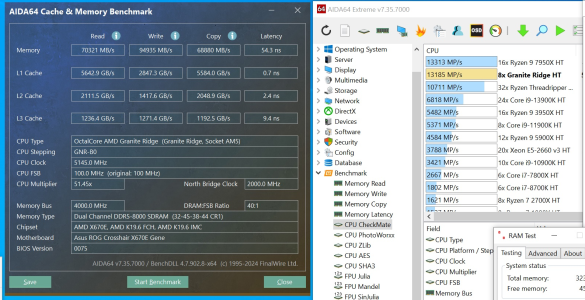
Lets just say there is more left in the tank
His latency numbers seem pretty medicore

But i agree that you can get much more out of Zen5 with a overclock, compared to Zen4.
These cpus are powerlimited at default settings
1723060416460.png
 
Last edited:

CakeMonster

Golden Member
Nov 22, 2012
1,663
843
136
The parts are also considerably cheaper, at MSRP and adjusting for inflation. (MSRP is the better way to measure this, as all tech products are gradually discounted with time.) You pay about 20% less for 5-15% more performance and ¿40%? less energy consumption. It's not nothing, considering how the true enabler of improvements, semiconductor manufacturing, has stalled.
Agreed, this release has highlighted some trends in the industry

NV and AMD foregoing N3*, choosing N4 for their 2024 lineup with no expectation of another generation before 2026 (NV might actually not even make 2024). This is probably mostly because of cost.

NV shrinking die sizes with each generation for most of the SKU's to save money. AMD reducing power usage on 1-CCX parts partly to make it easier for themselves to get good yields initially.

I think its obviously about cost. There could be some bigger performance gains in 2026 with the next generation, but the market by then will decide where they put their priorities. N3* sure will help, but they might further try to improve margin based on the situation then.
 

eek2121

Diamond Member
Aug 2, 2005
3,491
5,183
136
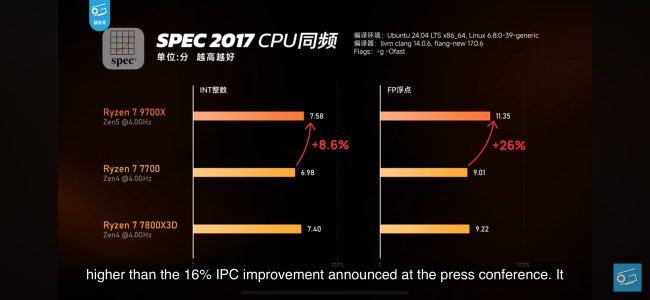
No he wasn't. He said SPEC rate. And neither FP nor int show that.
It is quite possible that is affected as well. Zen 4 is starved for bandwidth as well.

We can actually determine this pretty easily by simply waiting for Turin benchmarks.

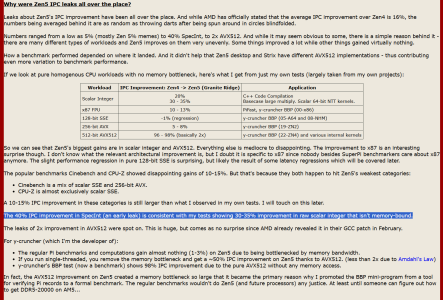
If non-SPEC INT “INT” tests are showing a 30-35% improvement, that suggests the problem is SPEC being limited in some way.

Note that I am it is the current chiplet design (especially 1 CCD parts!) that is limiting bandwidth, NOT DDR5. It also means Zen 6 should rectify the situation. 😈

🚂 ( hype train)