
DisEnchantment
Golden Member
Speculate at will
Last edited:

Geez I wish they would’ve used the 7940HS too. Would be nice to compare that as the Anandtech review had. Computerbase had 8945HS. Need a spreadsheet to do a proper comparison.Phoronix:
Seriously impressive efficiency gains gen over gen.
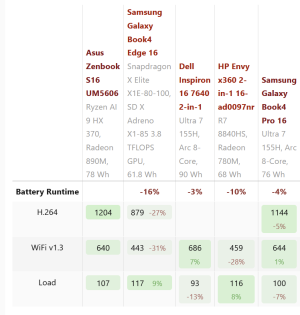
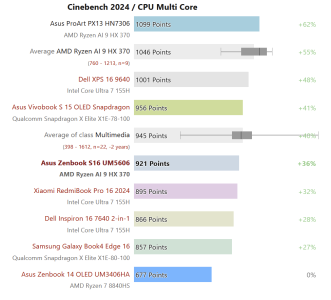
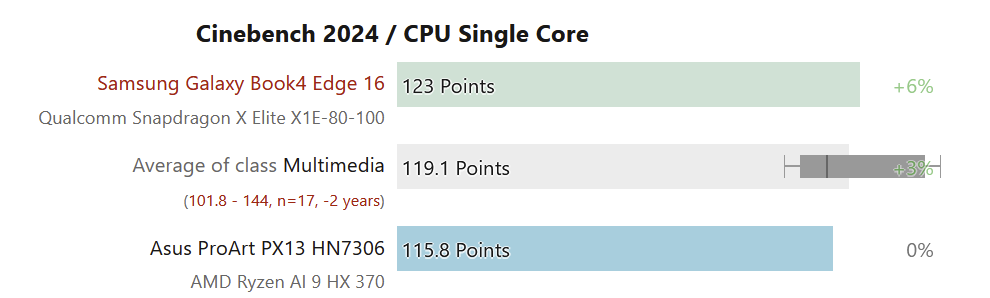
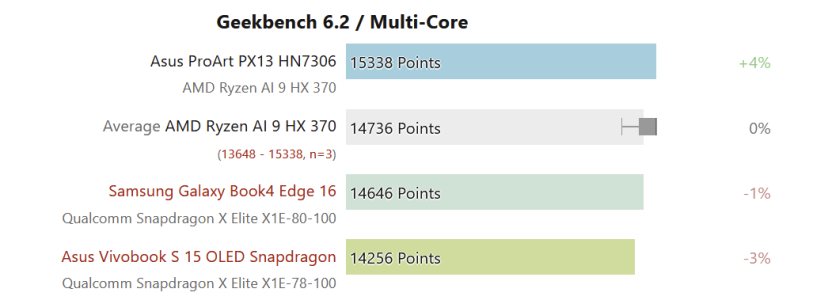
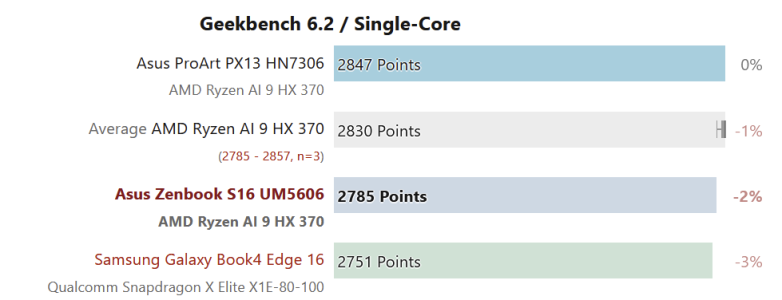
I think PX13 goes up to 54 (?) W. There is a datapoint in Just Josh's review.If you want to know how STX performs with higher power, you can go to the Zenbook review and look for the Asus Proart numbers. The review isn't up yet, but they have the numbers in the Zenbook charts. Not sure what the power consumption in the Proart is though.
View attachment 104047
View attachment 104048
View attachment 104050
View attachment 104051
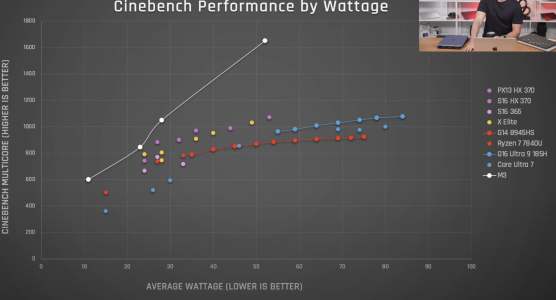
I think PX13 goes up to 54 (?) W. There is a datapoint in Just Josh's review.
View attachment 104053
I think PX13 goes up to 54 (?) W. There is a datapoint in Just Josh's review.
View attachment 104053
Strix Point is much worse than I expected.
No point waiting for cheap Kraken Point when they'll only be ~10% better compared to existing 7/8000 laptops. Actually since it's 4+4 it might be worse in MT.

Bit strange. Perhaps it's M3 Max mislabelled as M3.Dunno for the other curves but the one of the M3 is pure fairy tale.


And iGPU is gonna be worse too with 8 CUs. You will literally have 10% better ST and a stupid NPU that can't be used properly.Actually since it's 4+4 it might be worse in MT.
Bit strange. Perhaps it's M3 Max mislabelled as M3.
 t.bilibili.com

Yup. I thought the same. They even made a 7545U/8540U with 2+4c config with unified cache. Could have done something like that for efficiency rather than doing this.Splitting core to 2 different CCXs really hurt performance. Still don't understand why they did it, it seems that doing one 8-core hybrid CCX solution would have been better alternative.
Whatever it is that s still an impossible curve, there s no CPU whose perf increase linearly with power, that s against the laws of physics.
This and the fact that the 8945H gain only 10-12% perf from 35W to 70W lead me to think that this guy has no clue about power mesurements methodologies.
Same as NBC who put the 370 at same perf/watt in ST than a 185H, yet Computerbase measure 40-50% more power for the 185H in Cinebench ST at 28W while the 370 hoover at 18-20W.
Edit : There s a pic of the die at Bilibili, die size is 225.64mm2 :
动态-哔哩哔哩
RAM bandwidth and GPU L2 size are both unchanged... meaning that it's essentially the same memory subsystem for the GPU as Phoenix.Barely faster than a 780M with same LPDDR5x-7500? What happened? Bandwidth limitation too big?

That is what Zen 6 is to solve, I guess.The fact that a single CCX can only support upto 8 cores seems to be a problem for AMD. More cores would require another CCX, and a seperaye L3 block. Perhaps they should work on larger CCXes, or even do a rework of their core cluster hierarchy?
Also, that's not an M3 but an M3 Max for the white line. That's a slight 2.6x exaggeration in score.That chart is awful.
The fact that a single CCX can only support upto 8 cores seems to be a problem for AMD. More cores would require another CCX, and a seperate L3 block. Perhaps they should work on larger CCXes, or even do a rework of their core cluster hierarchy?
For comparison, the ARM DSU-120 can support upto 14 cores in a single cluster, with a single block of L3 cache.
NBC does power and perf/watt measurements for the whole system, which greatly obscures the differences in SoC power/efficiency.
From the same review, I think this is a great achievement:From Phoronix's 100+ Linux benchmark test:
These initial Ryzen AI 9 HX 370 results have me super excited for Zen 5. It's different having AMD shipping their next-gen laptop SoCs ahead of the desktop processors, but in a few weeks attention will turn to the Ryzen 9000 series. I've been pushing the limits of this SoC in being eager to test Zen 5, so stay tuned for more articles ahead of the Ryzen 9000 series launch. The generational performance uplift is nice with Zen 5 but really captivating my interest has been the large power efficiency gains at least among these laptop SoCs. The Ryzen AI 9 HX 370 also furthers its lead over Intel Meteor Lake that makes an even larger hill for Lunar Lake to climb, which will be interesting to see how that battle goes later in the quarter.
Yes, it is. The 600 dot at the bottom fits for the regular M3. Apparently that "M3" more or less means the whole family of M3 silicon.Bit strange. Perhaps it's M3 Max mislabelled as M3.
Unless it's an M3 Max 16-core. The idiot didn't specify in the graph.Dunno for the other curves but the one of the M3 is pure fairy tale.


