DisEnchantment
Golden Member
Speculate at will
Last edited:

NopePbo+co?

I was just going by their quoted TDP values, and the HX identifier. Seems like it’d be fair to compare top HX SKUs from 7000 vs 9000.
Otherwise what would be the correct comparison? I don’t see anything else in their lineup that would be a better match.
So 170-180W PPT seems like a sweet spot, for this ES anyway (I assume retail units will have a slightly different v/f curve)View attachment 103232
View attachment 103233
View attachment 103234
40W: https://forums.anandtech.com/thread...ranite-ridge-ryzen-9000.2607350/post-41252027
60W: https://forums.anandtech.com/thread...ranite-ridge-ryzen-9000.2607350/post-41252719
80W: https://forums.anandtech.com/thread...ranite-ridge-ryzen-9000.2607350/post-41253719
100W: https://forums.anandtech.com/thread...ranite-ridge-ryzen-9000.2607350/post-41254064
120W: https://forums.anandtech.com/thread...ranite-ridge-ryzen-9000.2607350/post-41254436
View attachment 103235

Igor is not involved. You mean @leoneazzurro 🙂Igor is correct. The correct comparison for Strix is Phoenix or Hawk Point.
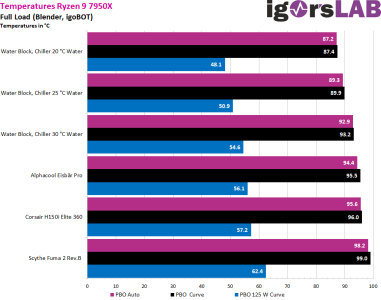
HOLY SH*ET. How is this thing under 60c ??????
Remember:Custom Waterloop?
Ah indeed, I stand corrected.Igor is correct. The correct comparison for Strix is Phoenix or Hawk Point.
I already know all of this i was not asking for an explenation. Im still in shock under 60c not delided with my jaw on the floor while driving 130km/h and typing with 1handRemember:
AMD did this based on lessons about hotspots learned from previous chip generations.²
- The thermal conductivity was improved. (Of the chip? Of the interface from chip to heatspreader? Of the heatspreader? AMD didn't elaborate.)¹
- The placement of on-chip temperature sensors has been changed.²
- The thermal management algorithms have been changed.²
¹) source: AnandTech's tech day report
²) source: Computerbase's tech day report (in German)
Igor is not involved. You mean @leoneazzurro 🙂
Discussion - Zen 5 Speculation (EPYC Turin and Strix Point/Granite Ridge - Ryzen 9000)
Page 638 - Seeking answers? Join the AnandTech community: where nearly half-a-million members share solutions and discuss the latest tech.forums.anandtech.com
For clarification sake: a comparison with a more than likely unstable CPU due to an extreme undervolting or extreme low AC / DC loadline values (I know it because I own a 13900k), is totally useless.For comparison sake 13900K can do 30500 at 100W PL2.

Strix Point compared to Phoenix (8945H) also because they are the top monolithic die of their respective generations, and because they both include a large integrated GPU.I was just going by their quoted TDP values, and the HX identifier. Seems like it’d be fair to compare top HX SKUs from 7000 vs 9000.
Otherwise what would be the correct comparison? I don’t see anything else in their lineup that would be a better match.

View attachment 103232
View attachment 103233
View attachment 103234
40W: https://forums.anandtech.com/thread...ranite-ridge-ryzen-9000.2607350/post-41252027
60W: https://forums.anandtech.com/thread...ranite-ridge-ryzen-9000.2607350/post-41252719
80W: https://forums.anandtech.com/thread...ranite-ridge-ryzen-9000.2607350/post-41253719
100W: https://forums.anandtech.com/thread...ranite-ridge-ryzen-9000.2607350/post-41254064
120W: https://forums.anandtech.com/thread...ranite-ridge-ryzen-9000.2607350/post-41254436
View attachment 103235

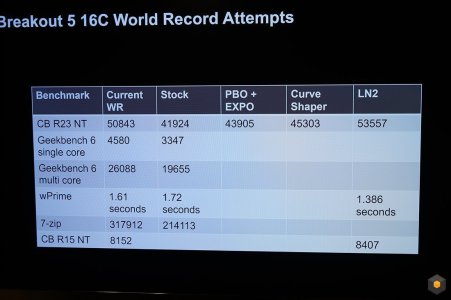
Yeah, also the leaked numbers from the AMD event were 42k stock and 44k PBO. No way this ES does 46k. Something is off.27c delta vs 20c chiller setup ???
I know AMD says it is better, but 7950X ran at 95° pretty much everywhere. There's no way we are sitting at 60° now with 9950X. Also the numbers are higher than the leaked PBO ones.
- The thermal conductivity was improved. (Of the chip? Of the interface from chip to heatspreader? Of the heatspreader? AMD didn't elaborate.)¹
- The placement of on-chip temperature sensors has been changed.²
- The thermal management algorithms have been changed.²
Hassan (yeah I know, I know) did allude to GNR being unusually cool in one of his tweets.I know AMD says it is better, but 7950X ran at 95° pretty much everywhere. There's no way we are sitting at 60° now with 9950X. Also the numbers are higher than the leaked PBO ones.

I have no doubt that's based on the temps from this very thread.Hassan (yeah I know, I know) did allude to GNR being unusually cool in one of his tweets.

I think he tweeted that before Igor started leaking here.I have no doubt that's based on the temps from this very thread.
No, the tweet is a month old I think.I have no doubt that's based on the temps from this very thread.
Yeah, also the leaked numbers from the AMD event were 42k stock and 44k PBO. No way this ES does 46k. Something is off.
I know AMD says it is better, but 7950X ran at 95° pretty much everywhere. There's no way we are sitting at 60° now with 9950X. Also the numbers are higher than the leaked PBO ones.
So default settings "out of the box" setting? Or something else, manual static OC?Nope
Whoops that makes it even more consistent 🙂 . Thanks for the correction.It was 43.3k at 5ghz all corehttps://x.com/9550pro/status/1813063693682557174?s=46

Not Tweets, an article.Hassan (yeah I know, I know) did allude to GNR being unusually cool in one of his tweets.
AMD's Ryzen 9000 "Zen 5" CPUs by default will run cooler than Ryzen 7000 "Zen 4" CPUs. Based on testing with a Ryzen 9 9950X CPU (Default ES), the chip consumed up to 190W of power whereas the Ryzen 9 7950X consumes around 220-ish Watts of power in the same workloads. The workload being performed here is Cinebench R23 and we got some interesting numbers here too. The 9950X is almost as fast as the Core i9-14900KS by default and that chip can consume over 300W of power with its extreme profile.
This is gonna take some time with so many different PPT levels to bench. I think I need to do 80, 100, 120, 160, 200, 230, 253, and unlimited. 253 and unlimited will do nothing because it doesn't even hit the 230W PPT cap at stock, but I'll run them anyway.I'll try my best 🙂
Do ones for 253W and Unlimited too.
But it doesn't make sense that stock ES is better than PBO scores that AMD shows officially. AlsoAll the numbers are quite consistent w.r.t. PPC.