DisEnchantment
Golden Member
Speculate at will
Last edited:


Operation Mockingbird. Project that used over 400 journalists as an active assets of the CIA. Carl Bernstein exposed that at least 10 journalists and editors at the NYT were active CIA operatives.total american cultural victory (he's polish but talks like a facebook Qmaga conspiraboomer).

total american cultural victory.Operation Mockingbird. Project that used over 400 journalists as an active assets of the CIA. Carl Bernstein exposed that at least 10 journalists and editors at the NYT were active CIA operatives.
You can google who Carl Bernstein is. I assume you won't because you know everything about the world.
Decode is frankly a not particularly super relevant point with AMD opcache sizes.This explains many things. I think 5 is the minimum. Most likely there will be a 6-way decoder. We'll see. There may be more GCC fixes coming soon.
i don't think anything.So you think Zen 5 can still have a 4-way decoder?

It's 8 wide dispatch apparently. No idea what the decode width is. It could be like Zen 4 but with 6 wide decode instead of 4 wide decode and higher dispatch from micro-op cache.This explains many things. I think 5 is the minimum. Most likely there will be a 6-way decoder. We'll see. There may be more GCC fixes coming soon.
many ways to skin that cat in particular.If they add a wider decoder, I think it matters because it's not done without a reason.

yeah LNC sucks.I just want to point out that Arrow Lake is a truly new core for Intel on a brand new (20A) 5nm node
no.It trails TSMC 3nm in efficiency by 15-20%.
has nothing to do with shortage and everything to do with N3b being bad.Zen 5 was supposed to be on the 3nm silicon but TSMC has a shortage of 3nm or AMD elected to wait it out because they are cheap.
they do not.I think AMD really needs to be on 3nm for the sake of efficiency
Their opcache is already the biggest and the widest in the industry.by increasing the ability to send decoded microinstructions from memory
Or you can have 2*4 or 2*6 stitching basic blocks.or by expanding the decoder from 4 to 6. Or both, by expanding the decoder to 5.

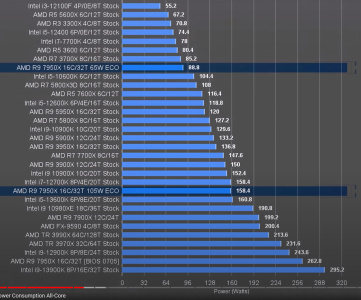
AMD bumped the TDP of Zen 4 because they worried that Intel would wipe the floor with them.
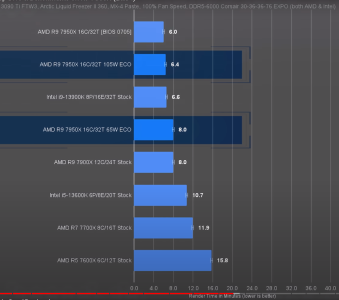
It's Intel who need to show ability to produce meaningful IPC gains without going for more and more bloat.AMD has yet to show the ability to make a huge generational jump in IPC on the Ryzen platform. Zen 1 does not count because the processors before it were so bad. Zen 2 and Zen 3 were really good gains but Zen 4 was a disappointment. I personally think Intel will have at least a 20% IPC gain with Arrow Lake. AMD's core count advantage will be gone because Intel will be on 5nm silicon as well.
I do not think AMD will be in the rear view mirror of Intel. I do think AMD will end up far enough back where they cannot perform a pit maneuver on Intel. I guess we will find out by the end of the year

Yeah, "total" is probably the only relevant word here, especially since 9/11 C.A.total american cultural victory
well unfortunately LNC is more bloat and more cache for middling gains.It's Intel who need to show ability to produce meaningful IPC gains without going for more and more bloat.
GLC and Zen 4 shouldn't even be close on paper on most metrics.
I am talking out of the gate when Zen 4 was released. They added the eco mode later which was good. With power efficiency, Intel cannot touch AMD. That was the big selling point for AMD. If AMD was on N3P out of the gate with Zen 5. Things would be looking very good for AMD. N4 is behind in efficiency of the originally planned (Zen 5) N3 silicon. The good stuff is N3P. That gives an uplift in performance as well as nice efficiency gains over N3.
Alder Lake had a huge IPC gain. The 10nm silicon was holding back Intel. It was inferior to the 5nm TSMC silicon that Zen 4 was built on.It's Intel who need to show ability to produce meaningful IPC gains without going for more and more bloat.
GLC and Zen 4 shouldn't even be close on paper on most metrics.
19% is Zen3-size but at a huge bloatcost.Alder Lake had a huge IPC gain.
no, their big cores are just bad.The 10nm silicon was holding back Intel.
i4 in MTL isn't yet the results.It was inferior to the 5nm TSMC silicon that Zen 4 was built on.
Alder Lake had a similar IPC gain over SNC to than achieved by Zen 3 over Zen 2 by making everything bigger.Alder Lake had a huge IPC gain. The 10nm silicon was holding back Intel. It was inferior to the 5nm TSMC silicon that Zen 4 was built on.