
DisEnchantment
Golden Member
Speculate at will
Last edited:


It always does.An architectural change that increases IPC may or may not increase power consumption
Not my fault you're not very smart and haven't touched a server part in your life.but my God did it take a whole bunch of useless posts and repetitions to get to that point

Actually it is. Giving, while technically correct, answers without showing the work or source makes everyone less smart.Not my fault you're not very smart.
Yeah but Milan benches are all over the internet, including Anandtech.Giving, while technically correct, answers without showing the work or source makes everyone less smart.
It always does.
The old Intel rule of the 00s was 2% IPC for each 1% of power spent.
One can hardly check if this rule is accurate because there s often node shrinks that blur the comparison, so far Intel s Haswell increased IPC substancially relatively to Ivy Bridge.
Also doesn't disprove that there are instances where a change can both increase IPC and reduce power consumption, which is very obviously true. Practically anything that reduces the need to move up the memory hierarchy may do that, or anything that reduces communication distances/hops, and of course not all work is created equal and it's possible to do more or less work to achieve a result. A more general approach to finding a result can both perform worse and consume more energy than a more specific approach. It's of course possible to do more work with less active transistors and vice versa. And then there's pipelines, branch prediction (which is huge, mispredictions are extremely expensive), OoO etc.
It's not a claim any engineer would make.
I don’t think that’s it. Zen 5 shouldn’t be that much more expensive than Zen 4.

Zen 3 vs. Zen 2Likelihood of increasing IPC while decreasing power is low.
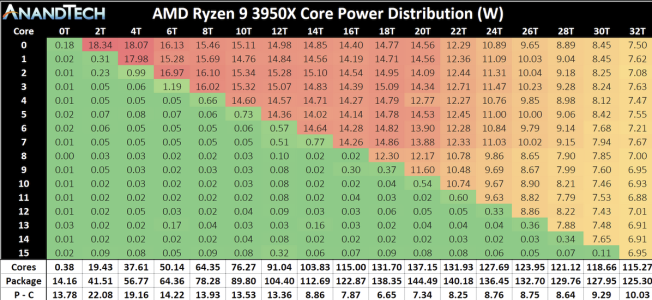
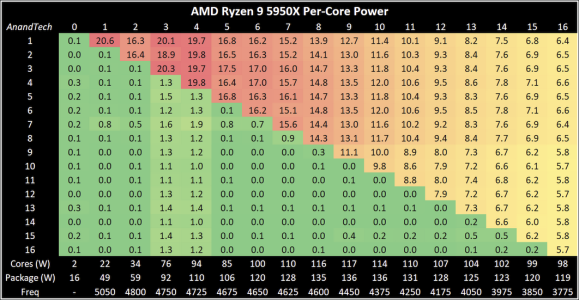
FI a misprediction will stall the pipeline and as a consequence there s no computation that is done in the back end, hence it doesnt use as much power as when the pipeline is correctly filled and exe units are performing actual work.
Likelihood of increasing IPC while decreasing power is low. Not because it's impossible, but because it implies the previous approach was less efficient and used more transistors to achieve that worse result.
There's not many places in a modern CPU where you could expect to swap out hardware for asymptotically better performance while reducing the transistors used at the same time. That fruit was picked a long time ago.
Almost anything the reduces memory latency (at least in terms of raw cycle count since the access time may decrease just as clock speed increases, which keeps the ratio similar even if both are faster) is a result of adding extra cache, which requires more transistors. Those need more power, but if they keep the rest of the CPU better fed it might reduce the overall power used for some workload even though the CPU is using more power at any individual point in time during that point.
If we froze our process tech and it never improved, newer chips would see a gradual increase in power use. The efficiency for some workloads may improve as the extra transistors allow that work to finish faster than the extra power increase accumulates to surpass the previous energy total.
Perhaps in the long run being stuck in that situation would drive engineers to rework existing solutions to use less power, even if only because there's no additional room to increase the power or add transistors. But generally, it's been node shrinks reducing both capacitance and voltage required that has led to lower power requirements.
You are obviously misinformed because you missed it will have either SMT2 or SMT 4 😎Here's what my inside sources tell me for Zen5:
* 5-35% IPC increase
* -5% to 15% frequency increase
* Max core count: 8-32P + possibly 8-32E cores
* Price of top AM5 desktop SKU: $499-$1599
* IO-die: Possibly same, possibly with e.g. RDNA 3.5+.
* Chipset: Possibly same or maybe e.g. node improvement.
* Release date: 2024Q1 -- 2025.
All from inside sources at AMD. Please feel free to call be out at end of 2025 if any of the above turns out to be inaccurate. 😎
Here's what my inside sources tell me for Zen5:
* 5-35% IPC increase
* -5% to 15% frequency increase
* Max core count: 8-32P + possibly 8-32E cores
* Price of top AM5 desktop SKU: $499-$1599
* IO-die: Possibly same, possibly with e.g. RDNA 3.5+.
* Chipset: Possibly same or maybe e.g. node improvement.
* Release date: 2024Q1 -- 2025.
All from inside sources at AMD. Please feel free to call be out at end of 2025 if any of the above turns out to be inaccurate. 😎
That's too low. Max core count would be 32P+32E. 😛Hi Paul.
Now all we need is someone to extrapolate the nT cinebench scorer for a 35% IPC gain with a 15% clock increase and an increase to 32 cores.
Here's what my inside sources tell me for Zen5:
* 5-35% IPC increase
* -5% to 15% frequency increase
* Max core count: 8-32P + possibly 8-32E cores
* Price of top AM5 desktop SKU: $499-$1599
* IO-die: Possibly same, possibly with e.g. RDNA 3.5+.
* Chipset: Possibly same or maybe e.g. node improvement.
* Release date: 2024Q1 -- 2025.
All from inside sources at AMD. Please feel free to call be out at end of 2025 if any of the above turns out to be inaccurate. 😎
You forgot multiple CCDs stacked on top of each other. Yes, AM4 cooler compatibility will be compromised but AMD is really scared of Intel Beast Lake 😛Just summarizing all the possible options gathered throughout this thread.
SMT3 coz Primes are better.You are obviously misinformed because you missed it will have either SMT2 or SMT 4 😎
Yeah, their janitors...All from inside sources at AMD.
2 is a primeSMT3 coz Primes are better.
2 is a prime...SMT3 coz Primes are better.
2 is a prime
But we already got SMT2 in our CPUs. Next up is SMT3. SMT4 would be too expensive to implement.2 is a prime...

Nah, SMT>1 is old tech. Where's reverse SMT when you need it??But we already got SMT2 in our CPUs. Next up is SMT3. SMT4 would be too expensive to implement.
To be honest I'm sort of baffled of how people here treated mlid like he's an anti-christ. He definitely has good infos and people who are into tech news watch him religiously. Right after a new video is posted, a member linked that here almost instantly. I used to think people hate watch him but my opinions have been swayed.That's too low. Max core count would be 32P+32E. 😛
But we could also have a disaster and get 16C, -5% frequency, 5% IPC, $1599, same IO die and chipset as for Zen4, in 2025Q4.
Just summarizing all the possible options gathered throughout this thread.


