A years worth of performance/efficiency improvements. For example M4 -> M5.What's a 'generation'


Question x86 and ARM architectures comparison thread.
Page 24 - Seeking answers? Join the AnandTech community: where nearly half-a-million members share solutions and discuss the latest tech.
You are using an out of date browser. It may not display this or other websites correctly.
You should upgrade or use an alternative browser.
You should upgrade or use an alternative browser.
Will note that not competing effectively against Apple is why Microsoft created the Surface line, and why they've now got Qualcomm making chips. I keep noting that Microsoft had a choice - they've contracted with AMD to make Xbox silicon but for their PC silicon they not only went to Qualcomm, they've committed massive resources to commit to ARM Windows parity. Why? Why on earth would they do that if AMD could just tweak the formula and deliver an equivalent x86 product? Either AMD can't do that, or AMD won't do that on the terms that Microsoft wants - cost, etc. But what matters is that Microsoft doesn't have that deal, and does have one with Qualcomm. And AMD may not care about MBPs but I'm pretty sure they do care about X2 Elite and X2 Elite Extreme laptops carrying Microsoft logo on them, and that product only exists because the MBP does because Intel/AMD/Dell/HP couldn't get their sh!t together to make a competing product. That Microsoft logo is something that AMD takes seriously because they can't compete against that.
I think you may be on to something, that Intel / AMD / Dell / HP told Microsoft they will not have a competitive product with MB Pro in near term.
And QCOM lied and said they can. So Microsoft client division went with QCOM.
Not a surprise, since Microsoft dumps their dumbest people to the client division.
They would have to increase their single-core performance by >65%. You are going to be sorely disappointed.I’ll go and say that Zen6 may match M6 in Cinebench 2024 ST.
Zen4 desktop matched M2 Pro/Max in ST on that benchmark. This was on the same node.
johnsonwax
Senior member
- Jun 27, 2024
- 466
- 674
- 96
Microsoft promises an absurd length of backward compatilbity, to the extent that it undermines their own progress - so they don't port Windows for a 3 year performance benefit, a project they started in 2017. That's intended to be a long-term decision.I think you may be on to something, that Intel / AMD / Dell / HP told Microsoft they will not have a competitive product with MB Pro in near term.
And QCOM lied and said they can. So Microsoft client division went with QCOM.
Not a surprise, since Microsoft dumps their dumbest people to the client division.
And you say Qualcomm lied, but doesn't the X Elite look a LOT more like an M4 in terms of performance per watt than Ryzen 7 does? That's not lying, that's delivering. Poke01:
You think that 6.5GHz part is going to be in a MBA/Surface competing product? Or is that a 200W gaming PC part? Because that's the issue - Intel and AMD weren't slow - but they couldn't scale their performance into a laptop, and that's the main market now - not the ATX form factor.I still expect excellent ST from AMD, if its clocking in at 6.5GHz ish.


- Mar 8, 2022
- 4,750
- 6,092
- 106
yeah true. My point was for topping the ST charts.You think that 6.5GHz part is going to be in a MBA/Surface competing product? Or is that a 200W gaming PC part? Because that's the issue - Intel and AMD weren't slow - but they couldn't scale their performance into a laptop, and that's the main market now - not the ATX form factor.
johnsonwax
Senior member
- Jun 27, 2024
- 466
- 674
- 96
And I think if you just look at those charts, even seeing Apple up there, you wouldn't think there was a dramatic gap. My rule of thumb was that a 15% performance improvement is where you can start to notice it being better - less than that and you don't notice.yeah true. My point was for topping the ST charts.
It's really when you do performance per watt that it looks dramatic. And on desktop, who cares unless you're an environmentalist or operating on a boat or something, but if you need that in a laptop, boy does it matter.
We have a strong theory of why Microsoft created the Surface line, but it's not a line of ATX products - it's a laptop/tablet line. Their strategy needs to work at 15W or 45W. And if AMD has a solution to catch the Mac Studio, then great, but Microsoft needs them to catch the iPad, the MBA, the MBP, and that's a big historical problem because Intel/AMD always treated laptops as lesser products, where Apple treats them as the flagship. The Studio isn't where Apple puts most of their energy - it's the MBP. It's why Apple was so unhappy with Intel's offerings.
Now, I don't think AMD are incapable of making that product, but I do think the cash cow is servers and bridging a server-centric mindset to laptops is VERY hard. Nobody disputes that Apple would struggle mightily to move into servers. We know they have the technical knowhow but that needs to elevated to a priority, and that's never happening at Apple. It's a corporate cultural limitation, not a technological one. I think the same is true at AMD. That's not a dig, it's just a recognition of where they make their money.
I'll add another interesting datapoint which is Steams recent announcement - the Steam Machine is custom AMD not unlike the Xbox, but the Frame is ARM with Steam porting SteamOS and their compatibility tools to ARM. That's a lot of work, so why didn't they just ask AMD to make that processor? My guess is that AMD won't make it. It's too far from where they make their real money.
Last edited:
Just a little level set right now.
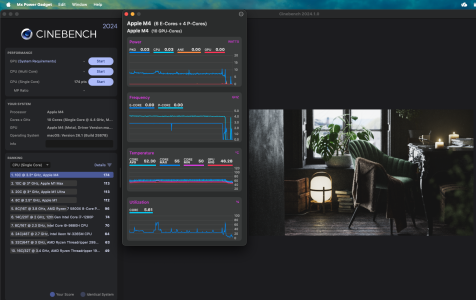
The M5 scores around 200 in CB24 ST and goes into the base model MacBook Pro, and consumes around 15W sustained.
The highest-end AMD product - 9950X3D scores 140 and goes into gaming desktops. Consuming what? At least 45W and that’s probably a low estimate. The 9955HX3D scores about 130, probably still at least 45W.
The HX 370/Max 395+ scores 117, and consumes about 45W.
So right now at worst, the M5 scores 43% higher than Zen 5 and consumes 1/3 the power. At best it scores 71% higher while consuming 1/3 the power.
Zen 6 will release near the same time as the M6. At best, the highest-end desktop SKU will see a 25% improvement in single core performance. Maybe* some reduction in power consumption. I have my doubts if they push frequency.
The M6 will probably see 15-20% improvement (with the process change in additional architectural tweaks I lean towards the latter), and possibly run leaner too.
Conclusion: Zen 6 at the highest end, perhaps narrows the ~50% performance gap by 5%.
I don’t see how you’re calculating Zen 6 bridges the gap to M6. It’s nowhere near realistic.
The M5 scores around 200 in CB24 ST and goes into the base model MacBook Pro, and consumes around 15W sustained.
The highest-end AMD product - 9950X3D scores 140 and goes into gaming desktops. Consuming what? At least 45W and that’s probably a low estimate. The 9955HX3D scores about 130, probably still at least 45W.
The HX 370/Max 395+ scores 117, and consumes about 45W.
So right now at worst, the M5 scores 43% higher than Zen 5 and consumes 1/3 the power. At best it scores 71% higher while consuming 1/3 the power.
Zen 6 will release near the same time as the M6. At best, the highest-end desktop SKU will see a 25% improvement in single core performance. Maybe* some reduction in power consumption. I have my doubts if they push frequency.
The M6 will probably see 15-20% improvement (with the process change in additional architectural tweaks I lean towards the latter), and possibly run leaner too.
Conclusion: Zen 6 at the highest end, perhaps narrows the ~50% performance gap by 5%.
I don’t see how you’re calculating Zen 6 bridges the gap to M6. It’s nowhere near realistic.
itsmydamnation
Diamond Member
- Feb 6, 2011
- 3,114
- 3,966
- 136
Why you invent numbers amds per core sustain power is nowhere near 45 watts. If you owned any of the products and tested you should know this.....
That was actually the thing that kept Intel in the game for ages they can slam so much more power into their cores and keep increasing clock.
That was actually the thing that kept Intel in the game for ages they can slam so much more power into their cores and keep increasing clock.
I’m not inventing anything.Why you invent numbers amds per core sustain power is nowhere near 45 watts. If you owned any of the products and tested you should know this.....
That was actually the thing that kept Intel in the game for ages they can slam so much more power into their cores and keep increasing clock.

Analysis of the Apple M5 SoC: Apple silicon extends its lead over AMD, Intel and Qualcomm
Notebookcheck analyzes the new Apple M5 SoC in the MacBook Pro 14 M5 in comparison with contemporary offerings from AMD, Intel, and Qualcomm.
 www.notebookcheck.net
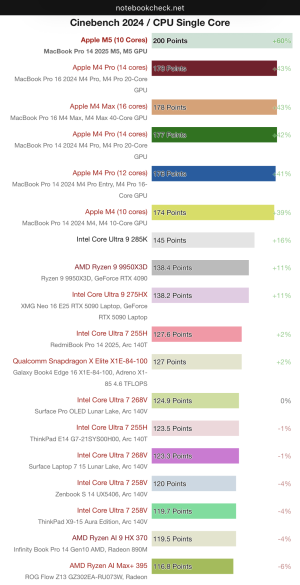
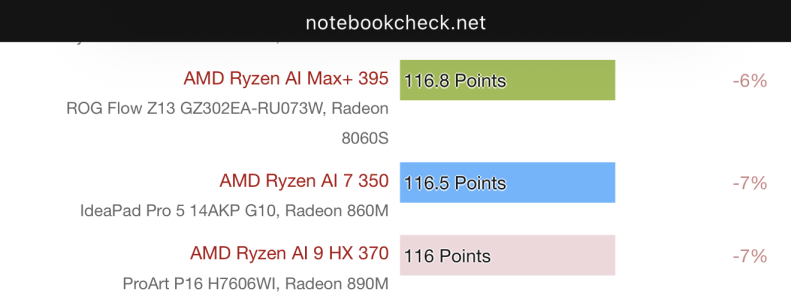
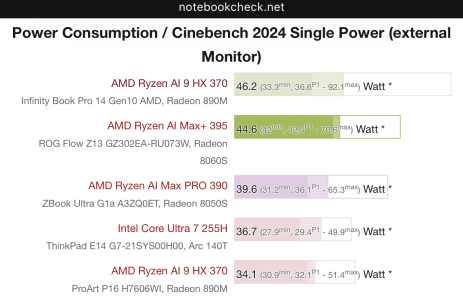

And fair enough.. you want to use that 34W value with that HX 370 entry. Scores 116. So 72% lower ST score and takes over 2x the power draw to do it.
Let’s take a better case, different source:
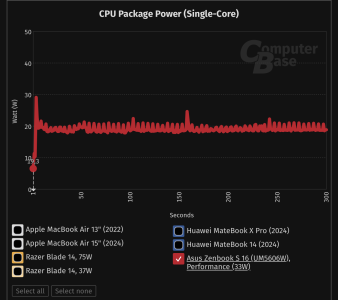
Ok, that’s better 20W sustained. Scores 112 in ST.
Now, maybe notebookcheck is measuring peak power draw, I think that could be the case. Though the M5 peaks I think at 20 W.
But anyway you slice it. It’s not realistic what he’s saying. And to say that I’m making something up is an unfair statement. AMD is far behind. I think you guys just have trouble accepting it.
itsmydamnation
Diamond Member
- Feb 6, 2011
- 3,114
- 3,966
- 136
sigh..... im running CB right now on a OC'd 7800X3D , peak single thread watts is 5.95watts.I’m not inventing anything.
View attachment 134136Analysis of the Apple M5 SoC: Apple silicon extends its lead over AMD, Intel and Qualcomm
Notebookcheck analyzes the new Apple M5 SoC in the MacBook Pro 14 M5 in comparison with contemporary offerings from AMD, Intel, and Qualcomm.
View attachment 134139
View attachment 134137
View attachment 134138
And fair enough.. you want to use that 34W value with that HX 370 entry. Scores 116. So 72% lower ST score and takes over 2x the power draw to do it.
this is why people with agendas a bias's are annoying, you will extrapolate an entire package that has a whole bunch of irreverent things to the thing they are measuring ................
you want to measure a ST workload across entirely different SOC's with entire different targets then to actually have anything worthwhile your going to have to measure CPU core usage.
for example my min vs max SOC power is 38 watts vs 46watts. thats idle with 335 user space proccess running vs with CB2024 running.
I’m just looking at the numbers of reported reviews, and pointing out the information therein. You’re shooting the messenger. You’re the one who sounds defensive. If the numbers state something differently I have no problem saying so.sigh..... im running CB right now on a OC'd 7800X3D , peak single thread watts is 5.95watts.
this is why people with agendas a bias's are annoying, you will extrapolate an entire package that has a whole bunch of irreverent things to the thing they are measuring ................
you want to measure a ST workload across entirely different SOC's with entire different targets then to actually have anything worthwhile your going to have to measure CPU core usage.
for example my min vs max SOC power is 38 watts vs 46watts. thats idle with 335 user space proccess running vs with CB2024 running.
Fair enough on CPU core alone. The Notebookcheck article noted 7.2-7.7W for the M5. But even their HX 370 analysis article says single-core is 19-21W. What is there to think of that? Are they deliberately misleading the reader?
This is getting completely sidetracked. The whole point is they’re significantly behind on single-core performance. It’s obvious. And, even if they consume the exact same amount of power, they still don’t get anywhere near the score, as in 60% of the score.
To think Zen 6 can just leapfrog up to the next gen M6, it’s wishcasting a miracle.
johnsonwax
Senior member
- Jun 27, 2024
- 466
- 674
- 96
If you could run a 9950X3D at 45W you'd see it in a gaming laptop. M4 Max runs as high as 45W and it's in a 18 hour battery life laptop.The highest-end AMD product - 9950X3D scores 140 and goes into gaming desktops. Consuming what? At least 45W and that’s probably a low estimate. The 9955HX3D scores about 130, probably still at least 45W.
- Mar 8, 2022
- 4,750
- 6,092
- 106
because both are CPU package power under a certain load...The Notebookcheck article noted 7.2-7.7W for the M5. But even their HX 370 analysis article says single-core is 19-21W.
A single P M5 thread consumes does NOT consume ~8watts when under load, its much less. You cannot check individual core power in macOS, every CPU power measurement for M chips is CPU package power.
- Mar 8, 2022
- 4,750
- 6,092
- 106
There is software CPU package reading which is what the 8w and 21w is and then there is wall power reading that NBC also does in their charts
A single Zen4/5 core uses 5-6w under load
The HX 370 uses 20 watts when taking package power into consideration.
The M5 P-core cluster uses 7-8w under load but the difference is this is reporting the CPU package, not a single thread.
This is where Apple has a HUGE lead.
A single Zen4/5 core uses 5-6w under load
The HX 370 uses 20 watts when taking package power into consideration.
The M5 P-core cluster uses 7-8w under load but the difference is this is reporting the CPU package, not a single thread.
This is where Apple has a HUGE lead.
Last edited:
The Blender benchmark is definitely cherry picking. It is highly unlikely that Blender Classroom used MetaRT.oh amd cares about apple in the high end laptop space.
View attachment 134095
If you look at the official Blender Benchmarks, M4 Pro 20core GPU is 2x faster than AMD AI Max+ 395 in GPU rendering performance.


Source: https://opendata.blender.org/benchm...PI&blender_version=4.5.0&group_by=device_name
No, you are using 50W+ to do it. That's core power. The Ryzen desktops gobble up in idle power. Look up people wondering why their Ryzen system is using so much in idle versus Intel. They are good in laptops, but desktops the CPU uses 20W+.sigh..... im running CB right now on a OC'd 7800X3D , peak single thread watts is 5.95watts.
Notebookcheck numbers are system power. You get it? They are benchmarking the entire laptop. The M5 laptop is using 15W to do so, while the HX 370 is using 45W. Actually, that particular system is inefficient. So let's compare to different results. The ProArt system is at 34W. Sooo 4x the efficiency at the system level. Against Lunarlake, and the best system at that, it has 150% advantage. Like the M5 makes Lunarlake look like Prescott vs Pentium M. Qualcomm has 70% advantage against Lunarlake.
@jdubs03 The WHOLE x86 camp is in the reality distortion field, same that was said of having with Apple fans, and that includes AMD's. AMD is doing better but that's a relative thing against the poorly run Intel. They can fit that M5 chip in Smartphones. AMD is behind Intel in that regard. More importantly, that chip is beating flagship desktop chips in absolute scores. And not by a small margin mind you.
4-5x advantage slaps Core 2 vs Netburst silly in the face. Zen 7 would need double "Conroe" to just catch up. That's why I keep saying it's not the ISA, but the competency of the teams. x86 landscape needed to have been blown open 15 years ago, but instead court sided with Intel and gave them a win instead of allowing Nvidia Denver, which was already silly as Denver wasn't even x86, but like Transmeta and had a hardware translation layer.
This is same as people wondering how Lunarlake uses less system power than the Ryzen laptops at same TDP settings. Well, everything else is lower that's why. Now that effect is multiplied with Apple systems.There is software CPU package reading which is what the 8w and 21w is and then there is wall power reading that NBC also does in their charts
A single Zen4/5 core uses 5-6w under load
The HX 370 uses 20 watts when taking package power into consideration.
The M5 P-core cluster uses 7-8w under load but the difference is this is reporting the CPU package, not a single thread.
Last edited:
- Mar 8, 2022
- 4,750
- 6,092
- 106
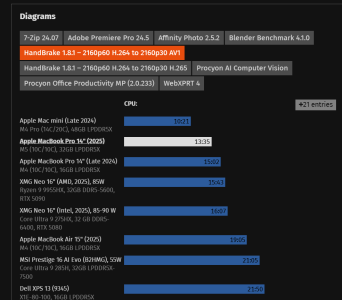
you can see how good Apple's cores are in this Handbrake 1.8.1 2160p60 H.264 to 2160p30 AV1 test. Since AV1 is new x86 hasn't gotten that big of a headstart for AV1 SIMD optimisation
In this AV1 test the M5 beats ALL x86 CPUs which is a ~30watt CPU for nT workloads. This is embarrasing for x86.
Note: AVX-512 is disabled by default in Handbrake 1.8.1
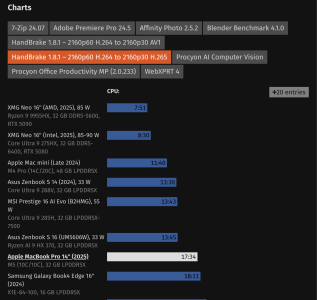
Now moving over to H.265, the M5 is slower than even the Intel 288V. This is because ARM is not as optimised as x86 in Handbrake 1.8.1.
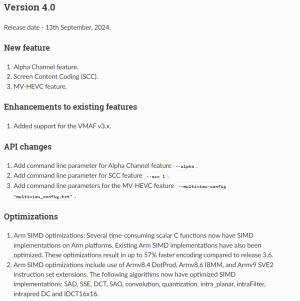
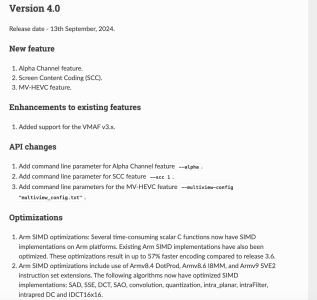
Handbrake 1.9.0 added x265 version 4.0/4.1 support which includes a number of ARM optimisations and speeds up to 56% compared to version 3.6 used in Handbrake 1.8.1.
In this AV1 test the M5 beats ALL x86 CPUs which is a ~30watt CPU for nT workloads. This is embarrasing for x86.
Note: AVX-512 is disabled by default in Handbrake 1.8.1
Now moving over to H.265, the M5 is slower than even the Intel 288V. This is because ARM is not as optimised as x86 in Handbrake 1.8.1.
Handbrake 1.9.0 added x265 version 4.0/4.1 support which includes a number of ARM optimisations and speeds up to 56% compared to version 3.6 used in Handbrake 1.8.1.
Attachments
Last edited:
This is all correct.No, you are using 50W+ to do it. That's core power. The Ryzen desktops gobble up in idle power. Look up people wondering why their Ryzen system is using so much in idle versus Intel. They are good in laptops, but desktops the CPU uses 20W+.
Notebookcheck numbers are system power. You get it? They are benchmarking the entire laptop. The M5 laptop is using 15W to do so, while the HX 370 is using 45W. Actually, that particular system is inefficient. So let's compare to different results. The ProArt system is at 34W. Sooo 4x the efficiency at the system level. Against Lunarlake, and the best system at that, it has 150% advantage. Like the M5 makes Lunarlake look like Prescott vs Pentium M. Qualcomm has 70% advantage against Lunarlake.
@jdubs03 The WHOLE x86 camp is in the reality distortion field, same that was said of having with Apple fans, and that includes AMD's. AMD is doing better but that's a relative thing against the poorly run Intel. They can fit that M5 chip in Smartphones. AMD is behind Intel in that regard. More importantly, that chip is beating flagship desktop chips in absolute scores. And not by a small margin mind you.
4-5x advantage slaps Core 2 vs Netburst silly in the face. Zen 7 would need double "Conroe" to just catch up. That's why I keep saying it's not the ISA, but the competency of the teams. x86 landscape needed to have been blown open 15 years ago, but instead court sided with Intel and gave them a win instead of allowing Nvidia Denver, which was already silly as Denver wasn't even x86, but like Transmeta and had a hardware translation layer.
This is same as people wondering how Lunarlake uses less system power than the Ryzen laptops at same TDP settings. Well, everything else is lower that's why. Now that effect is multiplied with Apple systems.
Honestly, anyone who has ever physically used an Apple Silicon Macbook knows just how much more efficient they are. No benchmarks needed. The efficiency translates extremely well to real world usage in terms of performance, battery life, quietness, coolness, thinness, etc. It truly does feel like Apple Silicon is 3-4x more efficient than AMD/Intel in laptop form.
Using an AMD/Intel laptop after using a Macbook is like going back in time by 15 years.
johnsonwax
Senior member
- Jun 27, 2024
- 466
- 674
- 96
I don't think this is quite fair, or at least unclear. In what areas did Apple show competency with Apple Silicon? Choice of ISA, choice of form factor, choice of market, choice of OS which affects things like how you design your scheduler, where you invest in silicon vs code, choice in what to deprecate, and so on. We can focus on the engineers designing the silicon, but that's really where most of AMDs agency lies. Apple's is MUCH broader, and that competence spreads across areas that are completely out of AMDs control. Even some really fundamental things like is Microsoft available to adopt new technologies in x86 silicon when they are making first party investments in ARM? Maybe, but maybe not. It's easy to say it's not the ISA in the case of AMD, because what fing choice do they have? They're not really in a position to change that - certainly not in the way Apple is. Apple could switch to RISC-V tomorrow. I don't think they will, but there's no technical, legal, cost barrier to them doing that. They have absolute agency to do that. AMD doesn't. Intel doesn't.That's why I keep saying it's not the ISA, but the competency of the teams. x86 landscape needed to have been blown open 15 years ago, but instead court sided with Intel and gave them a win instead of allowing Nvidia Denver, which was already silly as Denver wasn't even x86, but like Transmeta and had a hardware translation layer.
This is why I'm pessimistic about x86 - because there are these important areas where there is no agency and where coordination is needed - often among competitors which is really hard to accomplish. Markets only promise that winners and losers will be chosen by cost. It doesn't promise they will produce better outcomes, better products, and so on. I think Microsoft increasingly running the Apple playbook is likely to pay off, not because they are choosing ARM over x86, but because they are taking control of the full product and will have the agency necessary to make those decisions. How competently they make them is a different matter, but at least they can make them. That's what's been lacking in the x86 space. Blowing x86 apart is incredibly risky for whichever party does it, which is why no party does it - that's the lesson of Itanium - someone is going to make a big bet and lose. Apple doesn't have to worry about someone undercutting their decision - they only have to worry about their own ability to execute.
Apple isn't even AMD and Intel's biggest problem. It is most definitely Qualcomm.This is why I'm pessimistic about x86
Some might say Qualcomm's first Nuvia laptop chips flopped. To me, they're a resounding success because they demonstrated that they can already compete with AMD and Intel in performance and doing better in efficiency. Their second generation is likely to blow the tops off of AMD and Intel laptops in the Windows world because we can already see the performance and efficiency from Snapdragon phone SoCs.
Not only that, it seems like Qualcomm sells them at a much lower cost than Intel laptop chips based on the Dell leaks. https://videocardz.com/newz/snapdra...aptor-lakes-with-battery-life-up-to-98-higher
I think Qualcomm's Nuvia server chips will be a problem for AMD and Intel too because it's likely the first Arm server chip to win both performance AND efficiency from AMD. Nuvia's original founders originally wanted to make a server chip from Apple cores but Apple management refused. So they broke off from Apple to design a server chip. Now they will do it with Qualcomm.
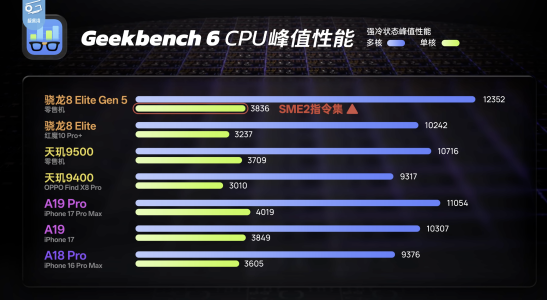
Qualcomm's phone SoC has faster ST speeds than the very best AMD and Intel desktop chips.
Last edited:
johnsonwax
Senior member
- Jun 27, 2024
- 466
- 674
- 96
Honestly, AppleSilicon feels even better than the benchmarks would suggest I think mainly due to the degree of integration/optimization Apple has been able to do with their own silicon. I jumped from a top of the line i9 MBP to a M1 Max and yeah, the Max benched faster, but the machine felt 5x faster. I attribute a LOT of that to Apple being able to dump virtually all of the system tasks on the E cores freeing up the P cores completely. So even though the i9 wasn't that much slower than the M1 in benchmarks it had this tendency to throttle back to a single core on which everything was trying to run. There is no scenario where an AS Mac isn't running the E cores full speed, so worst case the system is still responsive even if my front app is lagging.This is all correct.
Honestly, anyone who has ever physically used an Apple Silicon Macbook knows just how much more efficient they are. No benchmarks needed. The efficiency translates extremely well to real world usage in terms of performance, battery life, quietness, coolness, thinness, etc. It truly does feel like Apple Silicon is 3-4x more efficient than AMD/Intel in laptop form.
Using an AMD/Intel laptop after using a Macbook is like going back in time by 15 years.
Correct me if I'm wrong but you recently got an M4 Mini right? It's your first Apple Silicon Mac?because both are CPU package power under a certain load...
A single P M5 thread consumes does NOT consume ~8watts when under load, its much less. You cannot check individual core power in macOS, every CPU power measurement for M chips is CPU package power.
- Mar 8, 2022
- 4,750
- 6,092
- 106
i swapped it for a M4 macbook Air as I already have a desktop but yes its my first arm Mac.Correct me if I'm wrong but you recently got an M4 Mini right? It's your first Apple Silicon Mac?
johnsonwax
Senior member
- Jun 27, 2024
- 466
- 674
- 96
Yeah, but Qualcomm and even Surface wouldn't exist without Apple doing what they are doing. If not for Apple, the industry would still look like it did in 2010. Apple is what is creating the pressure for that shift to happen. It's Microsoft breaking from the old industry model which AMD/Intel are central to and doing what Apple is doing. Yes, directly the threat is Qualcomm, but Apple is why that relationship even exists and so long as Apple keeps doing what they're doing, Microsoft is almost certainly going to invest more in that relationship than they will in x86. Remember, the equivalent to AMDs win on x86-64 was the A7, which was only 12 years ago. Apple went from the first 64 bit ARM processor (in a phone no less) to dumping Intel in 8 years (which nobody thought was even realistic). We're now about to hit year 6 of the Apple Silicon era. I would hazard to say that Apple is the one in the drivers seat for all mobile/desktop silicon right now, with players like AMD/Intel/Qualcomm/Samsung chasing.Apple isn't even AMD and Intel's biggest problem. It is most definitely Qualcomm.
Some might say Qualcomm's first Nuvia laptop chips flopped. To me, they're a resounding success because they demonstrated that they can already compete with AMD and Intel in performance and doing better in efficiency. Their second generation is likely to blow the tops off of AMD and Intel laptops in the Windows world because we can already see the performance and efficiency from Snapdragon phone SoCs.
Not only that, it seems like Qualcomm sells them at a much lower cost than Intel laptop chips based on the Dell leaks. https://videocardz.com/newz/snapdra...aptor-lakes-with-battery-life-up-to-98-higher
I think Qualcomm's Nuvia server chips will be a problem for AMD and Intel too because it's likely the first Arm server chip to win both performance AND efficiency from AMD. Nuvia's original founders originally wanted to make a server chip from Apple cores but Apple management refused. So they broke off from Apple to design a server chip. Now they will do it with Qualcomm.
TRENDING THREADS
-
 Discussion Zen 5 Speculation (EPYC Turin and Strix Point/Granite Ridge - Ryzen 9000)
- Started by DisEnchantment
- Replies: 25K
-
Discussion Intel Meteor, Arrow, Lunar & Panther Lakes + WCL Discussion Threads
- Started by Tigerick
- Replies: 24K
-
 Discussion Intel current and future Lakes & Rapids thread
- Started by TheF34RChannel
- Replies: 23K
-

-


AnandTech is part of Future plc, an international media group and leading digital publisher. Visit our corporate site.
© Future Publishing Limited Quay House, The Ambury, Bath BA1 1UA. All rights reserved. England and Wales company registration number 2008885.
 Facebook
 Twitter